The Best of Everything
Encyclopedia Entry • Films Main
Autumn Leaves
1956
Critics' Reviews • Our Reviews • Movie Posters • Lobby Cards • Sheet Music • Misc. Images
Click here to see photos from the film.
US general release: 8/1/56. (Premiered June 1956 at the Berlin Film Festival.)
VHS release: 1/17/94. DVD release (part of TCM's "Joan Crawford in the 1950s" 4-disc set): 11/25/14. Cast: Joan Crawford (as Millicent Wetherby), Cliff Robertson, Vera Miles, Lorne Greene, Ruth Donnelly, Sheppard Strudwick, Selmer Jackson, Maxine Cooper, Marjorie Bennett, Frank Gerstle, Leonard Mudie, Maurice Manson, Bob Hopkins. Credits: Story and screenplay: Jack Jevne, Lewis Meltzer, and Robert Blees. Producer: William Goetz. Director: Robert Aldrich. Camera: Charles Lang. Art Director: Bill Glasgow. Music composer: Hans Salter. Conductor: Morris Stoloff. Gowns: Jean Louis. Editor: Michael Luciano. Title song sung by Nat "King" Cole.
Plot Summary: Few actresses other than Joan Crawford could have successfully pulled off the melodramatic excesses of Autumn Leaves. Though a very attractive fortysomething, Crawford remains aloof from romance until she meets Cliff Robertson, a young man half her age. An ardent and persistent suitor, Robertson finally breaks down her resistence to marriage. After a few weeks of wedded bliss, Crawford is confronted by Vera Miles, who claims to be Robertson's first wife. Miles further insists that Robertson is mentally unbalanced...and his subsequent behavior seems to bear this out. What Crawford doesn't know-but the audience does-is that the real villains of the piece are Miles and her middle-aged lover, Robertson's own father (Lorne Greene). Autumn Leaves works far better on screen than it does in print, thanks to the virtuoso performances of practically everyone in the cast. And, as anyone who's listened to top-40 radio during the past four decades already knows, the film also yielded a hit title song, written by Joseph Kosma, Jacques Prevert, and Johnny Mercer and performed during the credits by Nat King Cole. ~ Hal Erickson, All Movie Guide
Awards: Berlin International Film Festival, 1956, Silver Bear for Best Director Aldrich.
Notes: • Working title of the film was The Way We Are. • In 1997, the Writers' Guild of America restored the writing credits for Jean Rouverol and Hugo Butler, who were blacklisted at the time of the film's 1956 release. According to a 1997 Daily Variety article, the official writing credits are now: Jean Rouverol & Hugo Butler and Lewis Meltzer and Robert Blees. • Click here to read 19-page excerpt from co-star Cliff Robertson's unpublished autobiography re working with Joan.
|
|
Bosley Crowther in the New York Times August 2, 1956 A New Agonizer; Joan Crawford Stars in 'Autumn Leaves'JOAN CRAWFORD, who has probably logged more hours of suffering than any actress in American films, racks up another 108 minutes of it in Columbia's "Autumn Leaves." This dismal tale wrenched from Dr. Freud's notebooks fluttered down at the Astor yesterday.
This time, our lady of multiple miseries plays a lonely old maid who finally attracts a callow but charming suitor plainly young enough to be her son. The only trouble with this young fellow, which she discovers only after they are wed, is that he has had a terrible traumatic experience and is very much emotionally disturbed.
It seems that he happened to encounter his father and his own former bride in a state of association that even Dr. Freud would not have endorsed. This has unhinged our hero, so that when his father and his former wife show up, after his marriage to the unsuspecting old maid, he goes rather nicely off his chump. He throws things at poor Miss Crawford, blubbers and bites his thumbs.
Well, you know Miss Crawford. After agonizing through the pretty pass of being courted by a youngster, she goes through the further agony of trying to do something for him and then committing him to a mental hospital. This causes her great anguish, which she shows by endless pacing up and down. But in a trice the lad is reconverted and Miss Crawford is threatened with being happy, for a change.
The situation is valid—in its basic circumstances, anyhow—but it couldn't have been handled less considerately or convincingly without the whole thing's becoming utter farce. As a matter of fact, Miss Crawford's acting often touches absurdity. The principal concern of the writers and director Robert Aldrich appears to have been to make certain that the torment of their woman, a cardboard creature, is observed from all angles. It is. The realities and complexities of such a grotesque situation are barely brushed.
Under these trying conditions, Cliff Robertson's performance as the boy is a jumble of poignant awkwardness and embarrassing idiocies. His schizophrenic condition must adjust to the histrionic requirements of the heroine. As the father, Lorne Greene is an old-time "heavy" and, as the former wife, Vera Miles looks a lot more fetching than Miss Crawford. We wouldn't want to bet on that young fellow's "cure."
You might be interested to know that, at the beginning and at the end, the singer Nat (King) Cole gives a soggy sound-track rendering of the ballad "Autumn Leaves."
Lawrence J. Quirk in the Motion Picture Herald (1956): The heart-appeal is accentuated throughout, and with a moving eloquence kept within fine margins of restraint, thanks to director Robert Aldrich's control over a taut, well-knit, extremely literate script.... Miss Crawford as an aging "career girl" who brushes aside all doubts and guilt feelings to marry a man much younger, Cliff Robertson, brings to her latest role all the acting resources she has cultivated so successfully in 31 years of picture-making. As the lonely and heart-hungry but proud and valiant woman entering the autumnal years, she is moving and eloquent in her slow and hesitant acceptance of the love proffered by Robertson. As the wife who makes the horrifying discovery that she has married a very complex, tortured and confused young man sliding rapidly into the dark world of schizophrenia, she is brilliantly bewildered in her disenchantment, forceful and decisive when she decides to commit him to an institution, and eloquently tormented in heart and mind when she realizes that his eventual cure may rob her of his love and need for her which sent him reeling in her direction in the first place.
William K. Zinsser in the New York Herald Tribune (1956): The film is a mature study of loneliness and mental distress. On the whole Robert Aldrich has directed the film with good intentions. He has tried to explore the minds of the characters....Miss Crawford is as attractive as ever, and she brings the whole spectrum of emotions to her role. In her early scenes she is so afraid of being hurt that she is visibly tense and almost hostile. This is a good portrait of the career girl who has been single too long.... The strength of Miss Crawford's performance is that it is natural and controlled. A lesser actress would bring more than a tinge of ham to such a juicy role. |
If you've seen Autumn Leaves and would like to share your review here, please e-mail me. Include a photo of avatar of yourself to accompany the review and a star-rating, with 5 stars the best, as well as any of your favorite lines from the film.
|
Rating:
I had a chance to really look at this picture for the first time and pay closer attention to other, less obvious elements, even though I had seen it once several years before. My copy came included in the box set of Joan Crawford in the 1950’s, offered by TCM. The pacing of this film is perhaps one of the strongest aspects among many that make it great and enjoyable--even today. The story slowly and thoughtfully unfolds. Joan Crawford’s acting has been much maligned under the charge that she used a mannered, high-toned style. While modern viewers may agree with the assessment, it is easy to forget that she was acting in an era when a more pronounced approach to cinema performance art was often expected and appropriate. Her bravura acting, seen in other features from earlier years, is appropriately absent in this movie. When Crawford decided to pull back, tamp down and keep herself reserved in very dramatic material, she is better than a good actress, she is truly great (i.e., Mildred Pierce). Here again is the “reserved” style she employed in other pictures, but the effect in "Autumn Leaves" is truly touching and powerful. Crawford’s performance is poignant, thoughtful and, once again, beautifully paced. Cliff Robertson is a skilled performer and holds his own with Crawford. Supporting players Vera Miles and Lorne Greene are exceptional, even if seen in only a few scenesy. A highlight sequence: confrontations between Crawford, Miles and Greene are so well done that you are left in jaw-dropping wonder; Joan says “slut” in this movie so effectively that it sounds like poetry! There are moments in this movie that are revealing and deeply meaningful and strike a chord of familiarity with anyone who has ever been in love. This is not an upbeat pic, and some of the scenes with Crawford alone, thinking about her young lover who may never return, are extremely difficult to watch without being moved (because of this actress’s ability to convey with her face)--another solid argument against the naysayers on Joan Crawford and her acting. Everything about this movie is well done, but the stylish, thoughtful pacing is a standout. Watch for the unique camera angles, too. This is a Joan winner.
Rating:
While I've always been partial to "Autumn Leaves," I think that
inclination is limited only to the first half of the film. I find Joan's demure character of "Millie" to be a rather refreshing role amid her more hardcore roles of the '50s, such as in "Queen Bee," "Harriet Craig," "Johnny Guitar," and "Torch Song." But one aspect I find interesting about this film is the lack of character development for Joan's "Millie." I think the character of "Burt" (played by Cliff Robertson) is another victim of the '50s cinema's poor attempts at explaining mental illness. To me, much of Burt's behavior and the psychologist's explanations come off as cartoonish. Halfway through the film, it becomes clear to Millie, and the audience, that Burt isn't the man she thought he was, but by that time, she has fallen too deeply in love with him to simply leave him. What follows is the core of the film's story -- that of a woman who falls in love with 'the wrong man," at which point I begin to lose interest as it moves more and more into being melodramatic. The ending of the film leaves me disappointed. I think it could have been more meaningful had Burt returned home on his own accord to a surprised Millie, rather than her amazement in the yard of the mental institution to discover he still has feelings for her after he has been "cured," despite the doctor's advisement that his love for her could have been part of his psychosis. I would have found the ending more effective with a shot of Millie and Burt embracing in her living room when he returns home as the camera zoomed out the front door and into the yard with Nat King Cole's "Autumn Leaves" playing, rather than the lackluster scene of Millie and Burt walking through the mental institution's yard as the song begins playing. Overall, the film has great acting by all, including Vera Miles and Lorne Greene, and some very nice camerawork and close-ups of Joan; but it could have been a better quality film with a better screenplay that removed some of the melodrama and old-fashioned psychology from the second half.
 Steve Alva (December
2011) Steve Alva (December
2011) Rating:
Now first off folks, you shouldn’t be drinking alone and watching this movie. Sho nuf, it will push you over the deep end, and fast! First, Millicent is a spinster transcriber typing out manuscripts as if her life depended upon it. Wait a minute, living in that tiny but humble abode in north Los Angeles, her life did depend upon it. Being on her meager budget, she accepts a ticket to the theater for what would turn out to be a wild night on the town, and she managed to cart along her “Sue-Ann Glidden Everything Bag” complete with her own monogram. Okay, okay, I know I’ve skirted this topic long enough and can no longer hide behind the pillar. Yes, Millicent had the strangest hairdo I’ve ever seen in my life; even for 1956 it crossed the threshold. It appeared to be a -- wait a minute, more like a -- well, maybe a little -- just a cotton-pick’n second, does the word “Butch” ring a bell? Throughout this flick, I tried -- heaven knows, I tried -- to make heads or tails out of that hairdo, but to no avail; I guess we’re going to have to ask Dennis Farina to showcase it on “Unsolved Mysteries” as this totally escapes me. Forgive me for digressing. As Millicent attempts to “let her hair down” after the theater, she steps into a greasy spoon off of Spring Street and plays an earthshaking tune from the table jukebox called “Autumn Leaves.” She orders her “chicken salad” as she normally does in all her movies, and in comes Burt Hanson (Cliff Robertson) to sweep her off her feet. Before he can get to her crusty heels however, he has to pull teeth to sit at her table, and once the bottom row extraction is complete, he then contemplates what could possibly be her name from the initials on the “Sue-Ann Glidden Everything Bag.” He takes a few guesses: “Is your name 'Marabella Weber'? No, it must be 'Margie Willipenny.' Nope? How about 'Maxine Wintrop'? I got it! Then it must be Mayola Washers." Anyway, Millie finally caves and says 'Millicent Wetherby,' and then he gives himself extra credit (psychosis brewing here) because upside down and rightside up, her initials don’t change! So he finally manages to break the ice with ole Millie, but in his already warped mind, she’s not worth dishing out two bits for the chicken salad and makes her buy her own! Hey, the opening 10 minutes is well worth it, but bottom line, Child, this sucka lied easier than he breathed. He also was very fond of five-fingered discounts, bitch slapping, and even went to the extent of nearly making poor Millie a workers' comp recipient for life. No worries, folks, she’ll type again, only not as fast. This is all I’m saying. See it for yourself and try to find and solve the mysteries to which I’ve already alluded; but please, I implore you, no drinking during this movie because I’m afraid the end result would be either suicide, or a valiant attempt at one. This one gets four stars from me: One (1) to Millicent for having the nerve to cart along that Sue-Ann Glidden Everything Bag; one (1) for the Everything Bag; one (1) to the slut, Virginia (Vera Miles), for talking sassy to poor Millicent whilst wearing that awfully tight pencil skirt; and one (1) for Lorne Greene (Daddy) for wearing his pants Fred Mertz-style -- you know, 15 inches above the waist!
 Michael
Lia (October 2009) Michael
Lia (October 2009) Rating:
"Autumn Leaves" starts out with a squeaky door. In walks Ruth Donnelly, “one of the best character actresses in the business.” (She is so good that in a later scene complaining about sand at the beach, you can actually feel the sand in her clothes!) It only takes a few moments for the script to set the action in place and establish the situation of Millie’s’ life.
“Autumn Leaves” is already a wonderful film: Just watching the opening credits, you know it is going to be good, or at least you know you are going to get your money’s worth. The talent working on this film is incredible.
Producer William Goetz (son-in-law to Louis B.) had quite a career in Hollywood. In 1954 he formed his own production company and was one of the first producers to offer a percentage to the star. Here, he used all his resources and connections and signed some great artists.
The cameraman (Charles Lang), a fine craftsman, had just filmed Miss Crawford in “Sudden Fear,“ "Female on the Beach," and “Queen Bee." Here, he maintains the same cinematic quality; the film is crisp, clear, and clean. All four of his films with Miss Crawford are beautiful to look at. He won an Oscar for “A Farewell to Arms” in 1933. And was nominated over 15 times: one of those for “Queen Bee” and one for “Sudden Fear.” He had class and Miss Crawford was lucky to get him.
Robert Aldrich, the director, had an interesting career; with this film he shows a different side to himself: sensitive and direct. He won the West Berlin film festival “Best Director “award for this film. He was consistent in the mood he created with the highs and lows the writers provided. He kept a pace that keeps you aware of the anguish and emotional drama of Millie and Bert. And you do wonder what will happen. This really is an underrated film. This situation happens today, so don’t think it is just Crawford melodrama; take a deep look and you will notice Mr. Aldrich directed with the right amount of intensity.
The music composer and the conductor have fun feeding the dramatic moments and go along with the script. The theme song "Autumn Leaves," as we all know and have heard most of our lives, is sung by Mr. Nat King Cole.
I once worked for the actor Kerwin Matthews (“The Garment Jungle,” “The Devil at 4 o’clock,” and some Sinbad movies), who had auditioned for the Cliff Robertson role. I could not resist: One day I asked him what he thought of Miss Crawford. He did not get the role, as we know, and he did not play favor to Miss Crawford. He said, “She’s a ----." Ouch! I thought he was not happy and closed my ears to that word, and we talked of Cliff Robertson instead. I agree with Miss Crawford and feel he did a wonderful job portraying this emotionally messed up man. He took a big leap from his role in “Picnic" the year before. He is believable throughout. I could see a Supporting Actor nod for him. I believe Miss Crawford deserved an Oscar nomination for this role as well.
Vera Miles: I can look at her face! She is a minx and a fox and a rat in this movie (no wonder Hitchcock liked her). She is the last of the film noir femme fatales making an appearance on the screen. She is wonderfully wicked and selfish and Beautiful. I can even let Lorne Greene pass. He plays “father” like the big bad wolf. (Millie is not afraid of him, though she despises him.)
The squeaky door is still making noise at the end of the movie, and Miss Crawford and the writers save the best for last. She plays the scene where she meets Cliff Robertson after his ”cure” with all her acting abilities intact. She is dramatic, which means she has feeling and conveys her character's inner conflicts with a maturity that only a mature, experienced actor can do.
I think it is a superb film and Miss Crawford should be satisfied. I know I am!
 Stephanie
Jones
(May 2006) Stephanie
Jones
(May 2006) Rating:
[Warning: Some spoilers!]
Joan has the reputation of being a hard-ass in her '50s films, thanks to her tough-gal roles in movies like "Torch Song" ('53), "Johnny Guitar" ('54), and "Queen Bee" ('55). 1956's "Autumn Leaves," though, features a kinder, gentler type of character that Joan was just as adept (though relatively unheralded) at playing during this same time period.
In "Leaves" (tightly directed, with plenty of interesting camera angles, by Robert Aldrich, who would go on to do "Baby Jane"), Joan is "Millicent Wetherby," a 50-ish, lonely freelance typist who lives and works in her Los Angeles bungalow and whose only companionship is her clients and her crusty but good-natured old landlady (Ruth Donnelly). When a grateful client gives Millie two tickets to a recital, she can't think of anyone to invite, but puts on a brave face and decides to make a night of it all by herself. (A charming bow to Joan's real-life past comes with the vendor selling gardenias---Joan's much-publicized favorite flower in the '30s---outside the theater. Millie jauntily pins one flower to her lapel.)
After the concert (during which we're flashed back to Millie's past when she had to turn down suitors to stay home and take care of her ailing father), Millie stops for a quick bite at a nearby diner, where, because of the crowd, she's forced to share a table with a chatty-but-earnest much-younger man (Cliff Robertson as "Burt"), a military vet who's new in town. Despite first being tense and annoyed by his presence, his easy small talk finally relaxes her and she begins to visibly glow with his attention. After he walks her home, they agree to meet the next day at the beach; despite Millie's initial nervousness at her appearance in a bathing suit, Burt again immediately puts her at ease and their frolicing soon leads to a passionate surf-side clinch. (As Danny mentioned in his below review, Joan was at first signed to play Karen Holmes in 1953's "From Here to Eternity"---this roll in the surf has to be her attempt at re-enacting the famous scene that she missed out on!)
Once the couple gets back to Millie's bungalow, though, Millie seemingly has a change of heart; their 20-something-year age difference has been bothering her, and she's also afraid that Burt just wants her because he's lonely. Despite his protests to the contrary, she breaks off the burgeoning relationship, then spends the next month working hard and trying not to mope. When Burt re-appears on her doorstep, she's still a bit wary, but ecstatic nonetheless. In the heat of the moment, they run off to Mexico, where they're married.
Things immediately (and I mean immediately!) start to sour, though. As they're driving back to LA, Burt mentions being born in Chicago...Cue ominous music: Earlier he'd told Millie he'd been born in Racine, Wisconsin. Millie shrugs off this anomaly, but the discrepancies in his life story soon start to snowball, culminating with the appearance of Burt's ex-wife (Vera Miles as "Virginia") on her doorstep. Turns out Burt and Virginia were divorced only a month ago. And now Virginia wants Burt to sign some property over to her. Virginia also tells Millie about Burt's cheesy past as a compulsive liar and shoplifter. She also mentions that Burt's allegedly long-suffering father (whom Burt had said was dead) is in town...
In a bit of honestly wrenching acting, Joan's Millie is visibly nauseous and heart-heavy at this latest news. But, staunch New Englander that her character is, she pulls herself together and first goes to visit Burt's father (played appropriately smarmily by "Bonanza"'s Lorne Greene), then confronts Burt, demanding first that he tell the truth about his past and then that he go to make peace with his estranged father. Burt finally agrees to see his father again, but once at his hotel, Burt witnesses a scene that triggers an old psychic wound. I'm trying to avoid too many spoilers here, but suffice from the following speech by Millie to Virginia and Dad (a classic "Joan Moment" on film) that the two have been up to no good:
Where's your decency? In what garbage dump, Mr. Hanson? And where's yours, you tramp?...You, his loving, doting, fraud of a father. And you, you SLUT! You're both so consumed with evil! So rotten! Your filthy souls are too evil for hell itself!
At this point, Burt completely loses it. He's seen Millie with his father and ex-wife and, in a truly frightening scene, accuses Millie of being in cahoots with them, then violently attacks her. Afterwards, Burt blacks out and can't remember the incident; at first pretending nothing's wrong, Millie hides her wounds behind dark glasses and bandages, but is finally convinced by her doctor---and by Burt's incessant sleepwalking and sobbing---that Burt really does need psychiatric help and should be committed to a sanitarium. "Schizophrenic tendencies" and "infantilism" is the doctor's diagnosis. Millie's big fear now: Will Burt's need for her disappear once his neuroses are cured? Is she only a "neurotic need," as the doctor says??
"Autumn Leaves" was one of the first Joan-films I ever saw (in the late '80s) and it helped turn me into a definite fan. Upon just now re-viewing it, I remain impressed by the range and depth of Joan's performance. I'm also impressed by the refusal of the film itself to buy wholeheartedly into the stereotypical "desperate older woman who'll do anything for a semblance of love" theme that seems to have had a field-day in the neurotic 1950s.
Joan's Millie is a very real character---sure, she's lonely, but she's also not "desperate" or willing to accept any guy that looks at her twice. As she says, she's used to being by herself; she's also perfectly capable of entertaining herself for an evening, or gently mocking her younger lover when he's getting a bit too maudlin. She's also awkwardly funny, and amused by her own little jokes. In one early scene, she and Burt have been arguing about their age discrepancy; Millie admits, "I goofed" (apparently a new catch-phrase in 1956). Burt looks amazed and says, "Hey, that's bop-talk!" Millie looks bemused and wonders why she shouldn't know phrases like that---"I'm not that old!"
Joan's chemistry with Cliff Robertson is also very real. Though I personally found Burt a bit annoying---and, yes, "neurotic"---here, their characters are clearly very close sexually; whether he's nuzzling her neck as they dance or they're nuzzling in bed, Burt and Millie are obviously turned on by each other and sincerely like each other. Burt's puppyish charm lightens Millie considerably, just as her common sense and responsiveness to him give him much-needed assurance. (See "Sunset Blvd." and "The Roman Spring of Mrs. Stone" RE films that don't treat a May-October romance---when the female's the "October"---nearly so generously.)
The story obviously turns into a heavy one, what with Burt going nuts and all, but overall the movie's really not about his breakdown but, rather, about true love and about Millie's ability to weather a few emotional storms that life hadn't quite prepared her for.
The final scene at Burt's sanitarium is a real acting treat. Millie's insecurity at seeing her husband for the first time in 6 months---will he still love her?---exhibits itself in an intentionally long-winded and nervous soliloquy that's absolutely in-character for Millie. There are none of the famous "Joan Crawford Fireworks"---just Joan-the-Very-Good-Actress at her finest.
|
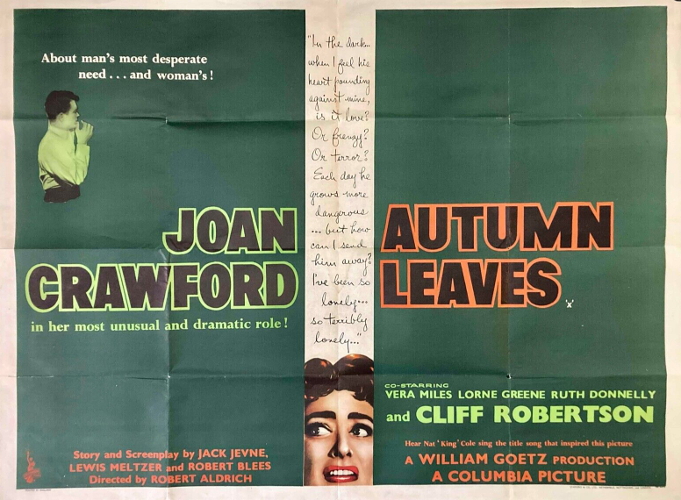
Above: UK quad poster (30 x 40 inches)
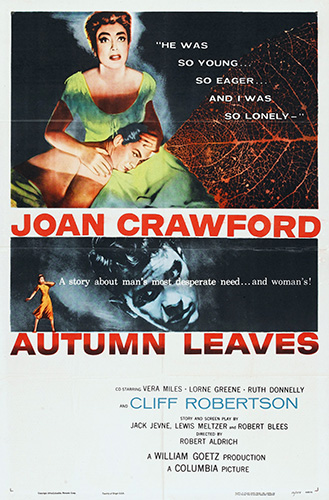
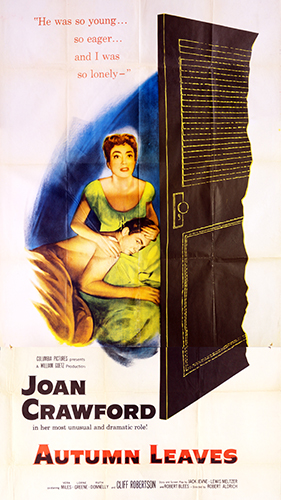

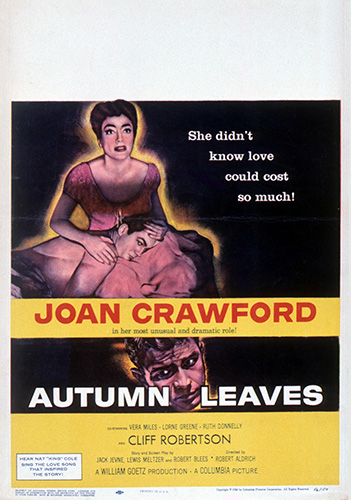
Above: US 1-sheet (27 x 41 inches), US 3-sheet (41 x 81), US 6-sheet (81 x 81)
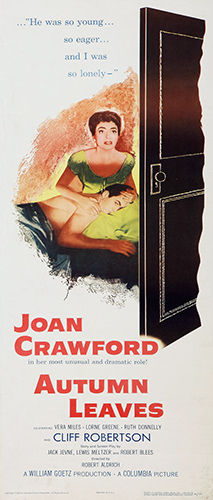
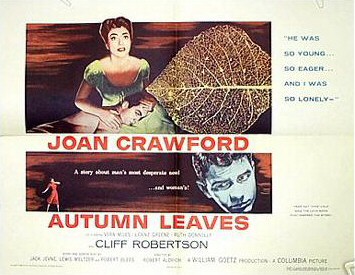
Below: US window card (14 x 22 inches), US insert (14 x 36), US half-sheet (22 x 28)


Above: Two from Italy.
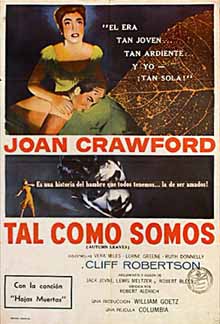

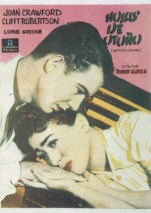
Above: Argentina, Belgium, and unknown.


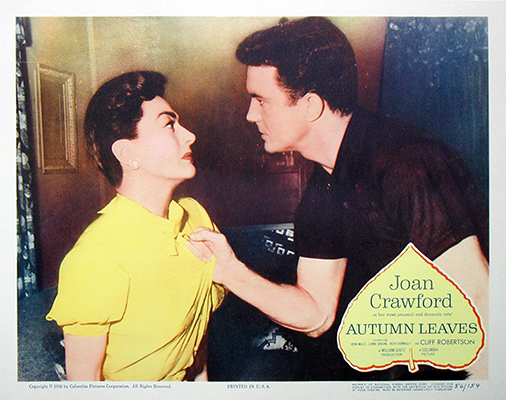


Above: US lobby cards.
Below: Italian Fotobusta lobby cards (13 x 17 inches).
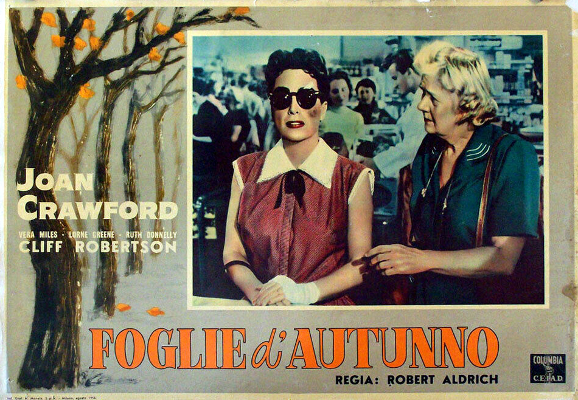
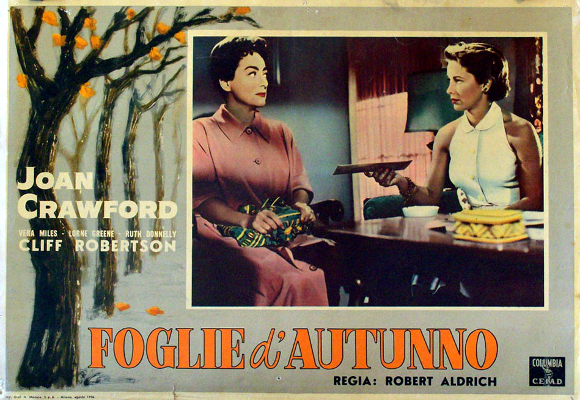
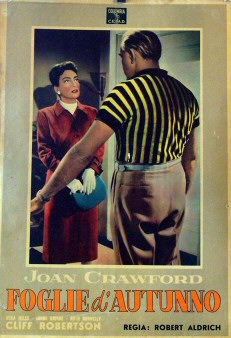
Below: UK lobby.

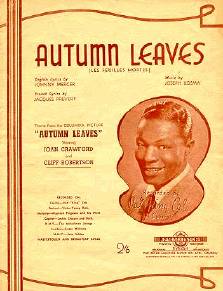
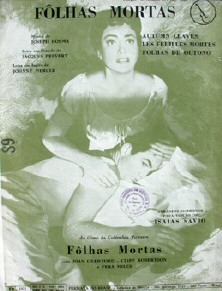
Above: French and Brazilian sheet music. Below: UK sheet music.
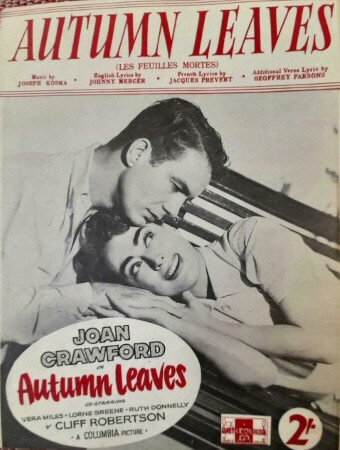

English lyrics by Johnny Mercer. French lyrics by Jacques Prevert. Music by Joseph Kosma. Sung by Nat "King" Cole.
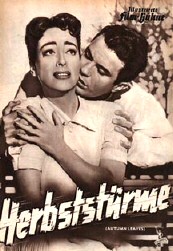
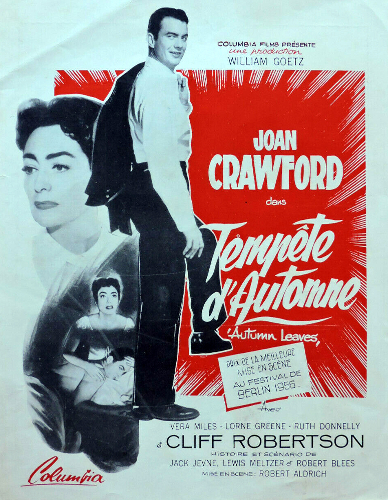

Above left: German and Belgian pressbook covers. (Click center Belgian cover to see large inside/back pages.) Above right: Newspaper ads from Ft. Smith, Arkansas.
Below: US pressbook cover, and US herald cover + centerfold.

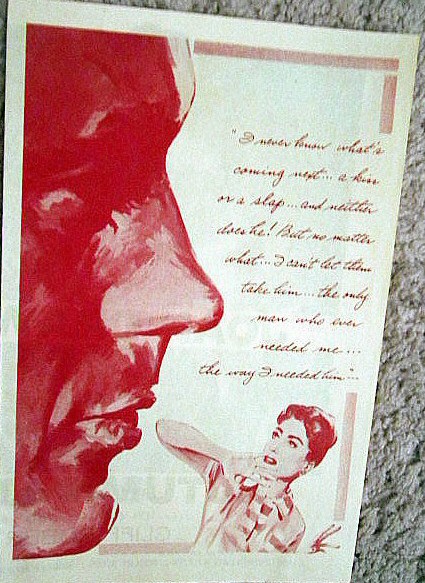
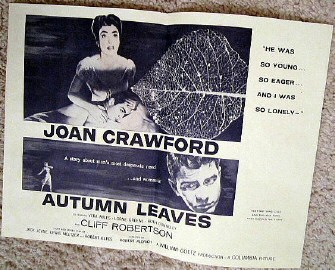
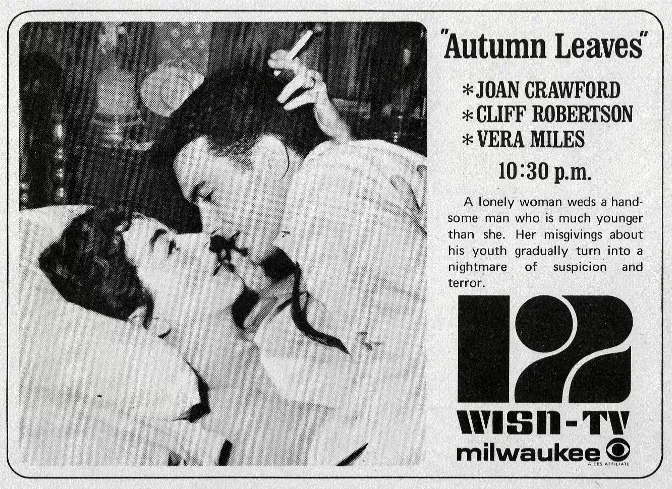
Below: A 1970 US newspaper ad (Milwaukee, Wisconsin) for a local TV showing.
The Best of Everything