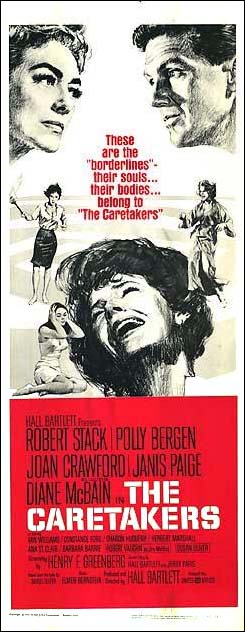
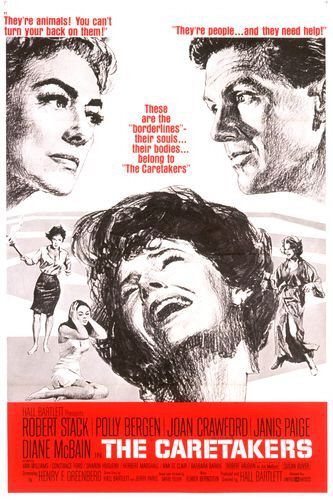
|
 Michael Lia (September 2010) Michael Lia (September 2010)
Rating:  of 5 of 5
This
movie can be summed up in just one word…rotten. Or it can be called
awful, take your pick. If I am in bed with the flu, this film will only
make me sicker. I don’t care if Miss Crawford performs some judo or
karate; it does not save the movie or her role. I vowed to myself that I
would not review these last horrible movies. (I have done a few, and this
movie review is a mistake, but I will not write about Trog, dammit!)
I
do not want to waste my time on this movie because there is nothing
remotely redeemable or anything artistic to talk about; it is cheap and
rotten, just like Veda! It is an odious film. I
do not have to watch it again to critique it because I am left with
horrible scars from just one viewing (have seen it more than once), like
some childhood accident. Thank the cinema gods for Baby Jane; it made up for the last bad and sad films of Miss Crawford’s life/career. I don’t care what the cults think.
Co-star
Herbert Marshall
is a gigantic favorite of mine; however, he is hard to look at this time, and
the script offers him and Miss Crawford no sense of anything. Robert Stack loses out,
as well. Everything was wrong.
The supporting players are straight from an acting class I took once.
No matter their experience, they behave in a high school drama manner. Even Ellen Corby, bless her, is reduced to an idiot left over from
The Snake Pit. It is a combination of every mental film ever made, including Possessed ('47) and, to present day, Girl Interrupted,
etc. Same old premise with the same old parakeet flying around. (Is the bird related to the one Bette Davis killed in Baby Jane? That is what I want to know.)
The only interest I have is how and why the director, producer and the writers mess up so badly. Neither the
cameraman nor Elmer Bernstein could help much, so what is the use? What was Miss Crawford thinking and why did she not have her own production company?
For
sticking around, Miss Crawford deluded herself and chipped the stone off
the façade (some just fell off naturally), like some beautiful piece of
architecture left for tourists to see the remains and rubble and ponder
about its grand past. In this case an audience looking at a grand
dame from their past a bit broken but not really diminished, at least in
their own minds and Miss Crawford’s.
 Bryan
Johnson (July 2009) Bryan
Johnson (July 2009)
The Caretakers has a couple of flaws; its major flaw is that
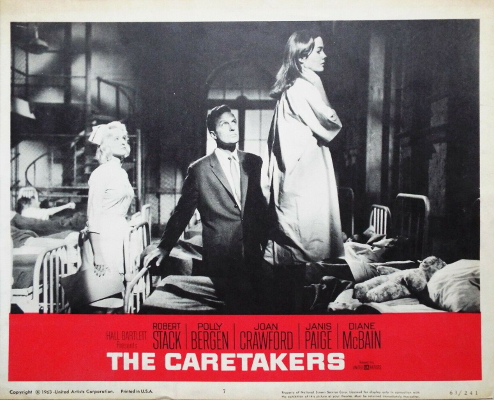
the film lacks any structure, or real direction. Entirely too much screen time is devoted to displaying the cheesy, stereotyped patients in the ward.
While watching, I got the impression that the film was intended as a character study, rather than an intelligent drama.
Polly Bergen does a good job in her role as does Janis Paige, though
I think Robert Stack was painfully miscast.
Joan (Lucretia Terry) doesn't appear until thirty minutes into the film.
The Lucretia Terry character never evolves and is only one dimensional.
After reading the novel of the same name, I discovered that the
character was much more interesting than what was written for the film. In the novel, Lucretia is introduced just as strong and stern as
Joan portrays her; however, Lucretia soon becomes overwhelmed with the
fear of losing her much cherished control she has over the hospital
because of the new doctor's plans. In response, she attacks any attempt to change the order of things, which includes patient care.
These
troubles, compounded with her love interest's rejection of her, causes
her to disregard her own appearance and job performance.
By the end
of the novel, a visibly exhausted Lucretia decides to abandon her
career and leave the hospital without notice. At her desk, with a shaking hand, Lucretia
writes a letter to her lover's new fiance and leaves it on her desk to "be
found" and leaves her office for the last time. It's implied she will
most likely commit suicide.
My final thoughts are: The film had possibilities, but is the victim of a bad screenplay and bad directing.
My advice is to only see this film for the Joan factor.
 Stephanie
Jones
(January 2006) Stephanie
Jones
(January 2006)
Rating:
of 5
Joan's
first post-Baby Jane film, The Caretakers is a pretty
cheesy "women in the nuthouse" picture stockpiled
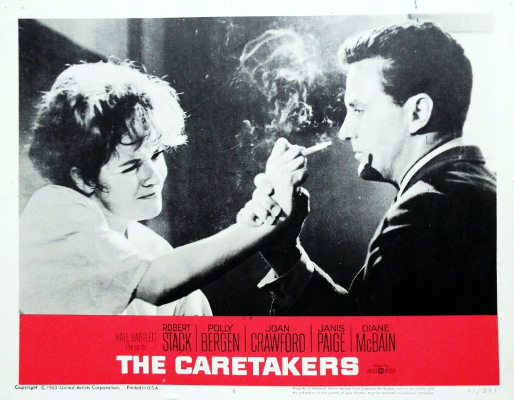
with stereotypical denizens of such film places: a chain-smoking
man-hating nympho (Janis Paige, in a funny, scene-stealing role),
a lonely semi-senile old woman (Ellen Corby), a Beatnik, a Foreigner,
an Annoying Mute...and our heroine Lorna (Polly Bergen), who's gone
nuts because her young son died in a car she was driving and
because (we later find out)...her father left her cold mother when
Lorna was small! (The movie also comes complete with the obligatory
shock treatment and rape-by-male-orderlies scenes, which are thrown
in completely gratuitously and immediately forgotten as far as the
plot goes.)
We
can pretty much guess what we're in for from the film's opening
credits, which roll over hideous paintings of tormented wretches,
accompanied by equally hideous and agitatedly dramatic music by
Elmer Bernstein, which are followed by shots of an agitatedly dramatic Polly
Bergen sweating and clutching her hair as she loses it in a movie
theater and is carted off to a psych ward.
Once
at the hospital, we're introduced to the crusading doctor (Robert
Stack) in charge of borderline patients. Dr. MacLeod passes out
smokes, loosens restraints, and quiets overwrought patients with
merely a kindly look or word. He's a proponent of Understanding
and Group Therapy, and his one dream is to replace psych wards with
"day hospitals." He's challenged in his "newfangled"
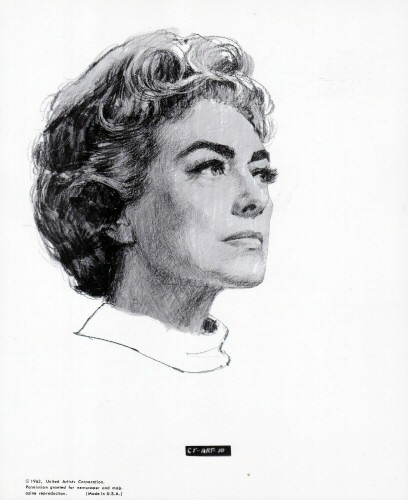
thinking by the old-school head nurse Lucretia Terry (Joan), who
believes in discipline and "the intelligent use of force"
(including judo, which we see her teach her nurses) when dealing
with patients.
Obviously
we're supposed to think Lucretia's an eeeevil Nurse Ratchett prototype,
but the examples the movie uses to demonstrate Lucretia's allegedly
backward thinking actually, to me at least, prove that she's being
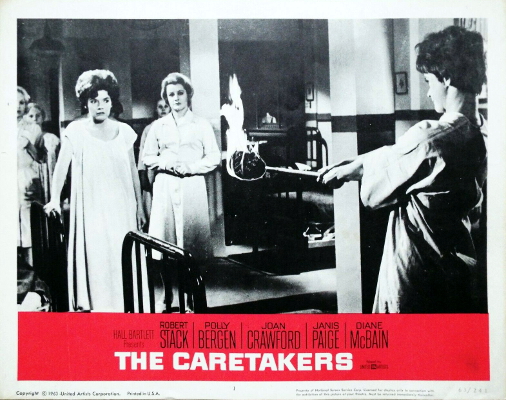
unfairly maligned! For instance, there's a major scene where the
borderline gals sneak in booze and start whooping it up a bit. One
patient (symbolically) frees another's bird from its cage; the bird-owner
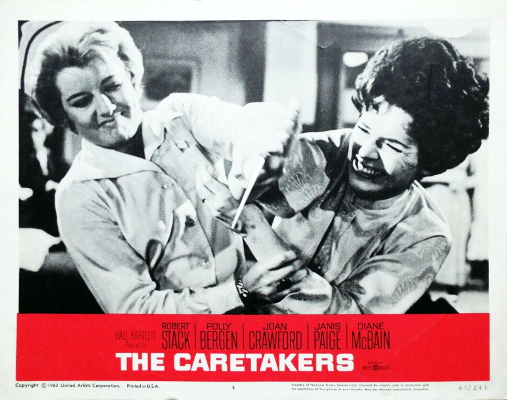
freaks out; the Annoying Mute grabs the bird... One of Lucretia's
henchwomen nurses comes in to settle things down and slaps the Mute
when she won't let go of the bird. This prompts Polly Bergen to
lunge at the nurse with a knife, and the nurse then uses judo on
her (good training, Lucretia!). Now, there was nothing Cuckoo's
Nest about this whole scene--- the allegedly mean nurse didn't
try to stop anyone from having a good time until after all hell
broke loose and she only resorted to judo to avoid being stabbed.
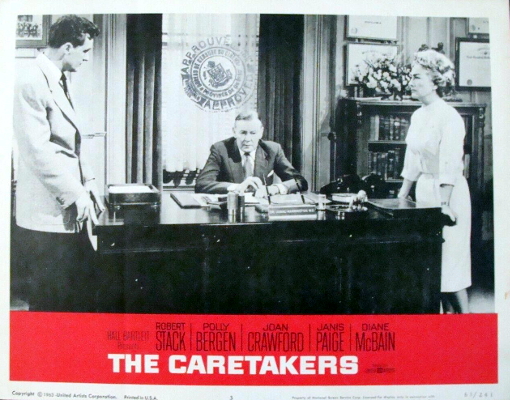
Yet the next day, she's being called before the hospital administrator
(Herbert Marshall, also Joan's co-star in 1941's When Ladies
Meet) and Dr. MacLeod is seriously demanding that she be fired
for her "inhumane" treatment of a patient.
The
whole movie careens along on this nonsensical axis: random sensationalistic
scenes usually followed by confrontations between Dr. MacLeod and
Lucretia over nursing methods, none of which contribute to an interesting
or plausible narrative.
Joan's
role is small and her appearances sporadic; there's really not much
she could have done with "Lucretia" other than play her
as a hard-ass. Despite the role's harsh one-note nature, though,
she does manage to insert a few human touches: At one point, when
Lucretia sees Dr. MacLeod approaching, she smiles and softens briefly...
only to slam her iron mask back into place once he immediately starts
berating her. A small enjoyable subtlety amid all of the obligatory
wild-eyed looks and pseudo-psychiatric theory flying about in this
film.
Scott
(July 2005)
Rating:
of 5
The Caretakers is a bizarre and grim film
experience. It's trying to make some serious points about the treatment of
those with mental illness, but it's really an over-the-top mental hospital drama
with some embarrassingly bad stretches of overacting. I remember
seeing one critic's comments that some of the scenes seemed like high
school improvisational theater, and the scenes with the patients play that
way: let's just sit in a circle and be crazy. Polly Bergen
and Robert Stack are the stars here. Polly didn't seem to have a clear
idea of how to approach her character, but that's probably the script's
fault. She has so many changes in mood from scene to scene that you're
exhausted after watching her. And Robert Stack seems a bit miscast because
he lacks the warmth that his crusading doctor needs. Janis
Paige as a loud nymphomaniac and Ellen Corby as a sad, defeated woman who seems
to have lost her grip on reality are the only ones who really come off well from
this group.
Joan is the high point of the film. In
many ways, her appearance here is similar to her role in The Best of
Everything. She only has a handful of scenes, but she plays all of
them for maximum impact. As Head Nurse Lucretia Terry, she is a hard-line
proponent of the old school of mental illness treatment. She's as tough
and iron-clad as the steel-gray helmet of a hairdo she wears in the film.
But her character isn't well-defined -- you don't really get to understand why
she feels so strongly about her methods. Even in her famous judo
scene, you wish she would stick around and show off some more moves and interact
more with her nurses, but she just flips Constance Ford, utters some lines
about why learning judo is so important for her nurses, and leaves
the gymnasium floor to argue a bit with Robert Stack. Joan has
some good moments with Herbert Marshall, who was apparently ailing at the time,
and she has her best henchwoman in Constance Ford's fierce Nurse Bracken.
As a whole, The Caretakers is better than
the rest of Joan's 1960s movies. It's more professionally done than the
William Castle flicks and her Herman Cohen films in England, but it's not nearly
as entertaining. The sharp black-and-white photography and the Elmer
Bernstein score make the movie seem better than it really is. I'd
recommend it for the good supporting performances (Joan, Constance Ford, Herbert
Marshall, Janis Paige, Ellen Corby) and the chance to see Joan in her last major
Hollywood film.
|
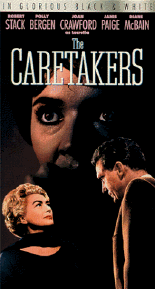
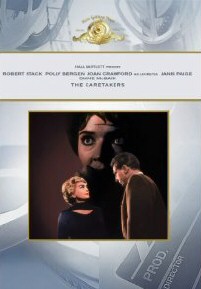 United
Artists. 97 minutes.
United
Artists. 97 minutes.