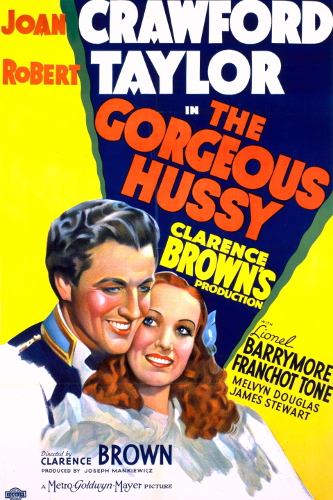
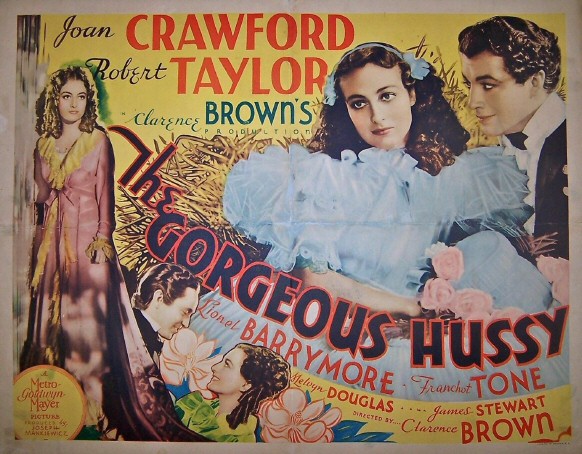
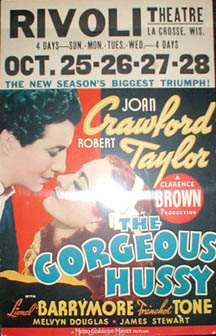
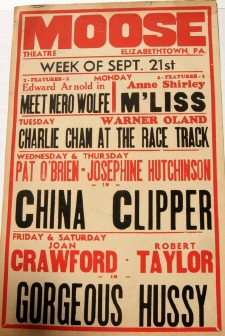
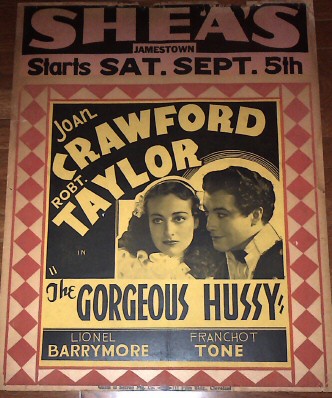
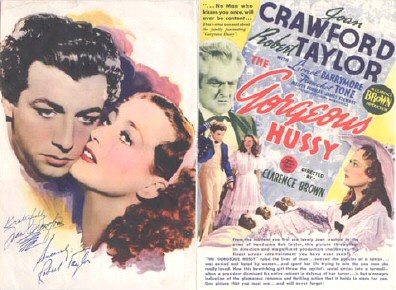
 Michael Lia (January 2026) Michael Lia (January 2026)
Rating:  -1/2 of 5 -1/2 of 5 I think you really have to be in the mood for this one:
maybe a stormy day in bed with a hangover, and the flu.
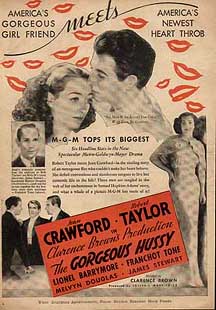
The film is advertised as fiction, and it does have some
truth in general. The historical role
of Peggy O’Neill (Eaton) was something Miss Crawford really wanted to do, even
though David Selznick was supposed to have said to Joan that she was “too
Modern to be in a costume picture.” Unfortunately,
the studio did not want to film the real-life story of this "gorgeous hussy."
Miss Crawford's role does have a lot of obstacles
while trying not
to get lost in the artificiality of the film. She did try, and she did take it
seriously, despite her later claim that she was a “damn fool” for trying. I don’t know what Miss Crawford imagined the role to be and
why she took it: Was it to compete with Norma Shearer and her historical blockbusters? Or Bette Davis in her period pieces? Gorgeous
Hussy did garner some
award nominations (a Photoplay award for Joan and a Best Supporting Actress for Beulah
Bondi, who played the pipe-smoking Rachel Jackson).
The
actual life of a First Lady
in Washington was full of struggles, gossip, snobbery, jealousy, and manipulation.
Maybe someday a mini-series will appear that won’t leave out the real story.
I've recently read a biography of
another First Lady, Lucy Hayes (husband in office from 1877-1881), who said
that she felt enough
compassion for Peggy Eaton to send
flowers when she died. Mrs.
Hayes’ biography also gave a quick rundown of what
actually happed in the Jackson administration. She says the President's support
of “pretty” Peggy O’Neill, the daughter of a Washington boarding-house owner
who married Jackson’s Secretary of War (General John
Eaton, played by Franchot Tone) caused a rift within the Jackson cabinet and the resignation
of Vice President John Calhoun. Journalists
of the time derided the tangled life Peggy led after
the death of General Eaton.
I can only imagine what the potential could have
been for Miss Crawford’s character, but I guess she had enough going on with
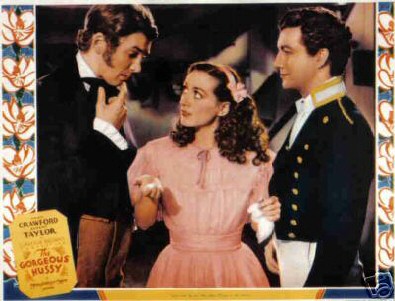
four or six leading men, including Robert Taylor as a young Navy lieutenant (with his rosy cheeks, a gleam in his eyes, teeth shining, and jet
black curly hair). His early death in the film initially gives the audience
a chance to have some sympathy for Peggy, but Peggy quickly moves on to other loves and interests.
After Taylor's death, the script takes off in
another direction and the trouble begins when Peggy marries General Eaton---breaking
with the tradition of mourning for a year.
The political debates within
this film are passionate, but the problem is
how to get all this history figured out and keep the focus on Peggy’s story:
Lionel Barrymore as
Andrew Jackson supplies enough ham for three Easter dinners; the energy level
certainly jumps up when he appears. The scenes he shares with Miss Crawford and
Miss Bondi are touching and poignant, but we still don’t get enough of Peggy
and all of her complexities.
Of
the various supporting players:
First off is Franchot Tone,
married to Joan at the time (only 26 lines as General Eaton and unhappy with
that fact). He comes off quite well, as he usually does, but behind the scenes he was late
to set, which infuriated his wife.
Melvyn Doulglas shows
up for the first of four movies with
Miss Crawford. He later wrote of how pleasant Miss Crawford was and how her maid
would offer him hot chocolate and how he was fascinated with the trappings of
being a star. Douglas plays Congressman John Randolph, whose real-life habits
MGM couldn’t actually put in the movie.
Jimmy Stewart is just a babe
beginning his career. He has the wrong ideas about Peggy. (And Jimmy has to wait until Ice Follies of 1939
to get Miss Crawford.)
The many character actors did as much as they could with the
tiny moments they had on screen to give
their characters meaning. The wonderful Clara Blandick and Allison Skipworth are
the perfect choices for old mean biddies spreading gossip and causing most of
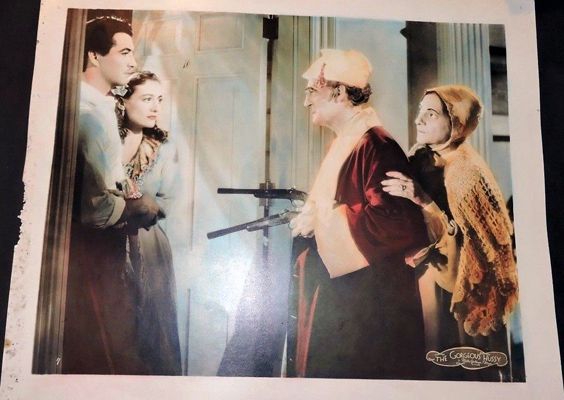
the trouble. The old grandma (Zeffie Tilbury) adds a bit of comedy and some sass
to the petty gossips. And of course there is the ubiquitous Bess Flowers---that
lady must have had a good time appearing in over 300 movies!
 Tom C. (August
2024) Tom C. (August
2024)
Rating: of 5 In Conversations
With Joan Crawford, Joan said of
The Gorgeous Hussy (1936): “Historical romance was simply not for
me.” Joan praised her co-stars but was critical of her own work in the film.
Joan did
very few period pieces. Apart from
Hussy, I can’t think of another costume drama she did in the talkie era, and in the silent era
were only
Winners of the Wilderness (1927) and Across to Singapore
(1928). As a prototypical Modern Woman during her late-1920s--mid-1930s prime, maybe Joan and MGM felt
her audience was uninterested in seeing her in movies set in the
distant past. In the mid-1930s, Joan’s competitors at MGM---Norma Shearer and Greta Garbo---were doing period films such as
The Barretts of Wimpole Street (1934) and Camille (1936),
respectively, and getting Oscar noms. Maybe this motivated Joan to try
historical romance herself. (BTW: Hussy itself earned 2 Oscar nominations:
Best Supporting Actress [Beulah
Bondi] and Best Cinematography [George Foley]. Both lost to nominees
from
Anthony Adverse---another
historical romance.)
In
Hussy, Joan resembles a slightly older version of Priscilla Crowninshield, her character from
Across to Singapore, costumed in crinoline and curls. I
think she does a fine job, albeit not her best effort. Crawford did
better as women with a bit of an edge to them. If Joan had played it less
"gorgeous" and more "hussy," that might have spiced
the movie up. Overall, Hussy focuses more on affairs of the heart and less on affairs of state.
MGM surrounded Joan with perhaps her most prestigious cast, apart from ensemble movies like
Grand Hotel (1932) and The Women (1939). I like how they
introduced the main players with a little picture of each in costume
during the opening credits. Lionel Barrymore (who played Kringelein in GH) is excellent as Andrew
Jackson. Jackson’s relationship with his wife Rachel, and the abuse
she suffered during the election of 1828, was dealt with touchingly.
Like her previous Joan film,
Rain (1932), Bondi is the moral voice of the film.
Bondi’s Rachel displays great strength dispensing simple,
homespun advice with no pretentioun. A melodramatic death scene could
easily have propelled Bondi to Oscar victory.
Robert Taylor
and Jimmy Stewart are also here, both on the cusp of stardom. In
Taylor’s case, he was getting the same treatment Gable got in 1931 and
Joan got in 1927/8,
i.e., pairing with major studio stars of the opposite sex to
build his own star power. Taylor is brash naval officer “Bow," but he’s
also tender in his pursuit of Joan’s Peggy Eaton, such as in the cute scene in
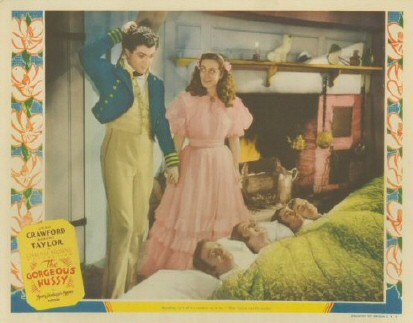
which boys and girls are “sewn into bed” (presumably
this was enough in the 1820s to thwart shenanigans). Stewart is
“Rowdy,” the “aw shucks” loyal friend he played in many of his early
movies. Taylor and Stewart would go on to co-star with Joan a few years
hence when they were bigger box office attractions:
in When Ladies Meet (1941) and Ice Follies of 1939, respectively.
Two-time Oscar awardee Melvyn Douglas plays John Randolph. He and Joan are fated throughout
Hussy to be star-crossed lovers who never connect. He co-starred
with Joan in 3 more movies over the next several years, culminating in
They All Kissed the Bride (1942),
the rom-com in which Joan
replaced the late Carole Lombard. Last but not least, Franchot Tone---Joan hubby #2---is also
here. This is one of his Joan pictures where I liked him.
Tone is less smart-alecky and gets to take a poke at
someone during the scene in which the infamous Petticoat Affair is
played out.
Among bit players in Hussy,
Zeffie Tilbury is my favorite. She’s the old lady who enjoys telling
off the society gossips who shunned Peg Eaton. (She was also the grandmother
in
The Grapes of Wrath [1940].)
The picture---and book of the same name by the
prolific Samuel Hopkins Adams (who also authored the source material
for films like
It Happened One Night [1934], The Harvey Girls [1946], and Flaming Youth [1923])---takes
pains to point out that historical accuracy
was sacrificed for the sake of storytelling. Clarence Brown---who directed Joan 5 times and
was one of her favorites---directs
Hussy. The movie was a tad long for me at 103 minutes, but there
are not many scenes that plod along, aside from some of those dealing with politics.
Given the cast assembled, Hussy could have been a much stronger film.
 Stephanie Jones
(April 2023) Stephanie Jones
(April 2023)
Rating: of 5
Good
God, what an annoyingly bland hodge-podge of a film! And it
has nothing to do with Joan in period costume; she's nothing particularly
special here, but she's certainly not the problem. Rather,
it's the screenplay writers, director, and editor who are to blame
for this big ol' mess.
I've
got to start with the real-life Peggy O'Neill (1799 - 1879), whose
actual life was much more interesting than anything you'll see in
this film. The focus of the later Petticoat Affair/Eaton Affair
(1829-1831) during the Andrew Jackson Administration was the
daughter of a Washington, DC, innkeeper, whose establishment was
frequented by notable politicians/military men of the day.
In 1816 (at age 17), she married 39-year-old Navy purser John Timberlake
(a real-life drunk who was heavily in debt; portrayed in the film
by Robert Taylor as a good-natured young Lieutenant, with the two marrying
in this film in 1828). They had 3 kids, and he died 12 years
later in 1828 during a job-related voyage.
A
mere 9 months after his death (this, plus her tavern-girl background,
were responsible for the societal scandal),
Peggy married Tennessee Senator John Eaton (played by Franchot
Tone in the film, in which he appears only several brief times as
a very minor character, albeit finally becoming her husband only
at the insistence of newly elected President Jackson), who was a
friend of Jackson's and was appointed Secretary of War
in the new Jackson Cabinet after Jackson's election in 1828. The
national Petticoat Affair/Eaton Affair began when Vice President
Calhoun's wife and the wives of other Cabinet members refused
to socialize with Peggy, leading to President Jackson's asking for
the resignations of most of the Cabinet members.
President
Jackson had been a long-time friend of both Peggy's and Eaton's,
and he also associated the social shunning of Peggy with the similar
shunning of his own once-divorced wife, Rachel, who died shortly
after his inauguration in 1829. In addition, VP John Calhoun of
South Carolina, whose wife was leading the social charge against
Peggy, was strongly against a tariff bill of 1828, supported by
Jackson, which would have financially harmed Southern states----Calhoun
was a strong proponent of States' Rights, even to the point of secession
from the Union, whereas Jackson was a Union supporter.
The
scandal blew over when Secretary of War Eaton resigned his Cabinet
post in 1831, going on to become an undistinguished Governor of
the Florida Territory (1834-1836) and then Ambassador to Spain (1836-1840).
He died in 1856. (In 1832, Calhoun resigned shortly after being
elected a second time as Jackson's Vice President and was elected
as a Senator from South Carolina.)
At
age 59, Peggy O'Neill Timberlake Eaton, 3 years after husband Eaton's
death, married a 20-something "Italian music teacher and
dancing master" (and all that implies!). A few years later,
he absconded to Europe with both her fortune and her 17-year-old
granddaughter. Peggy O'Neill died in poverty in DC.
---------------------
Now,
all of the above is a REAL movie! (Or two or three! The Petticoat
Affair is interesting in and of itself as a DC social drama. And
the Jackson politics of the time were certainly interesting, with
the Petticoat Affair as a side-note. And then there's the fact that
Peggy really was, in real life, a "hussy" 'til the
very end---I'd like to see a movie about her post-menopausal marriage
to that dance instructor who ran off with both her money and her
granddaughter!)
What
instead happens in this ridiculous 1936 film (which can't seem
to figure out if it's a fun, frothy costume picture or a serious
costume political drama---it alternates unsuccessfully and schizophrenically between
the two):
First
we get a title disclaimer: "The story of Peggy Eaton and her
times is not presented as a precise account of either --- rather,
as fiction founded upon historical fact. Except for historically
prominent personages, the characters are fictional...." We
then get an opening scene with Massachusetts Senator Daniel
Webster arguing with Virginia Senator John Randolph (played by Melvyn
Douglas) on the Senate floor about States' Rights, seguing to the
two arguing in the inn owned by Peggy's father. When Peggy shows
up to serve them and parries a bit to show her gumption, Webster
claims "You
should have been born a man." Peggy is then ogled by a newly arrived military
man, Timberlake (Robert Taylor), who's in turn chastised by Melvyn's
Senator
Randolph for being so bold as to ogle.
For
the first solid hour of the film, Joan's Peggy alternates between flirting
with the so-called "Lieutenant" Timberlake (second-billed
Taylor) and confessing, by candle-light, her long-time feelings
for Senator Randolph (Douglas). When Randolph (in real life, not even
an acquaintance
of Peggy's, and a bachelor and opium addict, but here portrayed as
a serious scholar and suitor)
dismisses her feelings, she rebounds. There are then multiple cutesy
scenes of Peggy and Timberlake flirting, him holding her knitting,
youthful hayrides, the two funnily being sewn into quilts when stranded
at an inn, the crotchety Andrew Jackson's disbelief at their marriage
license, etc. At the end of it all, they marry, only to have him
killed off minutes later. Yes, despite the 2nd billing, Taylor disappears
halfway into the movie! Joan
and Taylor are very attractive, but if your film both begins and
ends with scenes indicating that the Fate of a Nation is allegedly
at stake, then you probably shouldn't spend literally half of the
film focused on the cutesy goings-on of Crawford and Taylor! (Another
superfluous character is the non-entity "Rowdy"
played by James Stewart, who's also a complete waste of time.)
The Melvyn
Douglas character of Senator John Randolph had, in actuality, nothing at all to do with Peggy, but
here, he's portrayed as a serious-minded would-be lover who only
first rejects Peggy because she's too young to know her own mind.
Then later, after kisses, they can't be together because they disagree
politically (!) and because President Andrew Jackson doesn't
think it's best for the country (!). Later in the film, Randolph
is ridiculously shot by a pro-Slavery conspirator (when in
fact he actually died at age 60 from consumption and opium use),
providing yet another death scene for Joan to attend (the first
being that of Rachel---wife of Andrew Jackson).
After
Taylor's Timberlake has died at sea, and---before Douglas's Randolph gets
shot---Peggy marries Senator John Eaton (Franchot Tone)
after nearly zero interactions on-screen. Eaton just kind of "turns
up"---no introduction, nothing; he's all-of-a-sudden just THERE
waiting with Peggy for the 1828 Jackson election results to come in... Then
he hangs around to marry her and hangs around post-Randolph death
scene. In fact, when Peggy and Eaton sail off for Europe in
the final scene, Peggy's last words are "Goodbye, John Randolph"
before posing with Franchot's Eaton at the mast of the ship as it
sails.
This
film is a NON-hot mess. Nothing "hot" or exciting about
it. It's sloppily written, sloppily put together. There
are multiple potentially very interesting personal and societal/political tales
to be told here, but, unfortunately, the writers and director were
unable to arrange anything into any sort of cohesive sequence. Joan
barely counts here: She is tender in individual scenes with Taylor
and with true love Douglas, but she's, ultimately, a non-entity
in the overall haphazard proceedings.
|

 MGM. 105 minutes.