The Best of Everything
Encyclopedia Entry • Films Main
Grand Hotel
1932
|
2007: Selected by the United
States Library of Congress for preservation in the National Film Registry as being "culturally, historically, or aesthetically significant."
Library
of Congress brief
description of film.*
*According to Wikipedia, Daniel Eagan's full Library of Congress essay on the film was published in a book in 2010, but the essay does not yet appear on the website. |
Critics' Reviews • Our Reviews • Movie Posters • Lobby Cards • Misc. Images
Click here to see photos from the film.
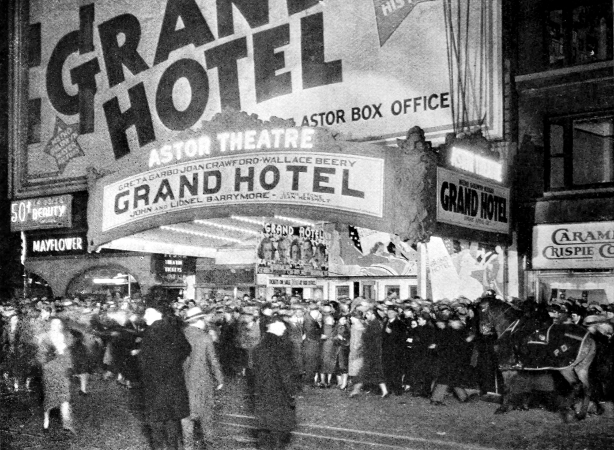
US premiere: 4/12/32 (NYC's Astor Theatre) US general release: 9/11/32.
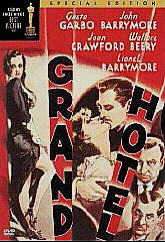
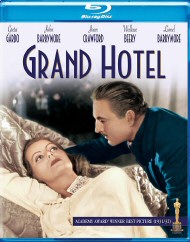
VHS release: 3/18/03. DVD release: 2/3/04. Blu-ray release: 1/8/13.
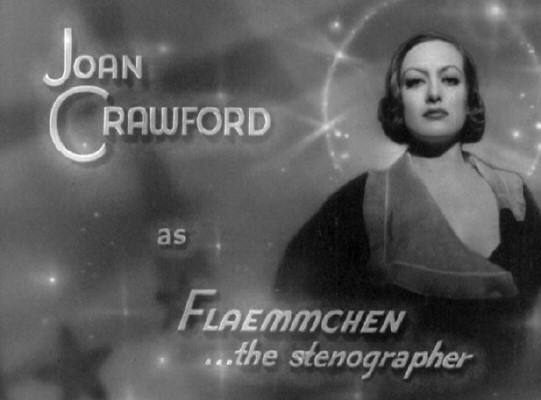
Cast: Greta Garbo, John Barrymore, Joan Crawford (as "Flaemmchen"), Wallace Beery, Lionel Barrymore, Lewis Stone, Jean Hersholt, Robert McWade, Purnell Pratt, Ferdinand Gottschalk, Rafaela Ottiano, Morgan Wallace, Tully Marshall, Frank Conroy, Murray Kinnell, Edwin Maxwell.
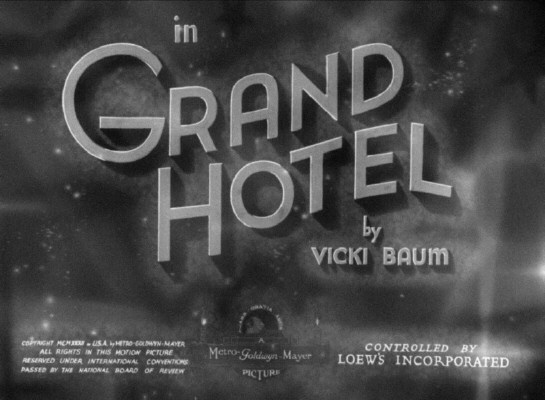
Credits: From the novel and play by Vicki Baum. Continuity: William A. Drake. Director: Edmund Goulding. Camera: William Daniels. Costumes: Adrian. Editor: Blanche Sewell. Producer: Paul Bern.
Plot Summary: Based on Vicki Baum's novel and produced by Irving Thalberg, this film is about the lavish Grand Hotel in Berlin, a place where "nothing ever happens." That statement proves to be false, however, as the story follows an intertwining cast of characters over the course of one tumultuous day. Greta Garbo is Grusinskaya, a ballerina whose jewels are coveted by Baron von Geigern (John Barrymore), a thief who fancies Flaemmchen (Joan Crawford), a stenographer and the mistress of Preysing (Wallace Beery), businessman boss of Kringelein (Lionel Barrymore), a terminally ill bookkeeper who is under the care of alcoholic physician Dr. Otternschlag (Lewis Stone). Grand Hotel won Best Picture at the 1932 Academy Awards. ~ Matthew Tobey, All Movie Guide
Awards: 1932 Oscar for Best Picture. (Trivia: The only Best Picture winner not to be nominated in any other categories. And Joan's only film to win Best Picture.)
Notes:
|
Mordaunt Hall in the New York Times (April 13, 1932)
A Pictorial Version of Vicki Baum's Stage Work
For the first showing last night of the film of Vicki Baum's stage work, "Grand Hotel," those worshippers of the stars of the Hollywood firmament choked the sidewalk outside the Astor and also the theatre lobby, while policemen afoot and on horse urged the throng to keep moving. And from across Broadway blinding beams of light added to the general excitement. Inside the theatre it was for a time difficult to move but very slowly, for many of those who had tickets pressed into the aisles and behind the orchestra seats with the evident hope of catching a glimpse of one or another cinema celebrity. But once microphone music came from the stage the spectators hastened to their places and soon the introductory scene of the much talked of motion picture was emblazoned on the screen. It was that of the telephone operators in the Grand Hotel and then the pushing and shouting was a thing of the past. It is a production thoroughly worthy of all the talk it has created and the several motion- picture luminaries deserve to feel very proud of their performances, particularly Greta Garbo and Lionel Barrymore. So far as the direction is concerned, Edmund Goulding has done an excellent piece of work, but occasionally it seems as though he relies too much on close-ups. Nevertheless he has sustained a steady momentum in darting here and there in the busy hostelry and working up to an effective dramatic pitch at the psychological moment. In all, the picture adheres faithfully to the original and while it undoubtedly lacks the life and depth and color of the play, by means of excellent characterizations it keeps the audience on the qui vive. It is indubitably a capital subject to bring to the screen, for it benefits by the sweeping scope of the camera and in swaying from room to room and from the lobby to the telephone switchboard, Mr. Goulding gives some markedly fine photographic effects. But it should be stated that in one scene he permits an extremely gruesome idea to creep in. This will probably be eliminated at some of the future exhibitions. Miss Garbo, of course, impersonates the dancer, Grusinskaya, played on the stage by Eugenie Leontovich. Miss Garbo, possibly appreciating that she was supported by a galaxy of efficient performers, decided that she would do her utmost to make her role shine. And she succeeds admirably. She is stunning in her early scenes and charming in the love scene with Baron Geigern, portrayed by John Barrymore with his usual savoir faire. And later, wearing a chinchilla coat, she is gay and lighthearted, for love has beckoned to the temperamental dancer. Grusinskaya leaves the screen hopeful of meeting the Baron at the railroad station, but the audience knows that the good-natured and sympathetic thief has met his doom at the hands of the ignoble Preysing, a part acted by Wallace Beery. It fell to Lionel Barrymore's lot to play Otto Kringelein, the humble bookkeeper who decides in an introductory scene that, as he has not long to live, he will go out of this world in a blaze of glory. Mr. Barrymore brings out every possible note of this sensitive person, who talks with bated breath to the Baron, entertains with champagne and caviar; loathes his employer, the hard-fisted, sensual Preysing, for whom he has worked for a pittance. He is going to die and therefore what cares he if Preysing discharges him? But, instead of passing away, he entrains for Paris with the attractive stenographer, Flaemmchen, who is seen in the person of Joan Crawford. Through Mr. Barrymore's skillful interpretation one gleans the satisfaction of this obsequious human adding machine has in hobnobbing with people of the world and in living in the corner suite of the Grand Hotel. Mr. Barrymore is superb when he as Kringelein finds himself tipsy, tipsy but elated. If ever an actor got under the skin of a character Mr. Barrymore does here. And, although Miss Garbo and Lionel Barrymore deliver talented portrayals, it does not mean that any aspersion is to be cast at the work of others in the cast. Miss Crawford, for instance, is splendid as Flaemmchen. She, too, does all that is possible to vie with the others in the cast. Then there is John Barrymore as the Baron. Nobody could hope to see such a type better acted. This Baron is handsome, a little sly, eager for money, but always thoughtful and friendly when it comes to his association with Kringelein. He steals Kringelein's wallet, but, when he hears Kringelein bewailing his loss, he "finds" the wallet, and how glad is Kringelein! As for Mr. Beery, it may seem that while his performance does not quite compare with that of Siegfried Rumann, the stage Preysing, it is nevertheless a very worthy characterization. Mr. Beery is sufficiently ponderous and forbidding as Preysing, but in having to assume a German accent he is not quite in his element. But those who did not see Mr. Rumann will undoubtedly decide that Mr. Beery's performance is good enough. No review of this picture would be complete without a mention of the genuinely pleasing work of Ferdinand Gottschalk, who acts the loyal underling of Grusinskaya. Lewis Stone also does well as Dr. Otternschlag and Jean Hersholt is up to his usual high standard as the porter, Senf, whose chief interest during the running of the story is the condition of his wife, who finally gives birth to a child as the story comes to a close. And it is Dr. Otternschlag who is given to saying that "people come and people go, and nothing ever happens in the Grand Hotel." And the audience has seen manslaughter, gambling, a baron bent on stealing pearls, love affairs, a business deal and various other doings. And "nothing ever happens!"
Irene Thirer in the New York Daily News (April 14, 1932) "Grand Hotel" opened its register to a notable and tense premiere assemblage at the Astor Theatre. On the merits of Vicki Baum's manuscript in its footlight version, and on the strength of the grand and glorious list of names in the talkie cast, this Metro-Goldwyn-Mayer production could draw box-office lines for some months to come. But it does not have to depend on its reputation as a stage play, nor on the array of talent in its film lineup - that is, not merely because the names are important cinema names. Each and every performer in the screened "Grand Hotel" does a remarkable piece of work. To us, Garbo is the supreme of magnificence. She is lithe and lovely in the flimsy gownery which makes her convincingly a dancer - even in the knee-length ballet costume of tarlatan and the ballet slippers which she wears in just one scene. She is glamorous in her street clothes, mink and chinchilla and high-crowned millinery such as only Garbo can wear with ease and distinction. Her voice is mellower than it has ever before been in talking pictures. And her part does not carry the picture. So, never once is there a feeling of monotony - of too much Garbo. The footage is divided quite evenly among Garbo, John and Lionel Barrymore, Wallace Beery and Joan Crawford with Lewis Stone and Jean Hersholt coming in for highly important, if lesser roles. John is sartorial splendor and a suave gentleman as the Baron of the screen piece. Wallace Beery assumes a Germany accent which is thoroughly believable for his role of Preysing, the big business man. Lionel Barrymore, who was adjudged too elderly for the part of Kringelein when the film cast was announced, is hereby declared a splendid choice for the role. He may not be exactly the character of the stage play - given us by another superlative actor, Sam Jaffe. But Lionel's interpretation of the weak underdog, about to die before his time, and determined to live the rest of his lean life in splendor is par excellence. He doesn't steal the movie because no one person does - the scenes are so evenly tendered in dramatic value. But as usual, this Barrymore brother comes close to putting the picture in his pocket and calling it his own. Joan Crawford, as the flip stenographer who makes her bread and butter by typewriter pounding and other means, does a singularly worthwhile piece of emoting. Any one of many actresses could have played this part as well - but that's no let-down for the comely Joan. Lewis Stone is the shell-shocked doctor, drowning his sorrows in drink and forever making philosophical remarks concerning the hotel's activities. His role is dimmed somewhat, but he subtly conveys the situation. And Jean Hersholt, cast as the Grand Hotel's chief clerk, actually arouses your sympathies for his young wife, lying in a hospital for two days awaiting the birth of a young Senf. It's a full, fervent picture which moves majestically from one dramatic scene to the next, outlining the events which transpire over a period of two short days in this Continental hostelry. The Baron, in financial straits, is after the dancer, Grusinskaya's pearls. But after he gets them, he returns them, because he falls in love with their owner. And she is brought out of a great despair into a world of light and love. She forgets that her audience did not applaud; that the house was half empty; that she is tired of it all. She wants to sing, dance - because she has found love. Yet she does not meet complete happiness, for the Baron is killed by the business man whom he tries to rob -rather than take easy money from the pocketbook of the ailing Kringelein. Gruisinkaya does not know of the Baron's death, as the tale concludes. But the others do, and there is an air of sadness in "Grand Hotel" - and some happiness too, for Kringelein and Flaemmchen the stenographer. Then the philosophical doctor observes: "Grand Hotel; people come and people go, and nothing ever happens." Edmund Goulding, who directed the picture, is to be commended for a finely restrained execution of his duties. William A. Drake did the adaptation, supervised by the author herself. Cedric Gibbons as art director, gives the film some stunning scenic background. A four star picture!
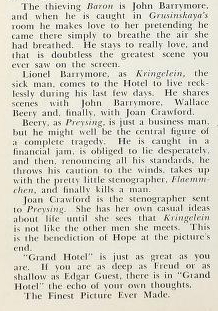
Modern Screen (July 1932)
James R. Quirk in Photoplay (1932) The story is not all Garbo. Joan Crawford gives excellent competition and moves up along her ladder of successes...You may argue about who deserves the most praise and not get anywhere, for the picture, as a whole, steals the show.
Silver Screen (July 1932)
film-forward.com (2004): What may come as a surprise is that, among this illustrious cast, it is Crawford who stands out. Her acting style is much more understated than Garbo’s swooning. Her charisma even upstages the Great Profile. It’s no wonder John Barrymore playfully asks her in their pre-Code banter, “I don’t suppose you’d take some dictation from me sometime?”
Glenn Erickson on dvdtalk.com (2004): Topic number two for Grand Hotel has always been Joan Crawford, with critics and fans getting excited about the ambitious star earning respect by 'upstaging' the Swedish legend. Thalberg was wise to keep the women completely separate. The difference in their acting styles makes comparisons pointless - Garbo is all poetry and grand gestures, while Crawford is a Berlin edition of her standard 'working girl willing to put out' persona. Complete review. |
If you've seen Grand Hotel and would like to share your review here, please e-mail me. Include a photo of yourself or avatar, a star rating (with 5 stars the best), and any of your favorite lines from the film.
Rating:
Grand Hotel
(1932) has long been one of my favorite movies, even before I was a
dyed-in-the-wool early Joan fanatic. I eagerly buy into the Thalbergian
hype that this is the first movie (and I think still one of the best) to
have an all-star cast. My usual criterion for a great film is one I can watch over and over. I think I've seen Grand Hotel
about 10 times, and rewatched my favorite scene (the early Joan/John
flirtathon) on YouTube a zillion times. Does Garbo overact? Probably,
but you expect a prima ballerina to be a drama llama. Is Lionel
Barrymore’s character annoying? Much of the time. However, I find the
little story threads---sometimes parallel, sometimes interwoven---to be
interesting, the characters riveting if not appealing, and I love the
opportunity to see a cast whose work I enjoyed individually together in
one movie. One
thing often overlooked about GH is just how good the supporting
characters are. Most were seasoned actors. The ones I like most are
Lewis Stone as the disfigured doctor, Jean Hersholt as the clerk whose
wife is expected to deliver a baby imminently, and Rafaela Ottiano as
Garbo’s maid/babysitter. Of
course, supporting cast can carry a movie just so far. I think John
Barrymore is great in this movie as the broke baron who turns to
larceny. His early pairing with Joan is one of my all-time favorite
movie scenes: the banter, innuendo, double entendre; the little pat on
the fanny The Great Profile gives Flaemmchen/Joan as she trundles
off to work for Preysing. The scene is unadulterated pre-code goodness.
"Flaemmchen" may be German for "little flame," but Joan is a raging
three-alarm fire in this film. Barrymore famously utters the line, "I
don't suppose you'd take some dictation from me sometime." Oh JB, you
scamp! Get in line! I have read that Grand Hotel
is the movie that transformed Joan from a star to a superstar. While
most of the other characters seem dated, not surprising for a 90-year-old movie, Joan looks fresh and her acting holds up as such nearly a
century later. Her poor stenographess character is multidimensional: You
care about Flaemmchen's decision to prostitute herself to Preysing for
cash and nice clothes, or wonder how her trip to Paris with Kringelein
might work out. Joan may have been the junior member of the
troupe at this time, but all these years later, she is among even GH's
all-star cast, to borrow a phrase from one of her biographies, The
Enduring Star. The rest are long dead and mostly forgotten except by
film buffs---except for Garbo, who is probably as famous for her reclusive
post-MGM lifestyle as for her filmography. But Joan's fans are still
legion many years after the great diva's ascendancy to
superstardom. I was surprised when I just checked IMDB and found Grand Hotel
was 1 hour 52 minutes. Long for a Joan movie of that era. The time
flies, however---another metric for a great film, in my opinion. Major
kudos to director Edmund Goulding. It must have been a real juggling act
directing all those dueling egos, but he pulled it off. Bravo.
Rating:
For some unfathomable reason, this primarily stodgy film won Best Picture for 1931-32. Well, not so unfathomable, actually. Probably the tremendous hype at the time and all of the star wattage on hand gave lazy Academy voters an easy reason to support GH. But the award is an undeserved one.
Based on the book, and later play, by popular German novelist Vicki Baum, "Grand Hotel" is a place where, as hotel patron Lewis Stone intones at both the beginning and end of the film, "People come. People go. But nothing ever happens." His statement's meant to be ironic since, after all, we're either about to witness or have just witnessed quite a few ostensibly intense "happenings," running the gamut from birth to death. Not so ironic, though, once we're subjected to some mightily annoying acting that did indeed manage to provoke an irritated "who cares what happens?" from this viewer at least.
Vying for "Most Annoying" are Lionel Barrymore as Kringelein, the Constantly Whining and Dying Pensioner with the Sappy Heart o' Gold Whom Patient People in the Film Are Forced to Be Nice To for Plot Reasons; and Greta Garbo as Grusinskaya, the Constantly Flower-Sniffing Ballerina Who Can't Stop Posing and Emoting for Even One Second. These two are truly a chore to watch and their heavy-handed hamminess borders on embarrassing at times. (In fact, back in the 1980s when I, a new Garbo and not-yet Joan fan, first saw this movie, Garbo's performance was enough to make me completely lose interest in her and her career.) Their awkwardness, along with some very plodding editing, drags down the film as a whole.
Things only come to life when Wallace Beery's skillfully brutish Preysing and Joan Crawford's subtle little slut Flaemmchen are on the scene. Want to see some interesting chemistry? Forget the overblown cow eyes that Grusinskaya and the Baron (John Barrymore) make at each other while awkwardly groping in an unintended parody of sexuality. Instead, take a look at Preysing's lustful-yet-shy smile while he's both eyeing Flaemmchen venally and trying to get her to actually like him. And listen to Flaemmchen's "no I won't" small talk -- just seconds before she segues into naming her price and slipping into something more comfortable.
By now, Beery's an old hand at this acting stuff, so his dexterity isn't quite a surprise. But Joan, still near the beginning of her career and never before thrown into the mix with such a heavy-duty group of players... what a revelation! "Grand Hotel" -- with its all-star cast and decidedly "adult" themes, as well as its Best Picture publicity -- decisively promoted Joan, up until 1932 a star primarily among younger United States filmgoers after the success of 1928's "Our Dancing Daughters," to superstar status among every segment of both US and international audiences. And with good reason. She's at her absolute peak of youthful beauty and power here -- not only because of her stunning face, which the camera lavishes with glowing close-ups, or her gorgeously lithe body, also framed and followed lovingly -- but because of the quiet self-assurance that her acting and her very presence exude onscreen.
The clumsy movements and overheated emoting of Garbo, the then-bigger star, serve to accentuate how very in control of her craft Joan is in comparison. Garbo appears dated and phony; Joan, natural and "modern" -- no thrashing about, no scenery chewing. Just a complete awareness of what a slight sucking in of the cheeks or sway of the hips, accompanied by a simple lowering and/or blaze of the eyes and even deceptively simpler delivery of lines, can do. While Garbo and Joan don't share any scenes in the movie, their blatantly divergent styles within the same film nonetheless signify an irreversible sea change in how we viewers would subsequently judge our film stars.
Joan aside (oh, but we can't really put aside her influence here!), the film itself isn't terrible...just terribly dull. And hardly the paean to style and glamour that at the time it was touted to be. (Sure, there's John Barrymore in a dinner jacket. And maybe two "deco-ish" shots from overhead down to the hotel atrium. Woooo.) The intermingled story lines themselves proceed dutifully, hardly innovatively. Several scenes (Preysing's deal-making, Kringelein's card-playing, Grusinskaya's phone-calling) quickly wear out their welcome, primarily because of slow-pokey, poor editing.
Overall, despite its elegant trappings, "Grand Hotel" is worth watching today only for historical (first all-star cast, Best Picture) -- and Joan -- purposes. It's a workhorse, not a showhorse, of a film, enlivened only by the interesting acting of the veteran Beery and the newly supremely confident -- and, in 1932, one to watch -- Joan Crawford.
Rating:
I am always generous to MGM when it provides me with a good cast, a good script, and a good producer. With a fun multi-talented director working from a successful novel written by a charming lady, how can it miss? It does not!
“Grand Hotel” was superb in 1932, and it is superb today. Get in the mood for some great 1932 acting.
The film is unique in many ways. It is the first book to become a stage play, a movie, then a musical. It was the first film of the Depression to “shake up” the industry as Irving Thalberg put it. Thank you, Irving .
Greta Garbo, John Barrymore, Lionel Barrymore, Wallace Berry, Jean Hersholt, and Joan Crawford! The cast of such extreme excellence can never be assembled again. It was Big! Today the cast could possibly be played by Meryl Streep or Julianna Moore, Jack Nicholson, Daniel Day Lewis, Robert DeNiro, no slouches. Who could play “Flaemmchen” ("Miss Flem" to you)?
No one is slumming at “Grand Hotel." MGM would not allow that!
The marquee of headline names is awesome! (Only time I like that word.) There is a major problem, however. One person comes out short for me and that is Miss Greta Garbo. She is beautiful and her scenes with John Barrymore are seductive and highly romantic, BUT... Garbo? a ballerina? No! It does not work. She does not work. It is embarrassing to see her attempt to “jump” around the room when she is happy. Her knees could not bend like a ballerina. How could anyone keep a straight face? Why couldn’t she be a spy, an heiress? Or a countess? or a queen? That is the only misfortune of her tragic role. But…what a face!
If I want to be super-picky, the location should have been moved from Berlin to New York or London. The cast was not European or able to speak German; that is the other discrepancy, as in most movies of that time. But I never let that bother me, because the theme is universal: MONEY: (security and food) could lead to lying and greed and murder! SURVIVAL: (sex for money and food) could lead to bad relationships and false friendships and murder. HAPPINESS: (money, sex, and food). At some point it is up to you! Did anyone figure it all out?
I am of the opinion that Miss Crawford was excellent here. She actually stole the show. Her character comes off better than Garbo’s and is more interesting. She is young and creamy, seductive and worldly. This character is like the "girl next door,” but the one who moved away: A sweet woman, yet she is bitter and untrusting of men; she is wise enough to know she needs them to make her way in life, even if it is just dinner. She is “Sadie Thompson” ... without the rain!
The people in “Grand Hotel’ are a sad lot, because their endings or their lives needn’t have been so tragic and unhappy and lonely, which is how they all started out!
So Lewis Stone was right when he said “Grand Hotel... People come, people go, but nothing ever happens”
It did not have to be that way….but their loneliness took over every thought process. Everybody in "Grand Hotel” is lonely!! (Even Jean Hersholt’s wife is having their baby alone)!
Joan should not have prostituted herself for a tan and a pair of ski boots.
Wallace Berry should not have lied in business, and he should not have killed poor John Barrymore.
John Barrymore should have taken a loan from Kringeline or let Miss Garbo pay the way. He should not have stolen Wallace Beery’s wallet! Because now he is dead and Miss Garbo will definitely commit suicide! Her maid will have a lot of work to do!
Garbo should not have allowed John Barrymore to leave her seeking money; she could have sold her pearls and left some money in his wallet?!
Lionel Barrymore (acting with a thick piece of ham) should have gone to Spain for warmer weather.
Miss Crawford is of interest throughout, and her scenes with Lionel Barrymore are genuine heartbreakers, and they walk away with the film. Thanks to director Edmund Goulding, who directed with enough nerve and with some pre-code flair. His focus was with heartfelt artistry. Let Mr. Thalberg worry about the budget and the schedule. Mr. Goulding spent his time working directly with story and characterization. (Damn... why did he not sense a scene had to be written for Garbo and Crawford? Or is that all just fantasy?)
I am glad the movie won Best Picture, and if there was a supporting Oscar category in 1932, I think Miss Crawford would have been nominated!
The cast also includes some comfortable favorites: Rafaela Ottiano, wonderful as the maid. (She is put to good use as a sneaky housekeeper in several 30’s movies). Purnell Pratt, who has a long Hollywood history, as well as Tully Marshall. Nice to see you guys!
“Grand Hotel” is 77 years old. It is a classic and remains a classic for many reasons, on many levels: Find some absinthe and watch it tonight!
Brad (December 2005) A major movie for MGM and a Joan Crawford standout. Joan's third place billing in a movie of this stature shows her prominence at MGM. She gave an outstanding performance and truly holds her own among the MGM mighty. Joan's role of the stenographer
puts her in her so called shop girl mode, and while she does indeed
play a poor girl who is willing to compromise her virtue (to a certain
extent) to move forward, she really is playing a young woman who dreams
of the good life and wishes to achieve happiness, success and most
important someone to love and be loved in return.
I
find Joan's performance in this movie a vital step forward towards her
stardom. One must remember that at this time MGM was THE movie studio
in the USA. She was given a role that countless women at MGM would have
wanted to play, and Joan played it perfect. Greta Garbo seems to have
gone to the Norma Shearer school of overacting in this movie - with her
wide eyes and exaggerated expressions, Wallace Beery works over a
dreadful German accent; the Barrymore brothers perform well and Louis
Stone does a fine job as the Doctor. Interesting point in this movie,
Joan's character has a scene with every major actor in the movie except
Garbo. Wisely enough MGM didn't put the two actresses together in the
movie, with Joan outperforming Greta. |
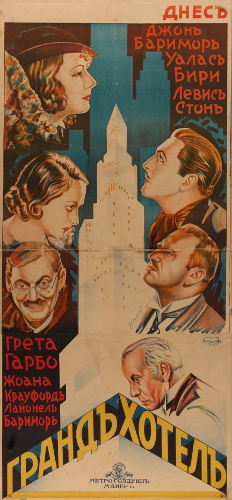
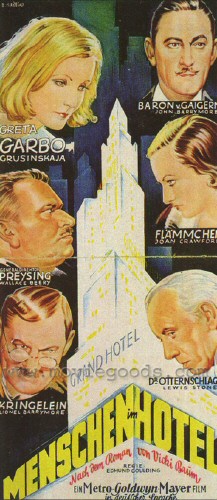
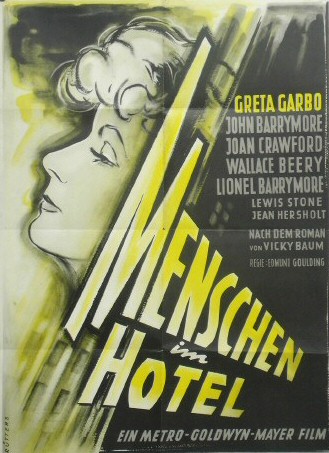
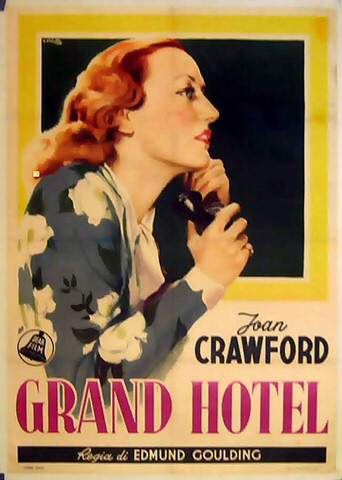
Above: Bulgaria, France, and Germany
Below: Italy

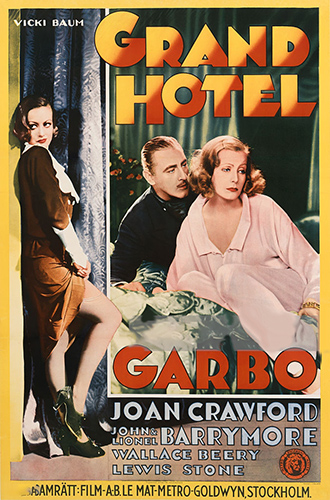
Below: Sweden and Russia
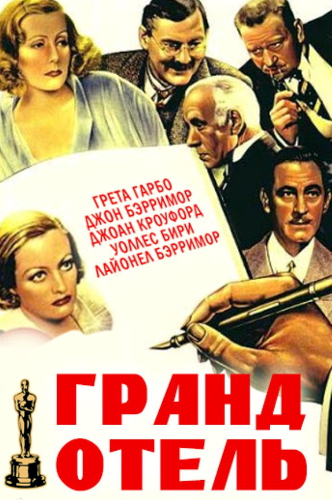
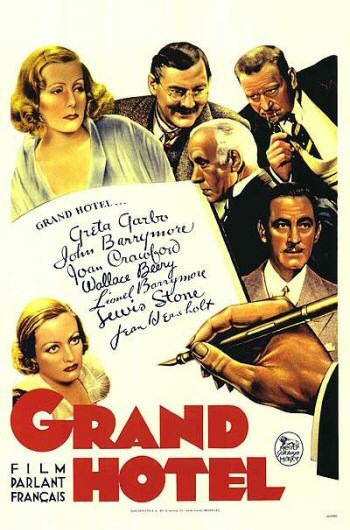
Below: United States
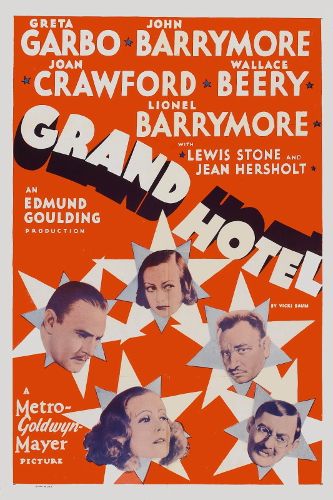

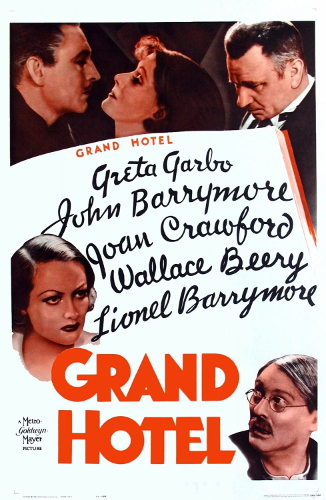
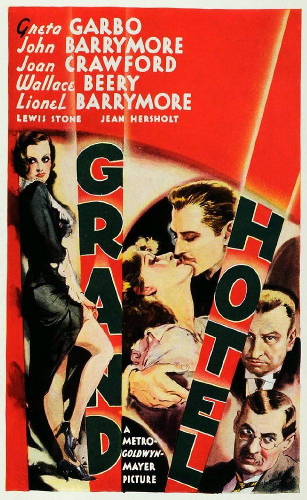
Below: 1950s re-release posters
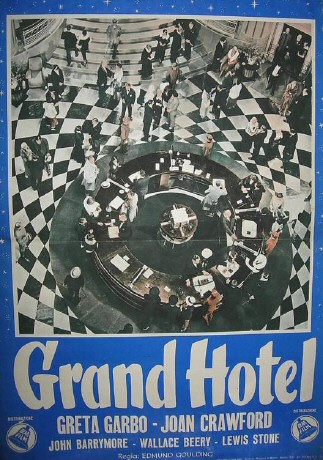
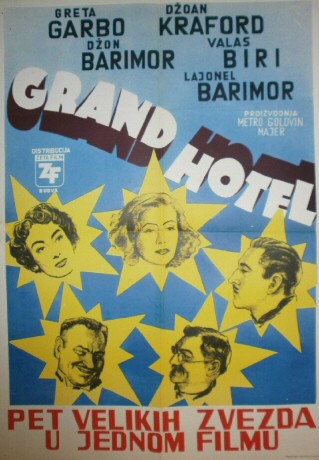
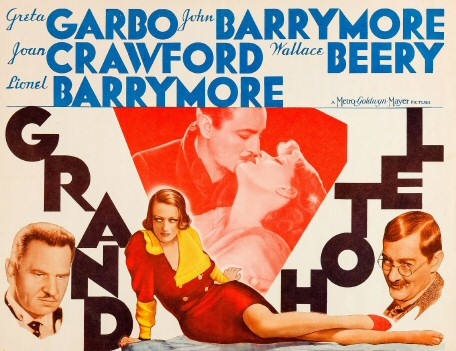
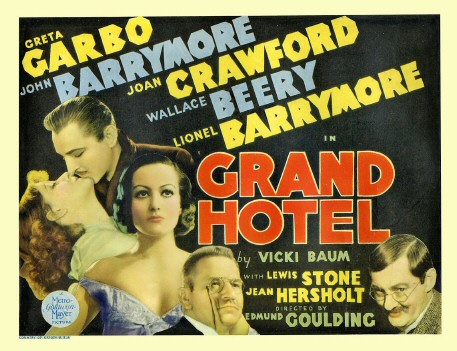
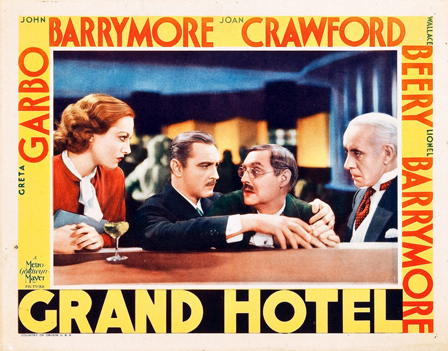
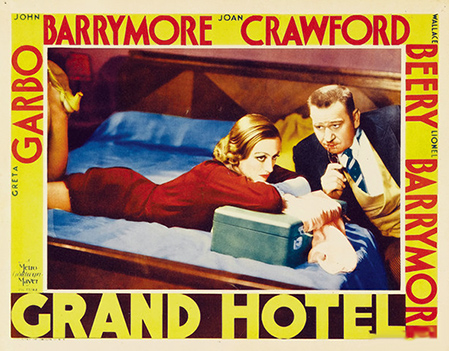
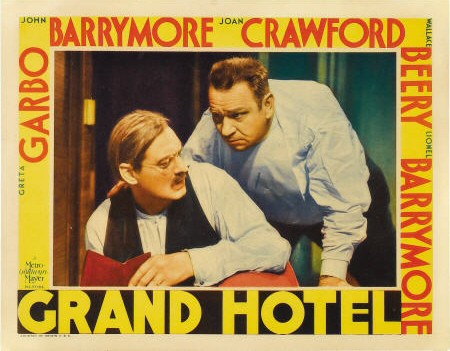
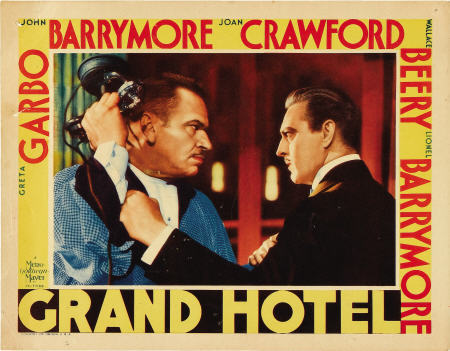
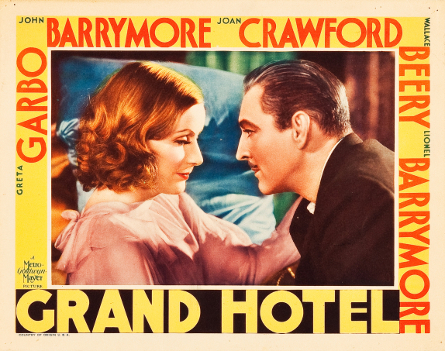
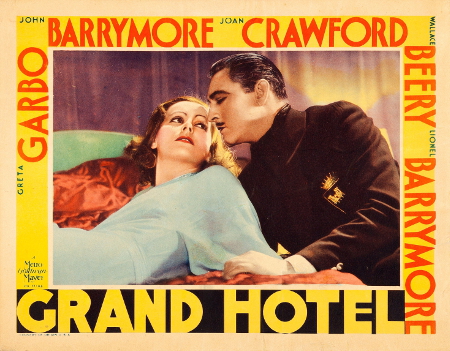
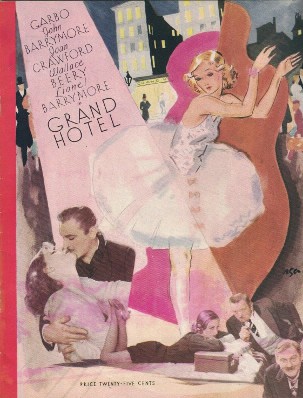

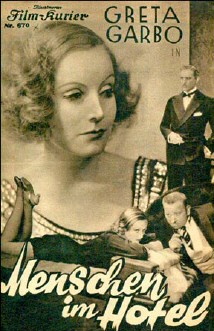
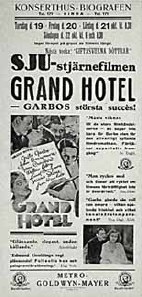
Above left: MGM program cover and page. Above right: German herald and Swedish flyer.
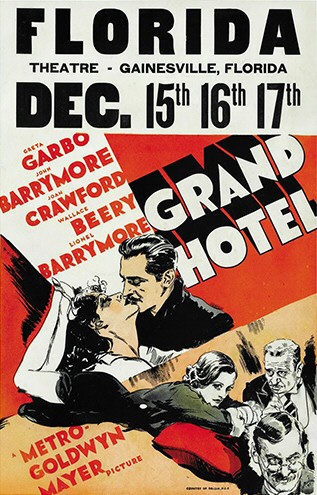


Above: Gainesville (Florida) window card, US glass theater slide, and Baltimore program cover.
Below: US newspaper ads.
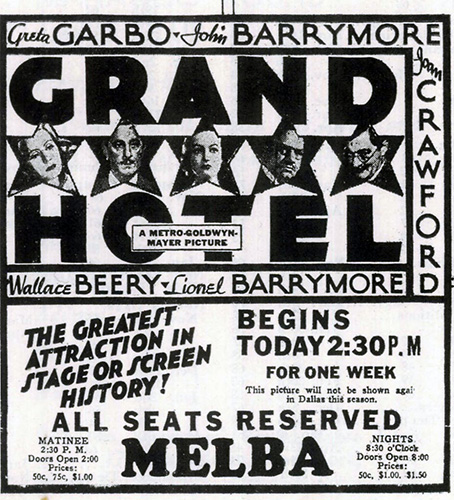


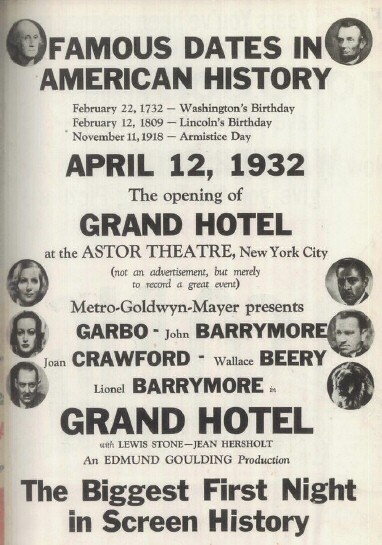

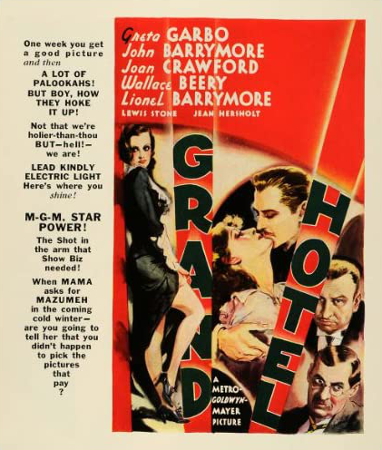
Below: Program from the premiere at NYC's Astor Theatre.


Below: April 12, 1932, premiere at NYC's Astor Theatre
The Best of Everything
 Tom C.

 Michael Lia (October 2009)