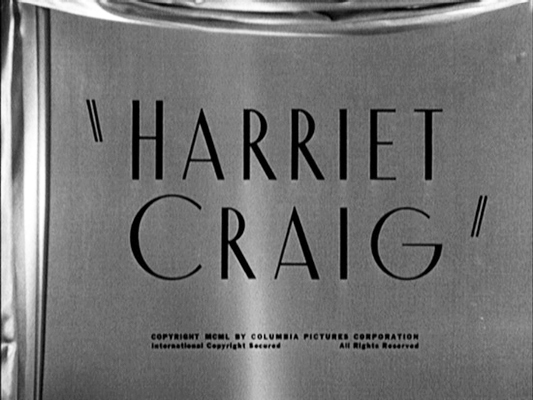
The Best of Everything
Encyclopedia Entry • Films Main
Harriet Craig
1950
Critics' Reviews • Our Reviews • Movie Posters • Lobby Cards • Misc. Images
Click here to see photos from the film.
US release: 11/2/50
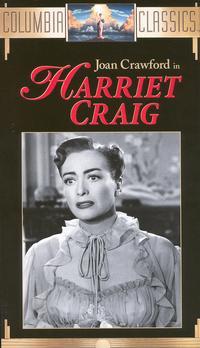
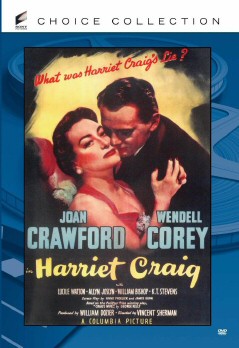
VHS release: 2/20/96 DVD release: 11/5/12, 8/6/13 (Sony)
Cast: Joan Crawford as "Harriet Craig," Wendell Corey, Lucille Watson, Allyn Joslyn, William Bishop, K.T. Stevens, Viola Roache, Rymond Greenleaf, Ellen Corby, Fiona O'Shiel, Patric Mitchell, Virginia Brissac, Katherine Warren, Douglas Wood, Kathryn Card, Charles Evans, Mira McKinney.
Credits: Based on the play "Craig's Wife" by George Kelly. Screenplay: Anne Froelick and James Gunn. Producer: William Dozer. Director:Vincent Sherman. Camera: Joseph Walker. Art Director: Walter Holscher. Music: Morris T. Stoloff. Wardrobe: Sheila O'Brien. Editor: Viola Lawrence.
Plot Summary: Harriet Craig is the third film version of George Kelly's Pulitzer Prize-winning play Craig's Wife. Joan Crawford stars as the title character, a thoroughly selfish woman who prizes her house and her possessions above all else. Harriet Craig is even willing to spoil the business opportunities of her husband Walter (Wendell Corey) to avoid losing her precious home. When her self-involvement causes turbulence in the romantic life of her cousin (K.T. Stevens), and when her husband's eyes are finally opened to his wife's true nature, Harriet Craig is at long last hoist on her own petard. ~ Hal Erickson, All Movie Guide
Notes: * Production dates: April 30 - May 23, 1950 * The film's working title was The Lady of the House. (AFI) * George Kelly's play, which ran from 10/12/25 to 8/21/26 and won the Pulitzer Prize in 1926, was the basis of two other films prior to this one, both entitled Craig's Wife: a 1928 silent version, directed by William C. de Mille, that starred Irene Rich and Warner Baxter, and a 1936 Columbia film starring Rosalind Russell and John Boles that was directed by Dorothy Arzner. (AFI; Pulitzer year correction and other details by me)
|
Bosley Crowther in the New York Times November 3, 1950
Do you remember Craig's wife, that nasty female who first appeared in a George Kelly play back in 1926 and has been haunting the movies, off and on, ever since? Well, she is back in the person of Joan Crawford, playing the role in Columbia's most recent remake. "Harriet Craig," which came to Loew's State yesterday. And, just between friends, we'd advise you to be wary of contact with her. Neither she nor her presentation have improved in the last fourteen years, which was when Columbia last loosed her with Rosalind Russell in command.
As a matter of fact, the poisonous woman which the lacquered Miss Crawford tries to play, under Vincent Sherman's direction, is not so much poisonous as just plain dull. Miss Crawford persists so intently in a harsh mechanistic acting style that there is simply no reason or reality in the perfunctory shrew that she parades. It is as though an over-dressed clotheshorse, without character or sex, were playing the role. Why anyone should work up interest in her is more than we can see.
And there's precious little interest in the screenplay which Anne Froelick and James Gunn have prepared and which Mr. Sherman has directed as though the whole thing were happening in a morgue. Slowly and tediously the meanness of Craig's wife is marched in review so that no one can possibly miss it, except the obvious dimwits in the play. These include Mr. Craig, the husband; a strangely adoring niece and the husband's boss, a doddering tycoon, to whom the lady glibly feeds a pack of lies. When finally her wickedness has been spelled out backwards and forwards and upside-down, the husband's eyes are slowly opened and he is allowed to give her the boot.
We can't say we sympathize with him. He is such an impossible dunce as Wendell Corey plays him—such a simpering, apologetic dope who goes around sucking on a brier pipe as though it were a lemon lollipop—that he plainly deserves all the misery to which he is subjected much more than do we. If he represents the Ideal Husband, no wonder this is a woman's world. K. T. Stevens is likewise dopey as the lady's deluded niece. Viola Roache as a long-suffering housemaid plays the only credible character in the film.
It may be this picture was intended for sloppy housewives to make them feel superior to the tidy monster in it. Okay, sloppy housewives; here's your film.
Variety (1950): Joan Crawford does a prime job of putting over the selfish title-character, equipping it with enough sock to cloak the obviousness that motivates the dramatics. Over the years, plot has lost freshness, but script up-dating, the strong playing, and direction add a sheen that keeps it interesting.
Otis L. Guernsey, Jr., in the New York Herald Tribune (1950): The film gives authentic movie star Joan Crawford an opportunity to command the camera's attention through an authentic star role. She remains, as always, a stylish performer in her clear and forceful characterization....Her vehicle may be somewhat laborious, but it is steady enough to carry Miss Crawford's act....In every mannerism of speech or gesture, Miss Crawford suggests that she is a queen in the country of the cinema, playing a dominant woman whose unkindly rule of her home has psychotic origins.
Stephen MacMillan Moser in the Austin Chronicle (2000): Joan, with director Sherman, trimmed all the fat away from Craig's Wife (that means removing every scene in which Joan would not be present) and turned it into a tour-de-force for La Crawford. As the epitome of every neurotic, deeply disturbed female that Joan ever portrayed, Harriet Craig is Joan with a capital J. Taking the role in her mouth and shaking it into submission, she is playing, ultimately, another facet of Joan herself. But what Joan film role didn't become Joan herself -- either before or after filming? In a case of Joan's art imitating her life, as well as her life imitating her art, Harriet provides Joan with yet one more of those peculiar roles -- roles which must have been written with only Joan in mind, since it would be difficult to imagine any other actress in this role. If Craig's Wife had focused this much attention on Rosalind Russell, it's hard to imagine the actress could have sustained it, since part of Russell's strength was her ability to respond to other characters while seemingly on a course all her own. But Joan, never one to shy away from any movie role, makes Harriet Craig one of the great milestones of her career. And we are indebted to her for it. As she explains to her niece (she always has nieces in movies like this -- sweet young things who come to live with her and become her indentured servants) about how to "keep men in line," we are given more pure-Joan philosophy. With lines like, "The average woman does put her life in someone else's hands -- her husband's. That's why she usually comes to grief," and "No man is born ready for marriage -- he has to be trained," it is familiar Joan territory. Familiar now, because we've seen Joan spackling her angst all over movie and TV screens for decades, but along with Mildred Pierce, Queen Bee, and Torch Song, Harriet Craig, at the time, was a new dimension in Joan's personal psychosis committed to film. |
If you've seen Harriet Craig and would like to share your review here, please e-mail me. Include a picture of yourself or avatar to accompany your review, as well as a star-rating (with 5 stars the best) and any of your favorite lines from the film.
|
Rating:
Being half-German (with both the "Nature" and "Nurture" that that entails), I found myself sympathizing with Joan's "Harriet Craig" maybe one-quarter of the time, rather than seeing her as purely a loveless, neurotic control freak.
Harriet is fairly recently ("almost 4 years") married to "Walter" (Wendell Corey), a congenial and successful Electronics Engineer who enjoys his work. The well-appointed upper-middle-class house they share is his childhood home, complete with his childhood housekeeper (Viola Roache as "Mrs. Harold"), as well as Harriet's much-younger cousin Clare (K.T. Stevens), whom Harriet took in after the young woman's parents died and who now acts as a harried servant/secretary to Harriet (catering to her every whim, and even putting her shoes on for her).
Harriet keeps the household on edge with her persnickety demands, as we see in the very first scene, when the women are all tensely scurrying around in preparation for Harriet's trip to visit her rapidly declining mother. The opening minutes of the film set the tone: The servants and Clare are stressed-out (Harriet is very anally specific about how the shades, the carpet, and the vase are all to be cared for in her absence, as well as how her bags should be packed), the mildly attractive widow next door picks this moment to show up with unwelcome flowers, and Harriet takes time for a warm, intimate moment with her clueless husband...
Once at the sanitarium, Harriet's mother barely recognizes her and doesn't take much interest in the gifts she's brought. In a bitter subsequent conversation with her mother's doctor, Harriet first reveals what will turn out to be her recurring psychological problem: Her father left the family when she was 14; had it not been for Harriet supporting herself and her mother, they "could have starved." Harriet thus does not trust either men or marriage. She thinks of marriage as a "practical matter" and wants "emotional security" above all. As she coldly tells her companion cousin: No man is born ready for marriage. He has to be trained.
There it is in a nutshell, for better or for worse: Why Harriet is about to behave as she does in the next hour of the film. In her fear of abandonment, she's truly incapable of ever relaxing. She has no apparent friends of her own, and every friend or acquaintance or business associate/business opportunity of her husband is a tremendous threat to her that she feels she must counter with every weapon in her mental arsenal, including outright lies. (And the warped mental defenses extend to her cousin, who has been nothing but helpful to her but whom she betrays.)
That's the very dark side of Harriet, and we viewers are ultimately glad to see her comeuppance. However, there's the "one-quarter" defense that I mentioned at the beginning. First, there's the obvious physical affection that she and husband Walter have for each other. Their physical scenes are truly warm and affectionate (even if she's occasionally using them to her advantage---as in getting Walter to cancel his golf game with old friend Billy in favor of going to bed with her). Second, the character really does have childhood problems regarding men's loyalty and the desire/need to control her man. (In short, she's not a completely hard, one-note character, acting as she does for no reason.)
Third... Some of Walter's friends (and his housekeeper) might indeed be a problem to any wife! Here's where my partial sympathy for Harriet really kicks in: (1) If I were married to someone and went away to see my sick mother, and I came home to a house full of empty bottles (and cigarette butts, some with lipstick on them), I'd be pissed off! (2) If I were married to someone, and his bachelor buddies (the funny Allyn Joslyn in this case) kept showing up at the door wanting to party with him, I'd be pissed off. (3) If the young widow next door kept showing up at my front door morning, noon, and night (and if her kid kept coming over to ask my husband to help fix things around their house), I'd be pissed off. (4) If my husband's long-time housekeeper didn't listen to me and only followed my husband's instructions, I'd be pissed off.
These, to me, are all extenuating circumstances that partially help justify a portion of Harriet's paranoid behavior. I haven't read the initial 1926 play "Craig's Wife" by George Kelly, but apparently there was a murder/homicide there that Harriet tried to frame her husband for---and not just a visit to the husband's boss to prevent Walter's career-move trip to Japan! So apparently THIS 1950 Harriet is just a bit more sympathetic!
Despite the unpleasantness of the character, Joan's performance is a psychological tour de force. Cold and hard when threatened; affectionate with her mother and husband in early scenes; truly emotional (but yet finally stolid) when faced with utter loss at the end. (And kudos for her funnily subtle delivery of the line "Billy...and friend" while contemplating a party guest-list.)
The last 20 minutes of the film are psychologically harrowing and emotionally honest, as Harriet and Walter have their final confrontation (preceded by other members of the household leaving for various reasons). Walter's throwing his cigarette on the floor and putting his feet up on the couch and his cradling and then breaking of the previously inviolate Ming vase are a call to arms that we viewers are happy and excited to see. He's always been a decent guy, and we want to see him rebel against Harriet's constrictions: How many ways can you lie, Harriet? You lie when you cry, you lie when you smile, you lie when you talk. Do you also lie when you--- [She cuts him off here.]
Was
there ever any love involved? Here, for the first time, Harriet
reveals to her husband her childhood trauma that has colored and
contorted her entire life:
He pities her. And she can keep the house. Oh, and there's the neighbor-woman ringing the bell again...
Rating: Warning: Spoiler Alerts!
Joan Crawford's title character in Harriet Craig (1950) is shown to be a control and neat freak, which will have those who know JC only from the tell-all book/movie by her daughter clucking with delight. As the movie progresses, Harriet takes an especially evil turn, torpedoing both the budding romance of her live-in ward/niece/lackie, Clare (K.T. Stevens), and the career of her husband (Wendell Corey). Harriet brooks no interference in the tidy life she has carved out in suburbia and will do what it takes to maintain a veneer of perfection. As expected, the tangled web of deceit she has spun ultimately comes undone, and at the end Harriet is left alone in her house, with hubby Walter off for Japan and promotion, niece Clare off to seek romance, the servants fired, and even Harriet's precious Ming vase smashed by Walter in a symbolic end to their marriage.
I enjoyed the supporting cast, even though Joan is the sun and they are minor planets in her orbit. The men are, for the most part, nebbishes. Wendell Corey does a good job as a henpecked husband who gradually realizes his wife is much more than just a nag. Perhaps the best male bit part is the literal boy-next-door Danny. Fatherless Danny (his mom, whom Harriet is jealous of, is a widow) provides Walter the opportunity to show off fathering skills, which makes the disclosure that Harriet’s inability to have children was psychological and not physical all the more gut-wrenching.
The ladies of the supporting cast shine. K.T. Stevens as Clare does a good job in her transition from servile niece, who is grateful the Craigs took her in when her parents died, to young woman seeking romance, to the final denouement when she learns of Harriet's betrayal. The widow-next-door (Fiona O'Shiel, I think) is effective even in her brief scenes. Viola Roache as the long-suffering housekeeper, Mrs. Harold, has Harriet pegged from the beginning. And there’s an appearance by a young Ellen Corby (who would go on to fame as Grandma Walton), playing a servant who gets fired for a minor infraction. The peach, though, is Lucile Watson as the wife of Walter’s boss (you may remember her as Norma Shearer's wisdom-dispensing mother in The Women). I like sassy old ladies---they remind me of my grandmother---and Watson is great in her few scenes. She’s feisty and fun, trying to cheat Walter at gin rummy and enjoying a good jolt of brandy after dinner. It is she who advises her husband that Walter is ready for advancement, and who reveals that Harriet might just be behind her husband’s decision not to promote Walter.
I give this 3 stars---2 for the film plus one more because those who know more about cinema regard it more highly than I do. In the final analysis, the problem I have with Harriet Craig is my own. This is not plucky 1920s Joan who gets redemption and her man before final credits roll. This is not Depression-era Joan who overcomes all odds to make good. Here, she plays an unsympathetic character. Perhaps given an inkling of why she acted the way she did before the final 10 minutes of the film, I might have developed more sympathy for Harriet and might have liked the movie better.
Rating:
For me personally, Joan Crawford's finest run of work
has to be between 1945 and 1952. During these years, and mostly with her
second studio home of Warner Bros, Miss Crawford finally had a
succession of roles and characters that showcased her great depth and
versatility as an actress with each and every film.
Harriet Craig (1950) was not a Warners production, instead a loan-out at Columbia. It does, however, sit so well alongside her many film noir dramas at her home studio. To say that Harriet Craig is a perfectionist would be an understatement. But at the cost of her endless quest for neatness, a life that runs like clockwork, and her general self-control come the intimidation, put-downs, and hold on others around her. Such things as a chance for her husband to improve his own self worth and gain a more fulfilling job role, or the chance of a loyal loved one to have a husband and a home of her own, mean very little to Mrs. Craig. Those things would simply disrupt her own neat life, and she could not possibly have that. Harriet
Craig is not the most likeable of characters that Joan Crawford ever
brought to the screen, nor one of the most charismatic. Her cold
poker-face persona never quite cracks for 3/4 of the 94
minutes. Until slowly but surely her perfect world (or rather the
Harriet Craig version of a perfect world) starts to crack and crumble
around her; and so, in turn, does she. And in all honesty, given her
actions to all those around her, her fate could not have happened to a more
deserving person!
In all, Harriet Craig is absolutely a Joan Crawford must-watch. It may be now 70 years old, but its appeal lies in the fact that it could be set today. The quest for perfection one way or another has never died. A small part of Harriet Craig in all of us perhaps...
Rating:
Possibly that she
played the real-life paramour of Vincent Sherman is why in Harriet Craig, Joan Crawford’s second film
with the director, most of the scenes feel manipulated for her own purpose.
Indeed the second screen adaptation of George Kelly’s Pulitzer Prize-winning
Craig’s Wife falls into the all- too- familiar traps synonymous with star
vehicles in that its singular lead performance dominates a mediocrely written
script.
Crawford conveys Harriet’s dictatorship with a gamut of artificiality. It works and, actually, it’s one of her fine performances. Where she occasionally fails to engage is more fault with the direction. Worse yet, Crawford’s supporting players lack the writing and development to elevate their roles above lifeless ciphers basking in the wake of her superior star power. Only Ellen Corby as the maid who has Harriet’s number can contend with her dictator’s steely presence. Vincent Sherman
does not connect with his material well enough to fulfil an indelible discussion
of the underlying sexual politics and interpersonal psychosis of the play. Even
with Crawford’s commanding-enough performance, her Harriet is one dimensional.
Instead, what should play out as kitchen-sink tense reads like an anodyne
melodrama with a side dish of glamour: Sherman glosses over the messy core of
Harriet, favouring an over-the-top music score and excessive closeups of the
sophisticatedly gowned Crawford. It implies disinterest, carrying the effect of
stymying his production and turning it into something borderline pedestrian as a
result.
One of my favorite Crawford films. In this film, Joan portrays a woman infatuated with tidiness and appearance. Early on, the audience learns that her anxiety for order stems from a dire childhood spent in poverty; however, none of those close to her, including her henpecked husband, know of her past. The character of Harriet is definitely the antagonist of the story; however, as Harriet's interference in the lives of those around her progresses, we as the audience can comfortably root for her objectives. If not for the early scene of Harriet that provides a partial glimpse into her upbringing, and thereby reveals her fear of abandonment, we might have more of a difficult time sympathizing with her actions of attempting to block her husband's promotion at work, and preventing her young live-in niece from dating. Much of the film's theme parallels Crawford's own personal habits of obsessive cleaning and order, which is perhaps why Joan's performance feels quite natural here. As with Crawford, Harriet believes perfect physical order translates into perfect emotional order. By the end of the film, Harriet's dishonest behavior surfaces, which leads to her worst fears being realized. Her niece leaves the Craig household, and her husband declares his intent to divorce her before leaving her alone in the house. Of all the open-ended films Joan made, this is the one that leaves me wondering the most about what happened to the character of Harriet after the world she had carefully constructed had collapsed.
Rating:
Wow, where do I begin with this one? I had a very difficult time hunting this movie down, but I finally found a bootleg of it from an online seller. I think it’s a crime that this film is not available on DVD in the US. It’s actually been released on DVD in Spain, I think. This film is definitely a Crawford classic, and of the three films she did with Vincent Sherman as director (the other two being Goodbye My Fancy and The Damned Don’t Cry), this one is by far and away my favorite. This is a very dark film with very dark themes and Joan plays a very dislikable character, but she looks fantastic doing it. She looks exceptionally good in this! I don’t know if it’s the lighting or the hair or what, but for the year this film was made she comes off as very beautiful and very striking, in my opinion even more so than in her previous two films, The Damned Don’t Cry and Flamingo Road. I think the proper word for her look in this film is “handsome.” The dark music score by George Duning matches the film perfectly. Here Joan plays a plotting, controlling, and conniving perfectionist of a wife who manipulates and lies to everyone around her to her own selfish ends, and in the end she is left with nothing but the house which she so coveted. I find it interesting that her character is so unsympathetic and so unlikable, yet she said in Conversations with Joan Crawford (CWJC): “At least I played a woman with which a portion of the audience could identify." What in the world did she mean by this? Am I misreading this quote, or did she really think that some women identified with her character in this film, or did she simply mean that women may identify with her in the sense that they might know what it’s like to come from an impoverished background and act out toward the people they love? This is a fascinating film that every Crawford fan MUST see. The added biographical elements to Harriet’s character are interesting as well, such as being abandoned by her father at a young age and working in a laundry with her mother to make ends meet, as well as not being able to have children, although that turned out to be a lie in the film. This film also has many similarities with her later film Queen Bee; however, I find Harriet Craig much more stylish and less campy. Queen Bee is basically the same film with more extremes, but in Harriet we find out in the end that her character has reasons for acting the way she does (poverty, abandonment), whereas in Queen Bee her character is just plain evil. Harriet Craig is not an evil woman, just misunderstood. I watched an Italian talk show on Youtube a while back that had Christina Crawford saying that Harriet Craig and Queen Bee matched her mother’s real persona the most! Of course she would say that! lol Despite the dark subject matter, there are many comical parts in this film, and the surprising sexual undertones are quite amusing. The supporting actresses -- Lucile Watson, who plays Celia, and Viola Roache, who plays Mrs. Harold -- are outstanding! Some entertaining quotes were when Walter says to Harriet: “I’ll carry a phone around with me.” If they only knew what was to come! Another is when Harriet says to her cousin: “No man’s born ready for marriage, they have to be trained.”
Rating:
Dust is the enemy! Harriet Craig is a great piece of filmdom, especially because of Miss Joan Crawford, who is at her professional best. It does not matter that the script is a rehash of the 1936 version starring Rosalind Russell -- Craig’s Wife, from the novel by John O’Hara. The script changes give the actress and the supporting cast some fresh topics to approach.
It is a great film to watch and it was reaffirming to know that Hollywood and the studios could put everyone together and come up with this entertainment. It’s also great to watch this flip, unflappable woman clean her house while you are cleaning yours. Her house is not just a house but a citadel and one of tidy unhappiness. Tidy, tidy, tidy. Psychotic, but clean! Harriet Craig takes today’s viewer back to 1950:It looks it, feels it, and the acting is classically the same. You can watch this movie with no intensity at all. ( I love it as background: Makes my day feel 50’s as I go about my daily chores, especially when I am ironing.)
However, watched with adults for their first glimpse at Harriet, the film can be serious viewing. Miss Joan Crawford keeps your attention like a film noir femme fatale with a note pad and a duster. She is playing close to her age (unlike Daisy Kenyon in 1947); she is believable throughout and matches fine with Wendell Cory as her husband Walter. (Yes, there are men like Walter.) She also has enough venom and controlling criminal cleanliness left over for her Eva Phillips character in Queen Bee in 1955 (so she can really sort things out!).
The writers and director do a fine job of making this more than a rehash of a “woman’s” picture, and it succeeds today because these issues do not date or go out of style. The script changes give Miss Crawford and the supporting cast some fresh topics to approach. Should you feel sorry for Harriet? Or would you just run from her? Things turn out well for everyone except Harriet and her mother (poor thing has to linger on in a nursing home). Her housekeeper and her cook, of course, get new jobs in other households. Little Tommy gets his radio fixed; and his Mother grows her roses and prepares for a man someday (whether it be Mr. Craig we do not know). Clair (in real life, niece of director George Stevens) and Wes elope. Billy goes to Japan.
Lucille Watson, who has a tiny role but one pivotal to the action, was superb as the boss’s wife and played it like an old bullet shooting straight ahead and aimed directly at Harriet. You wanted more of her feisty honest character. She certainly figured Harriet out and she was not going to accept it! Harriet did not see it coming. If it wasn’t for Ms. Watson, Harriet would still be abusing everyone.
As Harriet walks up the staircase at the film's fade-out, she is all alone in her house and in her thoughts. Her only friend might possibly be Miss Eve Harrington. Harriet will have to wait and see. Thankfully, I have learned, and after several viewings of this film I do believe Miss Crawford, that there is a little bit of Harriet in all of us! Only seek help for your wounds.
Mike O'Hanlon (August 2007) In order to truly appreciate Joan Crawford's performance in Harriet Craig, one must get the "Mommie Dearest" image of Joan out of their mind. In her pre-Harriet years, Joan Crawford was rarely unlikable onscreen. Even with 1939's The Women, the author of the play, Clare Boothe, had intended that the character of "Crystal Allan" receive the audience sympathy. 1950's Harriet Craig was the first time Joan Crawford had proved herself to be the completely unlikable bitch of the silver screen. Her performance in the title role never misses a beat. The opening of the movie is a typical introduction to a classic movie villain, everyone running around in a panic while the villain enters calm and reserved. It takes a little while for the tension to build, but Joan Crawford's intimidating appearance fits perfectly when Harriet and her husband throw a dinner party. Joan's minor facial expressions reveal how important control is for this woman. Don't be disappointed however; the beginning of the movie does move rather quickly. Her first act of cruelty comes when she verbally attacks the maids in the kitchen for their tardiness, and after one of them drops a tea cup, Harriet fires her and makes sure to deduct the cost of the cup from her salary. When her husband receives a promotion that will send him to Japan for a few months, Harriet Craig makes sure to visit her husband's boss and persuade him to change his mind by telling him that her husband is unreliable, and spends most of his time drinking himself stupid. There are a few moments in Harriet Craig where one begins to wonder if this woman is more than just a complete bitch, but a pathological liar at that. She lies to her husband's cousin, played by K.T. Stevens, and tells her that her new boyfriend is just merely interested in sex, and would even marry her just to get what he physically wants. Though the whole lie seems ridiculous, Joan Crawford's delivery is so on key, she makes even the most unbelievable crap seem true. She also lies to her husband that she cannot have children because, gasp!, children will make the house a mess. Though it never states that is her reason for not having children, the movie as a whole clearly implies it. After her lies are revealed, her husband calls her into the living room, where he smashes the vase that Harriet has cherished so as if it where her own child. The vase, and obviously house, are clearly personified as the children Harriet never had, so for her husband to smash the vase in rage... Well, he might as well have shot her. Vincent Sherman's direction of the movie is reasonably impressive. I have always thought that he should have ended the film with Harriet going into the living room, cleaning up the mess her husband leaves, and then have her walk up the stairs by herself, alone, and completely comfortable. As for Wendell Corey's interpretation as the husband, well, he's okay, but it's difficult to imagine him and Joan Crawford ever being married. Franchot Tone, Fredric March, Melvyn Douglas, or especially Robert Montgomery, would have been better.
No doubt in my mind Joan Crawford should have been at least nominated for an Academy Award. Maybe if the movie had been more commercially successful, she would have indeed received an Oscar nomination, but it remains one of the strongest performances of the movie. And remember to forget the whole "Mommie Dearest" campy image before watching the film, so one can appreciate it more.
John Finley (August 2007) Rating:
What a movie, and I give it five out of five stars! Joan's acting was incredible, of course. I just wanted to put my hand in the television and beat her husband to the punch of knocking that vase over. I also wanted to beat Harriet. She needed a good butt whipping! The movie moved at an easy pace; not too fast and not too slow. All of the acting was first rate, and Mr. Craig's boss's wife was darling. Joan's acting was so spectacular that she made me hate her and believe that she was capable of doing anything. I was so mad at Harriet for going into Mr. Craig's office and telling his boss all of those lies! I thought that she would have loved for her husband to be promoted, so she could buy even nicer things, and perhaps even buy a bigger home!
In addition, the life-long maid of Mr. Craig's was right for telling Harrriet off. She was a great character. I knew the moment would come when she would finally give Harriet a piece of her mind. At times, I would get so mad at her coniving ass, I just wanted to throw my television into the street. One of the most memorable quotes happened between Mr. Craig and his frumpy friend in the sound lab: "So, why don't you come over and have breakfast with Harriet and I?" "Oh, no thanks. I'll just honk!" That was too funny, because Harriet's cousin's boyfriend had just said the same thing!
This was a wonderful picture, and now it's become a favorite of mine.
As a lifelong vintage movie fan, I don't suffer with the need to find something contemporary in a movie. I am able to view a movie in context; to take into account the era in which it was produced, and the eras it represents.
However, I think "Harriet Craig" accurately represents many contemporary American marriages. Reviewers then and now focus only on Miss Crawford's performance, but the story as a whole is a fascinating one. (After all, it is adapted from a Pulitzer-Prize-winning play.)
It is enlightening, if you've waded through the slush about Crawford's monumental ego, to see her participate in the development of the subsidiary characters. Crawford seems to know that because only the audience knows that Harriet is a liar, seeing the things that Harriet's lies motivate others to do tell us more about Harriet's needs than her dialogue ever could. Here is the generous ensemble player her more accurate biographies reveal. Witness and admire, for example, Crawford's careful craftsmanship in the setting down of her coffee cup so as not to upstage Wendell Corey in an over-her-shoulder breakfast scene. The scene explains her husband's past, and exactly how it motivated him to marry Harriet.
In "Harriet Craig," a woman's desertion by her father creates an insecurity in her that manifests itself in a need to control every situation in which she finds herself, including marriage. It's a complex psychological study of a woman and a marriage, and it gives one food for thought as why strong women sometimes marry genuinely weak, or seemingly weak, men.
The plot has juicy twists, so I won't write too much about it.
Although the audience knows that the husband was a mama's boy, we're shown that he regards becoming a married man as an assertive move toward the maturity he seeks. Harriet didn't see her husband's oncoming maturity and independence until it was too late, and is now furiously backpedaling to stay in complete control of the marriage.
What makes this story so strong is that script and casting do not compromise the husband's attractiveness (or the complexity of the marriage's problems), by portraying him as mamby-pamby. He is brainy, educated, and ambitious to move past his already responsible and well-paying job. He is not unaware of Harriet's need for control, and sometimes expresses incredulity to her face in a kindly but forthright, or a kidding way. This gives the movie a very realistic edge.
This movie is more complex than one is lead to believe it is by reviewers who look for a vein of campiness in everything Crawford does, and review only that. Watch, for example, how Harriet's cousin and live-in secretary willingly fetches Harriet's shoes, kneels, and puts them on Harriet's feet. It might seem like Crawford camp, but it tells us much about the cousin character, and Harriet's relationship with her.
As in almost all of Miss Crawford's star vehicles, the director gives her several effective pantomimes to utilize her unique skill at this, and her silent-film experience.
A review I respect says that Harriet's feelings are dead-on correct about many things that other characters disregard. For example, the warm, easy-going widow next door who invents reasons to nosily drop in is hardly as harmless as she seems. Harriet alone knows that this woman could blow down her house of cards with her warmth and genuineness.
"Harriet Craig" is an interesting psychological study of a woman, and a must-have for Crawford fans to admire a seasoned screen pro at work.
|
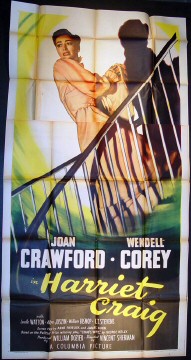
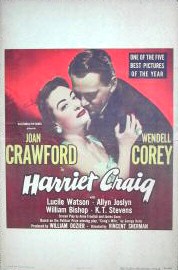
Above: US 3-sheet (41 x 81 inches), and US window card (14 x 22 inches).


Above: US half-sheets, 22 x 28 inches. Style A (left) and Style B (right).
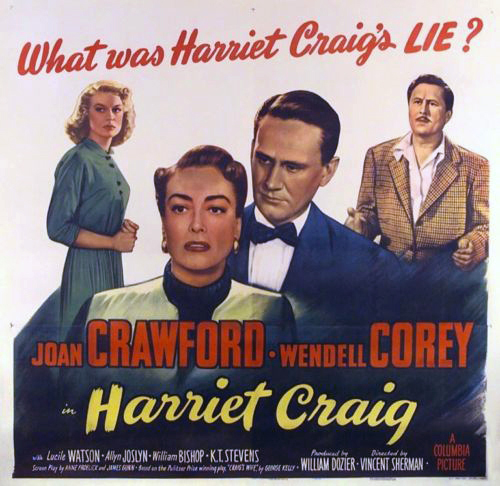
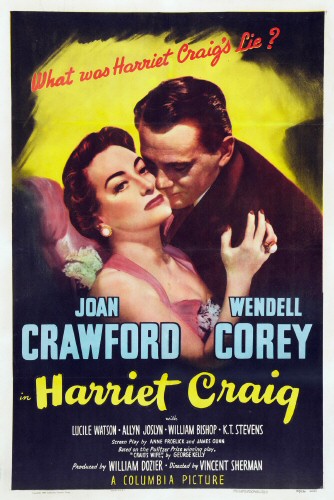
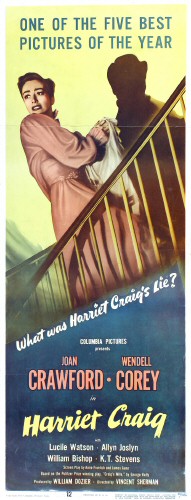
Above: US six-sheet (81 x 81 inches), US poster, and US insert (14 x 36 inches)

Above:
US lobby poster. 7 ft long x 27 inches high.


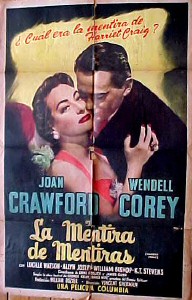
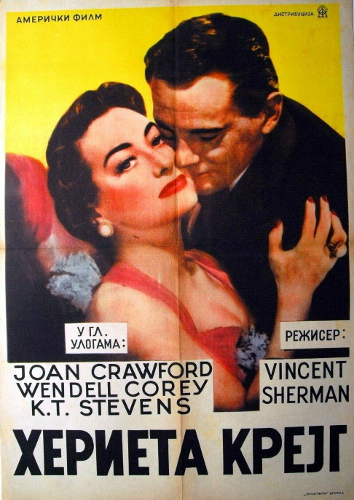
Above: Belgium, unknown, Spain, and Yugoslavia.
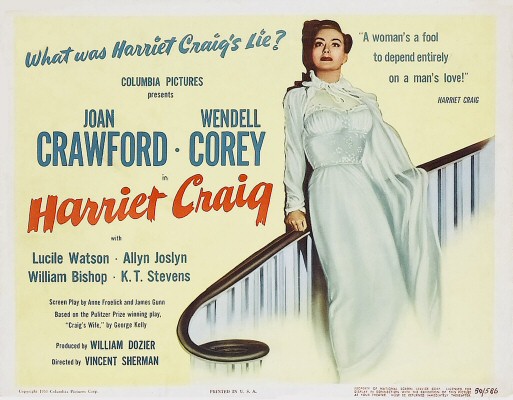
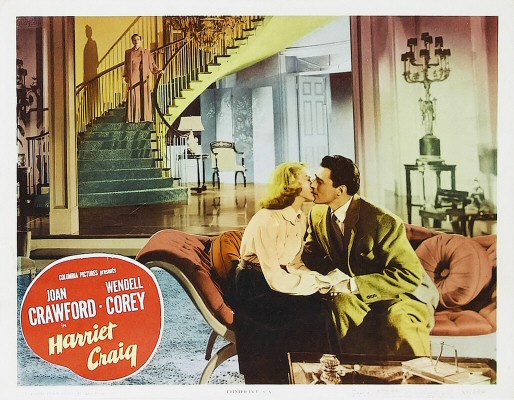


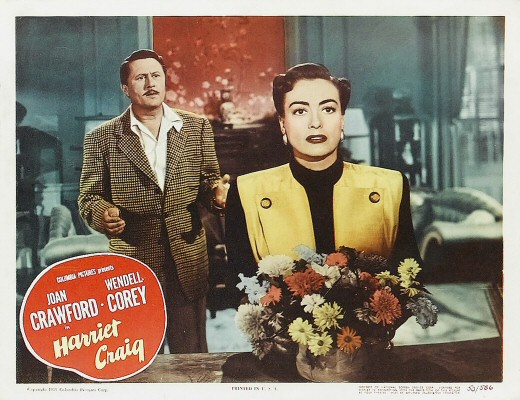
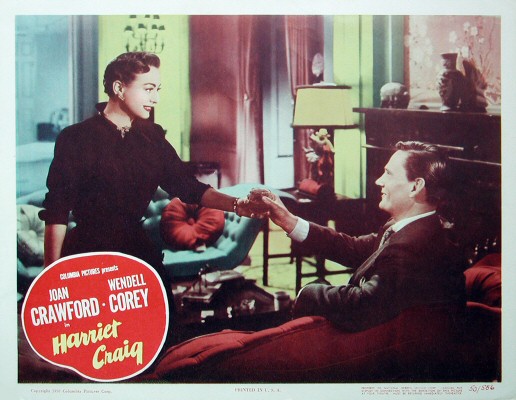
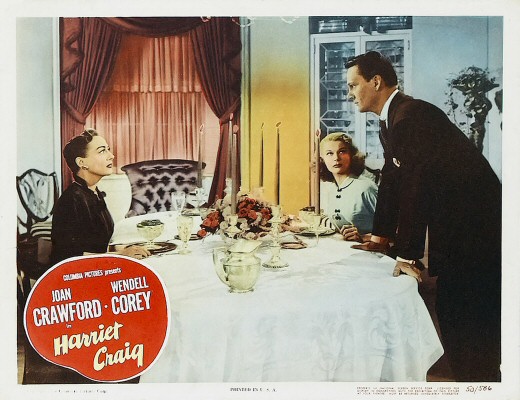
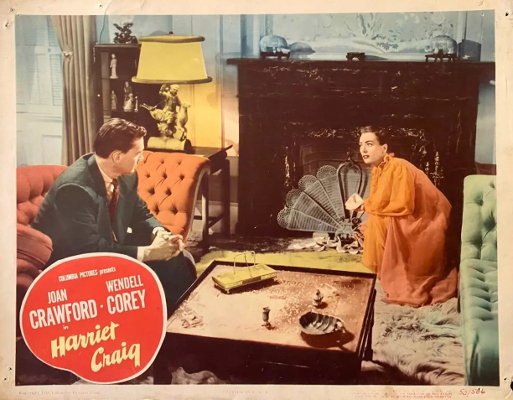
Above: US lobby cards.
Below: A Mexican lobby card.


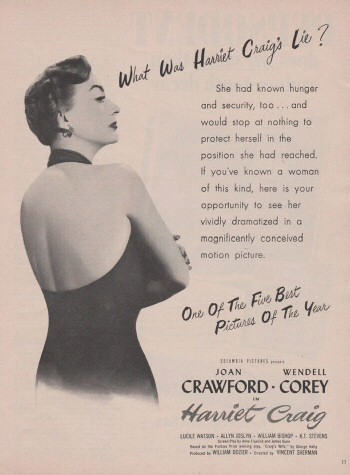
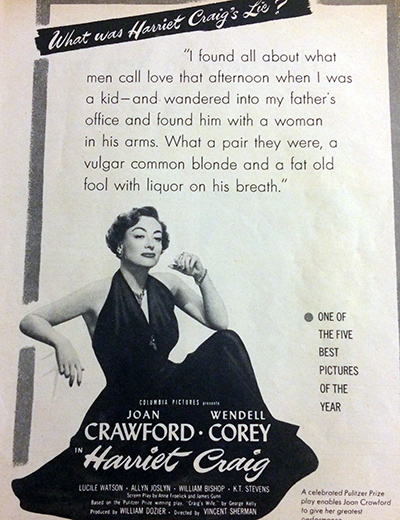
Above left: German program cover. Above right and below: US magazine ads.
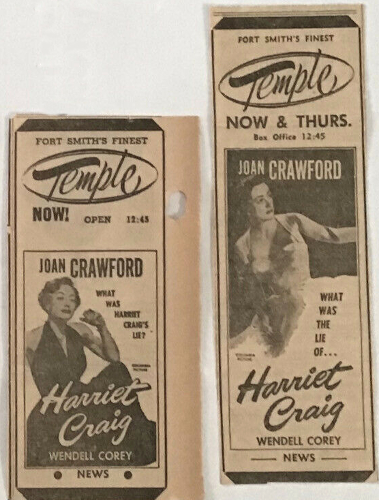
Below: US newspaper ads (Fort Smith, Arkansas)

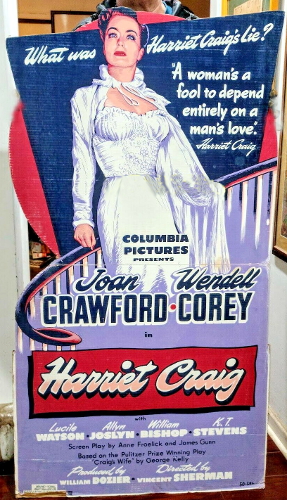
Above: A 33 x 59 inch standee from a US theater.
Also: See the Books Related to Joan Movies page for the 1926 publication cover of Craig's Wife by George Kelly: the Pulitzer-winning play that this movie was based on.
The Best of Everything
 Columbia







 Maureen Morrison