

The Best of Everything
Encyclopedia Entry • Films Main
Humoresque
1946
Critics' Reviews • Our Reviews • Movie Posters • Lobby Cards • Soundtracks • Books • Misc. Images
Click here to see photos from the film.
US general release: 1/25/47.
VHS release: 12/5/90. DVD release: 6/14/05. Blu-ray release: 11/26/24. Cast: Joan Crawford (as "Helen Wright"), John Garfield, Oscar Levant, J. Carroll Nash, Joan Chandler, Tom D'Andrea, Peggy Knudsen, Ruth Nelson, Craig Stevens, Paul Cavanaugh, Richard Gaines, John Abbott, Bobby Blake, Tommy Cook, Don McGuire, Fritz Leiber, Peg La Centra, Nestor Paiva, Richard Walsh. Credits: Based on a story by Fannie Hurst (first published in 1919 in Cosmopolitan, and then in her book Humoresque and Other Stories, 1919). Screenplay: Clifford Odets and Zachary Gold. Producer: Jerry Wald. Director: Jean Negulesco. Camera: Ernest Haller. Art Director: Hugh Reticker. Music Conductor: Franz Waxman. Musical Director: Leo F. Forbstein. Music Advisor: Isaac Stern. Joan's costumes: Adrian. Editor: Rudi Fehr. Plot Summary: Fannie Hurst's novel Humoresque is the lachrymose tale of a famed Jewish-American violinist who forgets all about his friends and family in his rise to fame. Screenwriters Clifford Odets and Zachary Gold refashioned this timeworn material into a first-class, big-budget soap opera, completely dominated by the high-octane talents of Joan Crawford and John Garfield. A gifted musician, Garfield rises from the slums to the upper echelons of society, thanks to the patronage of wealthy, alcoholic Crawford. Virtually ignored by her husband Paul Cavanaugh, Crawford adopts Garfield as her lover as well as her protégé. He is only mildly offended by the setup; she, on the other hand, becomes jealous and possessive. It is not a woman who comes between Crawford and Garfield: it the intensity of his talent, not to mention the spectre of the great composers whose works he interprets so brilliantly. Garfield's virago of a mother (Ruth Nelson) feeds upon Crawford's jealousy, planting the seeds of guilt for (allegedly) holding her son back. The ultrastylish suffering of Joan Crawford and the street-punk insouciance of John Garfield (who looks like a "Dead End Kid" even while wearing a tux) is counterpointed by the phlegmatic comedy relief of Oscar Levant. ~ Hal Erickson, All Movie Guide
Awards: 1947 Oscar nomination for Best Music, Scoring of a Dramatic or Comedy Picture: Franz Waxman.
Notes: * In production from mid-December 1945 to mid-April 1946. (AFI) * The screenplay "came from Warner Bros.' need to get something out of a very expensive and lengthy screenplay Clifford Odets had written for Rhapsody in Blue, their musical biography of composer George Gershwin. The Odets take on his story was good, but a little heavier on social commentary than they'd planned." (AFI)
|
Bosley Crowther in the New York Times December 26, 1946
According to definition, the word humoresque signifies a humorous production, especially a musical one. But there is certainly nothing humorous about the lachrymose "Humoresque," which the lately symphonic Warner Brothers delivered to the Hollywood yesterday. It is rather a mawkish lamentation upon the hopelessness of love between an art-dedicated violinist and a high-toned lady who lives for self alone. And whatever meagre resemblance it may have to reasonable life in the world of working musicians (aside from Oscar Levant) is merest luck. Apparently the latter-named gentleman with his painfully artificial wit and his Groucho Marx style of delivery is an occupational hazard to which musical people are subjected. At least, they are in some Warner Brother films—and the only distinction in this case is that there is more of Mr. Levant and it is worse. But the rest of this rags-to-penthouse fable in which a lower East Side boy makes good while an upper East Side girl makes trouble is mostly unadulterated schmaltz—a word of obese connotation, introduced by Mr. Levant. However, the Warner Brothers have wrapped this piteous affair in a blanket of soul-tearing music which is supposed to make it spiritually purgative. They have padded it out with long passages from symphonic scores by Bizet, Rossini and other masters, most of it scored for violin. And, for the smashing, titanic, climax, in which Joan Crawford wabbles out, soused to the ears and heaving, to cast herself tragically into the sea after a telephone conversation with John Garfield, who has told her that he loves his fiddle more, the music that cries and crashes is the Liebestod from "Tristan und Isolde." The music, we must say, is splendid—and, if you will only shut your eyes so that you don't have to watch Mr. Garfield leaning his soulful face against that violin or Miss Crawford violently emoting ("She's as complex as a Bach fugue," Oscar says), and if you will only shut your ears when folks are talking other such fatuous dialogue, provided by Zachary Gold and Clifford Odets, you may enjoy it very much. We offer no recommendation to any other part of it, save one slick and incidental rendition by Peg LaCentra of "I Guess I'll Have to Change My Plan." Lawrence J. Quirk in Screen Stars: I suspect that Crawford attained an extra dimension of romantic lyricism and dramatic sincerity in this because it was made at the time she received her Oscar for Mildred Pierce, and, for the first time truly confident of her powers, and inwardly fortified by the acclamation of her peers, she strode through the role with a grand self-confidence and a sweeping grasp of the part's emotional possibilities....A glamorous role for Crawford, a glamorous picture.... |
If you've seen Humoresque and would like to share your review here, please e-mail me. Include a picture or avatar of yourself to accompany your review, as well as a star-rating (with 5 stars the best) and any of your favorite lines from the film.
|
Rating:
Like the previous year's Oscar-winning Mildred, Humoresque is extremely tightly edited, with hardly a shot wasted, making for a very good film, even with its focus on emotional turbulence rather than the seemingly more-popular angle of "boy musical genius from Queens makes good." (The original 1919 story and 1920 silent film had no "Helen Wright" character; at that time, it was the tale of a poor-but-talented American violinist who rose to make good with European royals before he went off to serve in WWI and came home from the war both crippled and humbled.)
In this iteration by screenwriter Clifford Odets and Zachary Gold, violinist Paul Boray (John Garfield) emerges only slightly humbled by his few years of encounters with the dilettante Helen Wright (what a substitute for the original World War I)!
Boray is a good Jewish boy with a nice family (father a shopkeeper) who, because of his musical talent, becomes enmeshed with the decadent rich world of the Wrights. Joan's Helen is soon meeting him for drinks in dark bars; buying him nice suits; and, most importantly, introducing him to maestros who appreciate his talent and get him prestigious gigs. Pretty soon, the talented Boray is a star with country-wide tours...and Helen is feeling a bit neglected and jealous and sad...
The "poor-boy-makes-good" story is a story unto itself... until you add Joan Crawford to it. She truly does, via force of even-subdued personality, take over a picture.
Joan's "Helen Wright" is, for me, her most sexually attractive character. I find her attractive in many/most of her films, but often, like in "Grand Hotel" or "Letty," it's an attraction to her simultaneously youthful and gorgeous ennui; in "Dancing Lady," it's an attraction to her simultaneous beauty and spark. In Mildred, Joan was complacent rather than sexy.
Here, though, Joan's Helen is a lushly languid, sultry, sophisticate with both a past and a present (though apparently no future). She's sensually photographed by Ernest Haller in both bar and beach scenes, while getting to reveal herself emotionally to Boray with lines like:
I was married twice before, once at 16, once at 21. One was a crybaby, the other was a caveman. Between the two of them, I said goodbye to girlhood. And... I don't know how you men get that way, but every time you meet an attractive woman you begin to plan on how and where you can club her wings down.
As it turns out, Boray's a little different: He's not out to subdue her in any way; rather, he's a bit more concerned with himself and his own career, and puzzled as to why, after his success (mainly due to her influence, for which he's grateful), she seems to be constantly undermining their relations with her outbursts...
As mentioned, Joan is shot gorgeously in nearly every scene. The last 15 minutes of the film---with her downing her brandy while listening to Boray's "Tristan und Isolde" played on the radio and hearing the voices of her husband and Boray in her head, and seeing her reflection in the window before breaking it with her glass---are unusual and complicated and beautiful, as is Helen Wright. As is the shot of the dog-walker on the beach who passes her, then minutes later looks back to see...nothing. This entire sequence is brilliant and one of the most profound of Crawford's career.
Garfield's solid performance, Oscar Levant's constant witticisms, the family members' stout and sometimes-funny support of their boy... All contribute to a very good film. But Joan's near-orgasm while watching a Boray performance and her last 15 minutes of the film come very close to making Humoresque a memorable work of art.
Rating:
Warners' second showcase of Joan Crawford's rejuvenated starpower, Humoresque, is deceptively sprawling but nonetheless pretty to look at. It oozes bold and decadent style, is beautifully scored and its stars (namely a premiere starlet in the most luminous hour of her career) are peerlessly photographed; it is also artificially paced and staged, which threatens to hinder the emotional grand finale. Based on Fannie Hurst's story, Humoresque tells the tale of talented violinist Paul Boray (John Garfield), his rise to superstardom and his illicit affair with glamorous, and unhappily married, socialite Helen Wright (Joan Crawford). Boray possesses talent and ambition in abundance and his potential becomes realised when he plays at the party of the influential socialites. John Garfield is sensitively troubador as the musical prodigy. That he breathes a certain working-class hero charm into his part lures a permissiveness in Crawford's lovelorn Helen Wright. Their first fateful encounter at a party, where Paul effectively deflects Helen's bitchy wit with a fine display of his talent, you can virtually feel the electric current crackling between them. Such chemistry does not let up over the course of the entire film, from Helen fostering Paul's career to eventually surrendering to her burgeoning love for him. Helen being a creature of moodiness and complications threatens to drive a rift between Paul and his insatiable talent. The dialogue is fanciful, a little stagey, but delivered with precision and panache from all players. Given her original typecasting as the girl done good, Crawford, it should be said, works up an impressive feat of confidence in a considerably urbane role. Here, even during the occasional shot sporting spectacles, she looks and sounds utterly radiant. Periods where she overplays with prodigious angst there is welcome comic relief in Oscar Levant (playing Boray's pianist sidekick), firing off the film's wittiest lines. Humoresque is most delightful in its sonically arresting moments: Boray soulfully fiddling away to the sumptuous pieces of classical music. The trick employed here was a strategic camera angle that allowed Garfield to infuse emotion with his face while two violinists stood behind him and played. It works delightfully, as there are scenes where Garfield expresses being lost in the music while a few supporting characters observe with the expression of being genuinely moved. Crawford plays a woman bubbling and bristling beneath the surface, conveyed entrancingly with every gorgeous close up of her face. As with Mildred Pierce, Crawford's predecessor hit, Humoresque possessed all the ingredients of a blockbuster. The lack of subtlety somewhat hurts the emotional delivery of the story -- though the ending is nonetheless a rivetting opportunity to truly revel in the forceful beauty of Joan Crawford. The camera has never loved the fine proportions of her face more than in Humoresque, right until her melodramatic denouement. If Crawford serving Helen's sorrow to the sea doesn't quite strike at the heart, then the passionate musical score and Garfield softly mumbling his grief afterward is sure to cover up for it.
Carl Parran (August 2010)
Totally over the top. I first saw this aboard ship, a destroyer escort converted to a radar picket ship, out at sea. Being a John Garfield fan, this was quite a jump for my 18-year-old mind, in 1963. That scene, where Joan Crawford walks into the Atlantic, while John Garfield plays Wagner on his violin, is a real knockout! Don't make 'em like that anymore.
Gabriel Neilson (August 2010) Rating:
It is truly unfortunate that the English language does not provide
words of such magnitude that would correctly communicate the beauty of
this picture. In every scene I saw Helen Wright, I fell in love with
her. The way that Joan probed into the character was uncanny -- it's
astonishing, almost chilling. I truly believe she felt a little of
herself in Helen. The drinking, the proud exterior, the heart that at
its true essence was made of pure gold. The love that she conveyed makes you want to have love like that. And the sympathy that I felt for her
brought me to tears.
There is no doubt to me that Joan Crawford triumphed above all actresses. So I might be biased. But if the purity of emotions that Joan exposed in 1946 can be felt by this somewhat humble fifteen year old -- a male nonetheless! -- then she is proven timeless. Joan Crawford will never die, and neither will the characters she portrayed. If I ever feel such emotion, and if I ever feel such connection with a picture than I did in the moments that Joan walked alongside the ocean to the beauty of Liebestod, it'll be one damned cold day in hell. Six stars out of five -- and thank you, Joan.
Rating:
This has got to be hands-down my favorite JC movie, and I have just about seen them all!!
Miss Crawford played the role of socialite Helen Wright to a tee, and she never looked sexier. (I am surprised they didn't start a line of JC eyewear during that era because she even looked beautiful in her specks.)
I couldn't take my eyes off her, even during her scenes with the very handsome John Garfield. One of my favorite scenes takes place at a party when Helen tells her friend Teddy, "I say something stupid and you laugh; you're stupid." I also loved when violinist Paul Boray (John Garfield) comes to a bar to fetch a very intoxicated Mrs. Wright and she tells him she will not play second fiddle to the ghost of Beethoven.
This movie is superb. Miss Crawford made me feel her loneliness and her torture of being in an unhappy marriage, and yet the joy and pain of being in a forbidden relationship. The final scene when Helen walks zombie-like into the ocean was dark, yet Crawford brought some type of beauty to even it.
This movie has great acting, great direction,and a story line that still holds true today. Oh, how I wish they could bring back Old Hollywood.
Rating:
Yesterday my nephew totaled my car. After the first panic passed, I was happy to discover he was alright; and a car is a car, even though it was my Mercedes! The reports and paperwork were settled. I had a shot of Crown Royal and decided to be a bit depressed. I felt a sensation of crumbling.
I instantly thought of Helen Wright! She can finish me off for the night.
Miss Crawford seems to run the gamut of my emotions, and decidedly I watched Humoresque to satisfy my next challenges and to soothe my tired mind. Helen Wright, after all, is a courageous woman -- melodramatic, but with Champagne .
I do not mind the first scenes with John Garfield growing up in New York City, particularly with the Mother. She comes in handy later and has a nice face-off with Helen. Though there are times I fast-forward to Miss Crawford’s entrance at her party to get things going; she is wonderful! A creature she is in this movie and not from the black lagoon but from a world that never existed even when it did exist.
A being of stupendous physical power and sexuality combined with money, position and gracious clothing and good liquor! I love feeling depressed and defeated while watching this movie and nipping a brandy. Joan not only is acting but emoting to such a degree that you can feel Helen’s blood moving through her veins.
If only Helen had a wise mother or a close girlfriend to help her and be her friend. Helen really is lonely, but just too afraid to go to Coney Island and let loose. She relies on her money and is led around by her frustrated heart instead of seeking help or opening a day-care center. She falls in love with John Garfield, which was the wrong thing to do. She has to kill herself. She has and is nothing, or at least that is the way she feels. Poor Helen.
Warner Brothers did not let me down. The script is good ( thanks Mr. Odets) and the supporting cast is excellent; even Oscar Levant gets away with it. Paul Cavanaugh is an old hand at acting, and I liked seeing him there; he added some of the class. The cameraman Ernest Haller got used to Miss Crawford and deserved a nomination for his beautiful, sensitive work.
The picture made a lot of money and outclassed Bette Davis’s Deception, which was also about music and love. Sorry Miss Davis, Joan got you there.
John Garfield added this film to a good year, having done fine work in Body and Soul and The Postman Always Rings Twice, but no Oscar nominations! All the while he has Isaac Stern connected to his back in Humoresque.
A superb movie. Miss Crawford portrays one of her finest characters in one of her finest roles, and her acting outclasses many actresses of today!
Terry Wildish (October 2008) Rating:
Humoresque with Joan Crawford is the perfect star vehicle; a brittle rich woman falling madly in love with a violinist who is crazy about her has all the ingredients of tragedy. Joan, never more beautifully photographed, just drips sexual allure; crashing waves and moist lips suggest the torrid sex and lust which exist between the two leads without sex ever being mentioned. A fantastic film, great classical score, a luminous star at her peak. Who could ask for more.
James (March 2005) Rating:
Humoresque, based on the Fanny Hurst novel and previously filmed as a silent in 1920, centers around Paul Boray, a gifted violinist from a poor immigrant family in depression-era New York. John Garfield, a brilliant and vastly under-appreciated actor, stars as Boray, and his performance is shaded with nuance and realism not often seen in motion pictures made during the 1940s. Garfield, primarily a stage actor who appeared in many productions for the controversial Group Theater in the ‘30s, was Hollywood’s first "rebel", and his honest, sensitive performances paved the way for Brando, Clift, and James Dean a decade later. After giving such memorable performances in The Postman Always Rings Twice and Humoresque, it is indeed tragic that Garfield died so young and that his career was adversely affected by Communist allegations, as he surely would’ve risen to even greater heights later on. In Humoresque, Garfield delivers a thoughtful performance as a young musician whose passion for classical music fuels his life. Boray is a purist who believes that music should be performed as it was written, and he puts his heart and soul into perfecting his talent in the midst of numerous obstacles and discouraging set-backs. He is encouraged along the way by his friend Sid Jeffers, played by Oscar Levant. Levant, who was a friend and collaborator of George Gershwin’s in real life, has many scenes in Humoresque which beautifully showcase his skills as both a pianist and a humorist, and his character in the film provides witty, sophisticated comic relief amidst the drama of the plot. It is through Levant’s character that Paul Boray encounters Helen Wright, and the subsequent relationship between Boray and Helen forms the basis of the film’s story. Fresh from her Oscar-winning performance in Mildred Pierce the year before, Joan is nothing short of amazing as the troubled, alcoholic socialite Helen Wright. Bitter, jaded, and fully cognizant of her emotional problems and her fondness for booze, Helen is locked in a dispassionate, loveless third marriage with a much older and decidedly ineffectual wealthy man {intriguingly and somewhat ironically named "Mr. Wright"}. She’s unhappy but resigned to her indolent lifestyle, and she spends her days drinking cocktails, being catered to, and openly engaging in flirtations with younger men in the presence of her very tolerant husband, who chooses to look the other way while she embarrasses him in public. Bored and usually drunk by the evening, Helen often acts out and behaves in a bitchy, combative manner which she inevitably regrets the next morning. Filled with remorse, she drinks to forget, thus establishing the unhappy pattern of her life. It is through such an encounter that she meets Paul Boray, and after exchanging words with him during a party at her home, she sends him a gift the next day to apologize for her bad manners. Entranced by his talent and drawn to him like a moth to a flame, Helen becomes his benefactor and uses her wealth and social connections to help advance his career. Helen and Boray soon fall in love, which Helen resists at first, knowing in her heart that she’s all wrong for the young musician and believing that her character flaws will only bring him grief and disappointment. But Boray is like a drug to her, and she eventually succumbs to his charms, even though she’s tortured by jealousy and uncertainty. With class and dignity, Helen’s husband admits defeat and offers to give her a divorce so she can be with Boray. But their love is not meant to be, and the ending is tragic, effective, and deeply moving. Joan’s performance as Helen Wright is unusually subdued and restrained in comparison to her work in other films. She doesn’t yell once, no one gets slapped, and she only throws two drinks to punctuate her angst. Her skillful delivery of the sophisticated, complex Clifford Odets-penned dialogue is impressive, and the clipped, mid-Atlantic accent she adopts is appropriate for a society woman of great wealth and stature. She makes the audience believe that she’s aristocratic and urbane, and no traces of the brassy shopgirls Joan so often portrayed or Mildred Pierce’s commonness can be detected. She is Helen Wright, and she plays the role magnificently and with conviction. In addition, never was Crawford’s beauty more striking as it is in this film. Her hair and make-up are natural and highly flattering, and her costumes are stunning in their glamorous simplicity. Yes, her shoulder pads are huge and her infamous ankle strap shoes are firmly in place, but Adrian out-did himself this time and the overall look is uncontrived and classic. Of particular note is the white sequined outfit Joan wears in her first scenes, which is iconoclastic and memorable as one of Adrian’s very best designs. Even in glasses Joan looks stunning, and her jewelry {most of which was from her own personal collection} is gorgeous, especially the large emerald-cut ring she wears in the final scenes. The ending of the film is a tribute to Joan’s incredible talent and the skillful direction of Jean Negulesco. I’m always stunned by Crawford’s ability to wordlessly convey complex emotions with only her face and her eyes, a skill which harkens back to her beginnings in silent films. In a brilliantly filmed and edited sequence, Helen gets drunk while listening to a Paul Boray concert on the radio at her beach house. As her lover’s music overtakes her, Helen’s misery and torment become tangible through Joan’s vivid facial expressions, and she walks silently to the beach with the moonlight illuminating the tears on her face. Standing at the water‘s edge, she doesn’t move as a giant wave comes towards her. The camera slowly closes in on an extreme close-up of Joan’s face, which hauntingly conveys Helen’s submission to her fate. As the music reaches a crescendo, Helen walks towards the wave and the murky ocean engulfs her. The strains of violin music then poignantly come to a close, and we see the empty beach where she once stood as the waves gently lap the shore. Helen’s pain is over, and the viewer’s realization of what she has done is moving in the extreme. The musical scenes in Humoresque are of special note, especially the manner in which Jean Negulesco filmed John Garfield playing the violin. Because Garfield did not know how to play the violin, he was shown in close-up with the violin tucked under his chin while one violinist {who stood out of view} played the part of his right arm and another violinist {again out of view} played his left. The two violinists then strummed and bowed in unison, effectively creating the illusion that Garfield was indeed a skilled musician. Long-shots and rear-views were also used to great effect. The actual music was performed by the renowned musician Isaac Stern, and the classical pieces, which feature the work of the composer Antonin Dvorak, are beautiful and greatly enhance key moments in the plot. The cinematography of Ernest Haller is also magnificent, and the film’s visual style is evocative of the work of European film-maker Jean Renoir {son of the impressionist painter Pierre Auguste Renoir}, which contributes to the movie’s overall sophistication and tone. As well, Haller brilliantly captured Joan’s beauty at its peak, and his use of extreme close-ups is an essential component of the movie’s emotional sub-text. It’s interesting to note that Paul Boray as a young boy was played in Humoresque by a twelve-year-old Robert Blake, billed in the credits as "Bobby Blake". He only appears in a few early scenes, but his performance skillfully and deftly conveys young Paul’s passion for the violin. Considering the tragic circumstances Blake would encounter in his later years, his appearance in Humoresque adds an additional element of tragedy to the character of Paul Boray which fits quite well within the context of the film’s emotional tone. Humoresque is often referred to as "one of Crawford’s best". In this reviewer’s opinion, Humoresque IS Crawford’s best. They just don’t make films like this any more, and it’s an essential classic in the Crawford library which is often sadly overlooked. In order to fully understand how immensely talented Joan was, Humoresque is a definite must-see.
|


Above: Argentina, and two from Australia.
Below: Belgium, and France (original and '80s re-release).


Above: Italy. Below: US


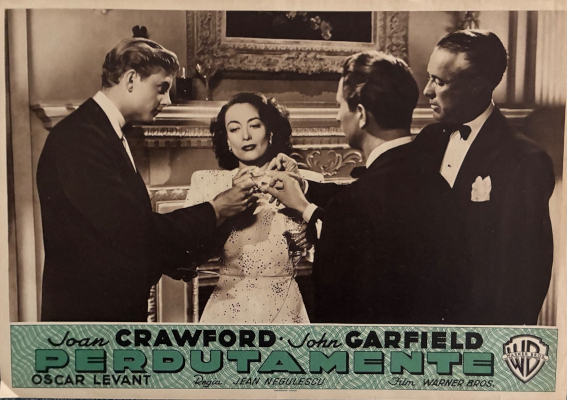
Above: US lobby cards. Below: Italian Fotobusta cards.


1946 4-disc 78 soundtrack featuring Isaac Stern and Oscar Levant; and 1998 CD by violinist Nadja Salerno-Sonnenberg with the London Symphony Orchestra.
See the Audio:Recordings page for track listings, more info.


Left:
1947
movie tie-in version of Fannie Hurst's 1919 collection of stories. Right: UK
movie tie-in.
See the Books
Related to Joan Movies
page for more info.
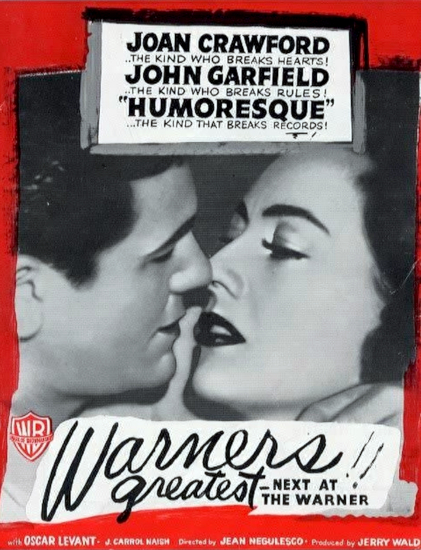
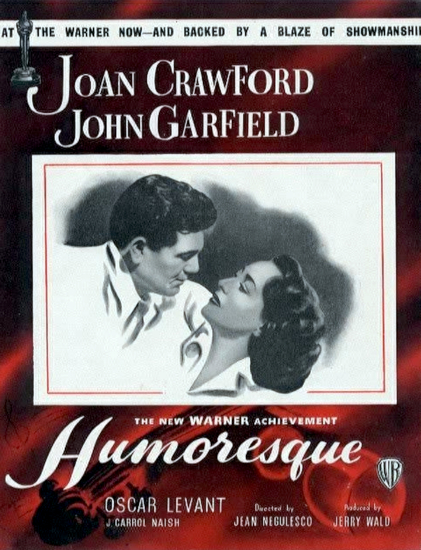

Above: UK trade ads.
Below: US trade ads.


Above: Argentinean ad and French press-kit cover.


Above: US sheet music, US glass slide, and Yugoslavian insert (13 x 19 inches).


Above: Danish program and German program cover.
Below: Humoresque at San Francisco's Warfield Theatre

The Best of Everything


 Warner Brothers. 125 minutes.
 Stephanie Jones

 Tasha
Gude (October 2009)
Tasha
Gude (October 2009) Michael
Lia (October 2009)
Michael
Lia (October 2009)