The Best of Everything
Encyclopedia Entry • Films Main
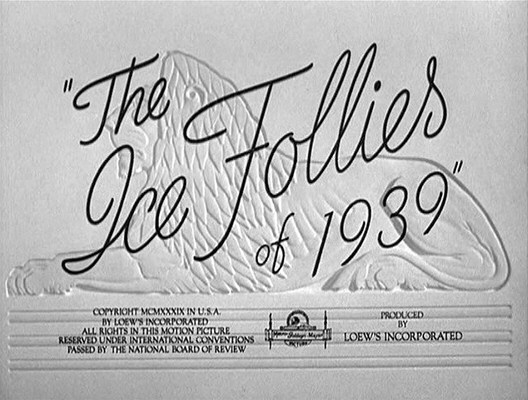
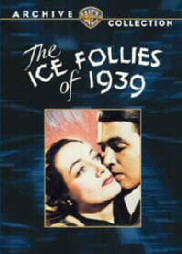
The Ice Follies of 1939
Critics' Reviews • Our Reviews • Movie Posters • Lobby Cards • Misc. Images
Click here to see photos from the film.
US release: 3/10/39
Warner Archive DVD release: 3/23/09 Cast: Joan Crawford (as "Mary McKay"), James Stewart, Lew Ayres, Lewis Stone, Lionel Stander, Charles D. Brown. Featuring "The International Ice Follies" with Bess Ehrhardt, Roy Shipstad, Eddie Shipstad, and Oscar Johnson. Credits: From the story by Leonard Praskins. Screenplay: Florence Ryerson and Edgar Allan Woolf. Producer: Harry Rapf. Director: Reinhold Schunzel. Camera: Joseph Ruttenberg, Oliver T. Marsh. Music: Roger Edens. Costumes: Adrian. Editor: W. Donn Hayes.
Plot Summary: Comedy, romance, and song hit the ice in this musical. Larry Hall (James Stewart) is a professional ice skater whose act with his friend Eddie Burgess (Lew Ayres) breaks up when Larry weds Mary McKay (Joan Crawford). Mary is also a skater, and she teams up with Larry to perform, but their on-stage (or, more accurately, on-ice) partnership proves short-lived when Mary is offered a contract to make movies in Hollywood. She quickly becomes a popular film star, but Larry does not have the same luck in California; in time, he decides to head to Canada, where he gets the idea of staging an elaborate ice revue. The producers of Ice Follies of 1939 worked with the Shipstad and Johnson Ice Follies troupe to stage the film's spectacular closing ice ballet, which was filmed in Technicolor (the remainder of the film was shot in black and white). ~ Mark Deming, All Movie Guide
Notes: Began production in October 1938.
|
R.W.D. in the New York Herald Tribune (1939):
Since some kind of story was needed to lead up to the film debut of "The International Ice Follies," and top-flight players to give it the necessary publicity gloss, Joan Crawford, James Stewart, and Lew Ayres were given the unenviable job of trying to make it digestible. Their acting is smart and likable; their material is not....Miss Crawford should avoid this type of film in the future, when she has to buck poor material, a group of specialists and Metro's own lavishness.
Frank S. Nugent in the New York Times March 17, 1939 Just when we were beginning to look forward to the Spring thaw, Metro gives us a picture called "The Ice Follies of 1939" (at the Capitol) contrary to the usual practice of dating all spectacle pictures at least a year in advance. This chronological restraint may be due to the fact that "Ice Follies" isn't altogether a spectacle picture; it also has a plot, and one which, if you will excuse our saying so, has been put on ice too late. Far be it from us to rap one of Mr. Rapf's more glittering productions; what we mildly object to is the fact that the glitter does not extend to the dialogue, the incidents, the characters (for whom "fictitious" is an understatement) or the story, which is the one about the matrimonial clashing of two careers. And how brilliant yet harmonious both turn out to be finally, with James Stewart producing the pictures, and with Joan Crawford starring in them, while that top-flight motion-picture mogul, Lewis Stone (remember what we said about the characters?) looks benignly on. Conceive, if yon can, that great dramatic moment for all America when Verna Lee, the great star, whose hair has been dyed black to give her glamour, renounces her career on a nation-wide hook-up to go back to the man she loves. Mr. Stewart, listening in, turns handsprings and somersaults at the news (it seems Verna always takes this public-address-system method to communicate her sentiments to the man she loves). But of course Mr. Stone won't submit to that; he would rather take Mr. Stewart from his little world as an ice-carnival impreseario into the larger, more rarefied atmosphere of producing than let Miss Crawford slip back into domesticity. Would you like to know how Miss Crawford gets her contract in the first place? She simply follows the producer's secretary into his office and tells him she isn't interested in a screen career, that nothing could induce her to accept a contract. In less than no time at all, girls, her picture is up in front of Grauman's Chinese Theatre as large as Stalin's at a party congress. Miss Crawford, Mr. Stewart, Lew Ayres, Mr. Stone and the others do as well as could be expected with such roles, the ice skating is nice and the first picture Mr. Stewart produces is all in Technicolor. |
If you've seen Ice Follies of 1939 and would like to share your review here, please e-mail me. Include a picture of yourself or avatar to accompany your review, as well as a star-rating (with 5 stars the best) and any of your favorite lines from the film.
|
Rating: The Ice Follies of 1939 is an odd entry in the Joan canon. Heck, it would be an odd entry to the filmography of any Golden Age actress other than Sonja Henie. Joan said re IF39 that “everyone was out of their collective minds.” I think the key word may be “collective.” IF39 struck me as a pie with too many fingers in it. Five people receive writing credits. I got the impression they were making it up as they went along as daily rushes poured in. Why Joan didn’t have a hissy fit a la Great Day (1930) and ask LB to let her off the hook, I cannot say. To be fair, two of the writers were also credited for the screenplay on another MGM 1939 flick you may have heard of, The Wizard of Oz. So, these folks were no slouches, but still IF39 seems to have too many threads. It starts as a drama, a copy of A Star is Born, complete with a close copy of Garland’s “This is Mrs. Norman Maine” speech from the 1953 variant. I enjoyed this part of the movie the most as it mirrored the rise of Lucille LeSueur to stardom: Joan's character Mary's ascent from obscurity to stardom via a combination of luck and pluck, her character's name change, Mary's joy and satisfaction at getting her name above the title, and a nice little Easter egg for early Joan historians---Mary’s initial contract is $75 per week, the same sum that Joan was allotted in her initial 1925 MGM contract! Harry Rapf, the same man who spotted Joan dancing in a NYC chorus line, is the producer of IF39, so he would certainly be familiar with Joan’s back story. Toward the end, the film becomes more of a rom-com, which was also reasonably pleasant. I liked the banter among Joan, Jimmy Stewart, and Lew Ayres as they watch the premiere of their film. Then, there is the part of this 82-minute film where the skating and music take over, and to be honest I was dozing off. I don’t think I’ve ever enjoyed a musical other than Kiss Me Kate (1953), and having actors belt out tunes while skating didn’t add anything for me. Another highlight of the film is the three-strip Technicolor grand finale, which cobbles together elements from Cinderella and The Wizard of Oz. To my knowledge, this is the first time that movie fans got to see Joan’s lovely auburn tresses and blue eyes in glorious Technicolor. Joan’s light blue dress, after her transformation, looks to be inspired by the costume Billie Burke wore as the good witch Glinda. For me, the winner is the shorter, darker blue dress that Joan is wearing when the Lollipop Guild ascertain her foot fits the glass slipper. Joan was in her mid-30s in this film and was known to work hard to maintain her figure. She looks great. 3 stars. One for the story, one for Technicolor Joanie in her prime, and another for those gorgeous legs.
Rating:
There's a reason for this film, really there is! (1) Norwegian Olympic skating champ Sonja Henie signed with Twentieth Century Fox and had a string of skating film hits starting in 1936. (2) MGM signed the "International Ice Follies" show around the same time and sought to reproduce the earlier/ongoing Fox success.
Though why Joan Crawford and James Stewart were forced to participate in the lowly Ice Follies isn't quite clear. Stewart had only had his first major hit (though 3rd-billed) the year before with You Can't Take It With You. So I can possibly see why he was still being assigned this drek. (And right after Follies, he made Mr. Smith Goes to Washington and Destry Rides Again---so Follies was definitely the last of his "apprenticeship.")
But Joan? After nearly 15 years of money-making films for MGM? Why? What was she being punished for?
With about a third of the film focusing purely on various ice-skating vignettes by pro skaters, the surrounding plot is extremely thin: A buddy skating duo (James Stewart as "Larry" and Lew Ayres as "Eddie" = "Hall and Burgess" as the poster in their shared apartment fondly reveals) has been together for 8 years, just recently joined by Larry's girlfriend, Mary (Joan), who apparently can't skate, though she looks good and has been getting them jobs. After the trio gets fired from their lowly halftime skating show at a local hockey rink, and feeling like a third wheel, Eddie quits. And thinking she's holding her man down and must start to bring in some money to support them, Mary visits a movie big-wig, Mr. Tolliver (Lewis Stone), at the local film studio; Tolliver's chauffeur had gotten into a wreck the night before with Larry/Eddie, and Tolliver left his card to pay off the damage. With this card, and hoping to avoid being a detriment to Larry's farcical dreams of "creating stories on ice that have never been told before!" Mary immediately bluffs her way into Tolliver's office...
Lo and behold! Tolliver, within ONE day, transforms Mary into a Hedy Lamarr-lookalike and changes her name to "Sandra Lee." Within ONE week, Mary has a starring role in a picture and then a big premiere and is soon coming home tipsy. Larry immediately leaves her: Until they can be equals, they cannot be together...
With the help of a seedy agent (seedily well-played by Lionel Stander; "Ice Skating Specialties" says the sign on his agent-door)---who mysteriously comes up with a lot of money out of nowhere, in about 5 minutes of screen time---buddies Larry and Eddie happily re-unite and are immediately successful in a series of ice-skating shows that feature skating horses, Russian peasants, chorus girls, a drag couple, and Indians. According to the Variety headlines we see flashed on the screen, Larry's show is now "the biggest show in history" in Boston, Chicago, AND Springfield! Thank goodness---now Larry feels "equal" enough to reunite with Mary/Sandra!
We see all of the above skating in black and white. Then, once the happy couple reunites with the blessing of impressario Tolliver---but in MOVIES this time!---everything turns to technicolor, starting with a quite-lengthy neon marquee: "Monarch Pictures presents a Larry Hall Production Starring Sandra Lee in 'A Story for Cinderella.'" (We then get to see more skating, but in color, accompanied by constant supposedly-cutesy comments between Larry and Mary seated in the film audience about how Mary could never skate.)
Aside from the obvious facts that Mary/Sandra would never have advanced at such a quick pace and that Larry's stupid ice shows would never have inspired such adulation, MGM should never have put Joan in this film. The role of "Mary/Sandra" was made for an ingenue, which Joan---based both on age and body of work---was decidedly NOT in 1939. (Though her portrayal of Mary is, indeed, soft and ingenue-ish. Joan doesn't do a bad job playing mild and agreeable to Larry's "just keep yessin' me"--- it's just that this silly role was meant for a starlet, not an established dramatic star.)
Thankfully, this was Joan's very last "ingenue" role EVER. She would accomplish a stunning change of image in next year's The Women, MGM would throw her a couple of more acting bones in 1940's Strange Cargo and 1941's A Woman's Face, and she'd hang on at the studio for another 5 years. But Ice Follies was the beginning of her Long Goodbye to both MGM and the haphazard, dull lot of films they'd primarily been assigning her since 1935 or so.
Rating:
My aunt was a costumer at the Ice Capades in Chicago in the early 1970s, and we were allowed to go backstage and meet the performers after the show. It was very exciting, and my memories are vivid of running around backstage and seeing all these different people. It was an exciting atmosphere. When Miss Crawford steps in the ring in Ice Follies, however, I have no memory at all and no excitement or interest. The only thing of interest is the color photography of Miss Crawford; she is radiant and beautiful in her fairy-princess gowns. Otherwise it is unmemorable studio trash. Mr. Rapf was no Thalberg and Mr. Mayer must have been at the horse races.
The film in its entirety stinks. It is bad and has the feel of a Flash Gordon serial; the quality is rotten, something I do not expect from MGM. There is no script to speak of and it has no feeling: I could care less if Miss Crawford gives everything up for a wimpy sexless James Stewart. What a fade-out folks... the happy lovers of the Ice Capades. Yuk.
Miss Crawford has no oomph, just one good “drunk” scene. She is saddled with male co-stars who act like dorky college roommates. She is given nothing in the script to work on except Adrian’s fabulous costumes; there are no brain tumors or blindness or guns or criminal activity or an intriguing love triangle, just the Ice and Jimmy Stewart's feelings. It is Horrible. I like Reinhold Schunzel, the director; I am assuming he just went along like everyone else and shrugged his shoulders. The audience would, too, if they did not fall asleep; and if they did wake up, they would wonder why Miss Crawford suddenly looks like Miss Hedy Lamar.
It is one of the rare occasions that I forget that I am watching a Joan Crawford film. In her scenes with Lewis Stone I can only think about Grand Hotel. I applaud him for giving his role a performance, but what a bore. All of the performances are cardboard, from a nothing script. Who exactly is to blame, I don’t know. Where was Sonja Henie? And Vera Ruba Ralston. Those girls could skate.
Okay, other than mentioning Mr. Stone and listening to nice Mr. Lew Ayres' voice, I have nothing else to say except, "Thank god it is only an 82 minute film -- and 80 of that is too long!"
Robert Viera (March 2007)
I was fortunate to record a copy of "Ice Follies of 1939" from Turner Classic Movies a few years ago and since then have had the good fortune to learn more about the history of the movie rather than base my observations purely on what is presented.
At the time the film was made, Joan's contract had just been renewed after possibly leaving MGM for Fox, since Darryl Zanuck had promised her a more diverse repertoire should she sign with Fox. (This information is in the book "The Divine Feud.") Since Joan had started her career as a dancer, her talents could lend themselves very easily to musicals. She reached a point where she wanted to expand her range from "shop girl."
She had been studying opera and had made a few recordings with the MGM symphony orchestra. Her agent presented the recordings to Mayer who, according to the book, was quite interested. I firmly believe that Mayer was no fool and would never express interest unless it was economically feasible. Joan signed a new contract and one of the first films was "Ice Follies."
When you see the film it is evident that this was a major, major production with the International Ice Follies troup participating and the finale in technicolor (something reserved only for those productions warranting a substantial investment by the studio). A major marketing campaign was in full swing about "hearing Joan Crawford sing." As also expressed in the book, "the word on the lot" was quite impressive about Joan's singing talent boasting a range to 2 octaves with an additional 2 - 3 notes on each side. Joan was also to sing 6 new songs.
Apparently the anticipation was so great that the reigning opera diva of that period, Jeannette MacDonald, also took notice. It is written that she saw L.B. Mayer and stated there was room for only one classical singer, and it was her. Because her films with Nelson Eddy were very successful, he did not want to jeopardize yet another revenue stream. It was also revealed in another book, "The Golden Girls of MGM," that Mayer was also very much in love with MacDonald.
The end result was a film with 4 of the 6 songs deleted and only bits and pieces of one other and possibly 30 seconds in the finale.
Joan Crawford's performance is -- as always -- stellar. You cannot help but see the focus and concentration as she did with any of her films and particularly this one since this supposed to be a turning point for her. I could not help but wonder where the missing songs were supposed to be. The film is filled with references to her great singing voice, but no voice is ever presented until the very end. What is presented is certainly very good and you cannot help but wonder what was so threatening to Jeannette MacDonald if the film were released as originally planned.
Jimmy Stewart and Lew Ayres are charming as usual. However, I personally find Jimmy Stewart's character dislikable, but the film is of its time.
One cannot help but be very impressed with the overall production values. It had to be very expensive in order to chop it up the way that it was.
In short, what could have been a wonderfully lavish production was turned into a very expensive "shop girl" picture. Perhaps with technology and interest in the film, we could see it restored. One can only hope.
|
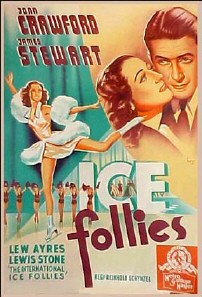
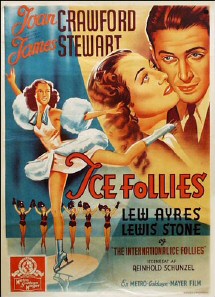
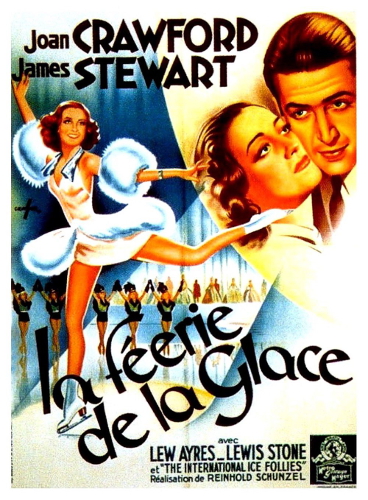
Above: Posters from Belgium, Denmark, and France.
Below: Two US posters and insert.
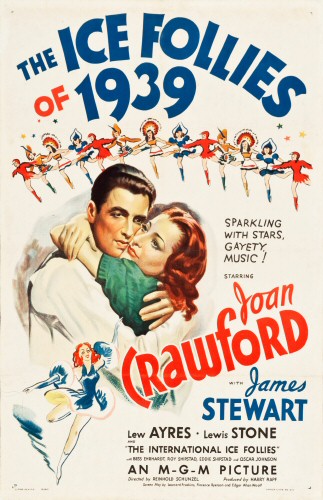
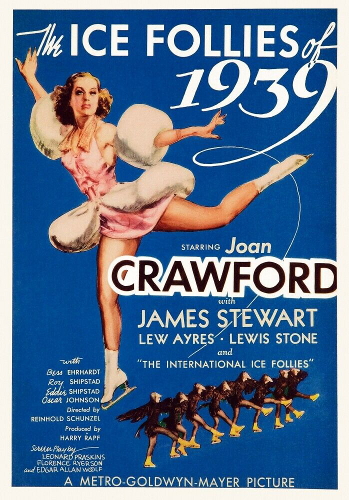
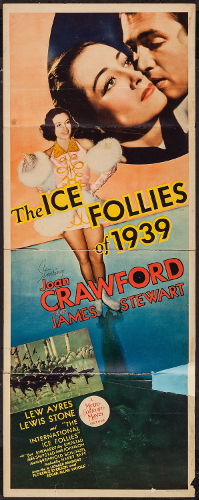

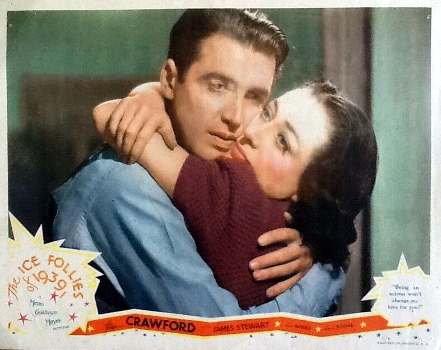
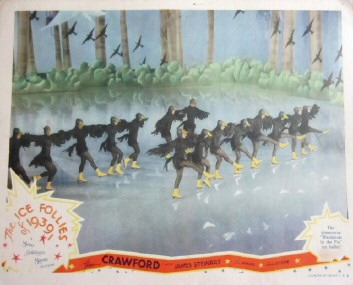
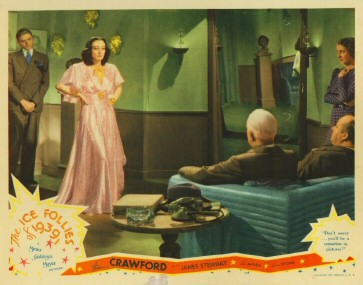
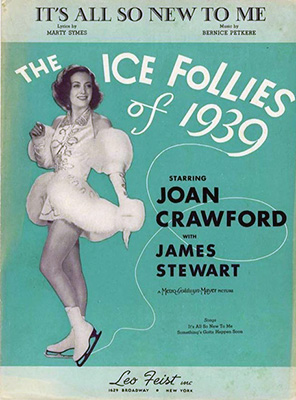
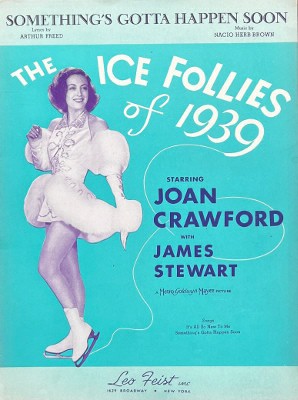
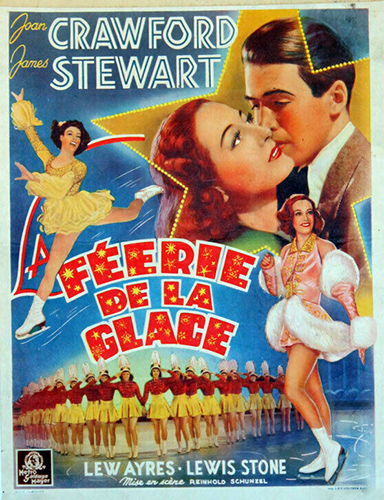
Above: US sheet music, and a Belgian window card.
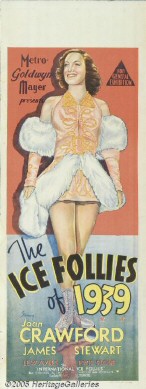
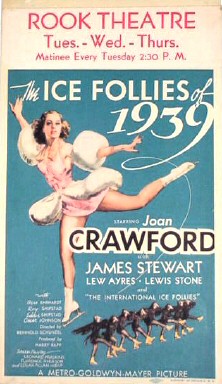
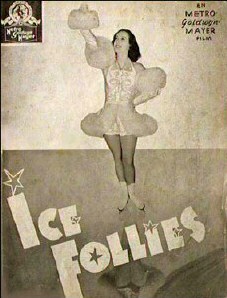
Below: Australian daybill, US window card, Danish program cover.
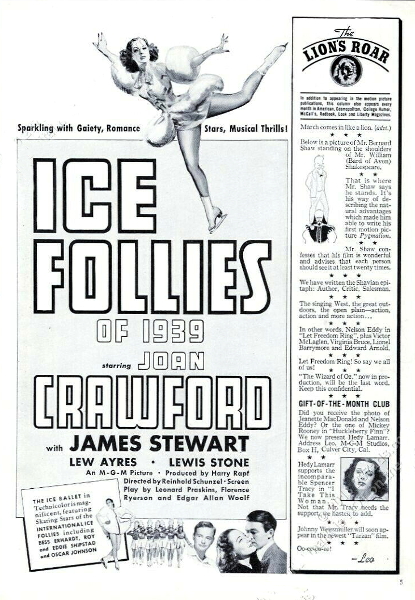
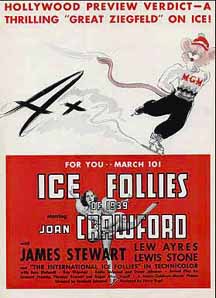
Above: US magazine ads.
Below: US herald cover and centerfold.
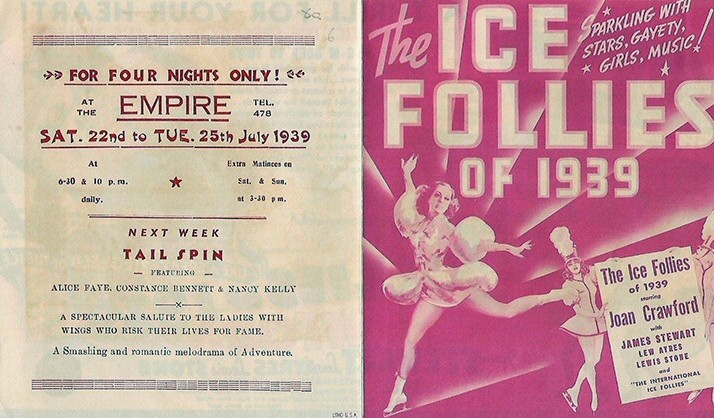
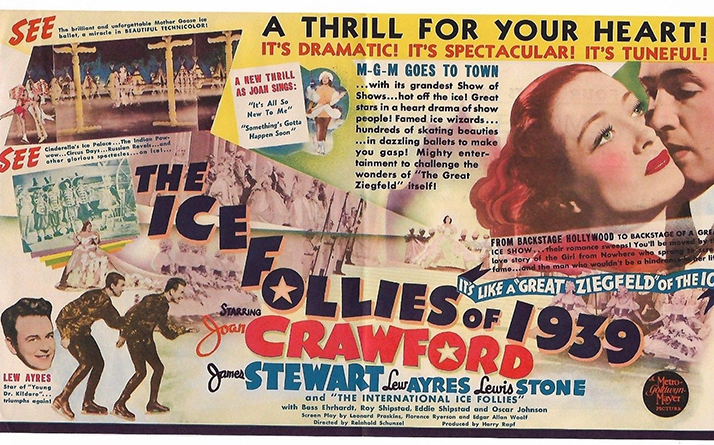
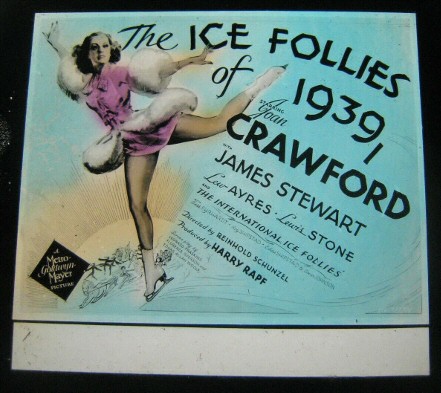
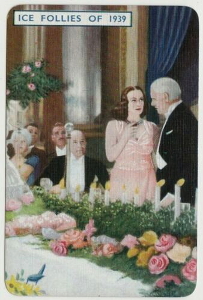
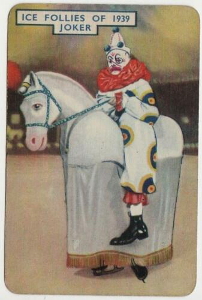
Below: Three "Ice Follies" cards and back from the UK "1939 Film Fantasy Card Game" deck (45 cards; 2-5/8 inches by 3-1/2 inches).

The Best of Everything
 MGM. 82 minutes.
 Tom C.
(June 2024)
Tom C.
(June 2024)