The Best of Everything
Encyclopedia Entry • Films Main
The Last of Mrs. Cheyney
1937
Critics' Reviews • Our Reviews • Movie Posters • Lobby Cards • Misc. Images
Click here to see photos from the film.
US release: 2/19/37.
VHS release: 6/24/92. DVD on-demand release from Warner Archives: 3/4/14. Cast: Joan Crawford (as "Fay Cheyney"), William Powell, Robert Montgomery, Frank Morgan, Jessie Ralph, Nigel Bruce, Colleen Clare, Benita Hume, Ralph Forbes, Aileen Pringle, Melville Cooper, Leonard Carey, Sara Haden, Lumsden Hare, Wallis Clark, Barnett Parker. Credits: Adapted from the 3-act play "The Last of Mrs. Cheyney" by Frederick Lonsdale. Screenplay: Leon Gordon, Samson Raphaelson, and Monckton Hoffe. Producer: Lawrence Weingarten. Director: Richard Boleslawski. (Boleslawski died in the middle of filming and the film was finished by Dorothy Arzner, who was uncredited.) Camera: George Folsey. Art Director: Cedric Gibbons. Music: Dr. William Axt. Editor: Frank Sullivan.
Notes: • The film was in production from 11/27/36 to 2/3/37. • Cheyney was Life magazine's movie pick of the week when Joan was named "First Queen of the Movies" in early 1937. • The original play opened in London on September 22,1925, and was published as a book in England in 1926. • The New York City run of the play began 11/9/25 and lasted for 385 performances. Helen Hayes starred. The play was published as a book in the US in 1929. • Two other versions of the film were made: in 1929, starring Norma Shearer, and in 1951, as The Law and the Lady, starring Greer Garson. • Myrna Loy was initially slated to play Mrs.Cheyney and Joan was supposed to play opposite Clark Gable in Parnell. The ladies switched roles after Joan refused to do another costume drama (after 1936's The Gorgeous Hussy). • Co-star Robert Montgomery later said of the film: "I barely remember the thing. Joan was fluttering all over the place, as usual. I just came in and did my work and went home at night until it was over." (JC: Essential Biography) • Cheyney co-stars Frank Morgan and Jessie Ralph also appeared with Joan in 1935's I Live My Life; Morgan was Joan's father and Ralph was Joan's grandmother. • Cheyney co-star Aileen Pringle ("Maria") was married to Mildred Pierce author James M. Cain during the time of MP's filming.
Thanks to Jon M. for contributing some of the information in the above Notes.
|
Frank S. Nugent in the New York Times February 19, 1937 On the wings of the aery Lonsdale badinage of a dozen years ago, with a few plumes of latter-day witticism stuck in to bring it up to date, that sophisticated melodrama, "The Last of Mrs. Cheyney," has come again to the Capitol, marking an end, perhaps, to an eight-year era of hard feeling in the films toward all recidivists, however delightful. The recollections Mrs. Cheyney conjures up are pleasing. They recall Ina Claire bringing Mr. Lonsdale's bright epigrams to Broadway in 1925 and Norma Shearer graciously, even gaily, fleecing a most delightful set of Mayfair victims of sundry baubles for the films in 1929, a year when there was still 20 per cent more gayety outside the theatres. These recollections make it difficult to appraise Miss Joan Crawford's interpretation of the vivacious Mrs. Cheyney fairly. To this reviewer Miss Crawford seemed overly arch, and certainly not properly condescending (as Miss Shearer was) toward the gilded victims of her designs. As Charles, the noble butler confederate in this jewel filching conspiracy, William Powell has a considerably reduced rôle, for the accent this time is on romance. What remains of the part simply oozes loftiness of spirit and self-sacrifice, however, and leaves you with the realization that Mr. Powell is equally fascinating, either side of the pale. The rest of Miss Crawford's cast is genially ideal, making it seem utterly marvelous that this spoof of Mayfair was actually done successfully before without the aid of Nigel (Willy) Bruce as Lord Wynton and that lovable fumbler, Frank Morgan, as the prime dupe, Lord Kelton. The romance, which is more seriously pursued in this current version, centers around Robert Montgomery, who was perhaps the only member of the cast unable to summon up an English accent. Cecilia Ager (1937): It is comforting to see in The Last of Mrs. Cheyney that Joan Crawford has at last attained the manner she's been striving for. Now she quietly looks any actor, no matter how English, straight in the eye, confident of the mastered casualness of her own pronunciation. No more 'beans' for 'beens' jut out from her speech naked and terrified; no more do unresolved trimmings distract from the compact and self-contained silhouette of her clothes. Instead of the mark of self-doubt that used to be--now Miss Crawford goes about doing right things, wearing right things, with deafening poise.
Marguerite Tazelaar in the New York Herald Tribune (1937): Joan Crawford as Mrs. Cheyney was competent, besides giving the part considerable sympathy....The picture has been staged handsomely, the musical score accompanying it is good, and the lines glitter.
|
If you've seen The Last of Mrs. Cheyney and would like to share your review here, please e-mail me. Include a photo of yourself or avatar, along with a star-rating (with 5 stars the best) and any of your favorite lines from the film.
 Tom C. (October
2024) Tom C. (October
2024)Rating: I like Cheyney, which has everything I want in a Joan movie: She looks gorgeous, suffers through l'amour while clothed impeccably by Adrian, does a bit of light comedy, romances a handsome leading man or two, has a great supporting cast---and all in a tight 98-minute package. Cheyney has a good balance of comedy, suspense, and melodrama. Light comedy is interspersed throughout the film, most enjoyably in the scene in which the upper crust Baroness (Jessie Ralph) and her family vacillate between indignation over Mrs. Cheyney's crimes and the possibility that a court case would air their dirty laundry. Joan claims in "Conversations" that she didn't give it her all, acting-wise, since she was having personal problems (with husband Franchot?) and could have gotten an Oscar nomination if she had been more focused. Debatable, perhaps, but I think she still does admirably. Acting gems are to be found up and down the cast list, starting with the two leading men: Debonair William Powell, the best gentleman crook of the Golden Age, and Robert Montgomery. (Poor Bob, if not for Gable, he'd be the man everyone remembers when they think of Joan's leading hunks.) Joan's acting is particularly good in her scenes with Jessie Ralph.Ralph was awesome as the cranky matriarch in the second Thin Man movie, and she's wonderful here as the Baroness with a colorful past (referring to herself as a former "gaiety girl"---make of that what you will!). Frank Morgan, future Wizard of Oz, is adorable as the richest man in England who gets tongue-tied talking to the ladies. Nigel Bruce---later famous as Watson to Basil Rathbone's Sherlock Holmes, and also a supporting player for Joan in 1940's Susan and God---is wonderful as a stuffy Brit with a sense of mischief. I also enjoyed Benita Hume, who plays his wife in this film. Silent screen siren Aileen Pringle, who co-starred with Joan in the lost Dream of Love (1928), also has a small part. One odd thing about this movie is that it took three directors to bring it to fruition. The first, Richard Boleslawski (perhaps best known for directing Theodora Goes Wild, Irene Dunne's comedic breakthrough), died during filming. George Fitzmaurice then came in but got sick and dropped out. Dorothy Arzner, one of the very rare female directors during the heyday of the studio system, finally took over. (Arzner also directed Joan's next film, 1937's The Bride Wore Red.) Only Boleslawski is credited.
Rating:
Queen of the Movies! That’s what Life magazine proclaimed in early 1937. The public and studio felt the same. BUT…changes were happening fast. It is a difficult task to maintain stardom and your position, even if you’re Sonja Henie. It is equally hard when the studio starts spinning out of control. Irving Thalberg died; the director of this movie died before the completion; the editor must have taken a vacation. The excellent supporting cast saves the show. Garbo is filming “Camille”; Luise Rainer is filming “TheGood Earth”; and the Queen is filming a Norma Shearer (off-screen for a year) remake. I would jump at the challenge, despite how my personal life might be at the moment, and be thankful that I was not put in the “Hardy” series. Miss Crawford also should have been contented with director Richard Boleslawski. He is no B director; however, he was ill (in fact dying). All his love for the theatre and motion pictures and his talent could not prolong his demise. It is a tragic end. We are cheated, as well as motion pictures. Miss Crawford (very well poised for a thief) takes a leap into an English living room for a change, and she is teamed with an excellent actor (another change of pace). William Powell and Miss Crawford get along well, and I am glad to see her have a chance with him; he is suave and charming and you "know” he is William Powell. I can watch him anytime. They work well together, as any actress does when paired with him (even the swimming actress). I have read a lot of criticisms about their pairing, and I have come to the conclusion that I am totally entertained. Miss Crawford holds her own with Mr. Powell. They do compliment each other, although I keep looking for Gable to show up. Robert Montgomery fits in well, as usual, and the three stars make me happy watching them use their craft together. It was a job, and they got a paycheck, and they are still paying off today! Now comes the part I really like about this film: Miss Crawford is supported by some of the most sophisticated character actors in the business. I watch this film as if I am getting all the candy I want; every person is delectable to me, and my appetite is quite satisfied. Mr. Frank Morgan comes out on top every time; this is really his film. He bumbles and fuddles and mumbles the entire time, and he makes you laugh. Take him away and the film is nothing. Jessie Ralph is one mean Momma, but here she plays a royal, sweet, refined worldly old lady (with shady beginnings); she has the loudest mouth of anyone over sixty. Nigel Bruce supports like no one's business (love him in Hitchcock’s “Suspicion” and fifty other things). Benita Hume is an interesting woman, but here I think she was playing herself, which was witchingly entertaining. I do not know Colleen Clare; I think she ended up on the cutting-room floor, like most of the movie did -- it is very "clippie." Maybe not the editor’s fault; perhaps the producer just stuck it together. Aileen Pringle, who was a star before Joan, now had just teeny tiny parts for the rest of her career. I was glad she was still hanging around. (In “The Women” she was reduced to handing Norma Shearer some clothes in the showroom). Melville Cooper, another English “refugee,” made a home here and in a lot of movies; you will see him everywhere. As well as Sara Haden (“Above Suspicion”) -- she was no spinster librarian here, but rather a cold lady looking for cash, if only to get off her sore feet! The film still glows and sparkles, thanks to Adrian (trying out some new looks) and George Folsey, the cameraman, who gives a softer touch. I wish things were different. We are saved by the shining delivery of comedic lines, and the dramatic moments come off with some real suspense. I’ll say what James Agee once said: “A lot of talented people were giving it all they got”!
Jon M. (January 2005) Rating:
The Last of Mrs. Cheyney is the second of three film versions of the Frederick Lonsdale play, a sophisticated comedy that is "Veddy, Veddy British" (at least by Hollywood standards of 1937).
Fay Cheyney (Joan Crawford) is an American widow/socialite from Minneapolis, now in England, who socializes with the upper crust of society. She has 2 potential suitors from the same family (Lord Dilling and Lord Kelton -- played by Robert Montgomery and Frank Morgan). Mrs.Cheyney is not what she seems to be; she is an impostor and has, of course, other motives. Her main partner in crime is "Charles," her supposed butler (played by William Powell). One of her main dilemmas: She actually has feelings for Lord Dilling, but her loyalty is with partner Charles.
The opening of the movie is a little slow, but many characters have to be introduced. It's a good idea, story-wise, that the English setting is retained; this way Mrs.Cheyney can and does put herself over as a socialite. The most interesting scenes are when the viewer discovers that everyone is not who they appear to be; it seems all of these characters involved have something to hide... More of these scenes (if added) could have made the film more of a crowd pleaser.
Performances are generally very good. I found the "Duchess of Ebley" (Jesse Ralph) to be especially enjoyable as the matriarch of the family. Joan Crawford's perfect diction serves her well in this film as she has much dialogue and appears very much as the "dignified lady" throughout.
The main problem with the film is that the original story was sanitized to fit the Production Code of the time (any suggestion of sex was not allowed, crime must be punished etc.). With the code in mind, somehow the talented writers succeed in telling an interesting story full of witty dialogue throughout.
Rating:
Following the commercial flops of 1932's Rain and 1933's Today We Live, MGM ended Joan's brief run of serious films from '30 to '32 in favor of starring her for the next several years in a series of "safer," frothier films designed primarily, it seems, to showcase her clothes and bring in more money for the studio.
Cheyney was part of this strategy, and the new formula had, after a few years, grown a bit stale at this point. There's the usual love-triangle, the by-now usual "high society" backdrop accompanied by occasionally witty patter, as well as Joan's ever-more-carefully enunciated diction and variety of gowns. (Also on hand is Joan's frequent '30s co-star Robert Montgomery, who never fails to annoy--me at least--with his smirky and insincere "charm.")
The film was more-than-partially redeemed for me, though, by William Powell, a quiet and graceful presence amid all of the accompanying high-pitched chatter. This is the only time he and Joan co-starred together, and he seems to anchor her own performance with his sense of assurance.
And it's an assured performance from Joan, as well. In her previous films to this point, whether light or dramatic, she'd always seemed a little ungrounded--a little too intense at times, either giddily or angrily so. Here she seems like an adult for possibly the first time---not a giddy flapper or socialite in the throes of a whirlwind romance, not a wronged woman, not a kept woman... Still a jewel thief, to be sure, but however unlikely the character and the accompanying goings-on, her "Mrs. Cheyney" remains a calm and sustained characterization.
Cheyney is also a treat for those who just like to look uninterruptedly at Joan! That may sound silly, since obviously we get to see her plenty in most of her films. But Cheyney lavishes more close-ups than usual, and it's one of the films where the viewer has the chance to really dwell on Joan's face for long stretches (notably when she's planning and executing the heist of pearls amid the shadows).
Joan later said that had her performance not been affected by her marital difficulties at the time, Cheyney might have garnered her an Oscar nomination. That's a bit of a stretch, given the limitations of the rather dated material she had to work with here. But the film is, nonetheless, very much worth watching for one of the first glimpses of the mature Joan that would appear in later MGM efforts like 1940's Strange Cargo and '41's A Woman's Face, and re-emerge full-force in her early Warners pictures Mildred Pierce and Humoresque.
Memorable line: Fay to Lord Dilling: "I don't care to be alone with you, even on the telephone."
|
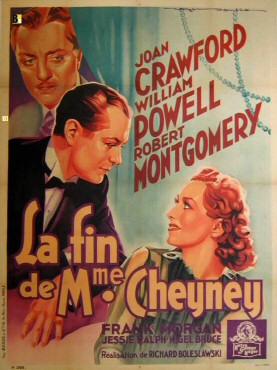
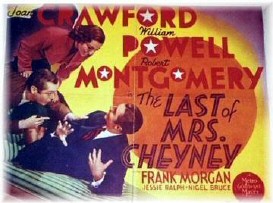
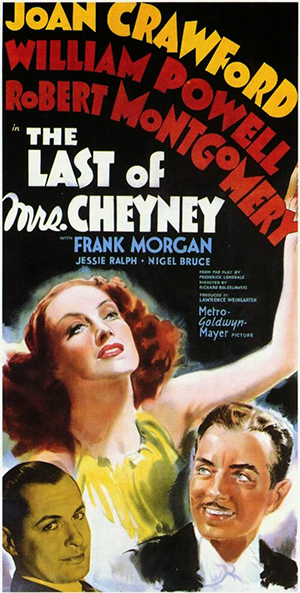


Above: An Italian lobby. Below: US lobby set.


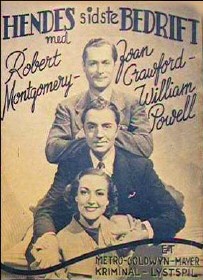
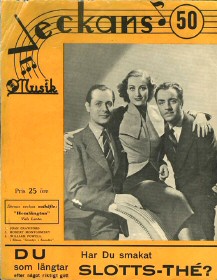
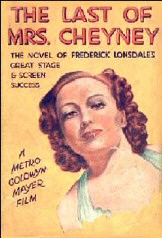
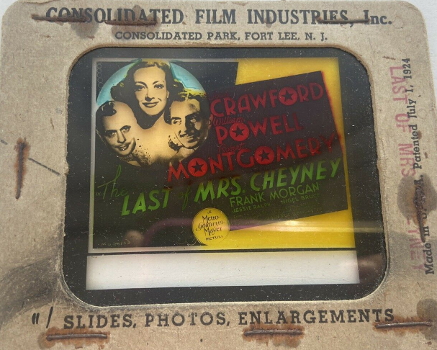
Above: Dutch program cover, Swedish sheet music cover, US novelization cover, and US glass theater slide.
Below: UK herald.


Above: Art from UK's Kinematograph Weekly (March 1937)
Below: A Waikiki (Honolulu) movie theater marquee featuring The Last of Mrs. Cheyney

The Best of Everything
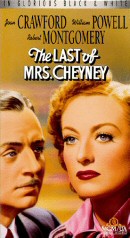
 MGM. 98 minutes.

 Did
I mention that Joan is a knockout in this movie? There are a few scenes where her
coif is a forerunner of what Crystal Allen sports in 1939's
The Women, but apart from that minor misstep, she's a wonder to
behold. Exhibit A: See photo at left from the film's opening credits. Love that sly
grin. JC looks like she's up to mischief, and I'd gleefully follow her
in whatever shenanigans she has planned.
Did
I mention that Joan is a knockout in this movie? There are a few scenes where her
coif is a forerunner of what Crystal Allen sports in 1939's
The Women, but apart from that minor misstep, she's a wonder to
behold. Exhibit A: See photo at left from the film's opening credits. Love that sly
grin. JC looks like she's up to mischief, and I'd gleefully follow her
in whatever shenanigans she has planned.