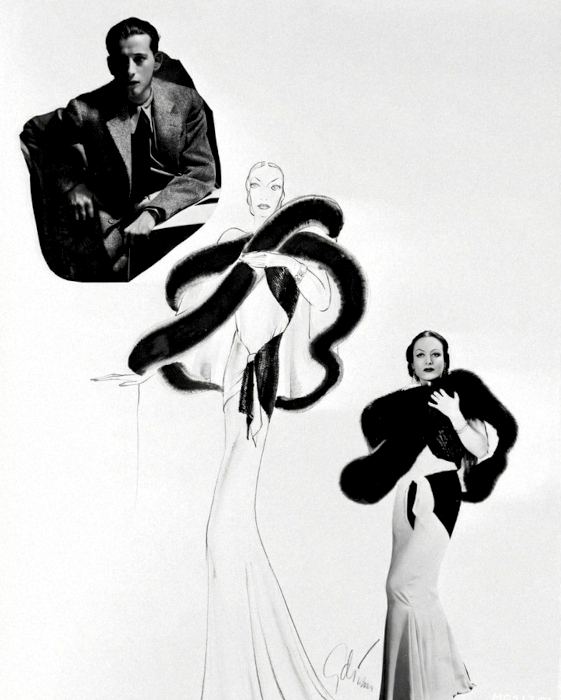
 Tom C. (September 2024) Tom C. (September 2024)
Rating:  -1/2 of 5 -1/2 of 5
Letty Lynton (1932)
is Joan’s “lost” talkie. Lost not to nitrate stock decay or a film
vault fire, but rather a copyright lawsuit that has kept LL in
legal limbo for about 90 years. Happily, a faded copy survived to be
uploaded to the Internet. Despite a back story as complicated as its
title character, LL has aged very well.
LL opens
in Montevideo at a place where society and the underworld mingle.
At “Salon de Baile” there
is a lotta smooching as couples engage in sexy Latin dances. Joan
(Letty) and Nils Asther (Emile) canoodle and dance, although a
few minutes later she hates him, and wants to flee. Indeed, her standard
operating procedure is to run away when life becomes too complicated.
But, Emile is a possessive sort, and he follows Letty...
A
historical side-note:
Montevideo may seem an odd choice to open the film, but it was an Art Deco hot spot in the 1930s, and thus likely familiar to MGM’s set
designer Cedric Gibbons:
https://www.worldofinteriors.com/story/montevideo-uruguay-art-deco-architecture-interiors Also, along with Buenos Aires and Rio, Montevideo
was a place known for vice! https://as.nyu.edu/research-centers/clacs/events/spring-2024/the-birth-of-a-pleasurescape--montevideo-in-the-1910s-1920s.html
From
the outset, it is clear Letty has left a trail of broken hearts across
various sin bins of South America. And, she has “mommy issues.” These
themes continue throughout the movie and lead to its climax.
To
escape Emile---and attempt a rapprochement with Mom---Letty hops a ship
for NYC. (1930s Joan had great luck with shipboard romances: Robert
Montgomery in 1929’s Untamed, and
Gable in 1934's Chained).
1932's
LL has Montgomery as Jerry Darrow, a rich young man whose
father owns a rubber
company (true in real life for Bob), while Letty's father owns a chemical factory. Two rich
kids, with the difference being that Jerry's parents love him and Letty's mother is
cold, in large part due to the similar reckless natures of Letty and her
late father. This is the third Crawford-Montgomery film. (Apart from Untamed, they also
appeared in 1930's Our Blushing Brides. As before, Montgomery here
plays a suave sophisticate who quickly falls in love with Joan.)
LL is
sprinkled with little vignettes---funny and sad---interspersed amidst the
romantic melodrama. A favorite is a bit where Letty’s maid---played by
the wonderful Louise Closser-Hale---and Jerry
independently bribe the steward so Jerry and Letty can share the same
table for meals. A
sadder vignette occurs when poor Letty gets no Christmas wires while on
the ship, which leads to Jerry suddenly proposing marriage!
Apart from Ms. Closser-Hale, another character actor of note in LL is May Robson (adorable as Franchot Tone’s grandma in Dancing Lady,
1933), who here plays Letty’s estranged mom. Lewis Stone---an MGM contract
employee of nearly 30 years---has a pivotal role as a cagey DA trying to
get to the bottom of the mystery of Letty Lynton and Emil Renaul.
The
heavy, Emile, is Nils Asther, who played alongside Joan in several of
her later silents (as well as co-starring with Garbo in several silents). Although
talkie-era parts dried up quickly for Asther due to his accent, contract
difficulties, and (probably) sexual orientation, he's excellent here in LL.
Emile Renaul could have easily devolved into a caricature, what with a
Scandinavian actor playing a South American cad with a French name and a
heavy but indeterminate accent. But, Asther is great in LL. He oozes menace without going overboard.
You may be wondering how after all my blather about Letty Lynton, I have not yet mentioned “the dress.” Here is the famous organdie dress in all its glory!
https://www.joancrawfordbest.com/32letty17apr1.htm
This YouTube video
does a very nice job covering the fashion impact of the Letty Lynton Dress:
https://www.youtube.com/watch?v=JL8bctl-GCw
It is reputed that Macy’s sold thousands---the exact number seems to change in the re-telling---of dresses inspired by Letty Lynton.
I’ve never found a contemporary source for that story, nor even a
1930’s Macy’s ad with the gown. But, I did find ads that tout a Letty Lynton-inspired coat with the gorgeous fur collar that Letty wears to Emile's apartment to beg him to return her steamy love letters:
https://www.joancrawfordbest.com/32letty6.htm
Other trivia:
Letty Lynton is partially
based on the 1857 Scottish trial of Madeleine Smith: https://en.wikipedia.org/wiki/Madeleine_Smith. Marie Belloc Lowndes wrote the book “Letty Lynton"
(1931) but
implies that it was only tangentially inspired by the Smith case. I’ve
only skimmed the book (https://archive.org/details/lettylynton0000lown),
but it seems quite different from the movie. MBL was a prolific writer,
with several works adapted for film, perhaps most famously for The Lodger, which inspired a movie of the same name, one of the first films directed by Alfred Hitchcock to garner critical acclaim:
https://en.wikipedia.org/wiki/Marie_Belloc_Lowndes
What did Joan have to say about Letty Lynton in
“Conversations”? Surprisingly, she liked it! I think she does very well
in this movie. She’s a bit tedious when vacillating among lovers at the
start of the movie, but overall does a good job conveying the emotional
emptiness of her dissolute lifestyle and the pangs of regret for the estrangement from her mother. She hits it out of the park in the “dirty mongrel” scene with Emile.
 Michael Lia (January
2011) Michael Lia (January
2011)
Rating:
 of 5
of 5
For legions of Crawford fans, and for many decades, Letty Lynton
was a mystery movie because of the plagiarism suit filed against MGM.
The film was rarely viewed or ever shown to the public. It could be quite a
challenge to try to find a copy of it and of course somebody did! Now we
can all see it! There was a build-up of excitement and intrigue waiting
to see this film and it does not disappoint for several reasons.
The Number One reason, of course, is Miss Joan Crawford! Letty Lynton
is definitely a turning point in the actress’s abilities and career.
She shows a new maturity quite different from her 1931 films except for Possessed, which is where this new process began and Joan Crawford the actor transcends to the next level in the grand year of 1932. She is no longer forming at this point: She is here!
(Grand Hotel and the misunderstood Rain take her to the finish line!)
At
this point she
is way ahead of the wispy actresses who play their craft safe and for
the talented underrated ladies who never got the chance at roles MGM was
passing out. Miss
Crawford was an avid student and ready for the growth the studio
offered her, and as her roles grew in importance, so did her confidence
and being: not to mention her box office receipts and adoring public!
The other reasons this film is special cinema is for the MGM touch:
Clarence Brown (another underrated director) captures the feel of South America and the Latin night life
of those times. The scenes on the ship are realistic. I find the
poignant Christmas scene very touching and I always remember Miss Crawford’s tears and sadness.
Her loneliness is subdued by Mr. Montgomery’s gallantry and love.
All the senses are touched by Adrian. (Need I say more?)
Miss Crawford is also
graced with the wonderful character actors Louise Closser Hale (Dinner at Eight), May Robson (Lady for a Day), and Emma Dunn (This Modern Age),
as well as Lewis Stone (Queen Christina).
All four are cinema treasures. It is true that the character actors
brought in a lot of fans; I am one of those people. In fact, Miss Crawford
has stated how the public loved the familiar faces -- the talent and class
that came with their performances.
Miss Crawford is given two male co-stars, Mr. Robert Montgomery and Mr. Nils Asther (absolutely fabulous in The Bitter Tea of General Yen),
aka "Mr. Suave" and "Mr. Sinister." I think Asther might have been Monty
Beragon’s father. He is one nasty international dude. I always get a
kick out of this particular casting since he is Swedish by birth; my mind
expects Ingrid Berman features. Asther's sleazy handsomeness allows him to play the Latin Lover with scary obsession and psychopathic
delight. I wonder what Letty saw in him? Oh.
Anyway,
Letty makes the mistake of hanging out with this louse for feminine
reasons (she and women to this day keep going for these sleazy meanies,
mostly with disastrous results). Miss Crawford presents a sexuality that
is desirable and glamorous and very feminine, even when she is planning
on taking her own life. The fact that Mr. Asther drinks the poison
champagne Letty intended for herself and she does not
stop him!! It is Pre-Code cinema delight: She actually gets away with
murder!!!! Never to happen again until the demise of the studio system
thirty years later! That is some kind of Hollywood record!!
Critics and men today have a jaded Mommie Dearest view that has even distorted Miss Crawford’s beauty and sensuality.
However, the camera does not lie. Miss
Crawford is beautiful as Letty. Thank you, Mr. Marsh -- another fine
craftsman from the MGM roster .He does some fine camera work within
the confines of the sets. I often wonder what the critics expected from Helen Hayes
in the sexual desire department. I never knew that an actress was supposed to
make the critic want to sleep with her; however, thousands of men in the
30s loved Miss Crawford, and she satisfies me with her beauty.
I
think any cinema lover will enjoy the taut, tight script and the
unfolding of the story in a swift 84 minutes. It is fine theatre,
presenting moments of frightening situations mixed with elegant glamour.
Nostalgia at its best!
 Shane Estes (August
2010) Shane Estes (August
2010)
Rating:
of 5
Another
extremely rare and amazing Crawford film! I can’t believe copyright
still prevents this from seeing an official DVD release! Everyone who
sued MGM over this film is long dead so it’s time to get over it!
Apparently this was one of the first court cases
of copyright infringement in the entertainment industry. Aside from
being rare due to legal issues, this film is also notable because of its
pre-Code subject matter. The protagonist Letty (Joan Crawford)
gets away with the murder of her embittered ex-lover without facing any
consequences for her actions. Due to the enforcement of the Hays Code
in 1934, this type of ending for a film would not be allowed again for
decades to come (the Hays Code was abandoned in 1968 for the MPAA rating system). I would have to say that this films ranks up there in my top 5 Joan films!
As a Crawford fan, I find this film simply amazing. It’s by far and away one of her best 1930’s pictures. 1932 was a very successful year for Crawford with Grand Hotel AND
Letty Lynton, both hugely successful films for her. As a side note, I guess Rain (1932) was a loss for United Artists,
but the numbers on the “Joan Crawford Box Office” page don’t add up for
me: if the film cost $591,000 to make and it made a total gross of
$704,000, wouldn’t that be an $113,000 profit? I’m not really sure how
that works, or why it’s listed as a $198,000 loss, but what we do know
for sure is that Crawford HATED that film! In my opinion, all three of
the films from 1932 are pretty damn good, but this one has to
be the best. By
1932, Crawford had definitely come into what became known as “the
Crawford look." Here she has the long lashes, the big mopey eyes, the
exaggerated lipstick, etc. She looks fantastic! She’s so fun to look at
here! The plot is the typical love triangle, just a bit more sinister than the later 1930’s Crawford love triangles. Letty can’t seem to get away from her controlling and domineering lover Emile (Nils Asther) despite many attempts to escape his grasp. While aboard a cruise ship she falls in love with Jerry (Robert Montgomery)
and accepts his proposal without telling Emile. When Emile finds out
about this and still won’t let her go, Letty intends to commit suicide
by poison, but when Emile lifts the glass to his own lips, she doesn’t
tell him that it’s poison. The
film definitely has an early talkie feel to it, but it holds up to the
test of time quite well. It has a nice combination of comedy and drama.
The early part of the film has a very lighthearted feel to it, like so
many of Joan’s other 1930’s films, before finally taking a turn for the
dark. Some good quotes are when Jerry and Letty are getting acquainted
and he is telling her a story about his run-in with a lion and she says,
“Oh, lucky it was a he-lion!” Another is when Letty says to some guy
hitting on her, “You know I never kiss anyone before 1 o’clock.” The
best quote of course is when Emile finally realizes that he has been
poisoned and Letty says to him, “Yes, I did it! I meant it for myself!
Do you hear me? I meant it for myself! I’m glad I did it! You dirty
filthy greedy mongrel! I’m glad I did it! If I hang for it, I'm glad I
did it!” And since
I’m ranting off quotes here, there is a funny quote in this film that
I’ve actually heard in several other early talkies, “This isn’t the
early 90’s.”
Scott
Coblio (July 2007)
Rating:
of 5
I give this film five stars--not for being perfect from start to finish
(which it isn't--but neither were most of the scripts Joan was usually
enlisted to elevate for MGM)--but for Joan's knockout performance in
the (in)famous poisoning sequence, which requires her to run an
emotional gamut ranging from quiet dread, abject humility as she
literally begs for a chance at happiness, smoldering resentment as it
is denied, shattering resign as she lets go of her dream of a new life,
of ANY life, then what can only be described as celebratory hysteria
when Renault takes the poison she intended for herself. Once he begins
to die from its effects, we see a suddenly-lethal Letty who has fought
for her life and won, but at the cost of becoming a murderess.
The problem lies in the first two thirds of the film leading up to
this-- "Letty" walks the usual tightrope between soap opera and
melodrama that Joan patented and did better than anyone else, but the
film--like "Rain" which followed it--is parched for physical action,
talky to a fault, and the lengthy dialogue is nowhere nearly as clever
or as cute as the screenwriters, director, et al, apparently thought it
to be. Joan, of course, is gorgeously lit, coiffed and dressed in her
Adrian finery, but the cruiseship romance/love triangle formulas are
not given enough of a twist until too late. By the time the plot heats
up, the viewer has already been exhausted by too much idle chatter.
That said, Joan makes up for it in the aforementioned Renault-death
scene. Her performance here is actually very modern. Listening to him
perish from the next room, with no more pathos than a lioness has for a
dying animal she has hunted, Joan's face seems to have undergone some
transformation into something almost ugly and bestial. Not content to
just HEAR him expire, she stalks back into the main room to watch his
death throes. Her face, her posture, her movement, all betray a woman
who still wants to attack, to rend and kill this oppresser with her
bare hands. But there is no need, for the poison is doing it for her.
Watch how she snatches the phone out from beyond his grasp as he
lunges to call for help. And her stridence when she tells him she's not
sorry. The Letty character is letting herself feel her own bloodlust,
with no apologies and no remorse. Like a prototype for the female
protagonist in "The Burning Bed" (still decades away), she has ceased
to be victimized and in her way is enjoying this act of revenge. And
part of that revenge is letting him SEE that she's enjoying it. She is
no longer prey. Having turned the tables on her predator, she has
discovered that she--like Renault-- can now oppress, cause suffering,
that she too can kill.
Once Renault is dead, and the threat he posed neutralized forever,
Letty collapses, her rigid posture melting immediately into heaving,
relieved sobs. She is crying, but not tears of regret. Surprise! While
the standard Crawford heroine would have been overcome with remorse and
surrendered to authorities, Letty still wants her freedom! And in fact
Renault has wreaked such havoc on her life by this time that the viewer
is compelled to view his execution as a public service.
With
characteristic resilience, Crawford wipes her fingerprints off all the
doorknobs and glasses, then stalks out of the hotel-room-turned-crime-scene
(but not before grabbing his framed picture of her, in a gesture that was
probably not meant for comedy--for she seems to locate it almost by scent!).
She arrives at her loveless mother's house in the early morning hours,
laconically answering the old woman's questions about her whereabouts
with blatant lies. After all, her mother was only the first in a long
line of people who have failed Letty--does anybody deserve the truth?
Having exterminated the enemy, Letty thus retires to bed until the
inevitable police sirens. But as Letty said to Renault as he lay
dying, "If I hang for it, I'm glad I did it!"
Joan would of course play madwomen and bitches after "Letty Lynton,"
but never so bewitchingly or with such abandon for the audience's
sympathy as she does here. Nor with such complexity, for in "Letty,"
she is neither victim nor villain, but rather something poised
uncomfortably between.
 Stephanie Jones (October 2005) Stephanie Jones (October 2005)
Rating:
of 5
Joan
is "Letty Lynton," a seemingly gay but actually rather emotionally
confused young woman who can't quite seem to figure out what to do with herself.
Rejected by her mother ("Home and mother. I wonder who ever put those two
words together."), New York socialite Letty has spent the past 3 months
debauching in South America with a smouldering, dangerous Latin Lover (Nils
Asther as "Emile Renaul") in the type of clubs "where society
dances with the underworld" and patrons, searched for weapons upon entering,
don't go home 'til daylight.
The
interesting moral ambiguity of the story presents itself immediately with Letty's
indecision: One minute she's languishing in Emile's arms saying she'll stay
with him forever; the very next, she's suddenly disgusted with herself and him
and their decadent lifestyle, threatening (as she has several times before)
to abandon him and return home to New York City.
This
time she's serious about leaving and does sail for New York. Aboard ship
she meets the pleasantly charming and rich Jerry Darrow (Robert Montgomery),
who, unlike the seedy Emile, would rather talk than kiss. This pureness of heart
is initially a bit annoying---Letty and Jerry's early conversations are weakly
written and their on-deck scampering more cloying than actually cute. A redeeming
scene, though, comes on Christmas Eve, when apparently all passengers but Letty
have received greeting wires from someone at home. Jerry, seeing Letty's stricken
expression, gallantly pretends that he, too, hasn't received anything---a touching,
sweet gesture that made me forget about the earlier overdone cuteness.
Upon
their arrival in New York, the couple are greeted by a wild press mob eager
for news about their just-announced engagement. Also on hand is Emile, who doesn't
yet know about Jerry and is eager to reunite with Letty and take her back to
South America. Letty pretends to greet him warmly, then skips out on him, only
to have him show up at her mother's house later that evening, threatening to
reveal Letty's letters to the press and to Jerry if she doesn't meet him at
his hotel that evening. (Seemingly unfortunately for Letty, her cold, disapproving
mother---who's already ignored Letty's Christmas gift, barely welcomed
her home, and said she's untrustworthy---happens to overhear this conversation...)
The
scene at the hotel is intense and frightening---we've been told that Emile is
"dangerous" and indeed, he does strike Letty twice as they argue,
but what is actually the most spooky and dangerous thing is the look
on Letty's face and in her eyes during most of this scene---a borderline-demonic (yet
subtle, if "subtly demonic" is possible!) blend of eroticism
and revulsion. Emile notices this, too: After Letty's expressed her loathing
of him and there's a brief lull in their fighting, he picks up a poison-laced
glass of wine that she has fixed with the intention of killing herself. As she
watches him drink, and makes no move to stop him, her eyes are glitteringly
fascinated and he says, smugly misunderstanding: "You look as though you
were interested in me once again." And, suddenly she is, embracing
him hysterically before asking to be left alone for a moment. After he
leaves, she is completely still as she listens to him singing in the next room;
she has an expression of palpable distaste, but there's much more than
that... The camera lingers on her expression for a long time, and I had
to keep replaying the instant to try to figure out what it was that was so disturbing
and compelling about it... Perhaps it was the sheer complexity of how Joan was
channelling the character---at that moment I didn't feel like I was watching
an actor playing hatred and guilt and morbid curiosity, but rather a
real person actually feeling those things. You rarely see such complicated
emotions adequately transferred to the screen by any actor---the shock
that you feel when you do see it makes you realize and appreciate the
skill involved.
And
the scene doesn't let you off the hook here. Finally, Letty goes to the
other room to see what is happening to Emile. The two look at each other for
an instant as he's dying, and finally Letty can't stand it a second longer and
lets loose, eyes again glittering ferally: "Yes, I did it! I meant it for
myself...I'm glad I did it! You dirty, filthy, greedy mongrel! I'm glad I did
it! If I hang for it, I'm glad I did it!" The intensity here is similar
to what Joan would only months later conjure up in Rain as Sadie
Thompson in Sadie's famous rant against the Reverend Davidson (which also gave
me goosebumps). But even that scene can't compare to Letty's outburst here.
Sadie's just plain mad at Davidson for his hypocrisy, but Letty's anger
at Emile is more primally a pure bloodlust and desire for revenge. She hates
him for trying to ruin her new pleasant life with Jerry, but also hates him
because he's a reminder of her own decadent past that she's perhaps still tempted
by.
Despite
the rather slight plot-line, Letty Lynton's morally complicated characters
make this film unusual and interesting: Letty is clearly confused and rather
disturbed by both her recent and her family past (immediately after Emile is
poisoned, Letty goes home from his room to Mother, who, inappropriately for
that moment, chastises her for not "naturally" bringing her fiance
Jerry home to meet the family; Letty wearily replies "Several natural things
might've happened this evening, Mother, if you'd ever cared anything about me.
It's too late for that now.") Aside from Letty's non-cardboard heroine,
Emile is also not a cardboard villain---he'd clearly become used to Letty's
caprice and understandably couldn't quite figure out when "No" really
meant "No"... Even the "mean mother" ultimately reveals
an unexpected depth of feeling. The film was banned in England for its non-PC
denouement, but it's that very element of surprise that made this film so interesting
to me.
Oh,
and how could I not mention the clothes?! Also starring in this picture are
the now-iconic dresses by Adrian---the organdy shoulder-ruffle dress that created
a nationwide fashion craze (selling 50,000 copies at Macy's in NYC alone),
the high-collared fur-trimmed coat and Garboesque skullcap, the ultra-glam gold
lamé dress, the black-and-white shoulderless dress only briefly seen at the
beginning of the film but immortalized by Hurrell...
Letty
is rarely seen today because of copyright issues
that have prevented its public release or showing on television; the fact
that it remains a talked-about and important part of Joan's cinematic legacy is
a tribute to its iconic style (as well as to the bootlegs out there that continue
to showcase Joan's highly interesting, intense performance).
The
one-two punch of Grand Hotel and Letty Lynton, released within
a month of each other in the spring of '32, established with both the public
and critics that Joan Crawford was a first-class actress as well as a star.
Rain, released in the fall of the same year, wasn't so successful at
the time, but this triumvirate when regarded today points to 1932 as the
most cinematically productive and important year of Joan's career.
|
 MGM. 84 minutes.