

The Best of Everything
Encyclopedia Entry • Films Main
Mildred Pierce
1945
|
1996: Selected by the United States Library of Congress for preservation in the National Film Registry as being "culturally, historically, or aesthetically significant." Library of Congress essay by Charles Achuff. |
Critics' Reviews • Our Reviews • Movie Posters • Lobby Cards • Misc. Images • Books
Click here to see film photos. And here to see test shots of the film sets.
US general release: 10/20/45.
VHS release: 12/5/90. DVD release: 2/4/03. Criterion Blu-ray release: 2/21/17. Criterion 4K UHD + Blu-ray release: 3/7/22. Cast: Joan Crawford (as "Mildred Pierce"), Jack Carson, Zachary Scott, Eve Arden, Ann Blyth, Bruce Bennett, George Tobias, Lee Patrick, Moroni Olsen, Jo Ann Marlow, Barbara Brown. Credits: Based on the 1941 novel by James M. Cain. Screenplay: Ranald MacDougall. Producer: Jerry Wald. Director: Michael Curtiz. Camera: Ernest Haller. Art Director: Anton Grot. Music: Max Steiner. Costumes: Milo Anderson. Editor: David Weisbart. Plot Summary: Joan Crawford won an Academy Award for her bravura portrayal of the titular heroine in Mildred Pierce. The original James M. Cain novel concerned a tawdry waitress who slept her way to financial security so as to provide a rosy future for her beloved daughter, only to be rewarded by having her true love stolen away by that same daughter. Ranald McDougall's screenplay tones down the novel's sexual content, enhancing its film noir value by adding a sordid murder. The film opens with oily lounge lizard Monte Beragon (Zachary Scott) being pumped full of bullets. Croaking out the name "Mildred", he collapses and dies. Both the police and the audience are led to believe that the murderer is chain-restaurant entrepreneur Mildred Pierce (Crawford), who takes the time to relate some of her sordid history. As the flashback begins, we see Mildred unhappily married to philandering Bert Pierce (Bruce Bennett). She divorces him, keeping custody of her two beloved daughters, Veda (Ann Blyth) and Kay (Jo Anne Marlowe). To keep oldest daughter Veda in comparative luxury, Mildred ends up taking a waitressing position at a local restaurant. With the help of slimy real estate agent Wally Fay (Jack Carson), she eventually buys her own establishment, which grows into a chain of restaurants throughout Southern California. Meanwhile, Mildred smothers Veda in affection and creature comforts. She goes so far as to enter into a loveless marriage with the wealthy Monty Beragon in order to improve her social standing; Beragon repays the favor by living the life of a layabout playboy, much to Mildred's dismay -- and possible financial ruin. ~ Hal Erickson, All Movie Guide
Awards: 1946 Academy Awards: Best Actress, Joan Crawford. Nominated for Best Picture; Best Supporting Actress (Eve Arden and Ann Blyth); Best Screenplay (Ranald MacDougall); Best Cinematography, B&W (Ernest Haller). 1945 National Board of Review Best Actress. 1996: Placed in the US National Film Registry by the National Film Preservation Board.
Notes: • In production from December 7, 1944, to May 1945. • The film cost $1,453,000; the total domestic ($3,483,000) and foreign earnings ($2,155,000) totalled $5,638,000. (Warner Bros. William Shaefer Ledger) • The home used for Mildred's beach house was located at 26652 Latigo Shore Drive in Malibu. Built in 1929, the two-story house collapsed into the ocean in late January 1983 after an intense week of storms. Click here to view the house as it collapsed.
criterion.com essay by Imogen Sara Smith greenbriarpictureshows.blogspot.com (2017 entry on the ad campaign for Mildred Pierce) |
Thomas M. Pryor in the New York Times September 29, 1945
Joan Crawford is playing a most troubled lady, and giving a sincere and generally effective characterization of same, in the new drama of James M. Cain origin, "Mildred Pierce," which the Warners presented yesterday at the Strand. But somehow all Miss Crawford's gallant suffering, even with the fillip of murder-mystery that was added to the novel by its screen adaptors, left this spectator strangely unmoved. For it does not seem reasonable that a level-headed person like Mildred Pierce, who builds a fabulously successful chain of restaurants on practically nothing, could be so completely dominated by a selfish and grasping daughter, who spells trouble in capital letters. This Veda Pierce, for whom poor Mildred works the polish off her nails and makes a loveless second marriage with a socially prominent parasite just to give the girl "background," is as mean and tricky as they come. Yet we couldn't help feeling that if Mildred had put Veda over her knee twice a day at the age of fourteen she might have grown up rather differently. But no, Mildred showers the brat with kindness, suffers the humiliation of seeing Veda make love to the worthless stepfather and then, in a final burst of nobility—and/or mother love—tries to cover up her daughter's shame. If you can accept this rather demanding premise — and there were not a few ladies in the Strand who were frequently blotting tears with evident enjoyment — then "Mildred Pierce" is just the tortured drama you've been waiting for. Michael Curtiz has directed the story with cunning dramatic artifice for most of its 111 minutes, but has let the character of Veda get out of hand. Ann Blyth interprets Veda with such devastating emphasis that she is quite incredible on the whole. She is an even less convincing protagonist on the screen than she was in Mr. Cain's original chronicle of the tribulations of Mildred Pierce. It is a tribute to Miss Crawford's art that Mildred, who is deserted by her first husband and suffers the death of her younger daughter in the home of her wayward spouse's inamorata, comes through the ordeal as well as she does. Jack Carson is noisy as a brassy friend whose constant pawing of Mildred is not in the best of taste, Bruce Bennett and Zachary Scott are the first and second husbands, respectively, the one being mostly sulky, the other offensively roguish. Eve Arden is her customary hardboiled self, and that's quite alright with us. "Mildred Pierce" lacks the driving force of stimulating drama, and its denouement hardly comes as a surprise, but it is cut from a pattern that has been hugely successful in the past and it probably will be this time too. Glenn Erickson, DVD Savant (2002): One of the best-made Hollywood movies ever, Mildred Pierce transcends the genre of the high-powered soap opera (tinged with a definite noir flavor) by encapsulating a number of vital American themes, some of them years before the nation knew they existed. The desperate search for identity and property as the key to happiness, and maternal love misplaced on a grand scale, are the twin engines of this lightning-fast entertainment machine. A holy monster of Hollywood who wouldn't stay dead, Joan Crawford made this show a shattering return to the top, in a role she'd more or less repeat throughout the rest of her career. Complete review/essay.
TV Guide Online: Everything about Mildred Pierce is first-rate, from stellar production values to Curtiz's marvelously paced direction, which refuses to allow sentiment to rule the story. The MacDougall script, adapted from Cain's terse novel, is adult and literate, with plenty of sharp dialogue. The Curtiz string-pulling is greatly aided by Grot's imposing sets, Haller's moody photography and Steiner's haunting score. Bravely cresting the waves of disaster is a mature Crawford in a real tour de force, defying the industry to write her off as washed up. She's matched every slap of the way by Blyth, here giving the performance of her career. ...
nicksflickpicks.com: Watch Mildred Pierce within the same week as Laura, The Letter, or Double Indemnity, and inevitably the whole thing collapses to bits. But watch it at midnight, with a soft spot for sequences where characters moan out a name with their dying breaths, and you could do a lot worse for glitzy, vulgar entertainment. You know you're in giddy, gimme-a-break Hollywood when a daughter is ashamed to have such a lowly, déclassée mother as Joan Crawford, but maybe you've noticed that Hollywood can be a pretty fun place to spend two hours. Complete review.
In the early forties, Joan Crawford left the suffocating glamour of M-G-M and entered the noirish shadows of Warner Bros. Her second film there was the startling “Mildred Pierce,” from the James M. Cain novel, which is perhaps more candid about money and social status than any American movie of the period. ...Crawford is the poor divorcée Mildred, who works as a waitress, then starts a restaurant, then a chain of restaurants, and finally marries the quintessential heel, Zachary Scott, all to satisfy the snobbish demands of her daughter, Ann Blyth, who resents her mother’s common origins. Crawford’s performance is convincing and intelligent, and the bitterness feels genuine (Crawford herself was a wrong-side-of-the-tracks girl who struggled for respect). Like other good forties movies, “Mildred Pierce” starts with a murder and then works back to the roots of the crime. The director, Michael Curtiz, keeps the palette dark and rich and the psychological undertones resonant.
|
If you've seen Mildred Pierce and would like to share your review here, please e-mail me. Include a photo of yourself or avatar, a star-rating (with 5 stars the best), and any of your favorite lines from the film.
|
2
Rating:
After her last several desultory years at MGM, Joan's first starring film at her new Warners studio starts off with a BANG! Literally! The fatally shot man (assailant unseen) falls to the floor of an eerily firelit beach house with one dying word on his lips: "Mildred..."
Prominent US ad campaign slogans of the time --- "The kind of woman most men want -- but shouldn't have!" and "Please don't tell anyone what Mildred Pierce did!" --- touted this noir aspect of the film, heavily implying that Mildred Pierce was a real man-killer (again, literally!). Such a campaign angle was admittedly much easier than trying to sell the actual story---a domestic melodrama featuring a fille fatale, rather than femme fatale, who snootily torments her long-suffering mother!
After the dramatic opening scene (and some further noirish machinations like an attempted suicide and attempted frame-up), Mildred is taken to police headquarters for questioning. Beginning in voiceover, Mildred takes us back 4 years to the reason for her divorce (and possible motive for her first husband, Bert, to have committed the murder of her second husband, Monte Beragon). Now the "regular" film kicks in: on a sunny street in Glendale, California, where the Pierce kids are coming home from school and Bert and Mildred are about to have their final row. Over nothing in particular (but really everything): Bert can't find work and is having an affair and their oldest daughter, Veda, is spoiled rotten...
Ann Blyth is a guilty pleasure to watch as the insouciantly wicked Veda, the unworthy object of her mother's affections and ambitions. Blyth's snobbish Veda and Joan's usually earnest, stolid Mildred consistently play well off each other, as in this emotionally charged scene after Veda's received a $10,000 check from blackmailing her boyfriend:
Veda: With this money I can get away from you. From you and your chickens and your pies and your kitchens and everything that smells of grease. I can get away from this shack with its cheap furniture and this town and its Dollar Days and its women that wear uniforms and its men that wear overalls.
Mildred: Veda, I think I'm really seeing you for the first time in my life, and you're cheap and horrible!
Veda: You think just because you made a little money you can get a new hairdo and some expensive clothes and turn yourself into a lady. But you can't. Because you'll never be anything but a common frump whose father lived over a grocery store and whose mother took in washing. With this money, I can get away from every rotten, stinking thing that makes me think of this place or you!
Mildred: Veda!! [rips up check / Veda slaps her so hard she falls backward, then...] Get out, Veda. Get your things out of this house right now before I throw them into the street and you with them. Get out before I kill you!
Yowza! This is one of my favorite Joan scenes of all time, ranking right up there with Sadie Thompson's confrontation of the Rev. Davidson in Rain, Letty's feral denouncement of her lover in Letty Lynton, and Anna Holm's bitch-slapping of a simpering society woman in A Woman's Face.
The main theme of Mildred's obsession with Veda is there in both the movie and the book upon which it was based, by noted crime-fiction writer James M. Cain. But the last part of the book devolves into some unnecessarily complicated business about Veda being an actually talented "coloratura soprano" who is discovered by a maestro and then, after being choked by Mildred, fakes vocal damage for the press before running off with Mildred's second husband to a lucrative singing career in NYC. The film does away with many of these complications while still skillfully maintaining the core of the relations among the characters, and adding the noir beginning and ending scenes that so successfully frame the film. There's no murder in the book, but its addition to the film is very well integrated into the story.
The book characters of Beragon and Wally and Veda are enacted just about perfectly in the movie by Zachary Scott, Jack Carson, and Blyth, respectively. But Mildred remains a bit of a cypher in both book and film---towed along by life's circumstances and reacting to others rather than captaining her own fate. Sure, she becomes a highly successful businesswoman, but Cain suggests this is more a result of dumb luck and the men she's slept with rather than any innate business savvy. The film, too, gives extremely short shrift to how exactly Mildred achieved her success: After her younger daughter dies (also given short shrift in the film), BAM---with a voiceover and rapid montage lasting only about a minute, Mildred is magically a success, with multiple restaurants to her name.
Despite the abovementioned minor shortcomings, the film is, overall, a well-paced, well-acted, well-written, and well-shot treat to watch, from both noir and "domestic drama" vantage points. It deservedly received Oscar nominations for Best Picture, Best Supporting Actress (both Eve Arden and Blyth), Best Screenplay (Ranald MacDougall), and Best Cinematography B&W (Ernest Haller). Of special note are supporting cast members Jack Carson as the on-the-make (both sexually and financially) shyster "Wally Fay" (favorite line, when asked by Mildred to take Veda home: It's not past my bedtime! Besides, I want to take you home!); and Eve Arden as "Ida," Mildred's wise-cracking friend and business associate, who gets to keep the men honest with lines like "You were probably frightened by a callous at an early age." Butterfly McQueen---whether wearing Mildred's waitress uniform or commenting on the best year for champagne---also helps to add welcome levity to the rather depressing emotional proceedings.
And, of course, Mildred Pierce gave Joan her only career Oscar win for Best Actress. Later, as quoted in Conversations with Joan Crawford, Joan looked back at her professional triumph with a bit of melancholy: What about Susan and God, A Woman's Face, and Strange Cargo? I'd given better performances in those pictures than I did in Mildred Pierce. All without recognition...I think the Academy voters honored me as much that night for A Woman's Face and Strange Cargo and maybe Grand Hotel as they did for Mildred. Or maybe it was for just staying around that long. Hollywood is like that; they compensate for their sins of omission later on, like the special awards they had to vote to Chaplin and Garbo in order not to seem completely ridiculous... And funny, the morning after, when I realized the award wasn't a dream after all, I realized that Mildred Pierce really rang down the curtain on "my" Hollywood. The character I played in that film was a composite of the roles I'd always played---and a few elements from my own personality and character. (Not the long-suffering bit; I'm too much of a Christian Scientist to suffer very long at a stretch.) My professional and personal worlds had changed so much---good friends were dying or moving away, the public was restless about making up its mind what it wanted to see, the studios were in bigger and bigger trouble. No, my day, my long and golden and often glorious day, had ended, and Mildred Pierce was sort of the bittersweet celebration of the end... In some respects everything that happened afterward---except [last husband] Alfred---was anti-climactic...It's like being a mountain climber: After you've done Everest, what's next? And, why? While Joan, in hindsight, might have seen Mildred as a curtain falling on an earlier, happier part of her career and life, the film nonetheless raised the curtain on a professionally more powerful and gritty (and often enjoyably campy!) era of Joan performances for which she's arguably best-remembered today.
Rating:
Thanks to the recent Joan-fest as part of TCM's “Summer Under the Stars"
[August 2022], I finally watched Mildred Pierce (1945). For many, MP is Joan’s definitive role, the role for which she won her only Oscar. In terms of career arc, this was Joan’s return to the top of Tinseltown after she left MGM when they kept feeding her bad scripts and giving the good ones to up-and-comers. Mildred Pierce inaugurated a second Belle Époque for JC. I have long assumed that without MP, Joan would have had to either accept supporting/character parts, embrace the burgeoning medium of TV like Barbara Stanwyck did, or---worse yet---endure a Norma Desmond-like descent, forgotten like many erstwhile movie queens who had the audacity to age and/or try to buck the system (think Kay Francis, Helen Twelvetrees, Gloria Swanson [excepting Hollywood Boulevard], etc.). Mildred Pierce gave her fans another decade or so of good-quality Joan product to enjoy. Without MP, I think Joan would have largely faded into obscurity, known mostly by film buffs, her movies infrequently popping up on TCM. Mildred Pierce
has been discussed and dissected from almost every conceivable angle,
to which I can add little. But I will say that one thing that struck me
about the film was just how good (at
being good or bad) almost every actor was in this film. Jack Carson as
jokester and shady businessman Wally Fay, Joan’s fellow Texan Zachary
Scott as smarmy Monte Beragon, Ann Blyth as detestable Veda,
wisecracking Eve Arden as Ida, etc. Even Butterfly McQueen, who was
titrated into MP in near homeopathic quantities, seemed to always show
up at just the right time in the right dose. The only character I
thought could have used a smidgen more development was younger sister
Kay. Joan really puts a ton of emotion into her role as lead character Mildred Pierce. I think she realized this movie was her comeback chance to be respected as a serious actress. In one scene Blyth tells Joan that despite her wealth, she (Mildred) will never be more than a common frump whose mother took in laundry. That must have been a gut punch for the erstwhile Lucille LeSueur, charwoman’s daughter. But “frump”? C’mon, Veda, that’s a low blow even for you! In
toto, 4 stars: Very good story and excellent acting gave Joan the Oscar
she so richly deserved, and a mid-career megaboost that added two more
decades to the Queen of Hollywood's reign.
Rating: The greatest strength of Mildred Pierce is the sentiment of "two fingers up" to the establishment. Now, that isn’t to detract from Joan Crawford’s Oscar-winning performance in it, because whether one deems Mildred Pierce to be her finest attainment is obviously subjective (and indeed, she is splendid), but where this film etches itself in the memory banks is for the moment a rejected box office star went rogue. With the addition of a noir-ish murder plot, Michael Curtiz’s film adaptation of Mildred Pierce is simultaneously grandiose and melodramatic; helmed by a broad scope of good acting and professional storytelling, it’s the hype that forever holds the film together. Recently remade into an HBO television film starring the wonderful Kate Winslet, this version has not only aged gracefully, but marries the noir genre with the trappings of a blockbuster -- and works as a set text for any middle-years actress looking to redefine a faltering career. The film opens with the murder of Crawford's eponymous character's second husband, and is told through Mildred's version of events as she is interrogated by the police. The viewer is taken back to Mildred's humble beginnings as a desperate housewife, where she ultimately rebounds from divorce by wrangling her fortunes upward as an established businesswoman. While the component of murder feels stitched in, Curtiz stays true to the heart of the novel: Mildred's accomplishments are not for achievement but to ceaselessly fail in winning the approval of her high-maintenance and borderline sociopathic daughter Veda. At her height of cinematic haute couture, Crawford’s newfound mature screen presence underlines Mildred's suffering with a she-wolf dignity. Her face, showing faint signs of middling years, contrasts beautifully with the smug youth of Ann Blyth's viper portrayal of Veda. That too is one of the film's strengths: peppered with an array of excellent supporting players (watch out for the sardonic wit of Eve Arden) and snappy dialogue, Crawford trims off her excesses and takes command of every scene. Mother and daughter wars, a subtext of livid sex, coquettish whodunnits and seductive glamour -- this is essentially the crux of film noir: enjoyable trash. But in an integral moment of an escape artist, Crawford overcame the meat grinder of Hollywood pageantry here. Truthfully, any way one wishes to assess it, Mildred Pierce is a playbook on everlasting personal and professional triumph.
Rating:
Mildred Pierce opens with a bang, a murder, and a major flashback -- all to the dramatic score by Max Steiner. (Yes, she finally got him away from Bette Davis!) The second asset is Ernest Haller’s crisp camera work. It is the height of noir. Even though this really isn’t film noir, the ocean waves rolling over the opening credits should tell you right off this is no comedy.
If there is a quintessential Joan Crawford movie, this is it. The film buff and Crawford detractors cannot take this away from her. This movie is hers. They give her that and they know that, and they like it! (Unfortunately, not many of Miss Crawford’s films are held in the same regard and have such widespread popularity. Thank god for Mildred Pierce!! And thank god everyone else turned it down!)
I have read the book by James M. Cain, and I am always fascinated by how Hollywood and the writers can think of the changes they make. In the book, there is no murder! Darling daughter Veda ends up with hubby "Monty" and sings happily ever after in New York City! (Ann Sheridan was offered the role and turned it down because "the daughter" was an absolute HORROR.) What the writers do works! Hollywood is magical sometimes.
Some of that magic is in people like Butterfly McQueen. (I am very sentimental, and if I could change history, I would.) She deserves more recognition. She brought a bit of comedy and pathos. Her role gave me genuine comfort. I am happy she was cast.
Lee Patrick as “Mrs. Biederhof” is cut down to a film second. But she is another face I love to see! (Now Voyager, In This Our life, The Maltese Falcon, and Auntie Mame!!)
Bruce Bennett supported in the bigtime for a change. He was perfect as Bert and was believable as a husband not being really happy but too lazy to try to change things (like many men I know). He does love Mildred; he was just being pigheaded, and it cost them all later. I wish he had gotten better parts. He wakes up a little when Mildred leaves him for Monty, played expertly by Zachary Scott (lucky casting break). He is sleaze at its best. He is slime right out of the bucket. He is greasier than Mildred’s chicken. Mr. Scott's talent is underrated: Watch him in the movie The Southerner.
Lights, Camera, Action! It’s Eve Arden! She is magical all the way. She takes off where Butterfly McQueen leaves us. Her character changed a lot from the book, but she brought an innate subtlety that verges on the sublime. She delivers her comic lines with street- wise truth and gets away with it. She replaces the '30s "friend of the star" and sets the new mold for the '40s "friend of the star." Where would Mildred and we be without her?!
Ouch, I just got slapped. I knew she was dangerous, but I got slapped anyway and she took ten bucks from me! VEDA!!! (People at work actually nicknamed me “Veda,” and I wasn’t sure why!?) She does bite, and she claws, and she schemes and plans. She leaves a nasty path of destruction. Children, and you want to have them? She is a rotten spoiled greedy shady seedy selfish and shallow person. Oh, sorry “Christina,” I did not mean you -- that would be hitting below the belt!
Ann Blyth is wonderful and should have won an Oscar! (By the way: She is alive and healthy! You can write to her, and she will write back ASAP. Better to send a picture for her to sign; I have her address if anyone wants to write Miss Blyth.) I recently heard a quote by her: “Without Veda, the movie would just be about a woman who opens a restaurant” -- that is pretty good and kind of true!
Besides Miss Crawford and the others, my favorite character is “Wally Fay." Jack Carson is the best! This is one moment I want my fantasy to come true: He really should have been nominated and should have won for Best Supporting Actor. I regret the Warner Bros. blind spot that did not see that he was at a peak here. He is my champion! He was made to play "Wally,” and he makes the character stand out.
I know Miss Crawford has played in more demanding roles; however, she does some of her best work here, with some of the best people. She knocked away any doubts about her being cast in the role.
She was Mildred, no doubt about it.
Director Mike Curtiz made sure of that, and his dramatic scenes are handled like a four- alarm fire. He keeps the pace moving hand-in-hand with the script. Miss Crawford follows suit and gives an astute emotional performance. I make my women friends watch this movie to teach them what not to do to their children. (Husbands are gone like Bert.) Mildred’s behavior is completely understandable and believable. All the elements of great filmmaking were there.
Mildred Pierce is great on a double bill with All About Eve. Makes for a fantastic evening.
James (June 2005) Rating:
Of the numerous movies produced in the "film noir" style during the 1940s, only three of them stand out in my mind: Laura starring Gene Tierney, The Strange Love of Martha Ivers starring Barbara Stanwyck, and Mildred Pierce starring Joan Crawford. "Mildred," based on a novel by James M. Cain, is easily the best of the three, holding up as a classic by which all other films of this genre are compared to. As a definitive film of its type, it defines an era. As a comeback vehicle for Crawford following her two-year hiatus from movies, it permanently established her screen persona and subsequently influenced every other role Miss Crawford played for the remainder of her long career.
After twenty years of shopgirl, showgirl, and society girl roles, Mildred Pierce allowed Crawford to dramatically switch gears and portray a common, lower-middle-class housewife saddled with two kids, a mortgage, and a husband who prefers the company of the flashy divorcee up the street. Joan portrays Mildred's drab existence in an unpretentious, world-weary manner, which perfectly reflects the unhappiness of her marriage and her life. After Mildred kicks her philandering husband out, she quickly realizes she's got bills to pay and that she needs to make some changes in her life. After finding a job as a waitress, Mildred begins to blossom and discovers previously untapped strengths and talents that she wasn't aware she possessed. With each new success, she comes more and more alive, culminating in a successful chain of restaurants where her former employer becomes her employee, and where she finds love with a dashing, albeit oily, society heir.
Playing opposite Joan are many talented actors and actresses: Eve Arden as the amusing, hard as nails Ida, Jack Carson as the lecherous Wally Fay, Zachary Scott as the morally (and fiscally) bankrupt Monty Beragon, Jo Ann Marlowe as spunky Kay Pierce, Butterfly McQueen as scatterbrained Lottie, and (most importantly) Ann Blyth as Mildred's spoiled, conniving daughter Veda. Much of the movie's plot concerns the relationship between Mildred and Veda, and Miss Blyth adds just the right note of willful spite and malice to her role, playing beautifully opposite Joan as they spar and jab at one another like every good love-hate relationship demands. Mildred isn't perfect, but everything she does she does out of love. Veda, on the other hand, is an unmitigated little bitch who only cares about money and social stature. Her mother works hard to give Veda everything she desires, but Veda remains blatantly disdainful of Mildred, thoroughly embarrassed that her mother makes money running a chain of greasy spoons. The acting between Crawford and Blythe is electric, and they compliment each other perfectly.
Joan's costumes in this movie firmly established her as an icon of the twentieth century.Her style in this film is the one she held on to for the rest of her life, rarely deviating from the broad padded shoulders, bold jewelry, upswept hair, heavy eyebrows, and ankle strapped "fuck me" shoes that she wore as Mildred Pierce. The look virtually defined the 1940s, and the tailored, mannish "power-suits" worked extremely well both for the character and for Joan.
With a top-rate cast, an excellent script by Ranald MacDougall, visually riveting cinematography by Ernest Haller, a haunting score by Max Steiner, and strong direction by Michael Curtiz, Mildred Pierce succeeds as a highly entertaining movie that one can watch repeatedly and never grow tired of. Joan Crawford outdid herself as Mildred, and she wholeheartedly deserved her Academy Award.
Memorable lines:
Veda: "You think just because you made a little money you can get a new hairdo and some expensive clothes and turn yourself into a lady. But you can't. Because you'll never be anything but a common frump whose father lived over a grocery store and whose mother took in washing."
Mildred: "Veda, I think I'm really seeing you for the first time in my life and you're cheap and horrible."
Veda: "With this money I can get away from you. From you and your chickens and your pies and your kitchens and everything that smells of grease. I can get away from this shack with its cheap furniture. And this town and its dollar days, and its women that wear uniforms and its men that wear overalls."
Mildred: "Get out, Veda...get out before I kill you!" ----- Ida: "Personally, Veda's convinced me that alligators have the right idea. They eat their young."
Ida: "When men get around me, they get allergic to wedding rings."
Wally Fay to Ida: "I hate all women. Thank goodness you're not one."
|
Original Release, 1945
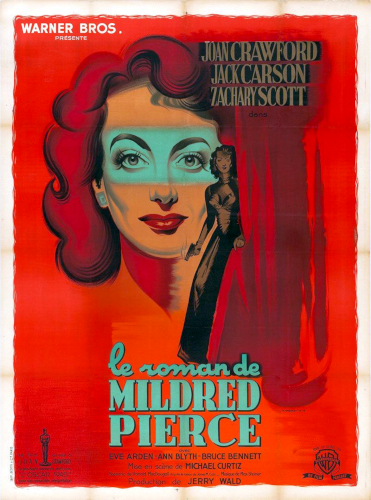
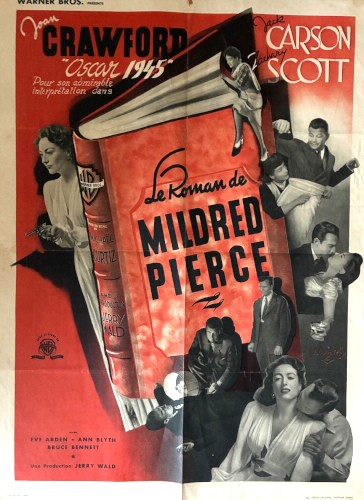
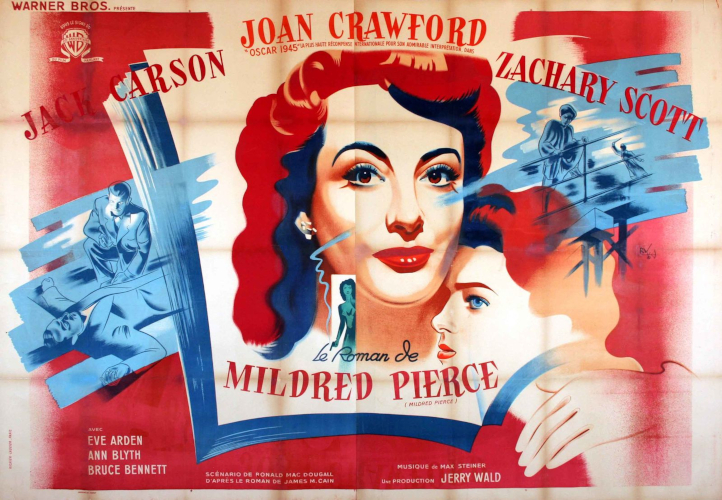
Above: 3 from France.


Above: Argentina, Belgium, and Germany.


Above: Holland, and 2 from Italy.


Above: Spain and unknown country.


Above: USA.
Re-Release Posters


Above: US lobby card set. Below: 1956 re-release lobby cards.


Above: (left) March 7, 1946, Grauman's program. Above (right) Cover of Warners pressbook for Mildred Pierce. Click on image to see pages from the whole book.
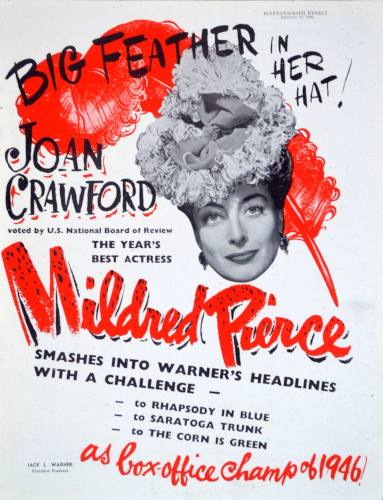
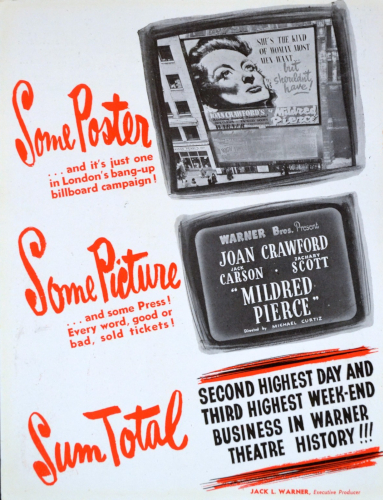

Above: UK trade ads. Below: US trade ads.


\

Below: NYC subway advertisement card (21 x 11 inches)
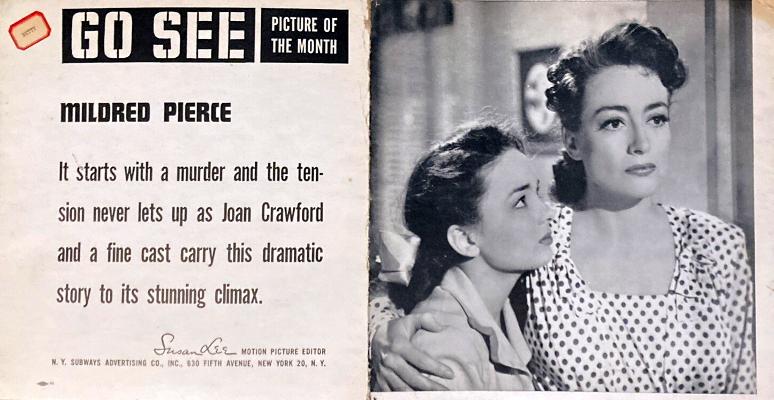
Below: Newspaper ads from Chicago, Detroit, and Dallas.


Below: US newspaper ads (unknown cities).


Below: (left) Ladies' matinee in New London, Connecticut. (right) Promotion truck outside theater.


Above: Production schedule (click for larger), litigation letter to Joan (click for larger), and MGM promo art.


Above: Charcoal storyboard drawings by the film's Art Director Anton Grot.


Above: Pages from a Danish program. Below: A Spanish herald from 1950.


Below: Left: Congratulatory trade ad from unknown country in South America. Right: Congratulatory U.S. trade ad from Jack Warner.


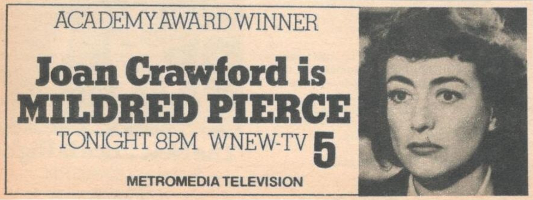
Below: Newspaper ad for a 1972 New York City TV showing.
For more information, see the Books Related to Joan Movies page.


The Best of Everything


 Stephanie Jones



 Michael Lia
