The Best of Everything
Encyclopedia Entry • Films Main
Pretty Ladies
1925
Critics' Reviews • Our Reviews • Movie Posters • Lobby Cards • Misc. Images
Click here to see photos from the film.
|
US release: 7/15/25 (premiere); 9/6/25 (general). Print survival status: From silentera.com: "Print exists (minus Technicolor sequences)" Not available on VHS or DVD. (A 53-minute version is available on YouTube. And Amazon currently offers what looks like an incomplete bootleg version.) Cast: ZaSu Pitts, Tom Moore, Ann Pennington, Lilyan Tashman, Bernard Randall, Helen D'Algy, Conrad Nagel, Norma Shearer, George K. Arthur, Lucille LeSueur (Joan as "Bobby"), Paul Ellis, Roy D'Arcy, Gwendolyn Lee, Dorothy Seastrom, Lew Harvey, Chad Huber, Walter Shumway, Dan Crimmins, Jimmy Quinn. Credits: From the story "Hearts" by Adela Rogers St. Johns, which appeared in Cosmopolitan magazine. Adaptation: Alice D.G. Miller. Director: Monta Bell. Camera: Ira H. Morgan.
Plot Summary: This comedy-drama about the Follies was written by veteran newspaper reporter and "sob sister" Adela Rogers St. John. Maggie (ZaSu Pitts) is the Follies comedienne, and she envies all the other girls in the show -- the pretty ladies with their sweethearts. She knows she's only there for the laughs, and that no one would ever give her a second look if not for her clowning. Things change when the accidentally falls into the orchestra and breaks the drums being played by Al Cassidy (Tom Moore). A friendship begins which blooms into romance, sparking the jealousy of Selma, the leading lady (Lilyan Tashman). Cassidy writes a hit for Maggie and sticks by her. Eventually they marry and start a family. Cassidy, who has become a renowned songwriter, is called to Atlantic City to prepare a new score for Selma. Finally he falls prey to her charms. A gossip informs Maggie of this fact, but when he returns home contrite she refuses to listen to him and pretends nothing has happened. Secretly, she prays it will never happen again. The supporting cast in this picture is impressive. It includes Norma Shearer, Conrad Nagel, and Ann Pennington as herself. In a bit part is an ambitious, up-and-coming young starlet by the name of Lucille LeSueur. It would be a mere matter of months before she became more well known as Joan Crawford. ~ Janiss Garza, All Movie Guide
Notes:
|
"Sisk" in Variety (1925): An expensive film devoted primarily to plugging the Follies, for it mentions that show by name several times....The fault with the film is that either [director] Bell or the producers have tried to mix a spectacle of New York's theatrical world with an absorbing human interest story. Most of the revue scenes are shown in color. Living chandeliers and undressed ladies, usual revue adjuncts, are to be seen.
New York Times (July 14, 1925): Here is one of those "back-stage" photoplays with a very commonplace story, and yet it has been made a thoroughly worth-while film. The external evidence is all to the effect that the directing is what made it. Monta Bell is the director. He deserves the highest praise for this piece of work turned out of his studio.
The background of the play is the "Follies." It is so thinly disguised that direct imitations of Will Rogers, Frisco, Gallagher and Shean and Eddie Cantor appear before the curtain, while the character of Aaron Savage, the manager, is made up to look like Flo Ziegfeld. With a locale like this to exploit, many directors would have let it run away with them and we should have had another of those exhibitions which in the end get very tiresome. That was not allowed to happen in this case, however.
The "Follies" do get in, and some of the sequences occurring on their stage are made in colors and are very effective. But they are kept as a background, and a very fine one they make.What counts in the picture is that the merely conventional thing has been avoided. The director has kept the picture from being a stereotype. He has used brains and imagination. He keeps the interest unflagging throughout. One of his methods of doing this is to be constantly inventing little human touches. You get a vivid sense that all these people are real. You want to know and see more of their doings. No one has to drag you reluctant to the feast. In fact, if any one should get in your way you would be apt to push.
Even in handling his
spectacular effects the director shows originality. A Japanese scene
changes in the twinkling of an eye to a snow-covered section of the Alps,
the chorus costumes changing with it. There is a fly ballet in which
the scene is the top of a kitchen table, with the human beings in size
proportionate to an insect perspective. The story itself is very thin,
and when you stop to analyze how thin it is, you get a measure of the
director's skill in having kept things moving so satisfactorily by other
means. Al Cassidy (Tom Moore) is a drummer in the theatre orchestra.
Maggie Keenan (Zasu Pitts) is the show's comedienne, who dreams of love
but never experiences it. The drummer finally writes a song for her, she
"makes" it and him, and they marry. He has an episode with Selma Larson
(Lilyan Tashman), who wants him to use his talents for her benefit, and
"vamps" him. Maggie learns and forgives. That's all there is.
Thoroughly Worth While. PRETTY LADIES, with Zasu Pitts, Tom Moore, Lilyan Tashman, Conrad Nagel, Norma Shearer, Bernard Randall and others, adapted from the story by Adela Rogers St. John, directed by Monta Bell; Albert Rappaport, tenor; "The Beach After Dark," a Robert C. Bruce scenic; "An Hawaiian Night," with singing and dancing: Mme. Gambarelli, assisted by Frank Moulan in "A Fantasy." At the Capitol Theatre. New York American (1925): If the footlights hold a glamour for you, don't stay away from this picture. Pretty Ladies starts off with a rattling good story by Adela Rogers St. Johns. It's not just a hoked-up plot to keep some high-salaried actress at work. ...And Alice D.G. Miller has adapted it splendidly.... The cast is much too long and too good to describe in detail, but ZaSu Pitts, Tom Moore and Lilyan Tashman deserve special praise. |
If you've seen Pretty Ladies and would like to share your review here, please e-mail me. Include a picture of yourself or avatar to accompany your review, as well as a star-rating (with 5 stars the best) and any of your favorite lines from the film.
|
Rating: I thought I was going to be bored by Pretty Ladies, but I was wrong---I was thoroughly entertained! The opening with jazzy music sets the pace for something fun. The cameraman does a great job setting the backstage story theme, opening with the group of men playing cards and smoking (when they get up and move to the orchestra pit, you realize they are the musicians). The curtain rises and the show is on: lights, music, dancing girls, snowflakes, and, later, a bottle of gin and powder puffs. As the omnipresent stage-door johnnies and millionaires are taking their places, the camera pans through the theatre, capturing the frenzy and activity of the players and the vibe of the theatre, making you want to be involved. I even thought I might get a glimpse of Mama Rose and Baby June and Gypsy Rose Lee, or the "born in a trunk" Gumm sisters---such was the authentic vaudeville atmosphere. (I was also surprised to see a baby in a basket getting his feeding between acts from his showgirl mother!) For Lucille LeSueur, fitting in and working hard were her priorities. In her first billed role as showgirl "Bobby," she was in good hands for the few scenes she appeared in: Monta Bell directing, Adela Rogers St. Johns writing the story of backstage life, MGM artist Cedric Gibbons designing the sets. Lucille looked good and, having worked in the chorus herself, she fit right in with the story and the cast. I had always heard the name of Zazu Pitts growing up (how could you forget a name like that?). Here in Pretty Ladies, her "Maggey" is the star of the musical comedy, playing the clown and sharing the stage with a goat and dozens of “Pretty Ladies." Among the ladies of the Follies is fierce antagonist Selma (played by Lilyan Tashman), who causes a lot of trouble! She is demanding, selfish, and conniving---a real prima donna who wants all the attention and the applause. Maggey, however, is loved by her co-workers but has no love of her own. When the floodlights dim, she goes home to her elegant apartment and is served dinner by her maid, while fantasizing about a dream man (played by the popular Conrad Nagel). Miss Pitts has the audience on her side because the burdens she carries are achingly heartfelt. Aside from the complications of everyone’s love lives, there are some funny moments. I was at first confused when Zazu performs dressed as a house fly with a chorus of dancing girls backing her up---I cracked up when I figured out she was a fly; it was so bizarre, and I never thought I’d feel sad for a dead fly! The chorus girl with the baby has a funny scene: She lets a millionaire pay for her taxi, but after he hands her the baby, she takes off in the taxi without him. I also got a kick of Miss Crawford making out on a couch at a party and telling a man to scram when he intrudes. There is more comedy when Zazu falls into the orchestra pit and lands in the drum of her future husband, Al (played by Tom Moore). She buys him a new drum, and Cupid gets to work in perfect MGM harmony... Her love for Al takes a beating, however, when the scent of Broadway beckons him to help the wicked seductress Selma. Maggy doesn’t want to hear or believe the subsequent gossip: She knows God would not break up her family... Norma Shearer and Myrna Loy (Williams) supposedly appeared in this film, but I wasn't able to spot them (the lighting at times made the faces blur and I could find no distinction). And I wasn’t sure which one of the girls was Broadway star Ann Pennington, who played herself. I do know that Miss Loy later wrote: "Joan and I became friends [during the making of Pretty Ladies] and stayed friends, which is the most that came out of my first MGM experience." (And this is also the year in which Joan would begin her life-long relationship with us fans!)
Rating:
What
a good, and honest, backstage story!
Selma throws fits because she thinks Maggey is stealing her scenes, and the producer-boyfriend suggests to Maggey that she should perhaps postpone her entrance in order to help out Selma's performance...
Thus
is the sad Maggey's life: Talented, but unappreciated and love-lorn,
she watches other couples pair off after the show, then sadly goes
home alone, where she fantasizes about a Dream Man (a cameo by Conrad
Nagel, who, in a bit of trick photography, dines with her and kisses
her, though he doesn't exist).
Once home, Maggey pushes the Dream Man into a closet as she guides Al to her table... His "House Fly Blues" later appears as a clever show number: On the backdrop of a kitchen table, Maggey is a buzzing, crawling fly...
Aside
from the surface Maggey-and-Al love story, the film includes many
realistic (and cleverly done) behind-the-scenes looks at the
Follies life, including a dirty-old-man stage manager looking up
the girls' skirts as they ascend a staircase. And a panned shot
across the showgirls, including Joan, getting ready in the
dressing room (this shot is featured in the "Ultimate
Star" bio of Joan). And then there's the chorus girl who, somewhat
shockingly to today's eyes, keeps
her baby in a basket below the dressing table; she takes a swig
of liquor, then adds it to the kid's milk-bottle, saying, "Here,
you little pie-faced mutt." (This same girl later has an offer
from a Stage-Door Johnny to take her out: She accepts his offer
of a cab, then gets in the cab with her baby and shuts the door
on the man.)
Overall,
an
interesting, well-shot and edited film---interesting in itself,
not just for being
Joan's first film credit as "Lucille LeSueur."
Rating:
I think this may be the best JC
film from 1925. Not that Joan is in it very much, but she gets more face
time than most of the extant films from her first year in Hollywood,
with perhaps the exception of Sally, Irene, and Mary. There
is a great cast and I think that's one of the things that attracts me
to Pretty Ladies, along with its blend of laughs and more serious fare.
ZaSu Pitts---fresh off a masterful turn in Greed, 1924---stars as a
Follies comedienne, Maggie. Tom Moore co-stars as Al, drummer in the Follies
orchestra and aspiring songwriter (Moore was a major star in the early '20s
and had a notable co-starring role in Manhandled with Gloria
Swanson, 1924). Moore is likewise very good as a bored drummer with
bigger show business dreams. Lilyan Tashman is Selma, Follies diva; she
does a great job as the bad egg (had Tashman not died young, I think she
would have been a big star). Other stars like Norma
Shearer and Ann Pennington are listed in the credits, but not seen in the available copy.
Reputedly, Myrna Loy and Carole Lombard appear as chorus girls in the
dance numbers. Conrad Nagel---the distinguished gent who introduced Joan
in her first talking role, her song and dance number in Hollywood
Revue---is Maggie's dream lover. The
story revolves around a romance between ZaSu Pitts' character, Maggie,
and Al, with Selma as antagonist. The latter, upset that comic Maggie's
entrances ruin her applause, decides to subvert the budding romance and
eventual marriage between Maggie and Al. When Al writes a hit song for
Maggie, Selma asks him over to her place to write a tune for him,
eventually setting the stage for his seduction. Pitts
is great as Maggie, playing the lonely clown with comedy and pathos.
There is a small, easily overlooked scene about 15 minutes into the movie.
An old, haggard cleaning woman at the theater (who I'd bet a nickel is
played by Bodil Rosing) shows Maggie the press clippings from when she,
Rossing's character, was a star on Broadway 30 years before. This
poignant exchange between the erstwhile and current Broadway stars is a
reminder that fame can be fleeting, and serves as a catalyst for Maggie
to take a chance on romance with Al. What
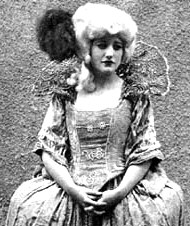
of JC? She plays Bobby, a dancer, and is billed for the only time as
Lucille LeSueur. She has a nice scene at the start in Maggie's dressing
room in which the latter helps JC smooth over a lovers' quarrel. JC also
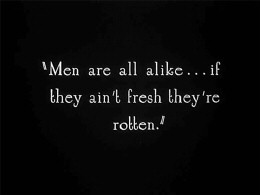
gets what is likely her first line in a movie when she utters the gem,
"Men are all alike, if they ain't fresh, they're rotten!" :
) JC has a
few scenes later on, playing a party guest, which seems to be a
recurring role for her in 1925. There's
a lot going on for an hour-long movie, but it moves along nicely. The
story ends with Maggie forgiving Al for his transgression. It's a tad
abrupt, though, as far as endings go, but this may be due to the missing
footage. JC gets quality screen time for what she considered her first
movie. I give this 4 stars. I would have gone higher if the missing reels had popped up, if the ending was a little better, and---of course---if there had been more Joan Crawford in it!
Rating:
I found Pretty Ladies from a man in Slovenia who happened to see a YouTube video I had posted of Twelve Miles Out. Very random and very lucky! I never thought I would see this film. The quality is much better than I anticipated. It has the look of a 35mm projector being recorded by a camcorder. You can see the flashing light of the projector and there is no music or anything. Truly a silent film.
This is the film that Joan Crawford counted as “film number one.” It is her first significant role in a film. Most sources say that this is the first and only time that Joan Crawford was billed by her real name, Lucille LeSueur, but I’m not so sure about that. The more I learn about Joan Crawford, the more I realize how many facts people got wrong, especially about the early years. There is no screen credit given to her in the print that I found. Not in the beginning, not in the end, and not during the film (as was done in many silent films). There is a Technicolor part missing from the film, so it’s possible she was given credit in that. The print I have is 54 minutes and the film is said to be 74 minutes. I would LOVE to see the Technicolor parts! Such a pity. It was probably a choreographed dancing act like other parts of the film.
The plot of the film is actually kind of strange. Maggie (Pitts) is part of the Ziegfeld Follies, along with many other showgirls. Her stage persona is that of a comedian and she is one of the stars, but in real life she is depressed and longs for true love. She envies the other showgirls’ exploits with men. She finally meets a man who writes a successful part in the show for her, and they fall in love and start a family, but another showgirl becomes jealous and has him write her a part in the show and ultimately gets him to commit adultery. Maggie finds out about it but refuses to acknowledge it. She remains with him, and the film ends with her praying to god that it doesn’t happen again. How sad! Such a tragic ending for such an upbeat film! You really want her to find love, and she does, but it’s not perfect love, and she doesn’t care… She says “I believe in God and God wouldn’t let this happen to me.” I’m not sure if there is a statement being made here or not.
By and large I enjoyed the film a lot. The fashion and the art direction alone are worth the watch. I found a small train scene in the rain particularly enjoyable. The film was a good start to an amazing career of an amazing woman that didn’t really come to an end until 1972.
|
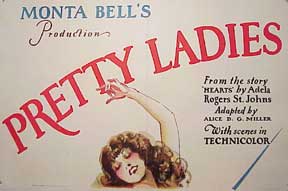


Above: A lantern slide. Below: A 4-page theater program from July 12, 1925


Above: Two U.S. trade ads (left), and US sheet music (right).
Below: US newspaper ads and review.
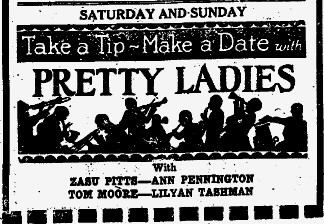


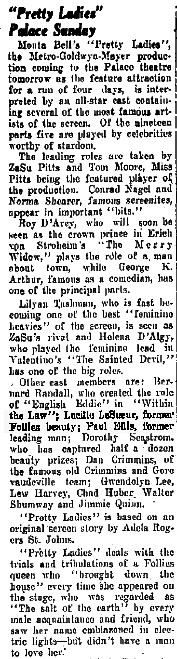
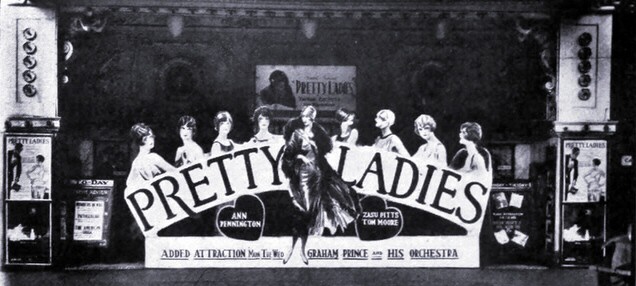
Below, from top to bottom: A Durham, North Carolina, standee. A St. Paul, Minnesota, marquee at Tower Theatre. And a San Francisco billboard.


The Best of Everything