|
 Michael Lia (March 2026) Michael Lia (March 2026)
Rating:  -1/2 of
5 -1/2 of
5 I always think I am going to be bored with Miss Crawford's
early Silents; however, in this film with
the popular William Haines, Miss Crawford shows us she has been a good student at
MGM and is
progressing in all areas of her acting life. Here, she may just be a foil for Haines
(most of her scenes are just reacting to him), and the
role of Allie (a rich society girl who hangs out at the country club in search
of love) might not offer that much of a challenge, but she does make her character explore
a wide range of emotions---and simply lets the camera love her.
The film might be formula and hokum, but for an audience
seeking a light, entertaining Haines comedy, it is harmless. Director/writer
Edward Sedwick (in films since 1920, including a few Buster Keaton films; his last
job was directing an I Love Lucy episode in 1953) might be bland, but he
knows how to make a story run its course. Spring Fever is predictable, but it
does also keep you rooting for the hero and heroine.
Haines
(Jack Kelly) and his father (Pop Kelly, played by Burt Woodruff,
who also appears in Joan's Laughing Sinners), both work in the same shipping factory
for industrialist George Fawcett (Flesh and the Devil 1926), an avid
golfer who's not very skilled. When the boss sees Jack goofing around on the
factory floor and hitting some wild golf shots, he offers him a
2-week membership at his fancy country club so Jack can help him
improve his swing. Thus begins the male version of Cinderella(also similar in theme to the beginning of Joan's later The Bride Wore
Red).
Once
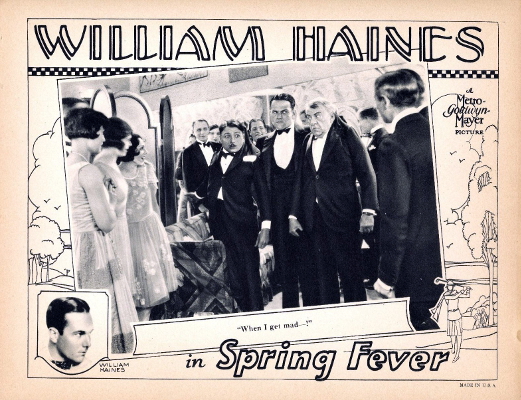
at the country club, Haines does a lot of slapstick and clowning,
which irritatesthe other club members, who think he is the nephew of the boss. He also
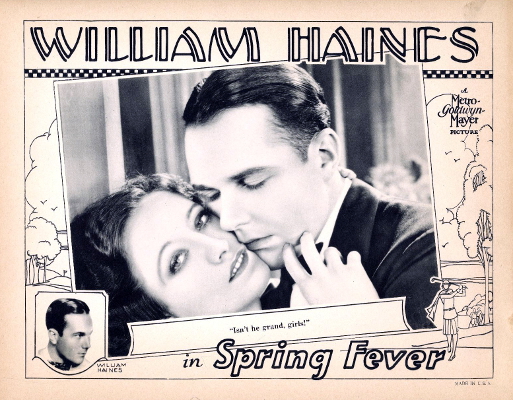
irritates Miss Crawford's "Allie," who puts off his persistent, aggressive flirting.
She might be amazed at his Harold-Lloyd-esque scaling of a building
and hanging off a ledge in attempts to impress her, but Allie also has
her own secret: She's not wealthy, either; her father has lost all
of the family's money. So her own sights are set on a wealthy
man (George K. Arthur) who seems more of a sure thing.
Most of the film's
action comes
from Jack's attempts at keeping his secret while living a double life. He loves the high life and the golf life---the
clothes and sophistication and beautiful girls, and everything else the country club embodies
for him. Once he gets a taste of it, he certainly doesn’t want to go
back to the factory, and to being just a shipping clerk and living with his poor old
dad. Jack also
loves the attention of the club members, and his expertise at golf makes him a show-off,
with an ego knowing no bounds. Once he wins a big match and his proud
(but rather decrepit-looking) father shows up to congratulate him, the dichotomy
between charade and reality is finally breached, and an ashamed Jack
finally has to confront his real circumstances and future.
Can he tell
Allie the truth that he is poor, but that he loves her? Will Allie admit her
own poverty and agree to marry him? Or will she marry the actually
wealthy man she doesn't love? There is a
lot at stake here, for everyone’s lives. Which is more important----love or
money?
The
beginning of Jack and Allie's final scene in a hotel room hasn't
yet answered these questions, although their mutual bravado has
now been reduced to shyness, and there are some clever and charming
hints of possible romance to come. AND...one more big golf match
to play! (It's an MGM film, after all---what do you think
happens in these final love and golf matches?!)
 Stephanie
Jones (October 2022) Stephanie
Jones (October 2022)
Rating: of
5
After immediately becoming suspicious
in the first couple of minutes of viewing, and then doing only a
tiny bit of online research: Yes, in the pre-Crash mid-1920s in
the USA, there was a golf vogue in middle-class America and in the
nation's press. Why else this mostly tedious film, in which a business
owner compares his local golf triumph to Lindbergh's famous
May 1927 trans-Atlantic flight, and where women's breasts (including
Joan's) literally heave while watching a golfer's swing? Or where
the supposed high point of the plot is when the hero's
girl has his favorite driver ("spoon") delivered to him
so he can beat the course record?
Aside from the blatant attempt to
cash in on that year's current golf trend, there's also the dumbed-down
film plot (still prevalent today) of a down-to-earth working-class
guy who mocks the system while still somehow managing to conquer
it (you know---the "comfortable at the opera AND at a
baseball game" stereotype). I always dislike such blatant kow-towing
to the masses (whether middle- or lower-class), which is why
I pretty much disliked this film. Every reviewer today seems
to hate Joan's "The Boob," released a year earlier, but
I'll at least give THAT film credit for being actually
funny and weird, and even original (in the use of the new technology).
"Spring Fever," on the other hand, is mainly a bore. (Director
Sedgwick was previously known primarily for his MGM Buster Keaton
films---I haven't seen most of Keaton's films, so I can't compare
Sedgwick's Keaton work with this throwaway film.)
William Haines is "Jack Kelly,"
a warehouse clerk who gets invited "for two weeks only"
to his boss's country club after he shows the boss a few fancy golf
shots. Kelly is a "man of the people": He makes faces
behind his boss's back and, when notified by phone that a chauffeur
will pick him up for the country club, replies, "Send
the car with that horn that sneers at people." (Kelly also lives with his
father in a tenement and is an old-school sentimental Daddy's boy: He helps
his decrepit old father, his co-worker at the warehouse, and
apologizes for being tetchy about Dad touching his "spoon."
He later hates to disappoint Daddy about his life choices.)
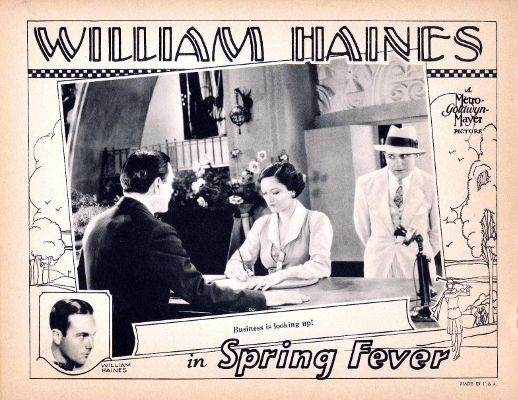
Joan is "Allie Monte," a
regular at the country club, whom Kelly meets about 1/3 of the way
into the movie upon check-in for his "two-week membership" and
immediately comes on to. Other country-club regulars introduced
here, for plot purposes, are a bland "Harry Johnson,"
who's in love with Allie; a bland, ennervated Brit "Eustace
Tewksbury," played by an unusually (thankfully!) subdued George K. Arthur;
and a horny "wealthy widow," who has "married
in haste and repented at Reno." Joan is notable in these
early scenes only for her diaphanous golf skirt and legs, which
are ogled by all.
After some rather meaningless golf
plot points (in a too-early head-to-head contest, Kelly quickly dispenses
with the hapless Harry Johnson---but...Will Kelly beat the COURSE
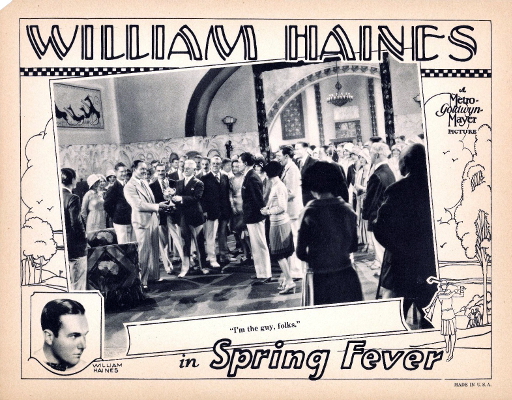
RECORD?!), the victorious Kelly declares at the after-party: "I'm
going to marry for money!," thus disappointing both his
boss and Pa, who has embarrassed him by showing his tattered old
face...and supposedly setting up the tepid latter gist of the film:
Will Kelly and Allie get together? And for love or money?
The last segment of the movie
features Jack and Allie at a ritzy hotel, where Joan gets to
display a bit of acting: Does she or does she not know that Kelly
is not rich? Here, she's still contorting her mouth, but her
eyes are rich and luminous, and some of her facial expressions are
what we'd come to recognize, and very much enjoy, in future
films. (The highlight of this scene, and pretty much the only even-partially
witty thing in the whole movie, is the complete blackout of
the screen and then "Whatever
did I do with my nightgown?")
Haines is the star here, but he's
not particularly engaging. There are his mildly funny
faces made behind his boss's back; the poke-in-the-butt he gives
his male co-worker (and, later, Allie); the early too-long scene
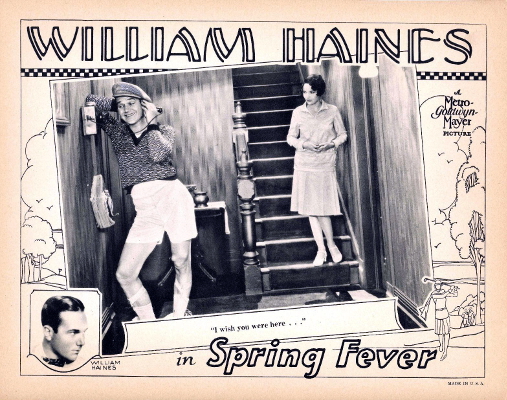
in the apartment hall where his pants have fallen down; and then
his slapstick tumbling about on the ledge outside Allie's window.
And the scenes where he's coming on to Allie are risque for the
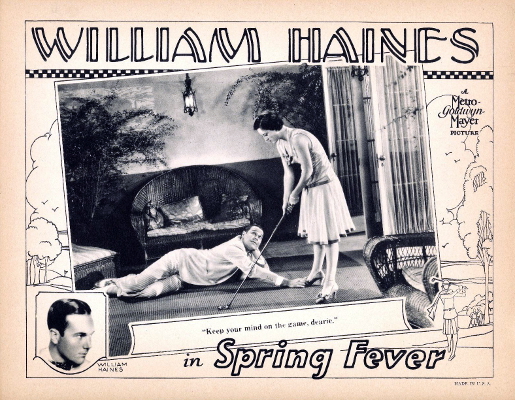
period: At
one point, he's lying on the floor looking at her legs and up her
skirt, plus there are the various scenes of him holding her close while teaching
her how to golf. But ultimately, for me at least: Who cares if Kelly wins the golf tournament
OR gets the girl? The stakes seem, at all times, extremely low.
In short: "Spring Fever"
seems like a blatant attempt at drawing in a lowest-common-denominator
audience. It's a throwaway for the working class, as well as for
trend/sex-seeking college students and their middle-class parents
who had read recently in press hype that "golf" was the latest thing.
 Tom C. (July 2022) Tom C. (July 2022)Rating:  -1/2 of 5 -1/2 of 5
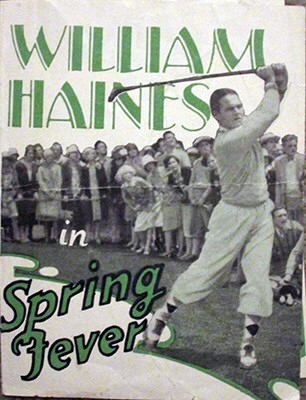
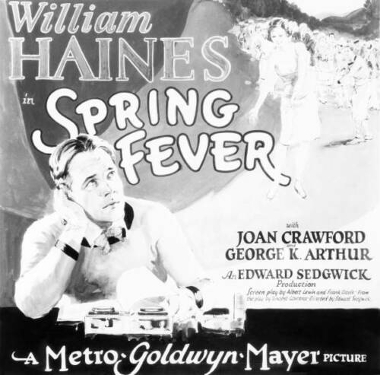
Spring Fever (1927) is Billie Haines' first starring role, per IMDB. He plays a golf
"bug" who endears himself to his boss through his acumen on the links.
As with many of his silents, he's a dashing-but-charming rogue who
needs to be brought down a peg, the latter usually arising from the love
of a good woman.
George Fawcett plays his boss and "uncle," and he's good here like in every film of his I've seen. (He played Don Jose in The Tide of Empire, 1929, a movie initially planned for Joan. He was the older Hugh Porteous in The Circle (1925) and also had a role in The Merry Widow,
also 1925, in which Joan had a bit part.) The scene where Billie
pantomimes Fawcett as the latter walks through the factory floor is very
funny.
William
Haines as Jack Kelly is his usual irrepressible self. I think Haines
could have been one of the great silent comedians if he had wished, and
if he wasn't so handsome! His timing and mannerisms are spot on. The
scene in which Haines answers the phone in his skivvies---the phone is
in the hallway of their tenement---is comedy gold. Likewise, the scene
where he destroys his caddie's pocket watch because he's distracted by
Joan's lovely gams is very amusing.
Joan (Allie Monte) doesn't appear until 18 minutes into this 78 minute movie. She's radiant. To paraphrase Conrad Nagel from The Hollywood Revue of 1929,
she's the personification of youth and beauty. Jack is immediately
smitten with Allie. I can't blame him! Joan catches him in a fib, and
down Mr. Haines goes in flames. You know that's not going to slow
Billie down, and eventually they'll fall out of and then back into
love.
Joan
and Billie have great chemistry on screen. They were, of course,
life-long friends. The nervous wedding-night scene, particularly the
little vignette where intertitles are projected in what is supposed to
be a blacked out room (Joan is too shy to disrobe and change into her
nightie in front of new hubby), is both funny and adorable.
Minor
characters are populated by familiar faces from other Joan silents.
George K. Arthur is a dweeb, as usual. (He was in early Joan movies Lady of the Night and The Boob, 1925 and 1926, respectively.) Edward Earle, her beau from 12 Miles Out (1927), plays the club pro and Jack's rival for Allie. Eileen
Percy plays a rich widow, whose main role appears to be comic relief. (She also acted with Joan in 12 Miles Out.)
The titles are witty, thanks to Ralph Spence, who also did the intertitles for Joan's first starring role, The Taxi Dancer (1927), the contemporary reviews of which seem to suggest Mr. Spence had a knack for this sort of thing.
Per
IMDB, some exteriors were shot at the Jewett Estate in Pasadena, which
featured in other silents. See links below. Nice spread!
This
is another formula Billie Haines picture, but the public seemed to like
them. Joan is clearly developing into a better actress (she made this
film right after The Unknown [1927], in which
she says that she started to learn the difference between acting and
standing in front of the camera from Lon Chaney).
And, with this review, Spring Fever
is the last of Joan’s extant silents I can find to review. Let’s hope
with the great diva’s Hollywood reign soon to enjoy its 100th
anniversary there is renewed interest in finding her “lost” silents that
laid the foundation for one of the greatest careers in film, and in
making them available to her adoring public.
 Shane Estes (August
2010) Shane Estes (August
2010)
Rating:
-1/2 of
5
Yay!
I’m the first one to review this film on this website! This is another
one of those Crawford films I avoided for the longest time because I
thought it would be really bad, but when I ran out of Joan films that I
had not seen I eventually made it to this one. Actually, this was the
last Crawford film I hadn’t seen that was easily obtainable. Joan said
in CWJC [Conversations With Joan Crawford] about Spring Fever: “God, golf is dull on film,” so I was immediately turned off; however this is not a film about golf, rather a comedic love story
with a golf background. I’ve come to find out that many of the films
that Joan talked bad about in CWJC I actually really like. She was a
very harsh critic of herself.
The
film itself is in pretty bad shape, with lots of celluloid damage you’d
expect from a film of this age, but that shouldn’t deter any Crawford
fans from watching this. It’s worth the time, trust me, and it’s amazing
that this film even exists at all. It’s an interesting watch for fans
of Crawford who want to see a very young and inexperienced Joan finding
her way in front of the camera, and a cute little film for anyone
interested in Old Hollywood really. It’s not her most entertaining silent film (for me, that one is The Unknown with Lon Chaney),
but it’s not her worst either. Despite the fact that this is a William
Haines film, Joan is actually a primary character who is integral to the
plot, and once she’s on screen she’s a part of the film to the end,
unlike West Point and Tramp, Tramp, Tramp, where she has very limited screen time.
Plot
and substance are very thin to say the least, but nevertheless
entertaining. Joan plays Allie Monte, the frumpy socialite who hangs
around the country club with the other aristocrats, and whose father
eventually loses all his money, forcing her to “marry for money” if she
wants to keep her social standing. Don’t expect to see any of that
beautiful flapper-Joan-look in this film. Unfortunately, it’s simply not
here. Haines plays Jack Kelly, the light-hearted funny man
who works as a clerk in some nowhere shop and never takes anything too
seriously, even his job. The two come together when Haines gets to spend
2 weeks in the country club for showing his boss how to golf, giving
him an opportunity to “marry for money." I’ve only seen Haines and
Crawford in one other film together (West Point), and their time
together in that film was very limited, but here you can
really see the chemistry between the two! They work wonderfully
together! It’s a shame what eventually happened to Haines’ career.
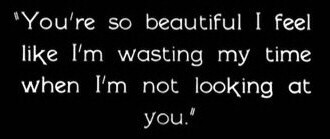 The film is full of hilarious and witty intertitles. A few of my favorites are when the film starts off with the line, “Golf
was invented by the Dutch in an effort to make the Scotch forget
bagpipes,” and when Haines compliments Crawford with the lines, “You’re
so beautiful, I feel like I’m wasting my time when I’m not looking at
you,” and “You look like a million right from the mint!” In all, this is
an entertaining film that anybody can enjoy. The film is full of hilarious and witty intertitles. A few of my favorites are when the film starts off with the line, “Golf
was invented by the Dutch in an effort to make the Scotch forget
bagpipes,” and when Haines compliments Crawford with the lines, “You’re
so beautiful, I feel like I’m wasting my time when I’m not looking at
you,” and “You look like a million right from the mint!” In all, this is
an entertaining film that anybody can enjoy.
|
 MGM Silent. 60 minutes
(7 reels).
MGM Silent. 60 minutes
(7 reels).