The Best of Everything
Encyclopedia Entry • Films Main
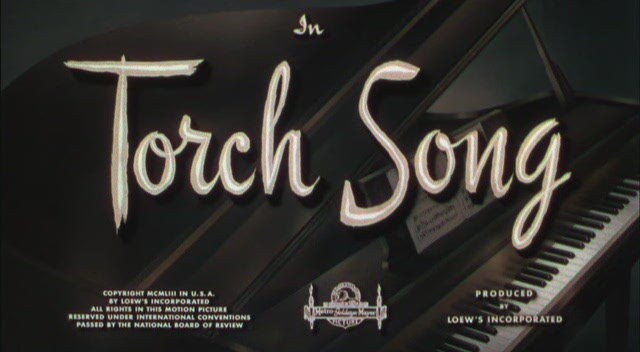
Torch Song
1953
Critics' Reviews • Our Reviews • Movie Posters • Lobby Cards • Misc. Images
Click here to see photos from the film.
|
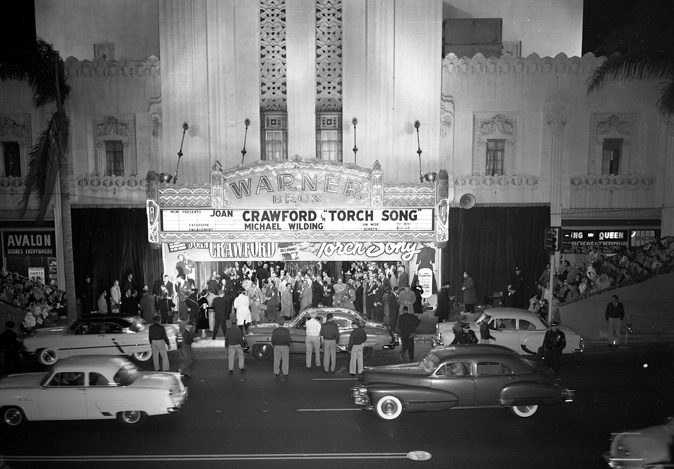
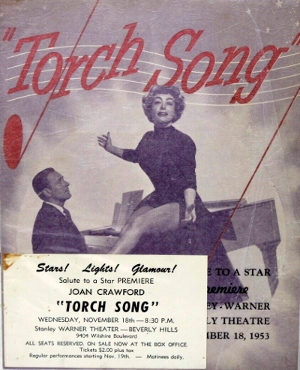
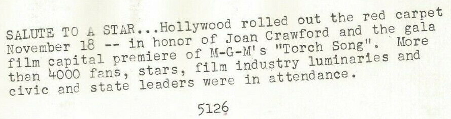
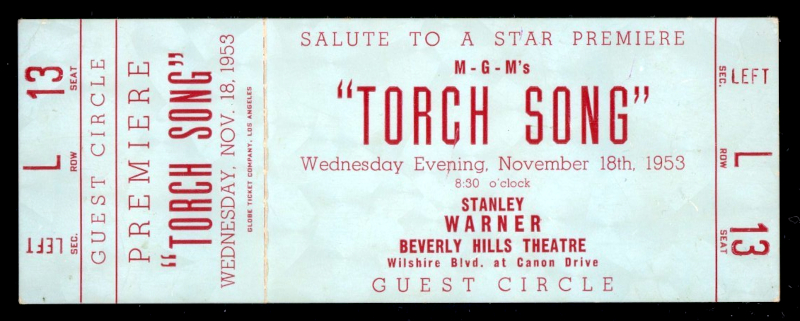
Various release dates: The AFI site says "world premiere in Columbus, OH, Syracuse, NY and Richmond, VA: 1 Oct 1953." AFI also says NYC premiere was October 12, and general release October 23. Hollywood "Salute to a Star" premiere date was November 18.
VHS release: 4/17/90. DVD release: 2/12/08 (as part of 5-disc Joan Crawford Collection Volume 2). Cast: Joan Crawford (as "Jenny Stewart"), Michael Wilding, Gig Young, Marjorie Rambeau, Henry Morgan, Dorothy Patrick, James Todd, Eugene Loring, Paul Guilfoyle, Benny Rubin, Peter Chong, Maidie Norman, Nancy Gates, Chris Warfield, Rudy Render. Credits: From the story "Why Should I Cry?" by I.A.R. Wylie. Screenplay: John Michael Hayes, Jan Lustig. Producers: Henry Berman, Sidney Franklin, Jr. Director: Charles Walters. Art Director: Cedric Gibbons. Music: Adolph Deutsch. Costumes: Helen Rose. Editor: Albert Akst.
Plot Summary: Joan Crawford's first Technicolor feature has come to be known as a textbook example of "high camp." Crawford stars as musical comedy luminary Jenny Stewart, who has been hardened by the worst life has to offer. Romance enters her life in the form of her new piano accompanist, blinded war-veteran Tye Graham (Michael Wilding). The fact that Graham refuses to kowtow to the temperamental Jenny's demands, coupled with the adversarial behavior of Graham's seeing-eye dog, makes the pianist all the more attractive to the lonely songstress. Torch Song is a favorite of bad-movie buffs and female impersonators the world over: Highlights include Crawford's blackface musical number, and the now-classic scene in which she simulates blindness to better understand the taciturn Graham. Director Charles Walters, a former choreographer, appears as Crawford's two-left-feet dancing partner in the opening scenes. ~ Hal Erickson, All Movie Guide
Awards: 1954 Best Supporting Actress nomination for Marjorie Rambeau.
Notes: • Joan's return to MGM after 10 years. • In production from April 27 through late May 1953. (AFI) • Working title for the film was Why Should I Cry? after the story it was based on. • 1952 and early 1953 items in the Hollywood Reporter announced Lana Turner and Ann Sheridan as stars, respectively. (AFI) • Joan was paid $125,000 for the film, in 83 installments for tax purposes. • India Adams does the actual singing of Joan's songs ("Tenderly," "Follow Me," "You Won't Forget Me," "Two-Faced Woman"). "Two-Faced Woman" was originally recorded by Adams for Cyd Charisse in the 1953 film The Band Wagon but the number was cut from that film. That's Entertainment III includes a segment presenting the two numbers side-by-side, in split screen. (Wikipedia)
|
In "Torch Song," which arrived yesterday at Loew's State, Joan Crawford's obvious charms are enhanced by Technicolor, and she wears a profusion of gowns and accessories likely to dazzle designers and debutantes while singing and dancing the numbers of a bulging musical comedy book. Miss Crawford, it is only fair to state, never looked lovelier, and it might be indicated also that "Torch Song" is not precisely a bright new kind of story. Miss Crawford's desperate need for love is the essence of the drama here, a film problem, it would appear, that she has encountered before. The lady is, in this case, a Broadway star who arrived at her zenith the hard way and is ruthless in maintaining that position during rehearsals of a new show to the extent of giving her associates, backstage and elsewhere, assorted megrims. At this point, however, Michael Wilding, a blind pianist, arrives on the scene as her arranger-accompanist to replace a predecessor who has been forced to flee her tantrums. The versatile Mr. Wilding, a drama critics before the war in which he lost his sight, also is secretly in love with Miss Crawford and, as a philosopher and psychologist of sorts, is a great hand at needling his lady fair. She finally responds by recognizing that she not only loves but needs him. It should be pointed out that the aforementioned essentials do not include some sparkling, contemporary lines contributed by John Michael Hayes and Jan Lustig, the scenarists, as well as good renditions of the Jack Lawrence-Walter Gross tune, "Tenderly"; the Kermit Goell-Fred Spielman number titled "You Won't Forget Me" and a production song and dance scene featuring "Two Faced Woman" by Arthur Schwartz and Howard Dietz. Michael Wilding is restrained but fairly effective as the pianist; Gig Young, Marjorie Rambeau, Henry Morgan and Dorothy Patrick are competent as Miss Crawford's boy friend, mother, stage manager and rival, respectively. But it is Miss Crawford's show and she plays it to the hilt justifiably, displaying her legs in a turn or two and a respectable amount of emotion to project both her tough but beautiful exterior and the essentially soft lovesick woman underneath it. However, despite its glitter and polish, her "Torch Song" is strangely familiar.
Otis L. Guernsey, Jr., in the New York Herald Tribune (1953): ...Joan Crawford has another of her star-sized roles....Playing a musical comedy actress in the throes of rehearsal and in love with a blind pianist, she is vivid and irritable, volcanic and feminine. She dances; she pretends to sing; she graciously permits her wide mouth and snappish eyes to be photographed in Technicolor....Here is Joan Crawford all over the screen, in command, in love and in color, a real movie star in what amounts to a carefully produced one-woman show. Miss Crawford's acting is sheer and colorful as a painted arrow, aimed straight at the sensibilities of her particular fans....
MonsterHunter.com (2004): ...[Here you have] the distinct pleasure of Joan overacting in each and every scene, her giant eyes and big snarling lips competing with her day-glo hair to see which would be more annoying to the viewer. She also like[s] to show her forty-something year old legs off at every opportunity. Thanks for that....[T]his movie really makes you wonder what MGM was thinking when they brought back her from her exile at Warner Brothers to do this movie. It is as unpleasant and gaudy as the make up Joan wore (even to bed) in this film. I know that she's supposed to be set up as this self-centered jerk and that she supposedly learns to be a better person from a blind guy, but her conversion to loving person was so fast and unexplained it just rang as false as the wigs Joan periodically donned....[T]he movie is in color and in 1953 that meant showing off by having everything you can imagine in gaudy colors, from Joan's lemon yellow robe, to green walls, to these weird blue suits the guys wore. It just added to the entire artificial and tacky flavor of the proceedings. Artificial and tacky. Hmmm. Not a bad way to sum up the movie and Crawford's "performance." |
If you've seen Torch Song and would like to share your review here, please e-mail me. Include a picture or avatar of yourself to accompany your review, as well as a star-rating (with 5 stars the best) and any of your favorite lines from the film.
|
Rating:
I was momentarily torn between a "3" and "3-1/2" for Torch. It's primarily very simplistic, acting- and plot-wise; and, yes, Joan's dancing/singing numbers are for the most part mediocre---except, that is, for "Two-Faced Woman," which is quite jaw-droppingly bizarre, psychedelic almost, and a wonder to behold! And, OK, Joan tends to bark most of her lines in the first two-thirds of the film. And so I had to realistically go for the slightly lower rating. But there are, nonetheless, some actually sincere moments near the end---along with many funny one-liners and Marjorie Rambeau's brief appearances as Joan's blowsy old mom---that, along with the "Two-Faced Woman" number, make this film interesting and decidedly one to watch in Joan's canon.
To
start off with the ridiculous, via some 1953
trailer tag lines for Torch (included with the Torch
disc from the 2005 5-disc Warners set): The Emotional Experience Every Woman Fears! [Well, I also wouldn't want my blind wannabe-boyfriend's guide-dog constantly growling at me....] Crawford---As you've always remembered her! [Maybe in 1933's Dancing Lady was she a star of a Broadway show, but other than that, she was only a minor chorus girl a couple of times.] Crawford---The Eternal Female [Joan's about as tough and Butch as she can be, outside of Johnny Guitar.]
Stuff like the above---and like the 1953 MGM publicity touting Joan's return to MGM after 10 years, and her first film in Technicolor, AND her "singing and dancing"---all served only to set expectations way too high. Torch is in no way a lighthearted, delightful romantic musical-comedy, or any sort of musical triumph for Joan. It DOES, however, turn out to be a relatively interesting drama.
RE the promotion of Joan as a triumphantly-returning-to-MGM dancer/singer: If you're familiar with any of Joan's '20s and early '30s movies, you know that, even as a young woman, she was a spirited and spunky chorus-style dancer, but hardly a graceful "good dancer." Same with her singing: Joan had a gentle, sincere warble that sounded perfectly OK in '30s pics like Possessed ('31) and The Bride Wore Red ('37) but was obviously not suitable for the more powerful vocal style of the '40s and '50s----per the Broadway singer Joan is portraying here. (Thus the dubbing by India Adams---which, though deep and throaty, did not match Joan's voice and seems weirdly and obviously dubbed in all of the singing scenes. Joan tried, though: The abovementioned Warners disc includes nearly an hour of numerous Joan outtakes for the song "Follow Me." "Don't laugh at me!" she says jokingly at one point; at another point, she says she's not going home 'til it's done----After the first 15 or so takes, it gets worse and worse...Seems like they should have all gone home a lot sooner!)
As for the infamous "Two-Faced Woman" blackface number: To a modern 20-year-old viewer: "OMG---she's in blackface." Which wasn't all that shocking in 1953, though the mid-'50s were the tail-end of blackface being presented in films. Aside from the mediocre dancing/singing in this particular number, it's funniest for camp aficionados in the final moment when Joan's Jenny Stewart rips off her black wig and glares after her departing love interest with white eyes and red hair blazing amid the black makeup. Not a DEI moment, but a wonderfully hilarious episode in Joan film history nonetheless.
RE the actual film:
Joan's "Jenny Stewart" is a hard-as-nails, perfectionist, long-time Broadway star rehearsing for a new show, and seemingly surrounded by dummies. Because she can't trust anyone around her, she's on top of everything from musical arrangements to dance steps to costumes. She's constantly angry (though "making a religion of" the theater and being very nice to fans waiting for her outside the stage door). She also has no one in her personal life, other than a 40-year-old decrepit "boy toy" (Gig Young) and her less-than-satisfactory family (Mom and sister), who are usually only asking her for money.
Into the picture comes the genteel, blind "Tye Graham" (Michael Wilding), a replacement musical arranger who drives Jenny mad with his actual opinions. As it turns out, before he was blinded in WWII, Graham was a Broadway critic who years ago wrote about Jenny as a "gypsy madonna" in her debut show. He fell in love with the kinder, gentler Jenny way back when... Today, though, his seeing-eye dog funnily growls at the grouchy Jenny every time she appears, and Graham himself is quite critical:
Tye: Did you ever hear of a defense mechanism? Jenny: You mean like a girdle?
Tye (re what the former musical arranger has said about Jenny): He said you had a sensational figure but that you threw it about like a burlesque queen.... He said your mouth belonged to an angel but that the words that came out of it were pure tramp.
Tye's critiques of Jenny aside: There are many great lines in this film! Not contributing to an overall stellar film or anything, but definitely contributing to funniness and future Camp Values:
Dance Director: If you could get your right leg in a little bit... Jenny: And spoil that line? Tell Mr. Ellis he's paid to get around that leg. And smile, or we get another boy.
Cabbie (to Jenny's producer as they ride together): What's your address, Mr. Norton? Jenny: Any dark bar.
Tye (after Jenny has questioned why he can't play the music as she wants): My right hand has a mind of its own. Jenny: Then sit on it!
Tye's Chinese houseman, quoting his father: The easy ones are no fun!
Jenny to boyfriend: You're completely useless but beautiful.
Boyfriend to Jenny: You're the distilled essence of effectiveness.
Jenny Stewart's alone-ness (which is what the film is actually about) is also indicated by various scenes in her apartment: She tries to read lines with her secretary (Maidie Norman, who later appeared in Baby Jane); she tries to amuse herself by fiddling with the lights, the radio, the clock (and mildly burning herself while trying to light a cig). She forces her manager to set up a party on a Sunday night (attended only by single males, since, as her manager has told her, people with families have other things to do on a Sunday night).
At this point, Jenny, in emotional desperation, goes back to her mother for comfort---and here is where Marjorie Rambeau's Oscar-nominated scene comes in. (Historical note: Rambeau---who was 16 years older than Joan---played Joan's showgirl friend in 1931's Laughing Sinners. And, before illness, was initially slated to play Joan's mother in 1931's This Modern Age.)
Rambeau's Mom character offers Jenny a beer and money (see, she wasn't just after Jenny's money earlier), and pontificates on men and loneliness (the two women both listen to the same late-night radio show for companionship)... When Jenny finally reveals that she's in love with a blind man, Mom reciprocates by telling her that Jenny's own father was bald---"We all carry some infirmity with us." When Jenny reveals that she both hates and loves Tye, Mom gives some wisdom from the local butcher's wife: "Basic Sex Antagonism = Love." Mom also has kept 10 scrapbooks of Jenny's every appearance since she became a star... When Jenny mentions the "gypsy madonna" phrase, Mom remembers it, and looks up the initial review for the song "Tenderly" that Tye wrote, pre-War, pre-blindness... Jenny listens to her mother's copy of "Tenderly" and sings along, as Mom guzzles her beer, and Jenny then seeks out Tye...
So there's a real love story here. And also a real family story, despite all of the other weirdness. And, as critic Molly Haskell says about Joan in the brief DVD doc that accompanies Torch: However outrageous, there's something about her that commands a kind of attention, a kind of sympathy. Attention must be paid.
Ed Budzilowicz (February 2015)
My wife and I recently watched Torch Song... This isn't so much of a review as a comment. Nearly every review, on your site and elsewhere, refers to Torch Song as "camp," in the sense of unintentionally funny. (The films of Ed Wood come to mind.) I think that does a disservice to the filmmakers, particularly the writers, because it's obvious-- to us-- they knew exactly what they were about. They were playing up the strengths, physical characteristics, and reputation of the actress; and the writing, and the way the supporting characters--Jenny Stewart's patsies and foils-- are drawn up is consistently clever. So, "camp" in the sense of high theatricality, yes. However, if there was a "joke," I think everyone involved in the production was in on it. Anyway, that's the way we see it.
Rating:
Entertaining cringe-worthy camp. I recently read a review that said “surprisingly this was Joan's first color movie. Clearly her face was designed for B & W.” I agree. So much from this era seems over-acted, like she got trapped in a vacuum of fierce steely determination that wouldn't allow even a hint of softness. Her real singing (which I discovered recently on YouTube) would have been a better match than the dubbed songs. Although impeccably lip-synced, the voice just doesn't seem to match the character, which adds to the over-all air of weirdness that swirls through this movie.
Rating:
Although it still serves as prime ammunition to deride its main star -- Christina Crawford takes bitter delight in highlighting her Mommie Dearest's grand empress delusions and "middle aged body" when reflecting on the film -- Torch Song beckons to be seen to be (dis)believed. Hyped as Joan Crawford's grand return to former studio label MGM, Torch Song is her first showing in technicolour: a pseudo-musical-cum-soap debacle that defies all taste and artistic coherence. Crawford dominates the picture as a difficult broadway star, stomping her way through cast and scenery alike. There's also an outrageous scene that etches itself into the banks of film faux pas forever. In what seemed to be a symbolic transition of Joan Crawford the actress to top-tier diva, she plays Jenny Stewart, an ageing broadway starlet with a volcanic temper. Jenny is preparing for her latest one-woman show and becomes increasingly frustrated with the production and cast alike; the film follows her backstage drama with intermittent musical rehearsals. In the introductory dance sequence, Jenny verbally decapitates a dancer (director Charles Morgan) that trips over her fabulous legs. Her poor (presumably alcoholic) agent fares worse when she threatens to cancel the show. This broadway star not only plays the part, but demands utmost perfection in every aspect of production values, and the term diva is personified so terrifyingly in Jenny's persona that it would even scare the modern-day myths of Mariah Carey. With strops and temper tantrums askew, Crawford bites into her lines with deadpan delivery. At times one can hear the brittle tone in her voice turning hoarse as the steam pours out of her ears. Such would be when Jenny's regular composer quits after becoming so mentally exhausted by her scrutinising nature; he is replaced by Ty Graham (Mr. Elizabeth Taylor, Michael Wilding), a pianist who lost his sight after serving during the war. Articulate Ty immediately strikes a nerve with Jenny with his tendency to tell her the truth at all times (read: that Jenny Stewart isn't and can't be perfect all the time). "Why don't you get yourself a seeing-eye girl?" Jenny quips to him. Of course, the enthrallingly amusing irony of all this is that for all Jenny berates her colleagues for, Crawford is neither singing or dancing (really) in Torch Song. The musical numbers are sung by India Adams and her dancing more or less consists of predetermined poses. In the now notorious "Two-Faced Woman" routine (recycled from a disused Cyd Charisse scene in The Band Wagon), Crawford emerges in a getup that has surely inspired a wave of Las Vegas drag-cabaret acts: full mulatto make up, blood red lipstick, her lacquered eyebrows dotted in rhinestones. If this image wasn't frightening enough, when the routine is finished and Jenny spots Ty bidding a silent departure, her mouth turns sullen as she yanks off her wig to reveal a shock of pastel orange hair. If one pauses at this shot, you will see Crawford's face in a recurring nightmare. The script becomes a tennis-match tussle between Jenny and Ty as their affections for one another bristle and entangle in equal turn. Jenny secretly appreciates Ty's honesty, but perhaps not so much when, at the end of his tether with her imperious manner, Ty brutally deconstructs Jenny by predicting a bitter future of alcoholism and loneliness as tears fill in her eyes. It must have been somewhat hard for Crawford to receive these lines as this was a period in her life that foreshadowed those two very things. Torch Song, blatantly, was conceived with a view to exploit Joan Crawford the star. Here we have her at scarcely 50 years of age, basking in brash technicolour glory and pancake makeup, her face locked in an expressionless mask, snarling her way through the dialogue and often resembling a bored drag queen waiting on her latest fix of drama. The set pieces are a hotch-potch of misguided electronic chic, but the costumes are over-the-top and glamorous (Crawford has never been photographed so beautifully in certain scenes, especially during the Sunday afternoon she spends alone in her room, draped in resplendent white). In two scenes there is a classic depiction of what defines Joan Crawford's magnetism on screen. The first occurs during a beautifully lip-synched routine of "You Won't Forget Me," where the camera frames Crawford's shapely face and her features bear a faraway expression of vulnerability. Then, when Jenny realises Ty Graham actually knows what she looks like, she quietly sings along to one of her old records, "Tenderly," as her humble Mother (Marjorie Rambeau) meanders on the joy of pure love. In this scene Crawford's eyes are things of pure wonder. It's the only moment in the entire film where Crawford's face breaks forth from its glum, opaque mask and effectively emotes something tangible. Spellbindingly garish, gaudily written and at times even completely laughable, there is also something irresistibly appealing about Torch Song too: perhaps it's the empathetically parallel connection between two lead perfectionists. Jenny trying to make a disorganised show work is akin to the gusto of Crawford stubbornly motivating the film from being disposable garbage. Or perhaps the strange charm of Torch Song is the lamentable fact that even after all those years where Crawford tirelessly proved her worth, MGM still failed to guarantee material that tailored to her talents. Nevertheless, Crawford obviously related to Jenny's dogged aversion to failure and while one will not complete Torch Song with any appreciation of artistic merit, one will undeniably feel weirdly entertained by it all. Of the great variety in Crawford's work, Torch Song ranks as one her huge misfires yet still retains the most to talk about.
Rating:
A woman friend of mine recently saw Torch Song on TCM, and she called me up and said, "I'm watching Joan Crawford, and she is such a bitch! I love her."
“What movie is it?" I asked. I was intrigued when I found out it was Torch Song. My friend was captivated for the afternoon. I was pleased that today someone can accidentally watch a Joan Crawford movie and see things I never saw or feel things I never felt and actually like the movie.
My friend identified with Miss Crawford’s character to such a degree that she no longer lets men treat her badly. She can be a bitch, too.
On the other hand, my mother also saw Torch Song that day, and we also talked on the phone, and she said, “Joan Crawford was on TV. In a really silly movie, she’s wearing all these crazy colors." My mom then let out this giggle that pretty much summed up the movie for her. She had Joan as company, but she kept reading her newspaper.
Of course, for my mom Miss Crawford is nothing new; however, my friend sat curled on her couch with her cats and enjoyed the whole movie!
My experience with Torch Song is not the camp that it has become, because it actually is a good movie, but a good bad movie. Maybe it is the color film that grosses out some scenes. (Miss Crawford walking around looking like a pastel banana with a red head in her bedroom scenes.) Oh, if it was only black and white, we would have been better off.
The fact that it is a musical with an actress 48 years old trying to keep an audience in their seats… it is a feat. (The great gams really help!) In my mind there is no music in Torch Song; there is no dancing inTorch Song; there are no good-looking men in Torch Song. Just bright colors: blue, green, red and yellow, and deep browns. The music is not the champion here, although India Adams is graceful in her tone, which is soothing and pleasing.
The men I mentioned: Well, Gig Young really stinks in this movie, and I think his role is kind of thankless and bland; after the beginning, we never see him again, which was OK by me. Michael Wilding is OK; I like him in Hitchcock’s Stage Fright. He is much better teamed with Miss Wyman. But if you ever saw him in Hitchcock’s Under Capricorn running around in these awful tights, well, can’t take him too seriously. He does have some good dramatic moments with Miss Crawford, but that is all.
The only person worth talking about is Marjorie Rambeau, who plays Joan’s mother (a candid old dame). She appeared in Laughing Sinners in 1931 with Miss Crawford, and here she is, some 20 years later, acting up a wonderful storm. She makes so much of her character that you want to hang out and have a beer with her! She is so good that she was nominated for an Oscar as Best Supporting Actress. She must have been surprised. She was a total pro and shows us what acting is about: reading lines and bringing them to life; she thought, she felt. The movie should have ended with everyone going to her house for a beer!
I was happy to see Henry Morgan (thankless as his role was and maybe even miscast). Maidie Norman shows some sentiment in her tiny role and makes her thoughts and feelings known with just a few sincere glances at Miss Crawford. (She is acting with her eyes!) She has all the feeling and emotion.
Everyone involved in this film deserves credit for taking the plunge with this movie. They really did try. I know it was put together by some expert people, and there was an audience for this film. The more I am thinking about it, Mr. Wilding and Miss Crawford actually do put a real and intense spin to the proceedings. (As I am writing this, I am thinking that they were actually excellent!)
Scott (June 2005) Rating:
This was the first Joan Crawford movie I remember seeing. It came on cable when Mommie Dearest first aired. After I saw Mommie Dearest, I scanned the cable guide to see when this movie would air next. I had to see what this Joan Crawford person was really like (at least, on film). Since I was still a youngster, I didn't have full control of the television and I wasn't able to watch the whole thing, but I was amazed at how tough this woman was. She seemed almost frightening. Torch Song is a somewhat over-the-top backstage drama with intermittent musical moments. Joan plays Jenny Stewart, Broadway Diva. She's about to open in a new show that appears to be some kind of revue, and she's trying to hammer the new show into shape. Early in the film, before Jenny Stewart's character shift, Joan snarls her dialogue and barrels her way through the movie, leaving devoured scenery and costars in her wake. I wasn't sure how old her character was supposed to be, but age became immaterial in most of Crawford's films from around 1949 onward. As always, she's fun to watch. And she has some very good scenes, especially when her character begins to soften about halfway through the movie. I liked her final scene with her mother. The musical numbers are hypnotic, but not in a good way. Her "Two-Faced Woman" number, performed as a mulatto, must be seen to be believed. Favorite moment -- the end of the dress rehearsal version of "Two Faced Woman" where she rips off her wig and glares into the audience in close-up. You'll hear yourself say "Yikes!" before you can stop yourself. Her dubbed singing voice (by India Adams) doesn't really sound like Joan and underscores the camp aspect of the musical numbers. Marjorie Rambeau (who got an Oscar nomination for this movie) and Henry Morgan (in his pre-MASH days before he was Harry Morgan) are good to watch among the supporting cast. The director, Charles Walters, is Joan's hapless dancing partner in the opening sequence who gets the rough edge of her tongue when he trips over one of her famous legs. Maidie Norman, who played Elvira in Whatever Happened to Baby Jane?, plays Joan's personal secretary here. Even though Torch Song looks like it was made on a low budget, the photography is great; Joan looks wonderful in Technicolor. However, that yellow robe that she wears near the beginning of the film is something you won't soon forget. I enjoyed Torch Song because it's entertaining, but I liked it more because of the backstory: it was Joan's return to MGM after almost ten years at Warner Brothers. She must have enjoyed making the film and based on her comments in Conversations with Joan Crawford, she had fond memories of it. She got a chance to show that she still looked good at the brink of 50 and that she could still do some pretty good dancing. By no means is it a great movie and it's not Joan's best film from the 1950s, but it's worth a look. |
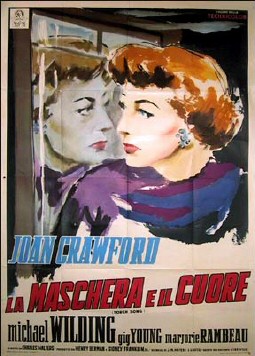
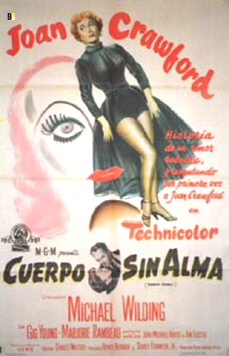
Above: Italy and Argentina.
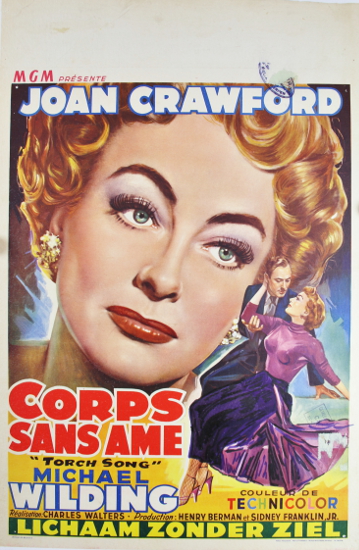
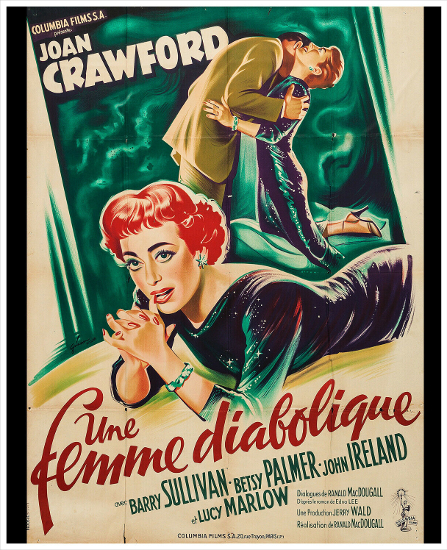
Below: Belgium, France, and Yugoslavia.

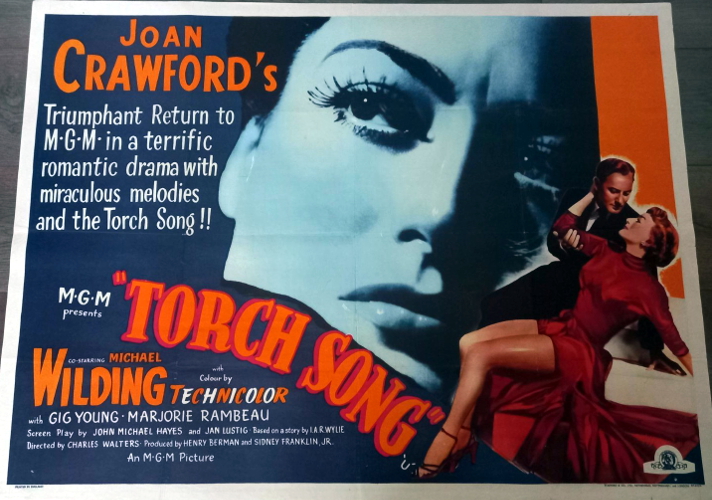
Below: UK quad poster (30 x 40 inches)
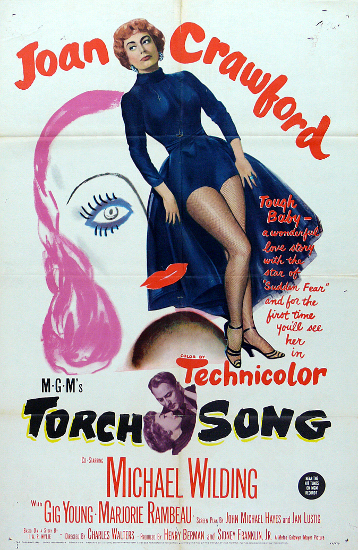
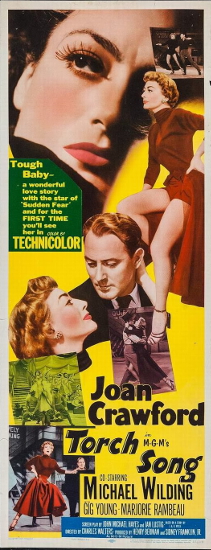
Below: US posters
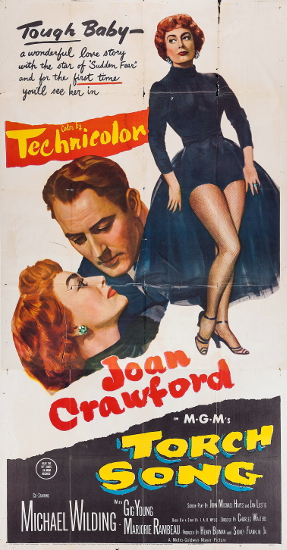
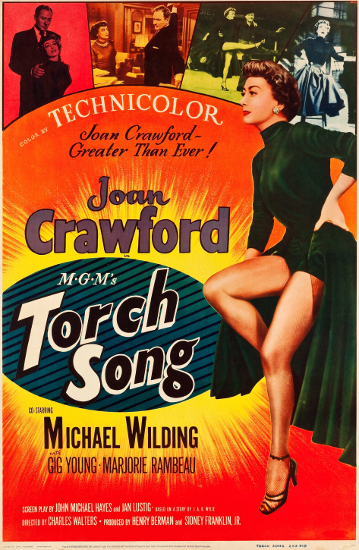
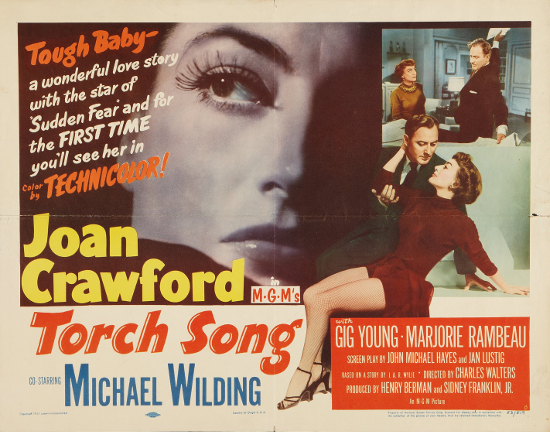
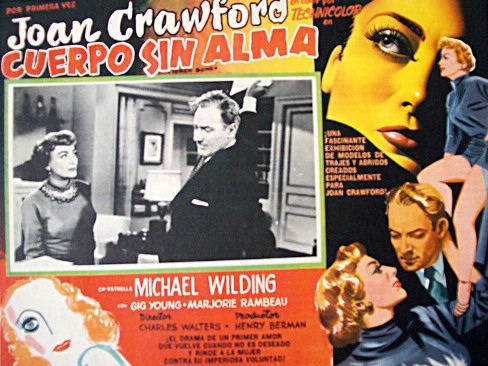
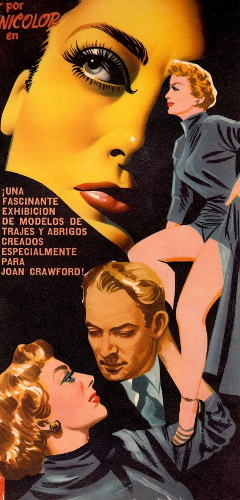
Above: Mexican lobby card and close-up.
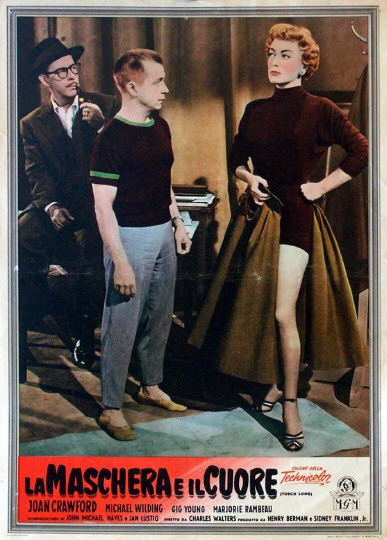
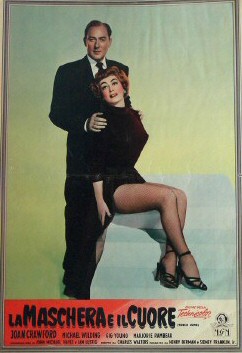
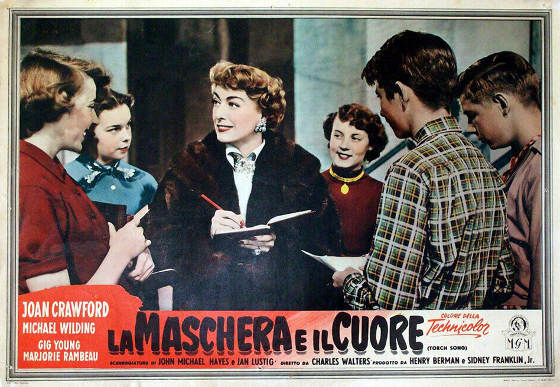
Below: Italian Fotobusta lobby cards (13 x 17 inches)
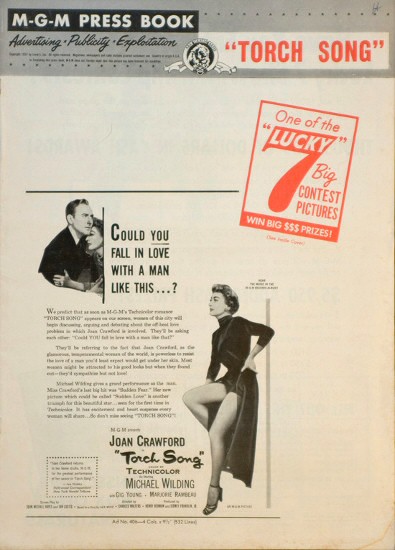

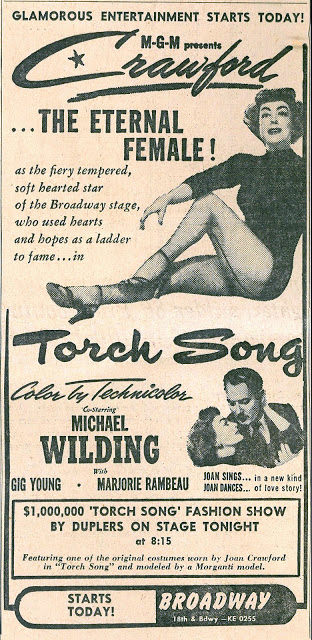
Above: US pressbook cover, US magazine ad, NYC newspaper ad, and store window tie-in.
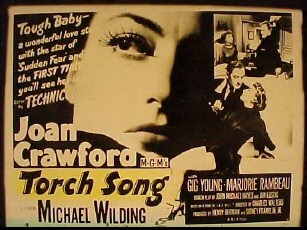
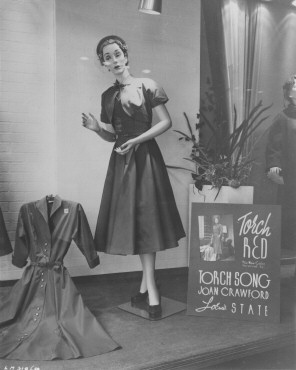
Above: US glass theater slide, and a store window tie-in.
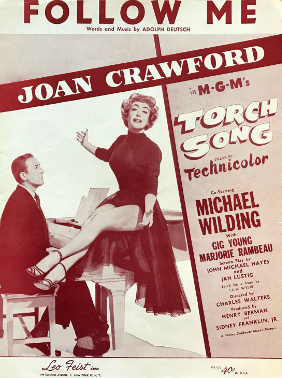
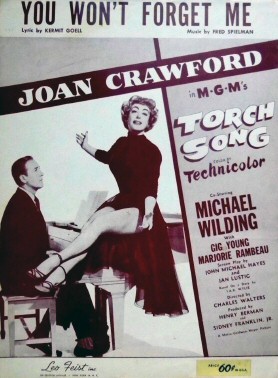
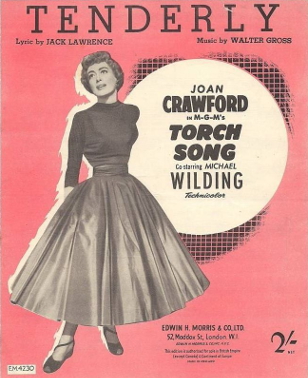
Above: Sheet music for Torch Song: Two US and one UK.
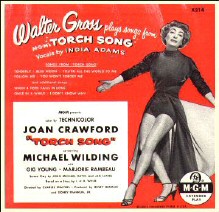
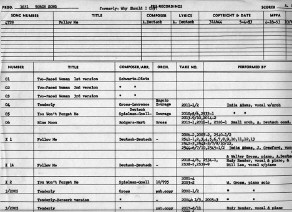
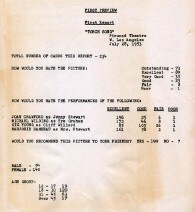
Above: US LP cover, recording schedule, and viewer preview comments for film. Click on any photo for more info.
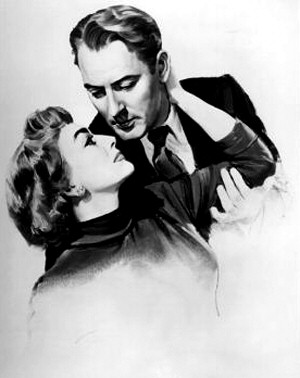
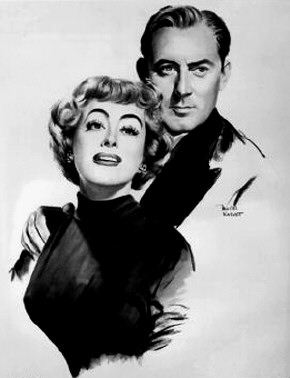
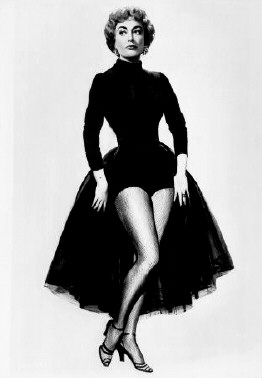
Above: MGM publicity art.
Below: Costume sketches by Helen Rose. Click on first to see larger version and press slug. Click on one at right to see 5 more sketches.
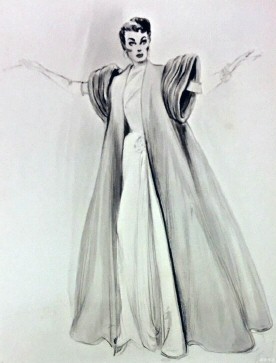
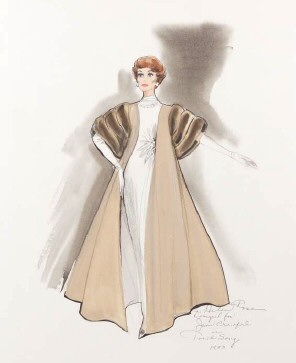
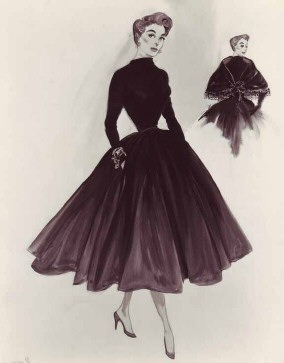
Below: November 18 Hollywood premiere of Torch Song at the Warner Beverly Hills Theatre: Photo, flyer, and ticket.
The Best of Everything
 MGM. 90 minutes.


 Ricoh
Vigen (June 2013)
Ricoh
Vigen (June 2013)
 Stuart Hoggan (March 2013)
 Michael
Lia
(October 2009)
Michael
Lia
(October 2009)