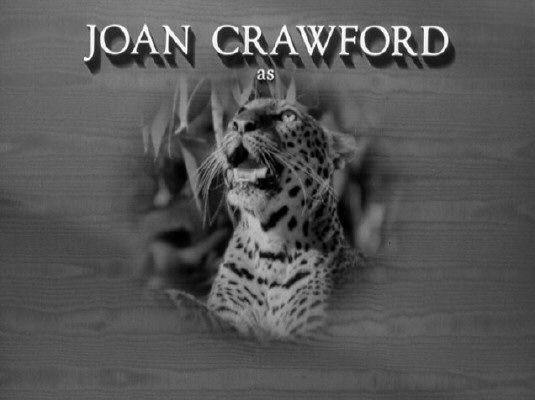

The Best of Everything
Encyclopedia Entry • Films Main
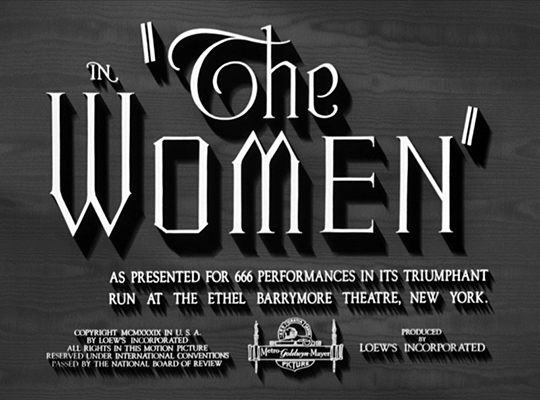
The Women
1939
|
2007: Selected by the United States Library of Congress for preservation in the National Film Registry as being "culturally, historically, or aesthetically significant." Library of Congress brief description of film. |
Critics' Reviews • Our Reviews • Movie Posters • Lobby Cards • Misc. Images
Click here to see photos from the film.
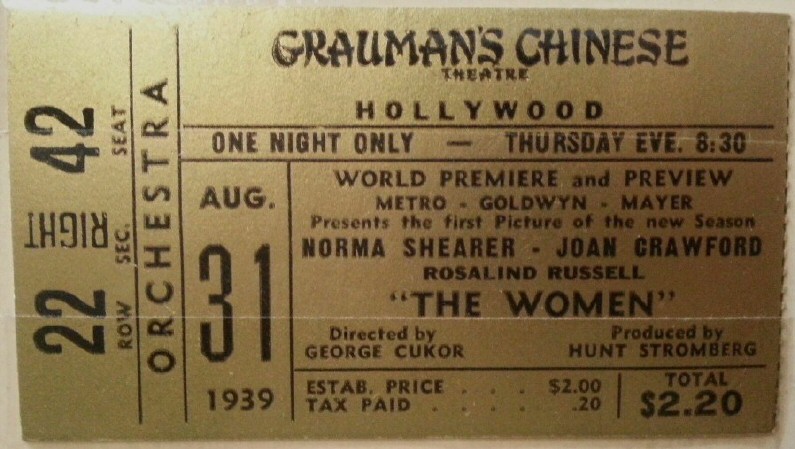
US theatrical release: 9/1/39. (Grauman's Hollywood premiere on 8/31/39) US theatrical re-release: 9/5/47.
VHS release: 6/25/96. DVD release: 7/7/02. Blu-ray release: 5/6/14. Cast: Norma Shearer, Joan Crawford (as "Crystal Allen"), Rosalind Russell, Mary Boland, Paulette Goddard, Phyllis Povah, Joan Fontaine, Virginia Weidler, Lucile Watson, Florence Nash, Muriel Hutchinson, Esther Dale, Ann Moriss, Ruth Hussey, Dennie Moore, Mary Cecil, Mary Beth Hughes, Virginia Grey, Marjorie Main, Cora Witherspoon, Hedda Hopper. Credits: Based on the play by Clare Boothe. Screenplay: Anita Loos, Jane Murfin. (F. Scott Fitzgerald and Donald Ogden Stewart were uncredited contributors.) Producer: Hunt Stromberg. Director: George Cukor. Camera: Oliver T. Marsh, Joseph Ruttenberg. Art Director: Cedric Gibbons. Music: Edward Ward, David Snell. Costumes: Adrian. Editor: Robert J. Kerns.
Plot Summary: Based on the Clare Booth Luce play of the same name, this MGM comedy is justly famous for its all-female cast and deft direction by George Cukor. The plot centers on a group of gossipy high-society women who spend their days at the beauty salon and haunting fashion shows. The sweet, happily wedded Mary Haines (Norma Shearer) finds her marriage in trouble when shopgirl Crystal Allen (Joan Crawford) gets her hooks into Mary's man. Naturally, this situation becomes the hot talk amongst Mary's catty friends, especially the scandalmonger Sylvia Fowler (Rosalind Russell), who has little room to talk -- she finds herself on a train to Reno and headed for divorce right after Mary. But with a bit of guts and daring, Mary snatches her man right back from Crystal's clutches. Snappy, witty dialogue, much of it courtesy of veteran screenwriter Anita Loos, helps send this film's humor over the top. So do the characterizations -- Crawford is as venomous as they come, and this was Russell's first chance to show what she could do as a comedienne. And don't discount Shearer -- her portrayal of good-girl Mary is never overpowered by these two far-flashier roles. The only part of The Women that misses is the fashion-show sequence. It was shot in color -- an innovative idea in its day -- but now both the concept and clothes are dreary and archaic. Do keep an eye on the supporting players, though, especially Mary Boland as the Countess DeLage. The role was based on a cafe society dame of that era, the Countess DiFrasso, who had a wild affair with Gary Cooper; that romance is satirized here. ~ Janiss Garza, All Movie Guide
Film Notes: • In production from 4/25/39 to 7/7/39. • The original play opened at the Ethel Barrymore Theatre in NYC on 12/26/36 and ran for 657 performances. • Phyllis Povah, Marjorie Main, Mary Cecil, and Marjorie Wood reprised their stage roles in the film. • The film was remade as "The Opposite Sex" in 1956, with Joan Collins in the Crystal Allen role. (Men did appear in this version.) And was remade again in 2008, directed by Diane English. • Named one of the 10 best films of 1939 by the New York Times. Also on the Times' 1000 best films list.
|
Frank S. Nugent in the New York Times September 22, 1939 The tonic effect of Metro-Goldwyn-Mayer's film of Clare Boothe's "The Women" is so marvelous we believe every studio in Hollywood should make at least one thoroughly nasty picture a year. The saccharine is too much with us; going and coming to syrupy movies we lose our sense of balance. Happily, Miss Boothe hasn't. She has dipped her pen in venom and written a comedy that would turn a litmus paper pink. Metro, without alkalizing it too much, has fed it to a company of actresses who normally are so sweet that butter (as the man says) would not melt in their mouths. And, instead of gasping and clutching at their throats, the women—bless 'em—have downed it without blinking, have gone on a glorious cat-clawing rampage and have turned in one of the merriest pictures of the season. Her comedy, which Metro's Anita Loos and Jane Murfin have adapted remarkably well, is in the nature of a sociological investigation of the scalpel-tongued Park Avenue set, entirely female, who amputate their best friends' reputations at luncheon, dissect their private lives at the beauty salon and perform the postmortems over the bridge table, while the victims industriously carve away at their surgeons. It is a ghoulish and disillusioning business and the drama critics, when first they saw the play, turned away in chivalrous horror, wondering—no doubt—whether they, too, had a Mrs. Hyde under their roofs. Possibly some of that venom has been lost in the screen translation. Edith Potter's "glorious motherhood"—do you remember the scene in the play when she blew the cigarette ashes off her infant's nose—has not been satirized so bitingly. A few of the blunt words have been softened. The omissions are not terribly important and some of the new sequences are so good Miss Boothe might have thought of them herself. Among these, however, we do not include a style show in Technicolor which may be lovely—at least that's what most of the women around us seemed to think—but has no place in the picture. Why not a diving exhibition or a number by the Rockettes? It is the only mark against George Cukor's otherwise shrewd and sentient direction. The most heartening part of it all, though, aside from the pleasure we derive from hearing witty lines crackle on the screen, is the way Norma Shearer, Joan Crawford, Rosalind Russell, Paulette Goddard and the others have leaped at the chance to be vixens. Miss Shearer, as the Mary Stephens whose divorce and matrimonial comeback keep the cat-fight going, is virtually the only member of the all-feminine cast who behaves as one of Hollywood's leading ladies is supposed to. And even Miss Shearer's Mary sharpens her talons finally and joins the birds of prey. It is, parenthetically, one of the best performances she has given. Rosalind Russell, who usually is sympathetic as all-get-out, is flawless—by which we mean as good as Ilka Chase was—as the archprowler in the Park Avenue jungle. Miss Crawford is hard as nails in the Crystal Allen role, which is as it should be; and Miss Goddard as a frank house-wrecker, Mary Boland as a shameless buyer in the love mart, Virginia Weidler as Miss Shearer's daughter, Lucile Watson as Mrs. Morehead, Marjorie Main as the realist from Reno are all so knowing, so keen on their jobs and so successful in bringing them off that we don't know when we've ever seen such a terrible collection of women. They're really appallingly good, and so is their picture. New York Herald Tribune (1939): Some of the venom of the play has been extracted, while Miss Boothe's sentimental consideration of her heroine has become even more sentimental. What will matter to most filmgoers is the fact that the show is caustically comic, that is has enlisted a slew of Hollywood's top actresses in its company, and that George Cukor, the atmosphere expert of the screen, has saturated the proceedings in femininity....The Women is a women's show, but one which is certain to flatter and amuse most men....Joan Crawford gives a conventional but striking performance as the shopgirl who tries to hook the heroine's husband.
|
If you've seen The Women and would like to share your review here, please e-mail me. Feel free to include a photo of yourself or avatar to accompany your review, a star-rating (with 5 stars the best), as well as any of your favorite lines from the film.
|
 Stephanie
Jones (June 2023) Stephanie
Jones (June 2023)
Rating:
Good lord, what actual women really act or speak like this? This is primarily a minstrel show, written by women seemingly for the approval of gay male viewers and critics.
According to this film (written by women: Anita Loos and Jane Murfin) based on a very successful 1936 Broadway play (written by a woman: Clare Boothe) in which only women appear, women are primarily either naive simpletons or constantly jabbering/squawking harridans seeking to break up each others' marriages. Aside from constant gossip, the latter group's only other interest in life appears to be faddish beauty treatments. I understand that this is supposed to be a "witty comedy," but all of the shrieking and slapstick "exercising" is far more tedious than amusing.
That said: Thank god for Joan Crawford in this film! Our Poor Joan had spent the greater part of the mid/late 1930s playing "good egg"-type characters who, by the particularly dreadful "Shining Hour" in '38 and "Ice Follies" in '39, had worn their welcome very, very thin. Even I was sick of looking at her at this point. In "Women," though, she sheds the phony "good-girl" acting and bursts into a real, exciting character: Crystal Allen, the eye-rolling, sarcastic, man-stealing shopgirl who's the bane of Norma Shearer's "good wife" existence. Joan's brief four scenes (and most of the lines therein) are the high points of this pseudo-"witty" movie:
(1) About a half-hour in, we first meet Crystal at the perfume counter of the "Black's" department store, where Rosalind Russell's Sylvia and Phyllis Povah's Edith have come to investigate just who Stephen Haines (Norma's husband) is having an affair with. Crystal is in the back-room simultaneously sparring with fellow shopgirl Virginia Grey and trying to convince Butterfly McQueen (LuLu) to come over to her apartment to cook dinner for Stephen. Says Crystal to Grey, with a little shimmy: "It's about time he found out I was a home-girl." When LuLu asks innocently if she'll find anything in Crystal's icebox, Grey says: "Yeah, cobwebs and a bottle of gin." And while Crystal is making nice with Stephen on the phone re her own ability to cook, Grey smirks: "She thinks because LuLu is dark, he won't be able to see her!" (The comedic timing between Grey and Joan is fantastic in this scene.)
(2) Backstage, after a fashion show attended by all the ladies in the UES hood (note that in the Zoo part of the 5-minute technicolor sequence, the models throw food to the audience as well as to the actual monkeys in cages!), Crystal and Norma's Mary Haines wind up in dressing rooms across from each other. (Crystal impudently and funnily turning around to check out a saleslady's ass as she enters.) Russell's Sylvia goads Mary into confronting Crystal, who has apparently, gasp!, been picknicking with Stephen and daughter. Below is a condensation of their conversation:
Mary: I know Stephen couldn't love a girl like you. Crystal: Well, if he couldn't, he's an awful good actor. Look --- what have you got to kick about? You've got everything that matters. You've got the name, the position, the money... Mary: My husband's love happens to mean more to me than anything. Crystal: Can the sob stuff, Mrs. Haines. You noble wives and mothers bore the brains out of me. I'll bet you bore your husbands, too. Mary: You are a hard one, aren't you? Crystal: Oh, I can be soft on the right occasion. Look --- what did you expect me to do, burst into tears and beg you to forgive me? Isn't that what you really came in here for, Mrs. Haines?... [Crystal escorts Mary to door, then...] Mary: May I suggest if you're dressing to please Stephen, not that one. He doesn't like such obvious effects. Crystal: Thanks for the tip. But when anything I wear doesn't please Stephen, I take it off.
BRAVO, Joan!
(3) Post-divorce scenes of Norma's Mary in Reno (where the entertaining characters of Mary Boland's four-times-divorced Countess De Lave and Paulette Goddard's chorus-girl Miriam and, best of all, Marjorie Main's ranch-host Lucy are introduced), the film cuts to 18 months later, with Crystal in a tub, canoodling via phone with the Countess's fifth husband, Buck Winston, while Little Mary enters. Little Mary and Crystal try, but awkwardly fail, to be polite to each other before Sylvia enters. (Joan, acting-wise, has to do several complicated things here, and she does them well: Talk dirty to Buck on the phone while simultaneously shifting between dirty talk and a surfacely-nice but nasty kid conversation with Little Mary re her father; and then more talk with Buck while juggling a Sylvia conversation.)
(4) End of film, after Stephen Haines has (off-screen) just punched out Buck Winston and Crystal's affair with Buck has been revealed, and all the ladies are gathered to give Crystal her comeuppance... Says Crystal as she exits in close-up: "Well, girls, looks like it's back to the perfume counter for me. And by the way: There's a name for you ladies, but it isn't used in high society, outside of a kennel. So long, ladies."
Joan's scenes ARE this film. (I highly doubt that The Women would ever have been selected for the US National Film Registry if anyone else had played these scenes; same goes for Mildred Pierce and Johnny Guitar and their Film Registry status---none of these films are that special without Joan Crawford in them.) The rest of the writing in The Women is confused palaver about how women should not have any personal pride, and about how stupid and vain and easily fooled men are. Top-billed Norma Shearer is dumb and bland; and third-billed Rosalind Russell is a shrilly annoying shrew. Aside from Joan, the only other character highlights of this film are scenes with Mary Boland as the quadruple-divorced Countess De Lave (l'amour, l'amour); the raunchy Marjorie Main as Lucy (with her warbling and tales of her "big, strong, red-headed man"); and the Wise Old Owl Lucile Watson as Mary's mother, who, from experience, advises her daughter to ignore both Stephen's infidelities and Mary's friends.
One scene among non-stars of the film that stands out is the maid and cook discussing what the maid has just overheard of the final fight between Mary and Stephen: Though we don't see it first-hand (similar to Hattie McDaniel describing a horrible personal scene between Scarlett and Rhett in GWTW), we get a blow-by-blow account of the both mean and plaintive things they say to each other. Though second-hand, it's a powerful, well-done scene, despite the cook throwing in her rather simplistic opinion at the end: "The first man that can think up an explanation of how he can be in love with his wife and another woman is gonna win that prize they're always givin' out in Sweden."
Overall: 3-1/2 stars. A definite 5 for Joan's film-historical four scenes, and for her departure from her earlier MGM drek, and a 2 or so for the rest of the mostly insipid film.
Rating:
While aspects of The Women
(1939) may seem dated, expected of a 80+ year old film, it remains
great watching due to amazing performances up and down the cast roster,
as well as crackling dialogue. To begin with, my favorite supporting cast members:
The three actresses with star billing in The Women: Norma Shearer, Joan, and Rosalind Russell (with Joan and Norma above Roz in the credits). The TCM outro states that Roz lobbied hard for this part, and I'm glad she did! Some reviewers argue that Russell stole this picture and I
think that has merit. This movie had the most impact on her career, as
Joan was already a star and Norma made only a few ho-hum pics before
retiring in 1942. The Women highlights Roz's deft comic skills, setting the stage for the next 20 years of her storied career. Top billing goes to Norma Shearer. The Widow Thalberg gets the somewhat thankless role of aggrieved Mary Haines, whose happy life is upset by a shopgirl (Joan!) scheming after Mary’s hubby. To be honest, I found Norma’s portrayal of Mary Haines to be somewhat annoying and overly melodramatic. I enjoyed Ms. Shearer most when she finally grew some claws, and decided to fight to get her man back at the end. The scene in which Stephen calls to inform her that he's marrying Crystal---Mary had just worked herself up into making a reconciliation---is very well done. A cinematic gut-punch. Amidst this star power, how does Joan fit in? Extremely well. As in her other ensemble movie, Grand Hotel, one suspects JC just wanted to prove she had the chops to hang with a talented cast, and went into The Women with all she could summon. Joan appears in 4 scenes: 1. Perfume Counter: In addition to delicious verbal sparring with Ms. Prowler (oops, I mean Fowler!), there is a great exchange between Joan and co-worker Pat (Virginia Grey), with the latter doing her best to egg on Crystal while she is on the phone with beau Stephen Haines. In one short scene, we see both sides of Joan’s character. 2. Joan-Norma Confrontation: Oh, to be a fly on the wall the day they shot this scene. L’anticipation! L’anticipation! Crystal gets the best shots in, especially after Norma admonishes her for wearing something Stephen might not approve of... Says Crystal in response: If Stephen doesn’t like something I’m wearing, I take it off! 3. Bathtub: I know a lot of people love this scene, but to me it drags on a skosh too long. Joan was warned against taking the relatively small part of homewrecker Crystal by LB Mayer, but she took it and attacked it like a jaguar pouncing on a deer! Joan’s excellent in The Women. When she’s on the screen, everyone seems to be better while trading verbal jabs with her. While The Women
has the famous gimmick of having no male parts in the movie, versus 120
or so female parts, one should also remember three important women
behind the scenes: Claire Boothe Luce, who wrote the play of the same name upon which this movie is based, was an interesting character---writer, diplomat, social commentator---and it’s the characters she crafted and the words she put into their mouths in 1936 that keep this movie enjoyable until today. Boothe’s play was adapted to the screen by Jane Murfin (who wrote What Price Hollywood? among many movies and plays). Director Cukor was reportedly not completely happy with Murfin’s draft and enlisted Anita Loos to spice things up. Loos says she was doing re-writes on a daily basis to modify CBL's dialogue to keep the zing but also get it past censors. (Loos, a pioneer screenwriter, was most famous as the author of Gentlemen Prefer Blondes, later made into a highly successful movie.) It would be remiss to not mention the man who played a key role in The Women’s success: Director George Cukor. What a task it must have been to keep all the divas in line. To my mind, there are very few scenes that drag on. Perhaps the ones with Joan Fontaine, who is a whiny young divorcee who discovers she’s pregnant, but that’s a minor quibble. We know that Joan considered Cukor to be one of her favorite directors and Roz Russell had nothing but positive things to say about him and how his directing and this role helped to boost her career and improve her approach to acting. 5 star rating. There is too much good acting and too much great dialogue to rate The Women as anything less.
Rating:
"La publicité, la publicité..." The life of a movie begins somewhere and has many lives before it becomes our favorite movie. It can come from an idea---something you saw, a thought, a true story, a poem, a stage play; or it can be a conversation heard by a sophisticated Hattie Carnegie-wearing lady with big ears and pen and paper in a women’s lounge in 1936. That moment of conversation overheard by author Clare Boothe Luce set into motion something that ultimately involved hundreds of lives and careers and became one of the best motion pictures of 1939, only after being performed on Broadway for 657 performances. The Women is still a favorite fabulous movie 80 years later; the film and Miss Crawford are something you will never forget. The drama that followed director George Cukor’s dismissal from GWTW and being sent to the set of The Women with a trainload of female stars waiting for him had to be somewhat difficult. After a lot of pressure from Joan, MGM head Louis B. Mayer OK’d Miss Crawford for what he considered a small, unpleasant role, one certainly not big enough for a star! Crawford also convinced Cukor she could handle the role; perhaps she only wanted the role so she could get back atlongtime rival and Women star Norma Shearer (then the First Lady of cinema and of MGM). The cast only the MGM factory could have assembled was sublime. Besides Joan and Norma was Paulette Goddard, on her way to and from Charlie Chaplin fame; Rosalind Russell, finally getting a comedic role; and Joan Fontaine, pre-Rebecca (1940), still the new girl on the block and the most insipid character in the movie. Thank God for Mary Boland, the best character actress next to Edna Mae Oliver and Billie Burke. Other standout character actresses are Lucille Watson (Harriet Craig, 1950), playing one of her recurring wise-mother roles, and Dennie Moore (Sylvia Scarlett, 1936) as Olga the Manicurist, who sets the movie in motion with her gossip. In my review here, I’ll try to focus primarily on Miss Crawford’s performance. She has only four scenes, but to me, she never seems to leave the screen. She is constantly lurking and scheming in the background and in the audience's collective mind. Thanks to Cukor, she reveals a new Crawford. (A side-note: I once read a review about Crawford’s performance here in which the writer said the film and performances are dated except for Crawford, who comes out best because “Bitches don’t date"! Joan really does come off the best in The Women; she, basically, is what the whole story is about.) I have worked as a fragrance sprayer in Bonwit Teller and Macy's and Marshall Field, before people got uptight about being sprayed by a man in a tuxedo or a beautiful tall girl in a gorgeous dress. I wasn’t a shopgirl, but I sure got to know them and the class system that existed both behind and in front of the counter, as well as the bitchery and competition that went on. I met many Crystals, so let's just bring her on--she is the composite of all of those women I worked with. Enter Butterfly McQueen (Mildred Pierce,1945) playing Lu Lu the cosmetic counter maid, here in her movie debut. “Were you asking for me, Miss Crystal?" Crystal, with a cig hanging out of her mouth, asks her to cook dinner for her and Stephen that evening. We never see Butterfly cooking those lamb chops in Crystal's apartment, and we never see Butterfly again, but one of my favorite quotes is when Crystal asked her to cook dinner for two bucks and Butterfly says, “Can’t you make it three?" Crystal gruffly replies, “I said two bucks." When Crystal's lover Stephen Haines calls her at work to cancel their rendezvous so he can be with his wife, you get all of Crystal right there, as you also do when Rosalind Russell and Phyllis Povah come to the perfume counter at “Blacks” to see the little tart who hooked Mr. Haines. Crystal's smirking and snarling has the audience in anticipation of loving to hate this woman who has stolen a husband from Miss Shearer, the loving loyal classy wife. (When I saw The Women at the Castro in San Francisco, the audience would gleefully hiss--AND cheer!--every time she appeared!) Crawford as Crystal is the epitome of an actress who knows what she is doing and has worked on her craft; no one should ever say she was not an actress. After nearly 15 years in films, she at this point has learned enough to know who Crystal is and how to portray her and how to dazzle us with her intricate performance. I'm sure fans at the time were shocked, but this time she wasn’t playing around with her tuxedo-clad male co-stars---she was here herself: raw, willing, and able! As we first see her fondling a bottle of perfume and mouthing insipid customer-friendly thoughts, she suddenly springs into action and shows us the real Crystal Allen: She is sharp, fast, and bold, as well as blunt and to the point. Her first rapid dialogue fires away with gutter sophistication, and her impressive voice is something to be saluted! (She could have taught dialects and accents in real life, but here she is the master of intonation and elocution.) She is right on and not afraid---which is really the point of the movie: Crystal is not afraid. The telephone scene is one of the best. Here, Crystal is supported by the young, fresh Virginia Grey (The Rose Tattoo, 1955), who smirks and mocks as Crystal says lines to Mr. Haines like, “It's such good discipline for my selfishness.” As the two nasty hens come creeping in to spy on Crystal at work, Crawford and Russell go wit for wit. They match each other perfectly; the dialogue and the tone of their voices are layered with subtle and not so subtle wisecracks and digs. Their Mrs. Prowler/Fowler exchange is skillful and funny. By Joan's next scene, Crystal is shopping on credit at “Blacks,” snapping up every item for her new life with Stephen. Russell's Sylvia gets a whiff of it and sets up a confrontation scene with Norma's Mrs. Haines, one possibly bigger than Miriam Hopkins and Bette Davis in 1943's Old Acquaintance. Just two MGM Queens letting art imitate life after years of rivalry. In this scene from The Women, the Queens discuss Mr. Haines and the illicit affair face to face, breath to breath, character to character. Crystal is not going to say she is sorry or try to fix things or even cry. Miss Norma tries her best dealing with white-trash Crystal with her “Oh, you are a hard one!" Crystal responds nonchalantly, “I can be soft in the right places.” Big stuff for 1939! Miss Crawford’s bathtub scene finishes off the audience's hatred of her; she is violent in that tub, throwing things at her maid and yelling, then dealing with the little Haines brat while waiting for her new lover Buck Winston to call. (Gosh, kind of twisted, these society people!) She then deals with the visiting, suspicious Sylvia (yes, there are a lot of people in that bathroom! As Crystal says, “You’d think it was Grand Central Station!") This exchange Crystal haswith her maid and the little Haines brat and Russell is another film wonder Joan gives us. You hate her, but you have to love her balls. And if you want her to be a little more mean, that’s OK. In Crystal's final scene, her affair with Buck Winston is busted. The gang of ladies are all here when Crystal enters to confront Sylvia. Finding Sylvia locked in the closet, Crystal realizes she has lost and will lose both Mr. Haines and the playboy Buck Winston. In Crystal's finale, she realizes she is going back to the perfume counter, but she goes out with the classic line: “There’s a name for you ladies, but it isn’t used outside of a kennel. So long!” And out she goes, with her fur hanging over one shoulder, and Norma running cross-eyed to her husband with her jungle-red nails aloft... The
only people I have known to dislike the film or play were Eleanor Roosevelt and my neighbor Darlene; they both
thought it made
women look bad and stupid and shallow. The First Lady had her reasons and would
feel the same way today about women and probably yoga pants. My elder sister,
who is a bitch, saw it and said, “Joan Crawford is such a bitch in that movie, I
never liked her.” So I had to explain to her that Miss Crawford was an excellent actress
and it was a part she was playing. As Mr. Cukor said, “Miss Crawford did not
hold back.” And aren’t you glad
Mike O'Hanlon (August 2007)
Though her screen time in The Women is relatively brief, Joan Crawford steals every scene she's in. She's completely believable and sexy as "the other woman", and delivers a performance that, with the exception of Rosalind Russell's, steals the film from the all-star cast. The supporting players are equally entertaining. Paulette Godard makes the most of her tough-as-nails character, Lucille Watson once again shows how intelligent a woman with experience can really be, and Mary Boland relishes with her backstabbing, two-faced part. Truly a classic movie, almost everyone will find something to enjoy with The Women.
By 1939, Joan Crawford's career had been on the wane for three years. Out of her previous seven films, only Love on the Run (1936) had performed successfully. When she renewed her MGM contract in 1938, her salary had dropped from $125,000 to $100,000 a picture. Well, duh! Her movies after 1934 were lackluster, and too predictable to draw long lines at the box office, but it wasn't her fault. MGM soaked her dry for box office, squeezing every last penny out of her. With The Women, Joan Crawford not only revived her career, but also proved she could act. She is indeed cold blooded, but to call her villain is overrating her. She's just portraying a woman who is determined to get herself on the right side of the tracks, just like old times. Joan Crawford is what made The Women so successful.
For Norma Shearer fans however, it was the perfect example of her Hollywood demise. Though her performance is virtually excellent considering she didn't have much to work with, The Women was a slap in the face to the image Norma had acquired after her Oscar winning performance in The Divorcee (1930). The character of Mary Haines is respectable, but she becomes a distraction after awhile, making one wish Crystal Allan would have been focused on more. When Mary catches her husband having an affair, she insists on getting a divorce to maintain her pride. It sounds like an revival of the Norma Shearer pre-Code days, but it's obvious throughout the movie she wants nothing to return to her husband, and pitifully does in the end. (When Norma finds out that Chester Morris has been fooling around in The Divorcee, sure she divorces him, but before she leaves, she goes out and has sex with her husband's best friend, Robert Montgomery. Could a jilted wife find any other way for real revenge?)
While Joan Crawford lobbied desperately to Louis B. Mayer and George Cukor to let her play Crystal Allan, Norma Shearer never wanted to make The Women. After achieving her enormous comeback in Marie Antoinette (1938), which grossed more money than any previous MGM movie, Norma followed it up with one of her most entertaining films, Idiot's Delight (1939). Norma wanted to follow up the latter film with Pride and Prejudice (1940); Louis B Mayer told her she would indeed star in it if she made The Women first, and she unwillingly agreed. Then Mayer, after promising Shearer the part opposite Lawrence Olivier, gave the part to Greer Garson for his own personal revenge on Norma for not selling Irving Thalberg's percent of MGM profits. (The percentage deal made her a very wealthy woman until she died.)
Unfortunately, this virtually excellent picture is the most known Norma Shearer movie, and probably the key to why it has turned the public against her. She does come off as boring and dull, but she can't help it, and the movie as a whole is perfect. Fortunately, now her naughty pre-Codes have gotten an ample amount of attention with the publishing of Mick LaSalle's "Complicated Women." Anyone who has enjoyed the sexy Joan Crawford in The Women (1939), might find Norma Shearer just as exciting in The Divorcee (1930).
|
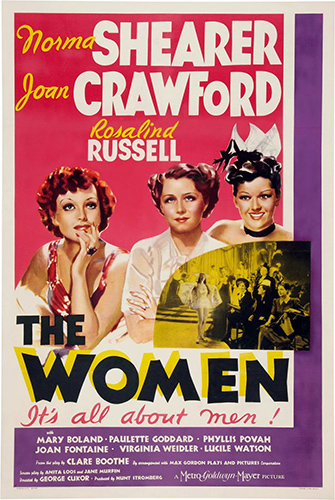
Original 1939 Release
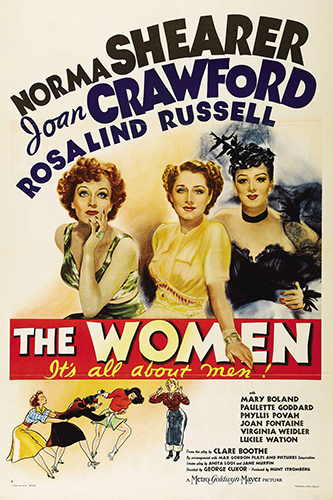
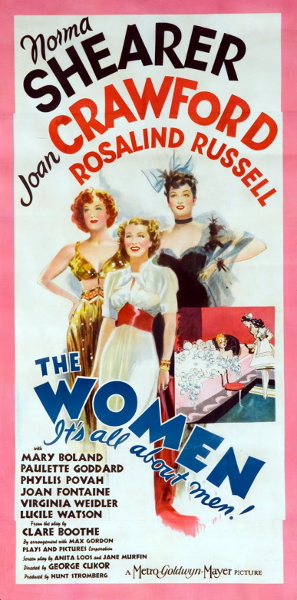


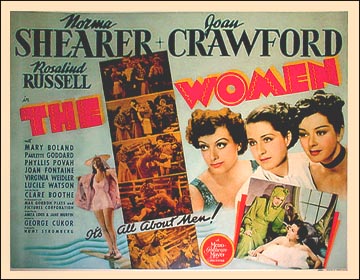
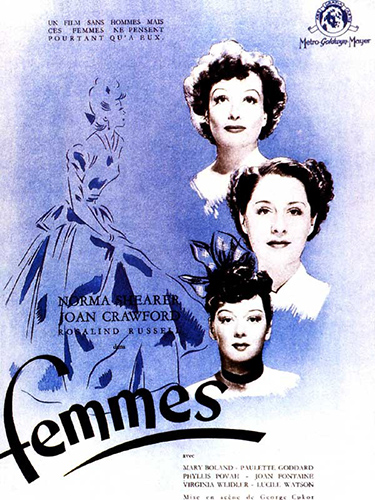
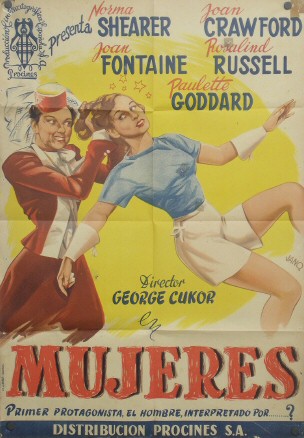
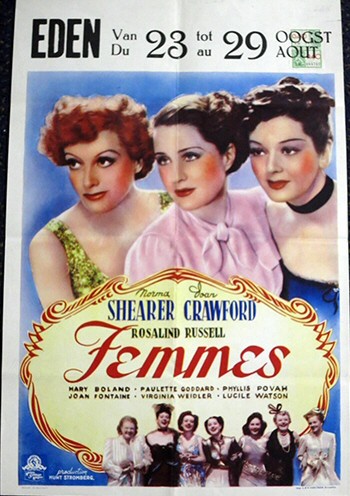
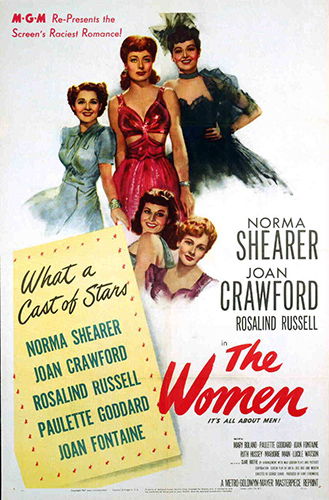
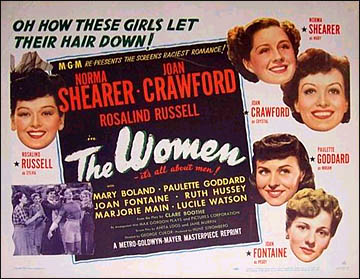
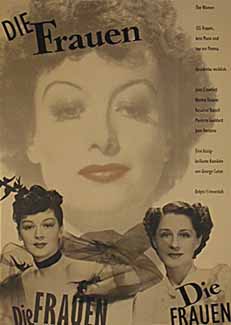
Subsequent Re-releases


Original 1939 US Release
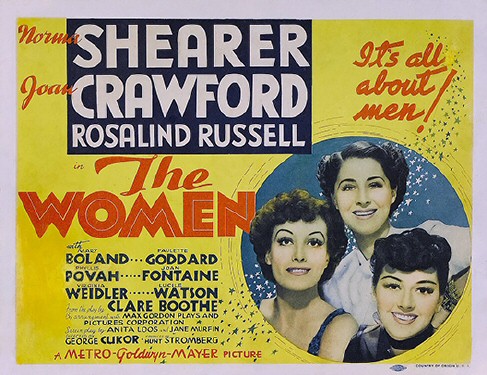

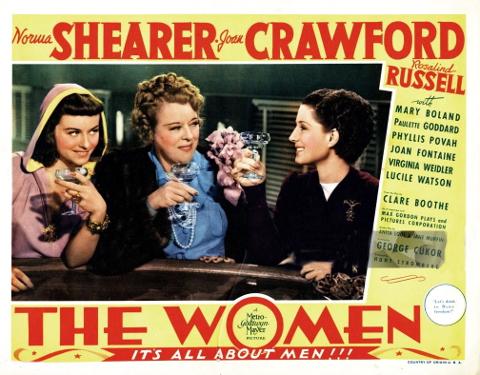
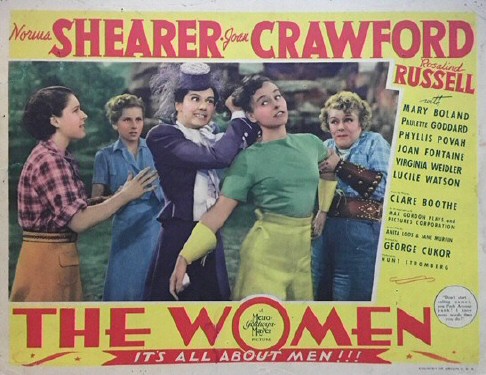
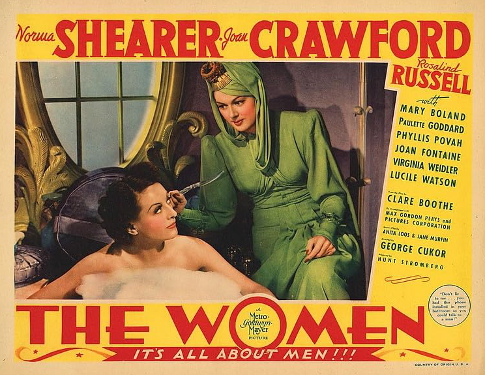

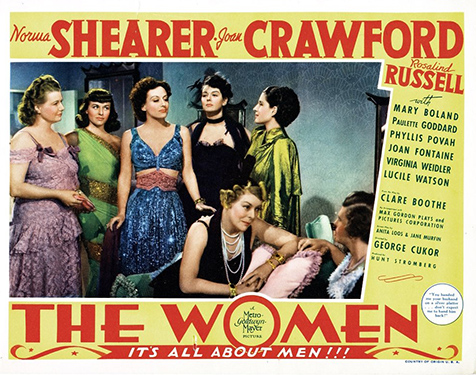

1947 US Re-release
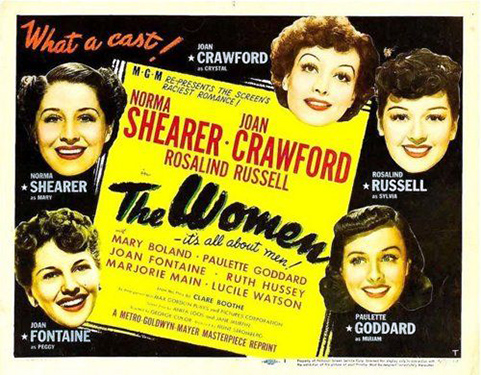
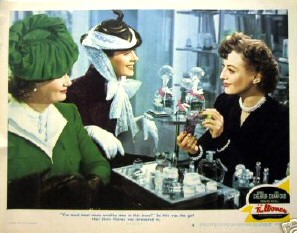

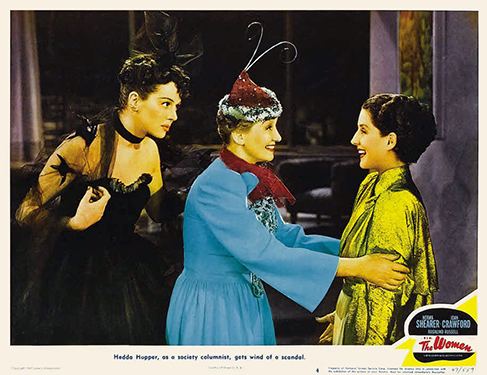
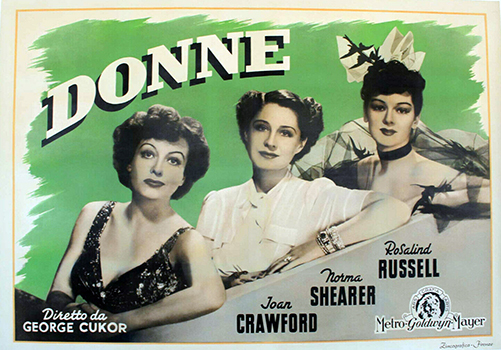
Below: Italian lobby (40 by 55 cm).

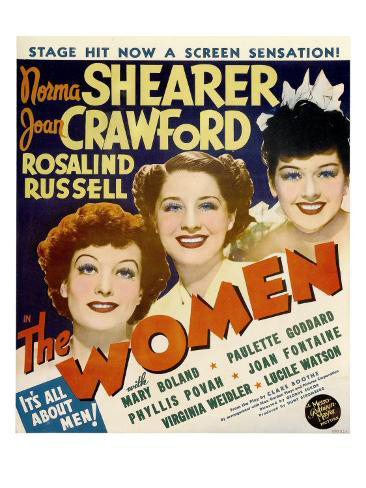
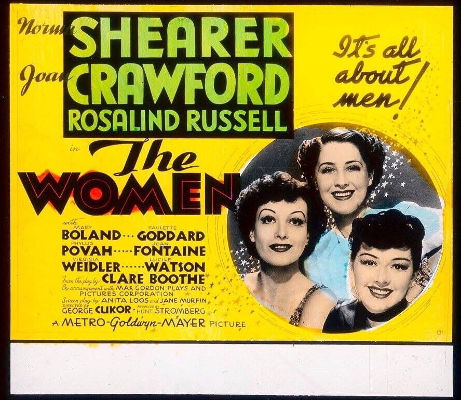
Above: US campaign-book cover, US window card, and US glass slide.
Below: UK magazine ad at left, and two US magazine ads.

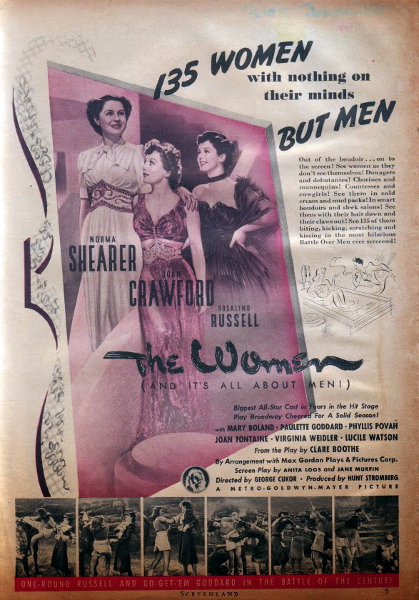
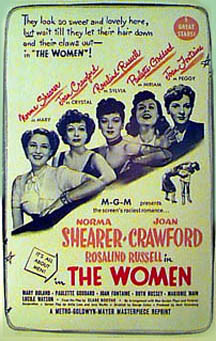
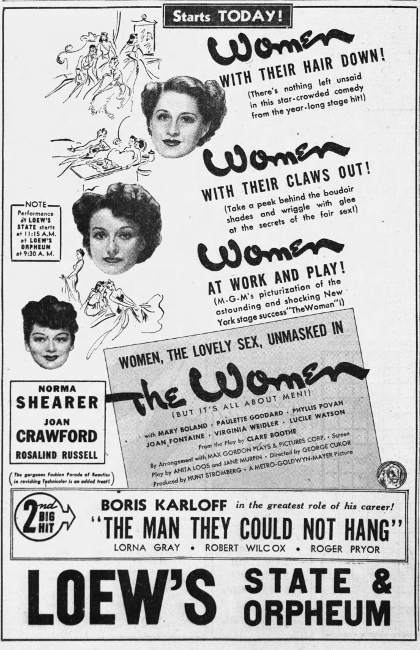
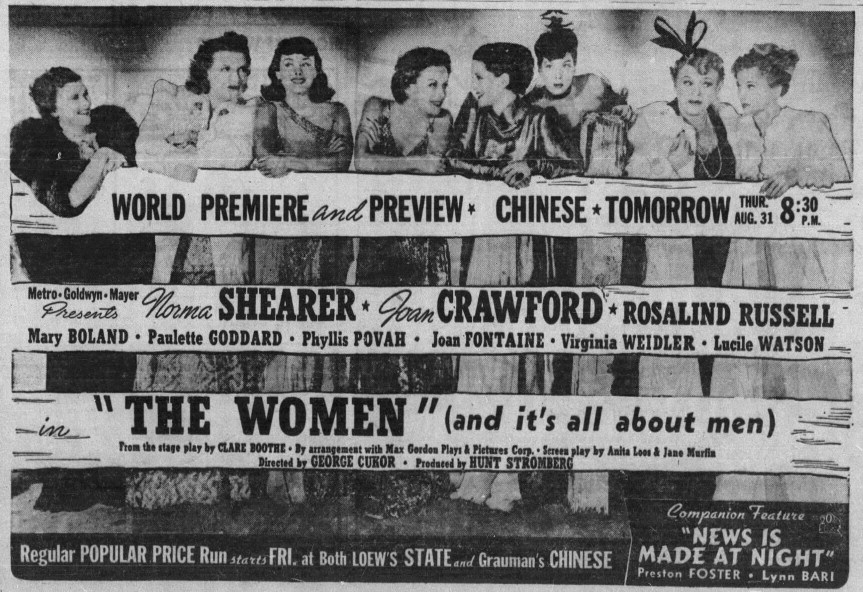
Below: Two US newspaper ads.
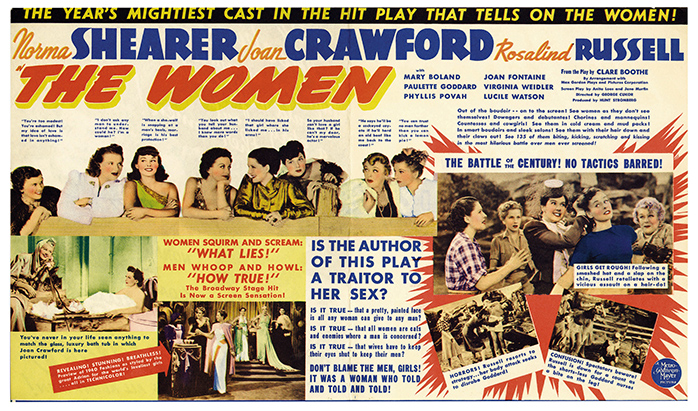
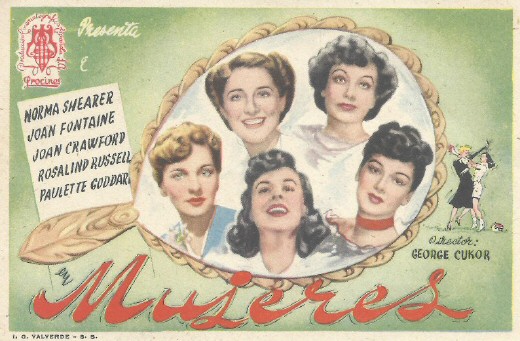
Below: US herald and Spanish herald.
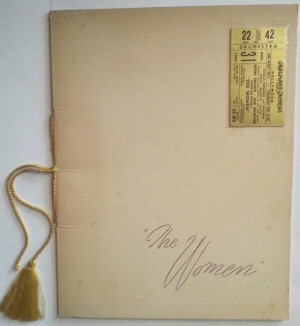
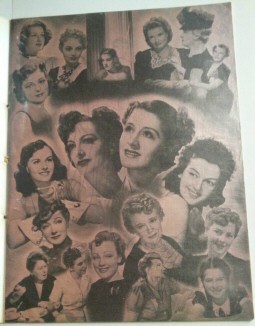
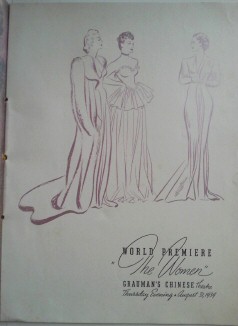
Below: Three pages of a program from the August 31, 1939, premiere night of The Women at Grauman's, plus a close-up of a ticket to the event.
The Best of Everything



 Tom
C.
Tom
C.