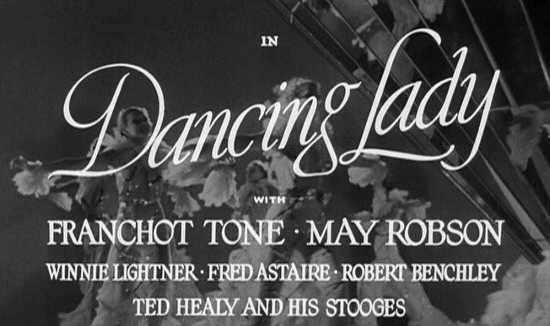
The Best of Everything
Encyclopedia Entry • Films Main
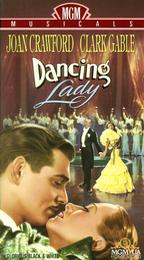
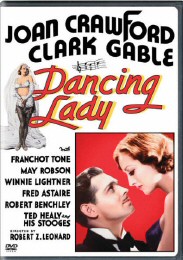
Dancing Lady
1933
Critics' Reviews • Our Reviews • Movie Posters • Lobby Cards • Misc. Images
Click here to see photos from the film.
|
Cast: Joan Crawford (as "Janie Barlow"), Clark Gable, Franchot Tone, May Robson, Winnie Lightner, Fred Astaire, Robert Benchley, Ted Healy, Gloria Foy, Art Jarrett, Grant Mitchell, Maynard Holmes, Nelson Eddy, Moe Howard, Jerry Howard, Larry Fine, Sterling Holloway, Eve Arden (billed under her real name "Eunice Quedens"). Credits: From the novel by James Warner Bellah (which had been serialized in the Saturday Evening Post from 4/30/32 to 6/4/32). Screenplay: Allen Rivkin and P.J. Wolfson. Producer: David O. Selznick. Director: Robert Z. Leonard. Camera: Oliver T. Marsh. Music: Burton Lane, Harold Adamson, Richard Rodgers, Lorenz Hart, Jimmy McHugh, Dorothy Fields. Conductor: Lou Silvers. Costumes: Adrian. Editor: Margaret Booth. Plot Summary: Virtually everybody except President Roosevelt was in the lavish MGM backstage musical Dancing Lady. Joan Crawford stars as Janie Barlow, an impoverished dancer reduced to working in a seedy Manhattan burlesque house. While on a slumming party with his society friend, wealthy young Tod Newton (Franchot Tone) spots Janie in the burleycue chorus line and immediately falls in love with her. When the joint is raided, Tod pays Janie's bail, but she resists his entreaties to become his mistress, promising instead to pay back every cent she owes him "honestly." With Tod's help, Janie is able to secure work in a big-time Broadway musical being staged by Patch Gallegher (Clark Gable), who is certain that the girl is an untalented opportunist and does everything he can to sabotage her audition. When he realizes that the girl "has something," he refuses to admit it but does, grudgingly, hire her for the show. Through a combination of skill and damned hard work, Janie ends up as the star of the show, whereupon Tod, worried that he'll lose the girl to the Great White Way, buys the show and promptly closes it. But Janie, who's fallen in love with Patch, teams with her new sweetheart to restage the show with their own meager savings -- and surprise of surprises, it's a smash hit. Truly an embarrassment of riches, Dancing Lady introduced Fred Astaire to the movie-going public, solidified the popularity of MGM's new tenor Nelson Eddy, and offered a wide berth for the comedy antics of Ted Healy and his Three Stooges -- Moe Howard, Curly Howard and Larry Fine (Larry, performing his role in a Jewish dialect, has a wonderful double-take bit with a jigsaw puzzle which turns out to be a portrait of Adolf Hitler). As a bonus, the film offers spectacular musical production numbers, not to mention the enduring song hit "Everything I Have is Yours." ~ Hal Erickson, All Movie Guide
Notes: Fred Astaire and Nelson Eddy made their film debuts in Dancing Lady. Production dates: 6/33 to 10/33. Budget: $923,055
|
|
Mordaunt Hall in the New York Times (December 1, 1933) Joan Crawford, Clark Gable and Franchot Tone in the Capitol's New Pictorial Offering.Undaunted by the scathing remarks made against it, the back-stage story rears its head more impudently than ever in the picture "Dancing Lady," which has found a haven at the Capitol. It is for the most part quite a lively affair, but nevertheless one constructed along the familiar lines. The closing interludes are given over to a lavishly staged spectacle which by some stroke of magic the leading male character is supposed to put on in an ordinary sized theatre. It looks as though it might be better suited to the Yale Bowl or Chicago's Soldier Field. Joan Crawford as Janie Barlow takes her turn among those who have startled Broadway producers. This attractive twinkletoes is presumed to be a marvelous dancer; in fact, a performer likely to make any show a huge success. Although Franchot Tone appears as the scion of a fabulously wealth family, one is well aware that the character acted by Clark Gable is he who is going to win Janie's heart and hand. Besides the aforementioned players, there are, among others in the cast, Robert Benchley, Fred Astaire, Ted Healy, May Robson and Grant Mitchell. All do well by their respective rôles, but it is a pity that Mr. Benchley's scenes are so exasperatingly brief, for just as one is becoming interested in his keen wit, he is dismissed and a more robust form of humor comes to the screen. This film tale, which is an adaptation of James Warner Bellah's novel of the same title, is more entertaining than the general run of behind the scenes conflicts because of the efficient work of the players. Otherwise the story offers little or no suspense. It is a case of Tod Newton (Mr. Tone) coming to Janie's rescue when she is unable to pay the fine in a night court. Newton eventually gives Janie a letter to Bradley Sr., who is a theatrical angel, and she receives a chance to drill with the chorus. The producer, Patch Gallegher (Mr. Gable) is not in the least impressed by Janie's presence, but the time comes when he realizes that he has discouraged real talent. As for Newton, he wishes to marry Janie and one gathers that he is not a little disappointed to discover that the lucky man is the handsome Patch Gallegher. The narrative, as usual, works up to the climatic stage show. Here it is understood that Patch has little or no money and he has to sell whatever he can to launch the production. It would be curious to observe what it might have been if his coffers had been well filled, for this exhibition of dancing and staging is evidently not one on which money has been spared. The dancing of Fred Astaire and Miss Crawford is most graceful and charming. The photographic effects of their scenes are an impressive achievement. There are several tuneful songs, such as "That's the Rhymth of the Day," "Dancing Lady," "Let's Go Bavarian," "Heigh Ho" and "Everything I Have Is Yours." Mr. Healy gives expression to his slick fun. Winnie Lightner is one of the players who is not particularly good. Mr. Tone and Mr. Gable do well by the back-stage stuff and Miss Crawford takes her rôle with no little seriousness.
Richard Watts, Jr., in the New York Herald Tribune (1933): The story... is almost furiously conventional in the manner in which it eludes none of the familiar cliches of its familiar school, but it is pleasantly enough played and effectively enough produced to make for pleasant if far from exciting cinema entertainment.... Miss Crawford, I think, is decidedly charming as the hopeful show girl, playing the role with humor, enough feeling, and with a sort of good-natured gayety which makes the heroine a rather gallant young woman. Miss Crawford's tap dance is excellent and the music is fair.
|
If you've seen Dancing Lady and would like to share your review here, please e-mail me. Include a picture of yourself or avatar to accompany your review, as well as a star-rating (with 5 stars the best) and any of your favorite lines from the film.
|
Rating:
Dancing Lady (1933) may not be a great movie, cinematically, but it is fun and very enjoyable to watch. Gable and Crawford are both listed in the opening credits before the title, but with Joan’s name above Clark's. This movie is their 4th pairing, and I think the sweet spot for these Hollywood greats. Many of the rough edges of their earlier joint acting efforts are absent in DL, but with much of the heat retained.
Joan plays Janie Barlow, the titular dancing lady, which is also the name of the production that Gable's Patch is producing. As with other early MGM efforts, one assumes that someone in MGM production read the script and immediately thought of Joan as a dancer. Franchot Tone is the third member of the requisite love triangle, Tod. Tone is a rich guy, who tries to woo Janie away from dancing, her passion in life.
Dancing Lady has many good scenes, and so while the plot may be predictable or meandering at times, the overall ensemble is enjoyable. There are funny scenes like the “night court” scene (look quickly, the judge is Ferdinand Gottschalk, Pimenov in Grand Hotel, 1932), as well as the one in which Janie (Joan) follows Patch (Clark) all around Manhattan trying to land an audition for his next Broadway production. Notable among the scens that highlight the Joan-Clark magic is the “gym scene" in which Janie finally breaks through Patch’s tough exterior ("Whaddya know, he can actually smile!”). My favorite JC-CG scene, however, is the one in which Clark helps Joan work out the cramp in her leg in his office. Pure sizzle.
One of the truly great things about Dancing Lady is the supporting cast. Fred Astaire is here in his very first movie with Joan as his first on-screen dancing partner. Nelson Eddy---pre-Jeanette MacDonald days---has his first credited role in DL. Ted Healy and the Three Stooges sprinkle levity throughout. Sterling Holloway (later the voice of Winnie the Pooh!) is the playwright. Winnie Lightner is delightful as Janie’s roommate and fellow burlesque dancer. Robert Benchley is Ward King, the theater gossip columnist who is always forgetting his pencil. May Robson is delicious as Tod’s grandmother; it's never clear if she’s deaf or has selective hearing, but the effect is fun nonetheless. Robson also played Joan's mom in Letty Lynton (1932). Eve Arden has a microscopic part, as does Lynn Bari, who became a popular pin-up girl during WW2. Heck, even Bess Flowers---Queen of the Hollywood Extras---is somewhere in Dancing Lady, playing a chorus girl!
The film is directed by Robert Z. Leonard, who directed another Joan film, 1941’s When Ladies Meet. Leonard does a good job of moving things along, and 94 minutes breeze by. (In terms of other connections within the Joan universe, Leonard was married first to Mae Murray---who starred in The Merry Widow [1925], in which Joan had a bit part---and then to Getrude Olmstead, star of The Boob [1926], in which Joan played Jane, the plucky government agent.)
This is a fun movie. No great drama apart from whether Patch and Janie can pull off making Dancing Lady a Broadway success, and if Janie will live happily ever after with Patch or Tod. This is 1930s Joan and MGM, so you can guess how those plot elements play out. There’s enough fun stuff in Dancing Lady from Joan, Clark, and Co. having a good time, to a superb supporting cast showing why many of them would go on to accomplish much in Hollywood.
Rating:
When I am carefree and happy, I watch Dancing Lady. I can never go wrong with Gable and Crawford and a little Franchot Tone (Robert Montgomery was originally cast but unavailable) thrown in at Miss Crawford’s urging. Put these three together and the recipe cooks itself.
The difference between this movie and Miss Crawford’s other thirties movies is that Dancing Lady has Everything: music, romance, survival, art, success, money, love, betrayal, glamour and The Three Stooges! Incredible! (Oh, but no murder.)
David O. Selznick, on his way up and soon out of MGM, produced this movie with as much flair and dedication as his Dinner at Eight that same year and his future successes. This is a story not originally picked out by Selznick, and he reworked the original script after Louie B. just handed him the assignment. Musicals were not his favorite thing! There were a lot of talented people working on Dancing Lady. They backed Joan all the way. Sometimes all the ingredients are there. This time it was right.
Miss Crawford plays Janie Barlow, a girl who decides to make something of herself -- and she wants to dance. (If you watch the dancing closely, especially in a rehearsal scene, Miss Crawford is in step, in line, in rhythm with every other dancer.) The age of clomp-clomp dancing was still upon them. I do cringe a bit when she auditions for Gallagher and the Stooges. But I don’t laugh; I pretend she’s great! No one heard of Eleanor Powell yet. Ever see Reckless with Jean Harlow? Ouch!
Other than the dancing and Busby Berkeley-type show, the rest of the entertainment comes from (as usual) the character actors in the film. Selznick was wise to keep all the backstage people:
Winnie Lightner, who could be Ruth Donnelly’s sister, is raucous and brings a lot of laughs even just rolling her eyes. She has a great part as an “older dancer” and Joan’s street wise pal/roommate. May Robson, “Letty's mother,” latches on for a bit of fun as Franchot Tone’s grandmother, but she will lose Joan as a prospective relative and she is out of the script fast. Ted Healy (a good actor) and his Stooges -- need I say more? They fit in just swell and I love the idea of having the extra entertainment. Robert Benchley makes me laugh and I loved all of his bits of business. Fred Astaire showed up from Broadway and entered the movies for the first time. With respect, he did not affect me or the movie at all. However, I enjoyed him dancing on the cloud. Selznick was shrewd and signed him before his Warner Brothers' debut in Flying Down to Rio that same year. Sterling Holloway, another comedian, has a small role as a weak, befuddled emotional playwright. Eve Arden walks through in ten seconds. It is interesting to see how an actor begins and hangs on in the business and hopefully moves forward.
Miss Crawford is driven, portraying the realistic lifestyle, especially in the opening scenes, without ever being dirty. You feel you know “Janie”; you believe in what she is trying to accomplish, and you want her to succeed not only in the show but with her man and in life.
Dancing Lady is pure entertainment and gives Hollywood and MGM that golden glow. These were the golden years after all!
Rating:
"Dancing Lady" (1933) was MGM's answer to the smash Warners musical "42nd Street" released earlier that year. Both films are backstage stories featuring a showgirl struggling to make it, a show struggling to make it, and intricately choreographed musical numbers (MGM lifting the now-famed geometric "human kaleidoscope" style directly from Busby Berkeley).
DL is also Joan at her MGM finest and most engaging, and an amalgam of her performances for the studio up to that time; not only does she get to dance and sing, as in her early "Dancing Daughter"-type roles, but she also brings to this stage a newly mature and rich acting style---recently honed in the previous year's hat trick of "Grand Hotel," "Letty Lynton," and "Rain"---as well as some powerful chemistry with co-star Clark Gable, with whom she'd previously sizzled in 1931's "Possessed."
Here Joan plays "Janie Barlow," a burlesque dancer busted by the cops and bailed out by smitten rich guy "Tod" (Joan's future husband Franchot Tone, in their second film together), who immediately tries to "improve" her with a written lecture on not saying "them things" or "can it" or "guy" and on not wearing shoes with ribbons or clothes with zippers.
After the jail-and-Tod experience, Janie decides to leave burlesque to pursue her dancing dreams with a legit Broadway show, one being directed by the notoriously hard-assed (and talented) Patch Gallagher (Gable). "I'm goin' uptown," Janie says resolutely, as the camera then cuts to a stream of subway street markers, stopping at "Times Square." (Such camera work is one of several clever touches by director Robert Z. Leonard. The next comes shortly afterwards, after Janie has gotten the heave-ho from Patch's show try-outs and then chases him around town: The camera zips along after them, shooting mainly their running feet as Patch tries to avoid her, interspersed with shots like Janie beaming at him and waving through the window of a Turkish bath, where he's gone to escape her. Very fresh and funny and fun to watch.)
After Janie's initial failed attempt to audition, Tod steps in, bribing the show's producer to force Patch to give Janie a chance. Patch is understandably reluctant, but her talent and work ethic win him over and he hires her, despite his continued misgivings about and digs at her association with the upper-crust Tod.
The Crawford/Gable chemistry is palpable (and fun) in this, their 4th film together. There aren't many (or any, really) hot-n-heavy love scenes; what's interesting is what they're not doing and how hard they're trying to find substitutes for what they want to be doing! There's plenty of verbal sparring from their equally headstrong, hardscrabble, ambitious characters, as well as some physical sparring---one of the funniest (and most lightheartedly sexy) scenes is when they're working out at the gym. After Janie initially swings across the room and kicks Patch in the rear, the two eventually start tossing a medicine ball harder and harder at each other. Patch keeps hitting her with the ball, then apologetically rubbing her where it hurts---first her hand, then her shoulder...At the end of the scene, he purposely throws the ball at her butt, then advances...at which Janie cutely sits down and scoots away, laughing "Oh no you don't!" Though Janie and Patch do eventually get to kiss, their playfulness (as well as feigned gruffness) with each other throughout the film is just as erotic (and much more erotic than Tod's overt protestations of love) as the final clinch.
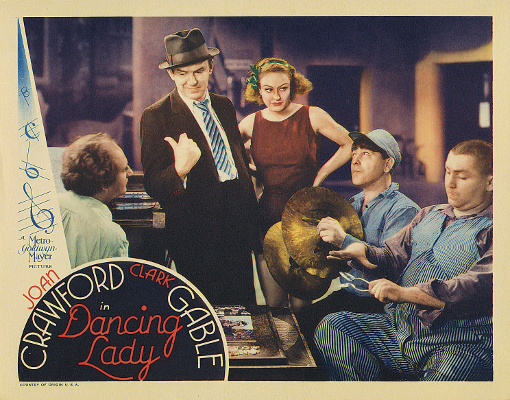
Joan's husband-to-be Tone is appropriately smooth and charming (and relatively sincere) in this film---no match for the more natural, rougher-hewn Gable onscreen, but still attractive. The supporting characters are also engaging---May Robson as Tod's crusty Nana; Ted Healy's Stooges (later to break away to become the famed "Three Stooges") providing slapstick shenanigans during Janie's audition; Winnie Lightner as Janie's wisecracking roomie and fellow showgirl; the high-strung "Pinky" and horny producer's son "Junior" adding more amusing goofiness. (Check out also Eve Arden in an uncredited brief appearance early in the film as she unsuccessfully auditions for Patch's show.) And of course there's Fred Astaire, in his film debut, hoofin' it and singing "Heigh Ho" and "Let's Go Bavarian" with Joan in the film's final big production number.
I didn't see a kitchen sink anywhere in the proceedings, but MGM nonetheless outdid itself in providing everything else but. What might have become a mere hodge-podge turned out to be a highly entertaining blend of romance, humor, and pure show-biz pizazz (as well as one of Joan's highest grossing pictures---at $750,000, topped only by "Grand Hotel," which made $950,000), easily held together by Joan and Gable's charm and depth, and Leonard's sure and inventive direction (as well as some clever writing). A real treat and one of my favorite Joan films.
Memorable Lines:
Janie
to Tod as she's dumping him for Patch: "I
love to say 'can it' and I love shoes with ribbons on 'em and I
got a perfect passion for zippers." Janie: "No, I'm afraid 'them things' won't mix with those things."
Patch to Janie at end of film: "What is this you're dishing out?" Janie to Patch, just before final big clinch: "Can't you take it?" |
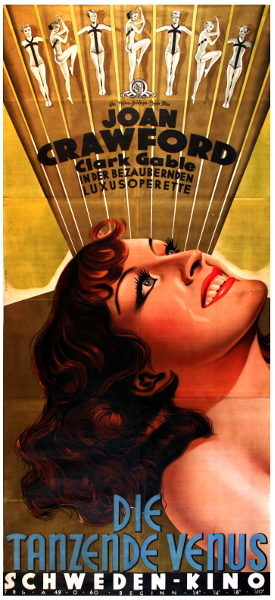
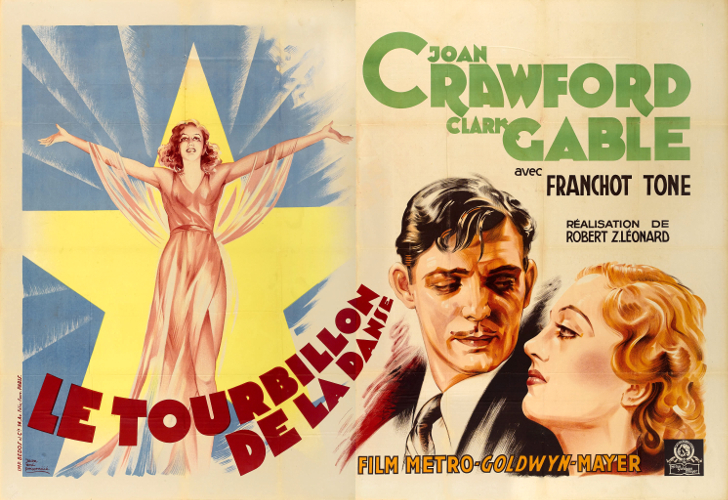
Above: Austria (50 x 108 inches) and France.
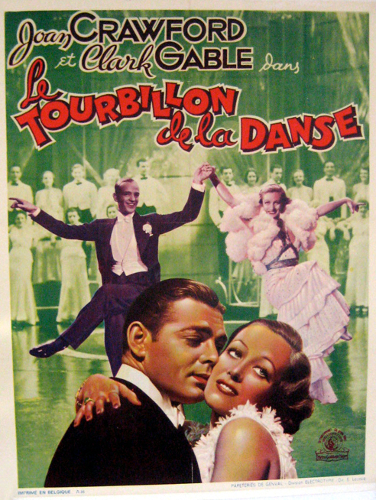


Above: Belgium, Germany, and Sweden.
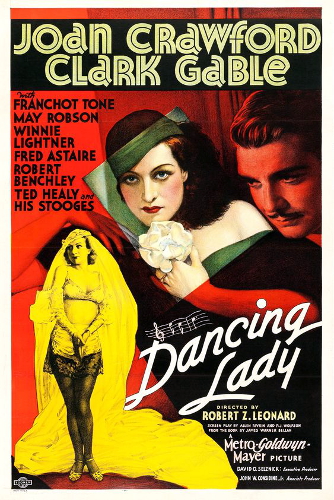
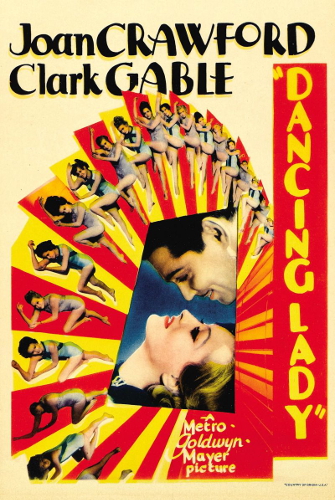
Above: US.
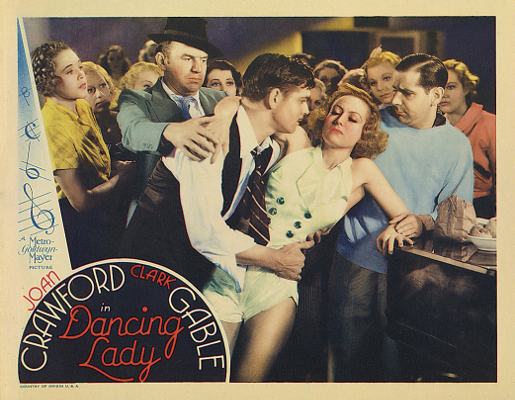
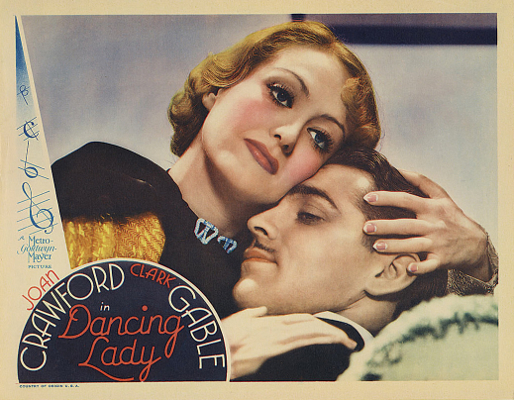
Below: US lobby cards.
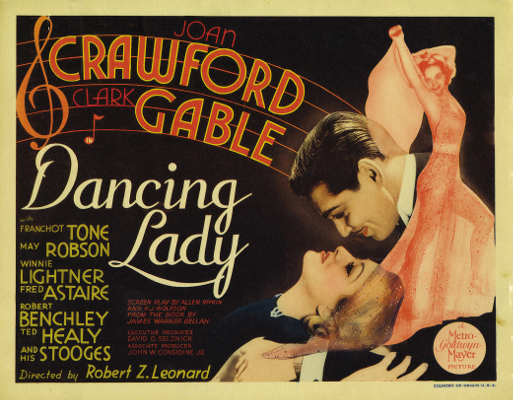




Above: Original artwork for a Dancing Lady ad.
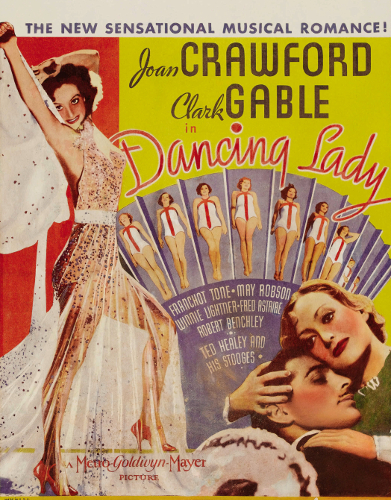

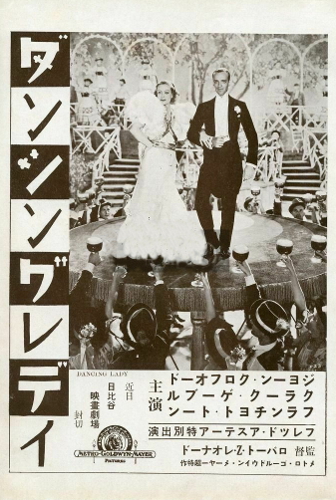
Above: Two US window cards, and Japanese magazine ad.
Below: US herald cover and centerfold.
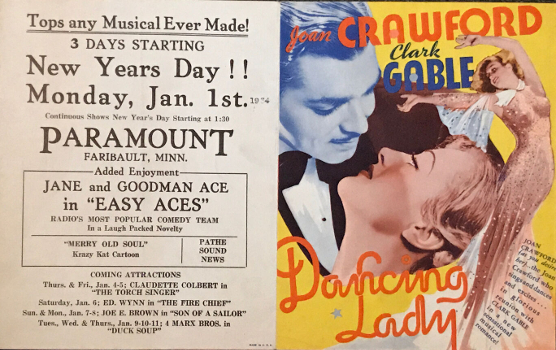
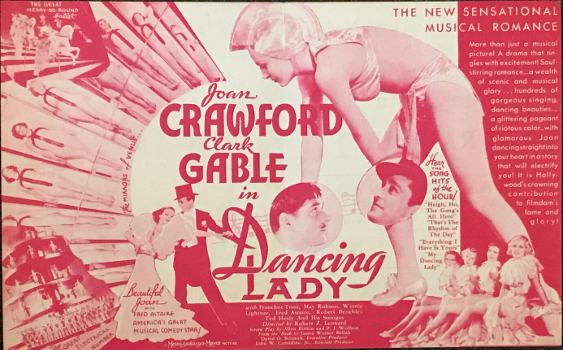
Below: US sheet music.
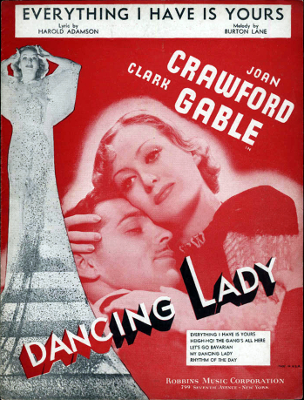
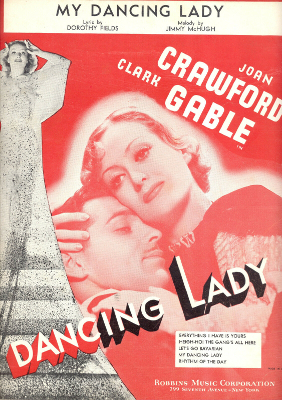
The Best of Everything
 Tom C. (April
2023)
Tom C. (April
2023)


 Stephanie
Jones
(March 2006)
Stephanie
Jones
(March 2006)