The Best of Everything
Encyclopedia Entry • Films Main
Flamingo Road
1949
Critics' Reviews • Our Reviews • Movie Posters • Lobby Cards • Misc. Images
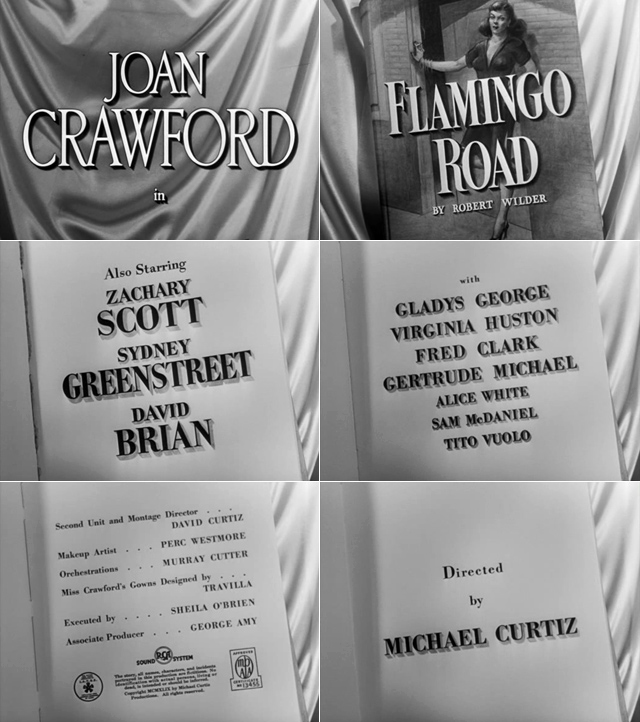
Click here to see color shots of the original prop book for the above title shots.
Click here to see photos from the film.
US general release: 4/30/49
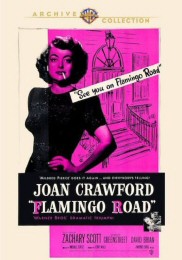
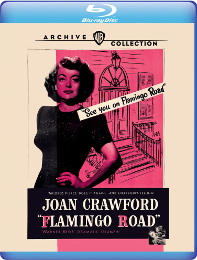
VHS release: 6/24/92 DVD release: 2/12/08 (part of Joan Crawford Collection 2) 2/28/17
(Warner Archive)
Cast: Joan Crawford (as "Lane Bellamy"), Zachary Scott, Sydney Greenstreet, David Brian, Gladys George, Virginia Huston, Fred Clark, Gertrude Michael, Alice White, Sam McDaniel, Tito Vuolo. Credits: From the play by Robert and Sally Wilder. [This was the screen credit, for the 1946 play, but Flamingo was first a 1942 novel by Robert Wilder.] Screenplay: Robert Wilder. Producer: Jerry Wald. Director: Michael Curtiz. Camera: Ted McCord. Art Director: Leo K. Kuter. Musical Score: Max Steiner. Musical Director: Ray Heindorf. Joan's Costumes: Designed by Travilla, executed by Sheila O'Brien. Editor: Folmar Blangsted.
Plot Summary: The fourth of Joan Crawford's Warner Bros. vehicles, Flamingo Road doesn't hold up as well as her earlier Mildred Pierce or Humoresque, but there's plenty to please the eye and ear. Sideshow kootch-dancer Lane Bellamy (Crawford), stranded in a backwater town, gets a job as a waitress. Lane begins falling in love with Fielding Carlisle (Zachary Scott), the political protégé of the town's big-daddy sheriff Titus Semple (Sidney Greenstreet). Semple regards Lane as a gold-digging troublemaker, and does his best to break up the romance, framing her on a trumped-up morals charges and having her shipped off to prison. Once out of the "joint," Lane returns to town, seeking revenge against both Semple and Carlisle. She charms political hack Dan Reynolds (David Brian) into marriage, then transforms Reynolds into a "reform candidate" bent on destroying the corrupt Semple machine. Faced with political ruin, Lane's ex-beau Carlisle commits suicide, a fact that Semple uses as a weapon against Reynolds. A showdown is inevitable--but the story is far from over! Flamingo Road later served as the basis for a weekly TV series; both the film and the series were based on a play by Robert and Sally Wilder. ~ Hal Erickson, All Movie Guide
Notes: * Production dates: early September to late October, 1948 (AFI) *
Ann Sheridan, who was first cast in the lead role, rejected the part
after deciding that the adaption was neither good nor faithful to the
book. Robert Wilder then rewrote the script. (AFI) |
It is fair to state that Joan Crawford has a somewhat unsettled career in the Strand's new picture from the Warners, a murky thing called "Flamingo Road." At the start of this jumbled melodrama, Miss Crawford is a carnival girl, solemnly bent upon retirement in a barbarous southern town. Successively thereafter she is a waitress in a cheap cafe, an inmate of the workhouse, an employe of a sporting resort, the mistress and wife of a political chieftain and, eventually, a jailbird again. In the course of this rather vagrant circuit, she initially falls in love with a young and aristocratic weakling who proves unworthy of her. That is to say, he forsakes her on the advice of his political boss who doesn't want this young hopeful getting mixed up with any strays. Then she transfers her affections to the rival political camp and soon finds herself playing housewife to the opposing boss. However, her suppressed emotions are unstable until her old suitor blows out his brains and she accidentally shoots his master. Then she knows that she loves the man she has wed. At the end, they are planning a happy future from her temporary lodgings in the jail. Miss Crawford runs this gamut in ninety-four minutes flat, and we think it rather significant that she isn't even winded at the end. Indeed, she has evidently disciplined and conditioned herself to the point where she can go through such an ordeal without showing the slightest strain. From one dramatic crisis to the next one, she moves like a sleek automaton. Her face, deeply plastered with make-up, is an ageless, emotionless mask. Adversity only registers now and then in her glycerin-moistened eyes. Hers is a Spartan demonstration of bearing-up-under-it-well. And that appears all that this picture was really designed to achieve, a mechanized demonstration of Miss Crawford's fortitude. For it is plain that the open-eyed inspection of political corruption that is promised at one point is midway diverted into channels that will only favor the involvement of the star. Politics goes out the window—or become a sweetly reformed gentlemen's game—when it finally becomes a matter of getting Miss Crawford straightened out. Set up for her convenience are Sydney Greenstreet as a vicious scalawag who rules the political machinery in a geographically vague southern town; Zachary Scott as the soft-hearted weakling and David Brian as the other political boss who becomes Miss Crawford's idolater simply because she can cook bacon crisp and mix a whisky-sour. Also around and torturing accents with supposedly Dixie twangs are Gladys George as a sporting-house madam and Gertrude Michael as a hash-house belle. Have no anxiety for the author, Robert Wilder, who wrote the book from which the film was taken. He wrote the script. And Michael Curtiz directed it with the obvious intention of making Miss Crawford devastating for her fans. How the latter will take it, deponent knoweth not.
Howard Barnes in the New York Herald Tribune (1949): Joan Crawford acquits herself ably in an utterly nonsensical and undefined part. As a carnival performer who determines to move to the right side of an anomalous town, she is attractive and vital. It is no fault of hers that she cannot handle the complicated romances and double crosses in which she is involved. Maintaining an impeccable reputation by virtue of Hollywood's tacit censorship, she falls in love with one man, marries another, and finally kills the villain. The recurrent line in her dialogue is: "I'm not sure."
Variety (excerpt from 12/31/48 review): Flamingo Road is a class vehicle for Joan Crawford, loaded with heartbreak, romance and stinging violence. Film is hooped together by a smart, well-meshed screenplay and reinforced by a strong cast and sound direction. Yarn [from a play by Robert and Sally Wilder] swivels around a deadly antagonism between Crawford and Sydney Greenstreet, a sinister small-town sheriff with a ruthless appetite for power. Film rapidly gathers momentum after Crawford, stranded by a bankrupt sideshow company, falls in love with Zachary Scott, the sheriff’s protege. Crawford imparts convincing personality shadings ranging from strength to tenderness with a continuous and convincing style. As the heavy, Greenstreet delivers a suavely powerful performance that surmounts his overdrawn role.
from MonsterHunter.com (2004): ...Crawford's performance in this one is quite subdued, so if you're looking for campy moments, you'll probably want to check out her later films, but it's really Greenstreet's effort that makes the movie worth seeking out. His Semple is one of the great "regular guy" villains who's frightening because of how effortlessly and callously he plots. This is a guy who acts like it's practically in his job description as sheriff to ruin people who get in his way. He and Joan have some good scenes together whether its when he's comparing her to a rat that bit off his toes or when she was comparing him to an elephant they had to shoot at the carny or when he's smacking her upside the head with that telephone.... Full review. |
If you have a review for Flamingo Road that you'd like to share here, please e-mail me. Include a photo of yourself or avatar, a star-rating (with 5 stars the best), and any of your favorite lines from the film.
|
Rating:
After three especially strong films to start her career with Warners (Mildred, Humoresque, and Possessed), Flamingo Road is a bit of a letdown. It's a well-paced, dramatically interesting film (her second and final film with her Mildred director Curtiz), but it's also more of a potboiler told in shorthand rather than an actually seriously good movie.
Joan plays "Lane Bellamy," an aging carney "girl" who stays behind crooning "If I could be with you..." alone in her tent after her carney is driven out of town because she's "tired of running." A weak-willed Deputy Sheriff (Zachary Scott as "Field Carlisle"), assigned to making sure the carney has cleared out, finds Lane there and immediately asks her to dinner (standing up his longtime "proper" girlfriend) and begins an affair with her (and gets her a cafe job), much to the chagrin of the town's political potentate (Sydney Greenstreet as "Titus Semple"), who is intent on making Field his candidate first for State Senate and then for Governor---but only if Field marries appropriately AND proves appropriately amenable to Titus's control.
There are plenty of subsequent plot machinations to make for an interesting film: Lane, as she states, is tired of running---once Titus stymies her relations with Field and has her fired from her cafe job and then arrested for prostitution, she finds solace not only in her own anger but in Lute Mae---the owner of Lute Mae's roadhouse where all the local politicos, including Titus, hang out. Lute Mae (Gladys George) is a tough old gal, who's not afraid of Titus or anyone because she's aware of all of their peccadillos. It's through this establishment that Lane meets "Dan Reynolds" (David Brian)---a political powerhouse to counter Titus.
There are two strains running through this film: "Good Government vs. Bad Government" (though Dan Reynolds is as power-hungry as Titus, he nonetheless proclaims a mild interest in non-corruption; the town's paper editor shows up sporadically to back him up, in accordance with the day's liberal principles); and then "Lane vs. Titus," which is, of course, the more interesting----we viewers want to see the Lane/Titus confrontations!
Joan is good here. A little too old to be a "carney girl," and a little too genteel in her speech for a carney girl. But she's also warm in her relations with both Field and Dan, and honest in her relations with both. Her short time at the "Women's Prison Farm" also generates a good line from her fellow prisoner: "My boyfriend cut himself on a knife I was holdin'." And, of course, we like seeing her triumphant in fur in the nightclub, when Dan and Field and Titus all run into each other.
Zachary Scott is appropriately weak-willed as "Field." And David Brian, as "Dan" in his first credited screen role (he'd later go on to co-star with Joan in The Damned Don't Cry and This Woman Is Dangerous), is a down-to-earth good-egg tough guy, grateful to Lane for fixing him a whiskey sour and making him breakfast the morning after a bender, then for buying him a soda (no one had ever given him anything since he was a kid).
The star of the show, though, is Sydney Greenstreet's "Titus Semple"--- "We had better-looking people than that in our side shows" says Lane upon first viewing him. Other highlights of his appearances are his bizarre tale of plugging up the holes in a warehouse to keep the rats from gnawing on his toes (which earns a double-slap from Lane, since she's figured out that she is one of the "rats" that he's referring to), and, of course, the final confrontation when Titus and Lane are both wrestling for the gun. Why is everyone so mad? According to Titus himself, he's "just an easy-going, friendly fat old man"! Greenstreet's seemingly benign malevolence is tremendously entertaining and truly the highlight of the film in every scene he appears in. Joan and Brian and Scott are perfectly competent, but this is actually a Sydney Greenstreet film.
Rating:
Flamingo Road (1949) tells the story of Lane Bellamy, circus dancer, played by Joan Crawford. Lane is left high and dry in the town of Boldon and runs afoul of Sheriff Titus Semple (Sydney Greenstreet). Along the way, La Crawford romances deputy sheriff and political aspirant Field Carlisle (Zachary Scott) and Semple's political rival (David Brian). I watched this right after Harriet Craig and enjoyed Flamingo Road much more, though a little less than The Damned Don't Cry, among the few but growing post-MGM Joan movies that I've seen. Lane Bellamy is the type of Joan character I like. She's from the wrong side of the tracks, but by guile, hard work, and sexiness is going to make it to Flamingo Road, the ritziest address in town! In the process, her fling with Brian turns from convenience to one of love. Field, knowing that he missed his chance with Joan, is driven to despair. That's Our Joan---driving men crazy, breaking hearts, and looking like a million bucks while doing so. I give this film 4.5 stars. The story is a good one. At 90-or-so minutes, it's terse and moves along. The supporting cast is very, very good. About the only one I didn't like was Annabelle (Virginia Huston), the spoiled rich girl whom Field marries to advance his career. Greenstreet is his typical excellent self, a seeming teddy bear of a man who exudes evil without histrionics. I don't know whether to pinch his cheeks or slap him. (Joan chooses the latter!) Scott and Brian do a good job as their characters regress and progress as they fall out of and in love with Lane, respectively. I very much enjoyed Gladys George as Lute-Mae, the spunky owner of the roadhouse who takes a shine to Lane. If you look closely, you can see pre-Code hottie Alice White in her final film role as Gracie. The movie is directed and scored by greats, Michael Curtiz and Max Steinberg, respectively.
Rating:
In what implied expiration point at Warners, the somewhat scatological Flamingo Road is among the weakest of Joan Crawford pictures post-Mildred Pierce. The moment our heroine, Lane Bellamy, is introduced to us onscreen while writhing in her gypsy garb, the reality that Joan Crawford is at the wrong end of her forties playing a carnival girl becomes an unshakeable distraction throughout the rest of the running time. The plot is bedecked with the machinations of the standard Crawford role: Lane, a girl on the wrong side of the tracks, gets herself a job as a waitress and falls in love with a more affluent other half -- in this case, Zachary Scott's wilting political player Fielding Carlisle. Unfortunately, her mere presence draws the ire of Titus Semple, a corrupt town sheriff (a magnetic Sydney Greenstreet) who not only sabotages her relationship with his protege but also tries to run her out of town completely. Crawford wrangles her fortunes upward, snagging a wealthier man in David Brian's Dan Reynolds (who provides the waving-of-the-wand duties by transforming Crawford from common frump to glamorous candour) and locking in a deathly feud with Semple. It's difficult to knock one of life's true tryers, and Crawford sure as hell gives the ruddy script all she's got, but with all its dull twists and daft narrative, Flamingo Road leaves an embarrassing impression: a 45-year-old woman clinging to a long- vapoured girlish earnestness. Sydney Greenstreet steals the show as the mean-spirited political hack, and many of his scenes with Crawford bristle with uneasy tension. Zachary Scott and David Brian, as lovely as their screen personalities are, reap up too much script time for such little character work, and the opportunity to explore Semple's corruption and particular antagonism of Crawford feels wasted. Flamingo Road is the type of vehicle that most likely would have provided an upcoming ingenue her first Oscar nomination. For Crawford, however, it seemed to mark the beginning of many roles that required delusion of youth to play with a straight face. Save for the odd quip sold with razor-sharp timing, avoid this turkey at all costs.
Rating: “I’m not a carnival girl anymore!” Miss Crawford shouts to fat, mean Sydney Greenstreet, then slaps him hard twice in the face. “I know,” I say to myself. "You are 45 years old and the script was for a Lizbeth Scott, Virginia Mayo, or Gloria Grahame or Ida Lupino." I’ll be damned if she pulls it off, and she gets to take a few people down! Love is the theme here; it is used in every angle of the script: falling in love, using love, jealous of love, thinking you're in love, wanting to be loved, and looking for love... all of which unleashes a tremendous amount of hate and hurt and murder and suicide!! And that’s not all!! The characters are motivated by success and money. Love works its way into politics and all sorts of maneuverings, just like life really is. I guess it makes for wonderful trash. This movie is fantastic in the correct meaning of the word. That is why it is intriguing. It even has its own theme song that plays throughout the nefarious “goings on." Just like a true love story! (Miss Crawford gets a chance at torching it up in a few scenes when Max is taking a break...la la la!) This film is about acceptance. Just like when you get lost on the road and lose your way, you are going to lose some time, but what you come across may be worth it despite how frustrating the experience becomes. Remember all things have an ending. Feelings and relationships are no different. Number One reason this is a must-see film is Sydney Greenstreet!! Call him a sleaze, a monster, a fathead, a meanie, a gloating bloating bossy pig. He is a great actor to match Miss Crawford, and she is fortunate to have appeared with him. He is a complete professional and made Warner Brothers and film noir carry on! He takes over the movie, but I don’t mind. The confrontation scene with Miss Crawford is what films are about. It is a great climactic scene. I won’t quote the lines people say to his character. When you hear them for the first time, they are bitingly hilarious. Rumor has it bad editing (Folmar Blangsted) lost the original flair of the intended shooting script. I can see that to a point, but what is left is comforting for my Friday-night thrills; it matches with Bette Davis in a few of her movies. You just have to watch them. Number Two reason for seeing this film is the wonderful glimpses of Gladys George. Her scenes are done so well, you want more of her. She is a hell of an actress. Another victim of not getting enough chances to prove herself, but when she does get a role it is always worth your viewing time. (Sadly, she died a few years after this film, and the cinema lost a great lady. I often wonder what roles and what movies she would have been in if she had lived longer. I hate being cheated.) Miss Crawford matches well with everyone. I like David Brian; he plays a semi-villain, but he’s the kind of guy women fall for, and underneath his shady business and gruff manner, he is a sentimental man and, yep, just wants to be loved. Zachary Scott is paired again with “Mildred,” and director Curtiz works with Scott's craft and gets a strong portrayal out of him. Even if you think Scott is a weak wimp, his acting is in high order. A sweet little thing, Virginia Huston ("Sudden Fear"), definitely got chopped out of a few scenes but does get to give a bit of credit to her “senator’s daughter,” in love with a rake and an alcoholic. (Gosh this is like real life.) Miss Crawford is given class-A treatment by Mr. Warner as long as her gams are holding out. The technical crews are some of the most experienced artists of the time. Designer Sheila O’Brien (Oscar-nominated for "Sudden Fear"), making her Crawford film debut, gave the star a new look that also fit with the script. When you want to get out of the dirt and grime of the city and relax in a small town, check out Boldon and Miss Crawford’s constant struggle for love.
|
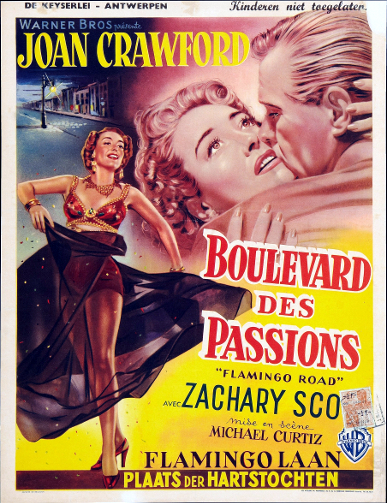
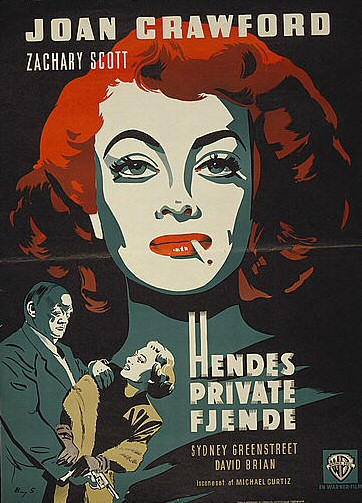
Above: Belgium and Denmark.
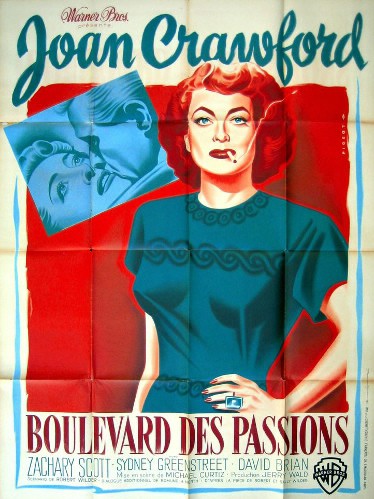
Below: France.
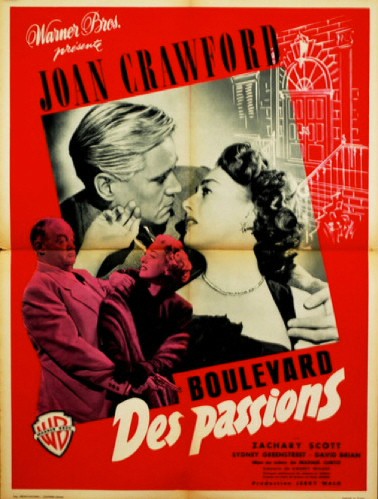
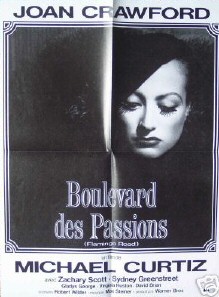
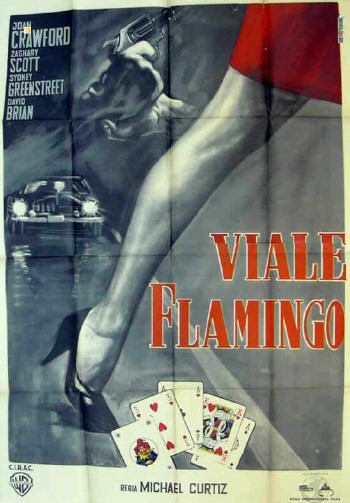
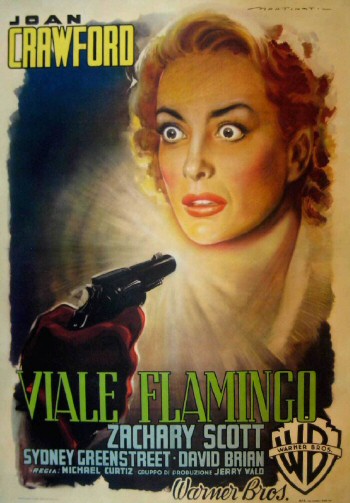
Above: Italy.
Below: United States.
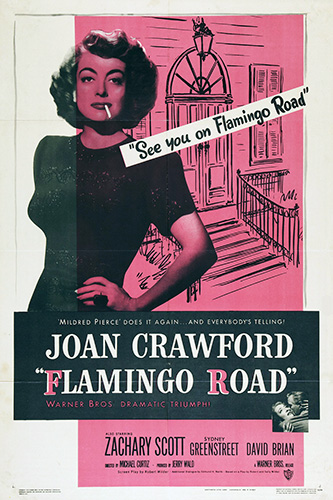
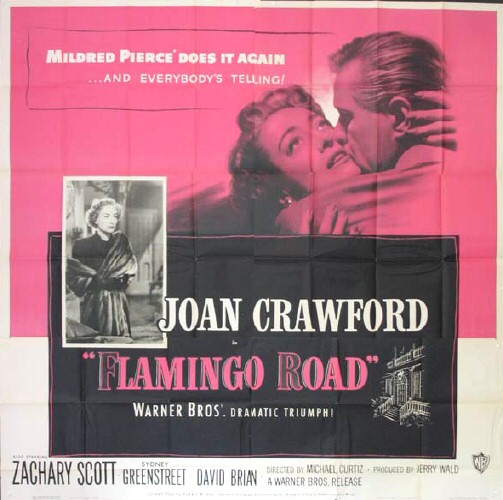
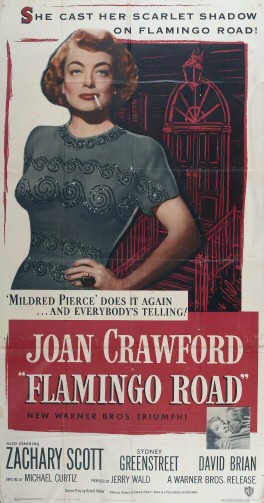
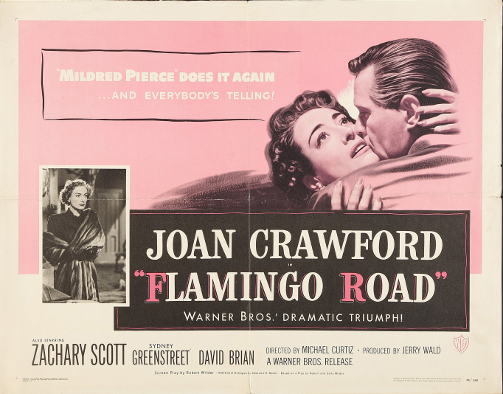
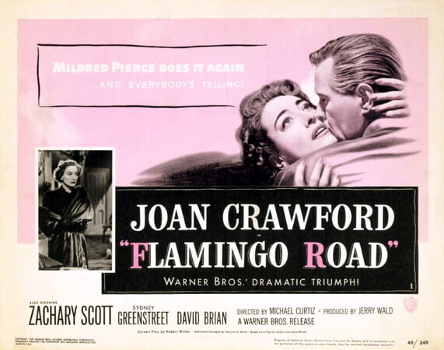
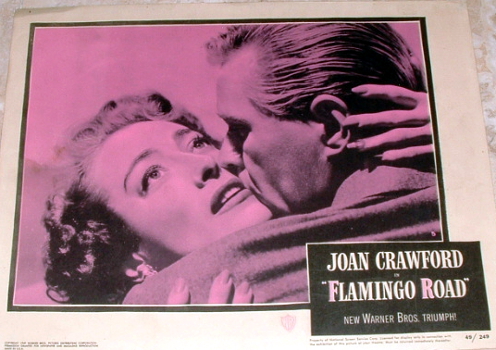
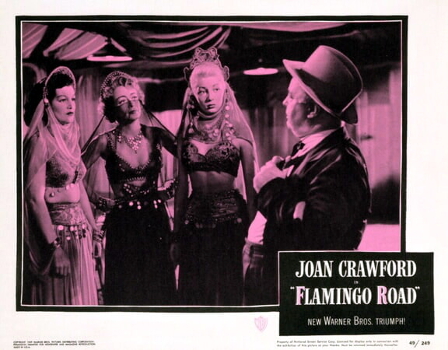
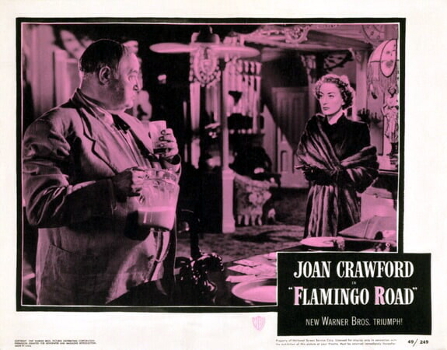
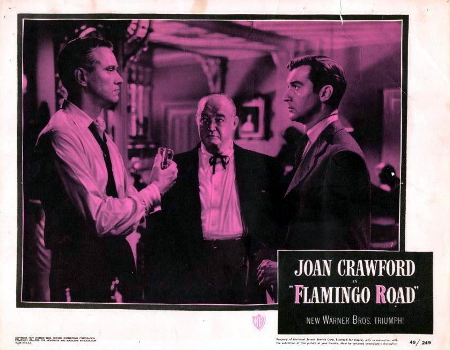
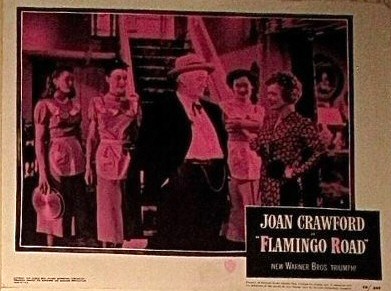
Above: US lobby cards.
Below: Italian lobby and Italian Fotobusta (26 x 17 inches).
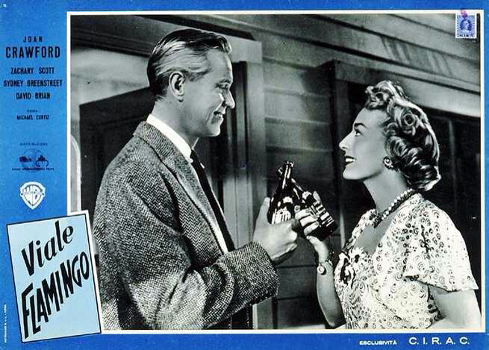
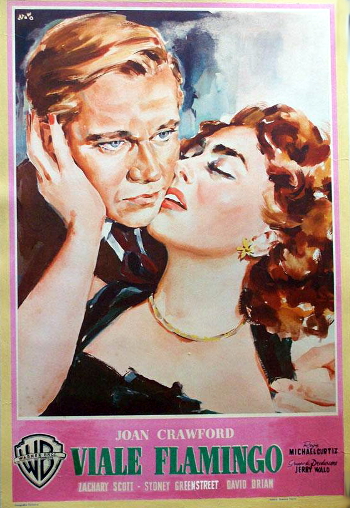
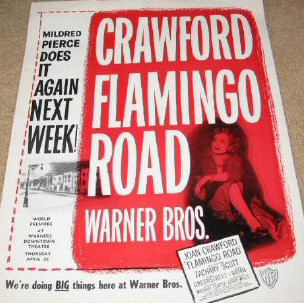
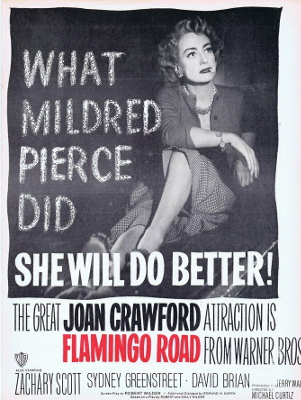
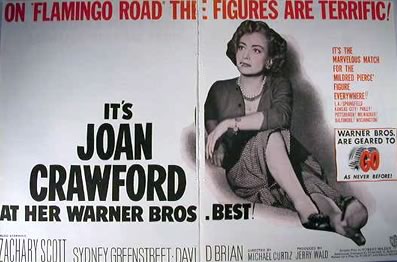
Above: Three US trade ads.
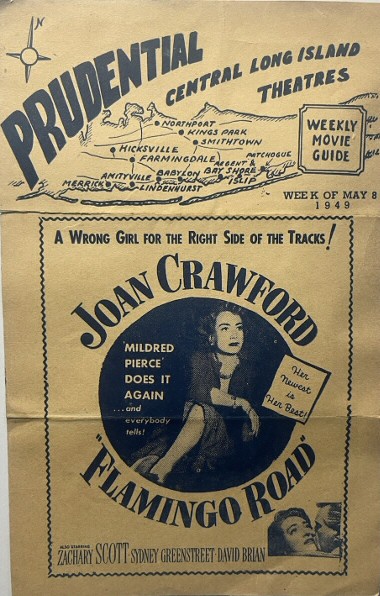
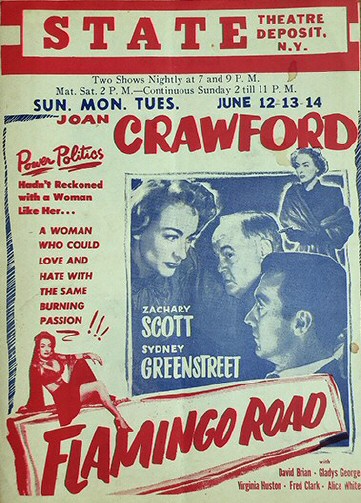
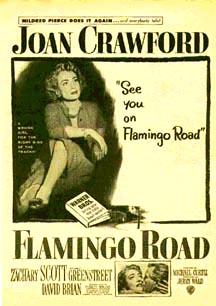
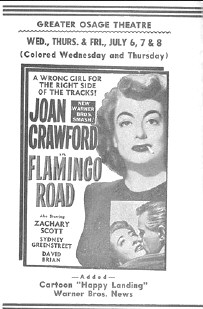
Above: US (Long Island) program, US (NY) herald, US print ad, US flyer.
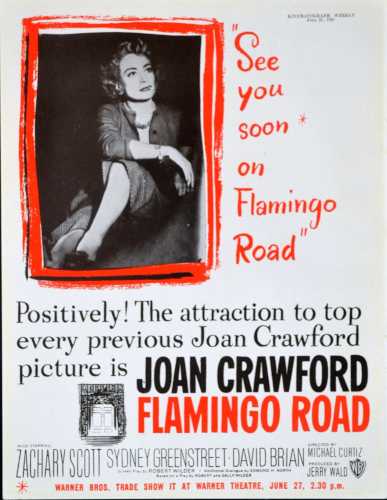
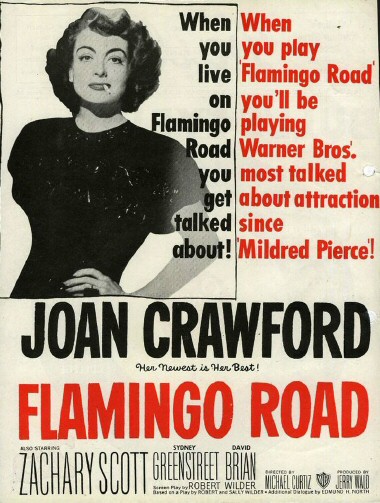
Above: UK trade ads from Kinematograph Weekly (June 23 and July 7, 1949)
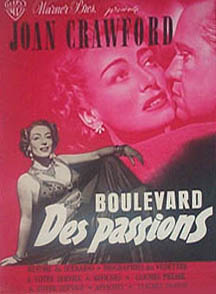
Above: French pressbook cover.

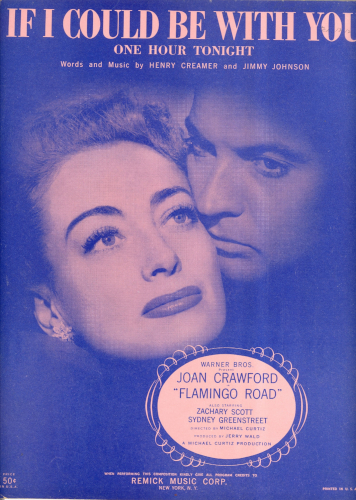
Above left: Click to read the full Warner Bros. US pressbook (12 pages). Above right: US sheet music

Above: Click to read the 2-page agreement for Flamingo credits.
For 8 cover photos of the novel Flamingo Road, see the Books Related to Joan Movies page.
The Best of Everything





 Michael Lia (November 2009)