The Best of Everything
Encyclopedia Entry • Films Main
Johnny Guitar
1954
|
2008: Selected by the United States Library of Congress for preservation in the National Film Registry as being "culturally, historically, or aesthetically significant." Library of Congress essay by Michael Schlesinger |
Critics' Reviews • Our Reviews • Movie Posters • Lobby Cards • Books • Misc. Images
Click here to see photos from the film.
And here to read a 2003 "Sedona Monthly" article on the making of JG.
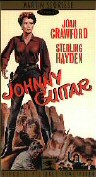
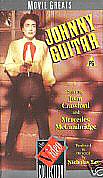
Below Left: Click photo to see 3 large shots of the present-day Johnny Guitar plaque in Sedona, Arizona (courtesy of Mike O, shot in 2014).
Below Right: Click photo to see 2 shots of the set of JG during shooting.


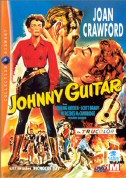
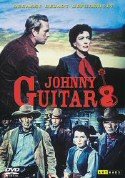
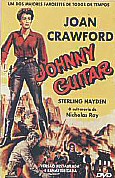
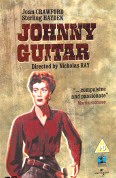
|
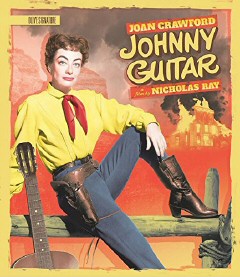
US general release: 5/26/54. VHS release: 4/4/95. DVD: France (2/12/02), Germany (4/3/03), Brazil (4/2/04), UK (2005), US (8/7/12). Olive Signature Blu-ray: 9/20/16. Cast: Joan Crawford (as "Vienna"), Sterling Hayden, Mercedes McCambridge, Scott Brady, Ward Bond, Ben Cooper, Ernest Borgnine, John Carradine, Royal Dano, Frank Ferguson, Paul Fix, Rhys Williams, Ian MacDonald. Credits: Based on the novel by Roy Chanslor. Screenplay: Philip Yordan. Producer: Herman J. Yates. Director: Nicholas Ray. Camera: Harry Stradling. Art Director: James Sullivan. Music: Victor Young. Title Song: Peggy Lee and Victor Young. Wardrobe: Sheila O'Brien. Editor: Richard L. Van Enger.
Plot Summary: One of the strangest westerns on record, Johnny Guitar has less in common with Zane Grey than it does with Sigmund Freud and Krafft-Ebbing. The title character, played by Sterling Hayden, is a guitar-strumming drifter who was once the lover of Arizona saloon-owner Vienna (Joan Crawford). Though her establishment doesn't make a dime, Vienna doesn't care because the railroad is going to come in soon, bringing a whole slew of thirsty new customers. This puts her at odds with bulldyke rancher Emma Small (Mercedes McCambridge), who doesn't want any new settlers on her land. Hating Vienna with a purple passion, Emma will do anything to drive her out of the territory...and even worse, Emma's got the law and the other ranchers on her side. Hoping to keep Emma at bay, Vienna hires Johnny Guitar, who unbeknownst to everyone else in town is a notorious gunslinger. But Johnny prefers to bide his time, waiting for Emma to strike before he makes his move. As a result, Vienna endures several life-threatening experiences, culminating with a feverish chase through the Arizona wilds with lynch-happy Emma and her minions in hot pursuit. According to most sources, the animosity between Joan Crawford and Mercedes McCambridge was quite real, added several extra dimensions to their scenes together. Director Nicholas Ray and screenwriter Philip Yordan stuff the film with so much sexual symbolism that one wonders why they left out a train going into a tunnel. Ms. Crawford's vivid red-and-blue wardrobe scheme was later appropriated by Ray for James Dean in Rebel Without a Cause--with equally stunning results. In addition to the stars, Johnny Guitar is well stocked with reliable supporting players, including Ernest Borgnine, Ben Cooper, Royal Dano (superb as a consumptive, book-reading hired gun) and Paul Fix. ~ Hal Erickson, All Movie Guide
Notes: • Joan Crawford bought the rights to Johnny Guitar before the book was published in May 1953. Author Roy Chanslor dedicated the book to her. • Joan wanted either Claire Trevor or Barbara Stanwyck for the Emma role, but the budget for the picture wouldn't allow it. • The outdoor scenes were shot in Sedona, Arizona, and at the Republic ranch in the San Fernando Valley. (Divine Feud) • Director Nicholas Ray and Joan first met on the set of Sudden Fear, where Ray would visit his then-wife Gloria Grahame, a co-star in the movie. (After their divorce in '52, Grahame would go on to date, and marry, Ray's son.) • Ray and Joan had an affair while filming Johnny. He later said of that time, "Joan was drinking a lot and she liked to fight," but that she was also "very attractive, with a basic decency." (DF) • Sterling Hayden starred with Bette Davis in The Star in 1952 -- which was supposedly based on Joan. (The film was written by Dale Eunson; he and wife Katharine Albert were once friends of Joan's, but had had a falling out earlier that year.) • During the filming of Johnny, when asked to compare Davis and Joan, Hayden said, "Listen. I'll say my lines and kiss any actress my paycheck says to kiss, whether I like 'em or not." (DF) • The set was rife with feuds, which were reported in the local papers. When one paper wrote about Joan's erratic behavior on the set, she responded by having an ad from the film's crew printed in a rival paper, saying what a "cooperative, charming, talented, understanding, generous, unspoiled, thoughtful, approachable person" she was. (DF) • When Hollywood columnist Erskine Johnson reported that Joan had been mistreating McCambridge, Joan called him at home to say "This is Joan Crawford. And you're a shit" before quickly hanging up. (DF) • Johnny Guitar appeared as a half-hour pilot for TV in 1959. The IMDb describes it as being about "a footloose, guitar-strumming cowboy who helps folks with their problems." There was no "Vienna" character in the show. • Mercedes McCambridge later did the voice of the devil in The Exorcist. • "Johnny Guitar: The Musical" opened off-Broadway on March 23, 2004 (Joan's birthday).
Thanks to Jon M. for providing over half of the Notes above.
|
Bosley Crowther in the New York Times May 28, 1954 In "Johnny Guitar," a Republic western, which came to the Mayfair yesterday, Joan Crawford plays essentially the role that Van Heflin played in "Shane." She is the law-abiding squatter who stakes a claim and builds a simon-pure saloon on land that greedy Mercedes McCambridge says should be kept open for cattle range. The only big difference in the character, as plainly rewritten for her, is that now it falls in love with the ex-gunfighter, whom Sterling Hayden here plays. But this condescension to Miss Crawford and her technically recognized sex [Editor's Note: Fuck you, Bosley Crowther.] does nothing more for the picture than give it some academic aspects of romance. No more femininity comes from her than from the rugged Mr. Heflin in "Shane." For the lady, as usual, is as sexless as the lions on the public library steps and as sharp and romantically forbidding as a package of unwrapped razor blades. Too bad, because there were possibilities in this stenciled but workable plot and in the lush accumulation of performers that Republic put into the film. However, neither Miss Crawford nor director Nicholas Ray has made it any more than a flat walk-through — or occasional ride-through—of western cliches. There's the rivalry between Miss Crawford's and Miss McCambridge's gangs and then there's a sub-rivalry between Mr. Hayden and Scott Brady, Miss Crawford's bad-boy friend. There's a great deal of talk and a little shooting, and at one point Miss Crawford is almost lynched—looking in this situation like a figure in a waxworks of famous crimes. That's about all there is to it. Miss McCambridge screeches nastily and Mr. Hayden gallumps about morosely as though he'd rather play the guitar. The color is slightly awful and the Arizona scenery is only fair. Let's put it down as a fiasco. Miss Crawford went thataway.
Brog in Variety (1954): It proves [Miss Crawford] should leave saddles and Levis to someone else and stick to city lights for a background....[S]o involved with character nuances and neuroses, all wrapped up in dialogue, that [the picture] never has a chance to rear up in the saddle.... The people in the story never achieve much depth, this character shallowness being at odds with the pretentious attempt at analysis to which the script and direction devotes so much time.
Francois Truffaut: She [Joan] has become unreal, a phantom of herself. Whiteness has invaded her eyes, muscles have taken over her face, a will of iron behind a face of steel. She is a phenomenon. She is becoming more manly as she grows older. Her clipped, tense acting, pushed almost to paroxysm by Ray, is in itself a strange and fascinating spectacle.
TV Guide Online:
Bright Wall/Dark Room essay (Veronica Fitzpatrick) (October 2019) Dennis Schwartz review (2000) Images Journal review (Grant Tracey) pif online review (Nick Burton) (1999) Roger Ebert review (2008) Rotten Tomatoes page Slant review (Calum Marsh) (2015) Turner Classic Movies review (Sean Axmaker) (2012) UK Guardian review (Derek Malcolm) (1999) |
If you've seen Johnny Guitar and would like to share your review here, please e-mail me. Include a star-rating (with five stars the best), a photo or avatar of yourself, and any of your favorite lines from the film.
|
Rating: After the 1948 Supreme Court decision forcing studios to divest their interests in movie theaters, the studio system that Joan Crawford had been brought up on was slowly crumbling. Production costs were rising, television was growing, and established stars were losing their long-time contracts and forced to scramble for employment. Miss Crawford had been an independent contractor after her exit from Warner Brothers in 1952, and with no major studio backing her next film, she was doing what a lot of actors and directors had to do: operating as producer and arranging their next project as a package deal. She had great success with her first independent film, co-producing and starring in Sudden Fear (1952), which received four Oscar nominations, but after losing her chance to be cast in From Here to Eternity (1953), she again had to be constantly on the lookout for a movie that she could help develop. For her next project, Miss Crawford purchased the rights to Roy Chanslor’s novel Johnny Guitar before it was even published in 1953. The novel features “Vienna,” an embattled saloon owner in conflict with local townspeople---led by the loveless, bitter “Emma Smalls”---for both business and personal reasons. Into this mix, Vienna’s long-lost love “Johnny Guitar” returns. Miss Crawford chose director Nicholas Ray (who would go on to direct Rebel Without a Cause in 1955), and attempted to get either Barbara Stanwyck or Claire Trevor to play “Emma,” but budget considerations forced her to instead hire Mercedes McCambridge (a Supporting Actress winner for All the King’s Men in 1949). Other key players that Joan had a hand in casting include Sterling Hayden (as Johnny), Scott Brady (as the Dancin’ Kid, an outlaw and one-time love interest of both Vienna’s and Emma’s), Ernest Borgnine (a cohort of the Kid’s), and a young Ben Cooper for the teen crowd. (You might have read previous tales about the tension on the set during filming: the drinking, the clashes of personalities. In her autobiography, Miss McCambridge called Joan a “rotten-egg lady.” Mr. Borgnine wrote in his own book that one day, after Joan invited everyone to her dressing room for drinks, she interpreted a simple comment from Mercedes as an insult and let out a fusillade of expletives that Borgnine said he had never heard before, despite having been in the Navy!) JG was a very big change from the type of films/roles that Miss Crawford, and her fans, were used to, although she was actually just joining other actresses of her day doing Westerns, like Jean Arthur, Claudette Colbert, and Barbara Stanwyck. (They also went out to pasture, so why not Miss Joan Crawford in long skirts and a gun, a horse, and a nice bonnet when she goes to town?) JG was partly filmed on location in Sedona, Arizona. Dealing with soaring temperatures, and a lot of alcohol, the actors prepared themselves for a seemingly routine Western. And as a Western, JG has it all: murder, bank robbery, secret hideouts, lynchings, stagecoaches, searching for gold and/or love, cattle ranchers, town folk, arson, saloons and drunks----but this time with two female rivals instead of Randolph Scott or John Wayne or Walter Brennan. The West would never be the same. The movie was a modest success, and only decades later attained cult status, with numerous critics (ranging from Francois Truffaut to my cousin Ann) pontificating on its “real” meaning: Is it about the political climate of the 1950s and its McCarthy witch hunts? What is the real relationship between the women? Are the male and female roles reversed? What would Freud say? The critics remain divided, but as for me: I think Miss
Crawford, who only wanted to keep acting, was simply giving a pretty thrilling performance.
She made the character of Vienna her own: a woman who has to be tough, a woman
whose past has made her strong but still vulnerable.
Rating:
Joan Crawford was a chameleon who shifted genres as they went in and out of fashion during her amazing half-century career. However, one does not usually associate JC with the Western genre. By my recollection, Joan made 3 Westerns: The Law of the Range, a 1928 silent (several Internet sources say a copy of Law exists; if so, someone please make this movie available!); Montana Moon, an early (1930) talkie; and Johnny Guitar, 1954. The first two are side notes in Joan’s filmography; as for Johnny Guitar: who’da thunk after 70 years that this would be one of Joan’s most dissected films? JG has become a cult classic, panned upon release in the U.S. albeit much loved by leading French auteurs, notably Jean-Luc Godard and Francois Truffaut. (I scoured the Internet to see if JG could complete the Triple Crown of French New Wave directors, but nowhere could I find commentary by Agnes Varda!) Critics have analyzed JG's sexual, political, social, feminist, etc. themes. I’ve now watched it three times and if I squint I might see subtle allusions to McCarthyism in scenes where the bank manager or Turkey is forced to “name names” to save his skin. But, I’m not that deep of a cinema buff; I want to be entertained. When I watch a Joan flick, I want to see her as the center of attention, overcoming tribulations, looking great, and delivering great lines. On that front, Johnny Guitar delivers. It’s fun, and a rare opportunity to see the great diva in color. As with other times I’ve had the pleasure to see Joan in living color---briefly in Ice Follies of 1939 and It’s a Great Feeling (1949)---those lovely blue eyes are worth the price of admission. Joan's garish clothing is another story, but maybe they were trying to show off the Trucolor process. What do I like about the movie, apart from Joan? Great character actors in the supporting cast: Ward Bond, Ernest Borgnine, John Carradine, Sterling Hayden, and so on. None of them hit a career highlight in this picture, but all are good. Among them, I thought Scott Brady was weakest. OK, so what do I not like about Johnny Guitar? Two words, Mercedes McCambridge. Linda Blair’s alter ego hams it up all movie long, in my opinion. Her voice reminds me of Mr. Peabody’s sidekick, Sherman, in the old Rocky & Bullwinkle cartoon. I have a hard time believing the men in a Wild West town wouldn’t have told MM to be quiet. I read that Joan wanted Claire Trevor for the part, and I think it would have greatly improved the film to have someone more of Joan’s stature for her to play off of. Of course, if we're dreaming, what about Bette Davis as Emma Small? That would have put Johnny Guitar into the cinematic pantheon! But, what do I know? Great directors love it, the Library of Congress deems it culturally significant. If nothing else, it proves Joan Crawford could do anything: drama, comedy, romance, musicals, and, yes, even Westerns. Nicholas Ray has been well lauded for directing the movie. As with almost all of Joan’s post-MGM films, I think it’s a reel or two too long. Two stars for the movie plus one more for Joan's lovely blue eyes in Trucolor.
Rating:
Throughout her five-decade-spanning career, Joan Crawford embodied numerous different roles, ranging from the shopgirl of the 1930s to the "Scream Queen" of the 1960s. It's in Johnny Guitar that Miss Crawford takes on one of her most notably different personas: the no-nonsense, yet still very much all woman, saloon owner Vienna.
Rating:
Like any true celebrity concerned with the adulation of her public, Joan Crawford was largely galvanised by her commercial failures. The lack of attention or acclaim was sinfully unacceptable by her standards but, while also remaining astutely self-reflective of her work, there were exceptions with two masterpieces with which her views would never atone. The first was Rain, a didactic and bold drama of religious and sexual oppression; the second has arguably propelled her into credible filmmaking chic, Johnny Guitar. The latter arrived as a twin-piece to Crawford's other curious genre-experiment, the doomed musical Torch Song; in spite of ample publicity, the reception was similarly ambivalent. Now, however, after years of being enamoured by the French, Nicholas Ray's Johnny Guitar has found an affectionate place in the hearts of today's generation. The DVD even bags a professor-esque introduction courtesy of Martin Scorsese. Most of the modern endorsement is typical pandering to the posthumous: The script is far from operatic, rather high-pitched camp delivered with gritty conviction. The screenplay and cinematography aren't artistically grandiose, but highly saturated in colour. The setpieces are interesting, as is the musical score, with the signature tune delivered by the wonderful Peggy Lee. On a whole, the visual presentation of Johnny Guitar is an intriguing, if flawed, advancement of colour in cinema. Johnny Guitar's
magic lies in bold themes implied through masterful subtext. Philip
Yordan's script poses a delicious melange of intellectual discussion: Is
it really an anti-Western portrait of feminism and psycho-sexual
hysteria, or is it a poker-faced parody of the genre itself? Here we
have a backdrop that might just be the most off-kilter on record. The
dritfing guitar-toting title character (Sterling Hayden) emerges in
Arizona, where he is reunited with his saloon-owner former lover, Vienna
(Joan Crawford). Vienna is downplaying the barren financial prospects
of her saloon as she patiently awaits the pending railroad to come into
town and flood her business with new customers. Unfortunately this draws
the ire of town rancher Emma Smalls (Mercedes McCambridge), who resents
the idea of new settlers on her land just as much as she resents Vienna. The first thing that immediately transfixes you is, unsurprisingly, Joan Crawford. She becomes transient in spirit and eschews acting here. What she projects onto the screen is a hybrid of glaring androgyny and indomitable presence. Even for the wrong reasons -- proceedings are undeniably campy -- Crawford's entire stance and delivery denote the staid calm of a killer. Crawford was maligned by her co-stars during production of this film, and watching Vienna churn out lines such as "Down there I sell beer and cards; all you can buy up here is a bullet in the head" illustrates the grisly determination she wielded to disarm any opponents -- off screen and on. While Sterling Hayden, more figure than actor, takes a likeably emasculated and subservient role to Vienna, the other star of this film is undeniably Mercedes McCambridge. "I'm going to kill you," she sneers early on to Vienna with a sleazy smile etched across her lips. "I know," fires back Crawford. "... If I don't kill you first." The sardonic fire of a wild animal in midst of catching its prey fills McCambridge's eyes in almost every scene; her dialogue is emoted through endless snarls and strained pitch. McCambridge is strangling her way through the script as her hands desired to around Crawford's neck. In the context of her character, this frustration depicts Emma being driven clinically nuts due to her lust for The Dancin' Kid. Johnny Guitar was unfortunately conceived at a point where Crawford's celebrity had broached caricature. Her face had completed its transformation from wide- eyed hopeful into a masculine, vulcan-browed, lizard-staring Grand Dame. This is beauty in hardened granite. There are, mind you, moments where Crawford glows in beatific form; her costumes make full use of bold colour, and when Emma and her posse come to arrest Vienna at her saloon, they find her draped in flowing, graceful white gown as she softly plays her piano. The tension boiling all through the film hits its climax in this scene, and the drama scales heights of ecstasy as Emma sets fire to the saloon in a moment of stolen victory. Between Nicholas Ray and his coalition of capable character actors, it's understandable that his film has been reassessed as meticulously detailed and stuffed with Freudian themes. If Johnny Guitar doesn't feel as though it possesses the intellectual backbone critics have subsequently implied, then at the very least it plays with angst in a blender and pressed on high. The ending, for instance, should always be watched by any two warring females that fancy a giggle at the silliness of their own feud. With Torch Song, Crawford's estranged professional relationships were brought to the focus of the camera; here, it's the off- screen rivalries that are perhaps the key ingredients that loan the film several deeper, more interesting dimensions. It's a shame that being labelled a misguided wreck during its time disheartened our leading lady: Johnny Guitar is one of the rare fruits of Joan Crawford's unsinkable commitment to her role -- it has rightfully earned the status of a post-modern classic.
Jon M. (February 2005) Rating:
Johnny Guitar is a film experience unlike any other you are likely to encounter. On the surface it is a role-reversal Western --- beneath that surface are many layers. To say the picture is ahead of its time is scratching the tip of an iceberg. The story opens somewhere in the Wild West, set in the late 1800s. Vienna (Joan Crawford) owns the saloon and gambling parlor just outside of town. Johnny Guitar (Sterling Hayden) arrives supposedly to start working for Vienna. The trouble begins when a stagecoach is held up and one of the casualties is the town banker. Emma Small (Mercedes McCambridge) is the sister of the victim; besides being angry, she appears to be sexually frustrated as well. Emma keeps company with John McIvers (Ward Bond). Besides owning most of the land and controlling commerce in the town, together they intimidate almost everyone else --- except Vienna of course. She is independent, runs her own business, and has much bigger plans as soon as the railroad comes. Just the idea of the railroad and the new people it will carry west sets off Emma and McIvers. Emma and McIvers are convinced that the "Dancin' Kid" (Scott Brady) and his bunch held up the stagecoach and that Vienna is mixed up in it as well. Emma, it seems, also has repressed feelings for the Dancin' Kid, so she is constantly at odds with herself. McIvers takes it upon himself to declare a new law ---"Vienna's" must close and the gang must leave town in 24 hours. A lot happens in that next 24 hours; it seems Vienna and Johnny have a past together and are not yet finished with each other. The gang has to decide if they should leave town or defy the law. Emma seems to get everyone in her posse to hate Vienna, the Dancin' Kid, and anyone else who represents change in their town. When the film was originally released in 1954 it was not a winner at the box office. Critics of the day generally panned the film; it seems to me that they were shortsighted, to say the least. Only in France did the film find an audience. In fact, Johnny Guitar was always considered a classic in that country; Francois Truffaut and Jean-Luc Godard both praised and were inspired by the film. Today, 50 years later, the movie is now considered a near-masterpiece everywhere. It really is something to see; it is a moody, tension-filled, heavily stylized film full of sexual symbolism and political references (presumably the McCarthy Witch hunts) that poses many questions---many of which are still relevant today in the early 21st century. It's amazing that critics and audiences of 1954 did not at least pick up on this. Performances are near-perfect in this film: Protagonist Joan Crawford is ideally matched with antagonist Mercedes McCambridge---If the two ladies are in a frame together the fireworks go off. The viewer clearly sees the contempt their two characters have for each other. Sterling Hayden was a somewhat limited actor, but in this film that is a plus; even though he plays Johnny, he is basically supporting Crawford. Ward Bond is typecast and effective as well. Ernest Borgnine comes off mean and selfish, as he should. Scott Brady is likable, but you don't completely trust his motives. In fact, most of the characters come to a point where they must make very important decisions, and the decisions they do make define that particular character even more. The direction is fine considering the fact that Nicholas Ray followed up this film with Rebel Without a Cause, which presented another misunderstood character against the grain. The writing is incredible, especially for its time (conservative early 1950s) --- so many long monologues by almost every main character. Johnny Guitar is one film that I believe turned out to be better than was originally expected. Memorable Lines I've never seen a woman who was more a man; she thinks like one, acts like one and sometimes makes me feel like I'm not. Sam describing his employer Vienna. You want The Kid and you're so ashamed of it, you want him dead. You want me dead, too, then maybe you can sleep nights. Vienna to Emma. Look at her standing there staring down at us like she's a somebody. Emma to Vienna. You're nothing but a railroad tramp, not fit enough to live among decent people. Emma to Vienna. I intend to be buried here. In the 20th century. Vienna to Emma and posse. Down there I sell whiskey and cards. All you can buy up here is a bullet in the head---now which do you want? Vienna to the posse. When you boil it all down, what does a man really need? Just a smoke and a cup of coffee. Johnny to the posse. When a man can't hold onto a glass he should drink like a baby from a bottle. Open your mouth, Guitar Man, I'll feed you. Ernest Borgnine's character to Johnny. Five years ago I met you in a saloon, now I find you in one. Johnny to Vienna. I'm not ashamed of how I've got what I have. The important thing is I've got it. Vienna to Johnny. A man can lie, steal, and even kill, but just as long as he can hold onto his pride he's still a man. All a woman has to do is slip once and she's a tramp. Must be a great comfort to you to be a man. Vienna to Johnny. Lie to me, tell me all those years you've waited. Johnny to Vienna. He makes her feel like a woman and that frightens her. Vienna to Johnny, describing Emma's feelings for The Kid. A posse is an animal, moves like one, thinks like one. Johnny to Vienna. You're acting like she's some fine lady and doing nothing makes you fine gentlemen --- well, she ain't and you're not. Emma to the posse, describing Vienna. Boys who play with guns have to be ready to die like men. Vienna to John Carradine's and Ben Cooper's characters. I'm sitting here in my own house, minding my own business, and playing my own piano--- I don't think you can make a crime out of that. Vienna to the posse. Nice fella. You've finally got someone to do your shooting for you. That ought to make you real happy. The Kid to Vienna. We've both done a lot of living; our problem now is how to do a little more. Vienna to Johnny.
Rating:
Frankly, I'm a bit baffled by some of the extravagant praise heaped on Johnny by today's critics. (See the above "Critics' Reviews" section.) Not that it's not a good movie--it is, and it was indeed highly underappreciated at the time of its release. It's just that modern-day critics' comments seem slightly off-base about what makes the film so unique. In reading over the Critics' Reviews above, I saw mentions of things like the film's "hallucinatory quality," "expressionistic sets," "surreal color photography," as well as its being "deliriously stylized." Well, I've probably seen Johnny at least 10 times now, and I still fail to see anything particularly hallucinatory, expressionistic, surreal, or stylized about physical things like the color and the sets. For one thing, a new color process, TruColor, was being tried out. As is the case with many early color films, the process hadn't yet been perfected and the colors came off as unintentionally gaudy. What might seem "surreal" today was, in fact, just an imperfection of the process at the time. In addition, at least as is documented in this case with producer Yates, a color film's director and cameraman were often pressured by producers to make the costumes and sets as vivid as possible in order to show off the new color technology. Nothing too mysterious and artistic about it, really---just an understandable desire by the money-men to display what they'd paid a lot for. As for the film's sets: The saloon, bank, hide-out, etc., all seemed pretty conventional to me as far as Westerns go. (I wonder---is it the burning of Vienna's saloon that has critics so enraptured? The posse does circle the conflagration for an inordinate amount of time; but when I spotted the same exact footage used at least twice, I attributed it to the director just milking the rather trite "action" for all it was worth...) Another aspect of the film that today's critics seem to imbue with untoward significance is what they say are the obvious parallels between the lynch-mob mentality in the movie and the red-baiting political climate in the US of the 1950s. A legitimate point if you're thinking about the film in a vacuum. However, if you've seen even two or three other Westerns of whatever time period, it's pretty obvious that a lynch scene demonstrating "the dangers of mob justice" is a pretty standard convention of the genre. Just as conventional are the Bad-Girl-With-A-Heart and the Laconic-Loner / Good-Man-With-A-Violent-Past characters of Vienna and Johnny. But here is where Johnny Guitar, for me, makes its radical mark both on the genre and on cinema as a whole: The usually stereotypical "Bad-Girl-With-A-Heart" isn't a minor character who's chucked condescendingly under the chin by the nostalgic Hero, who remembers his Bad Old Whoring Days with a bit of fondness but is nonetheless glad he's now found a better life for himself with a classier (but still hot) dame. No, this particular Bad Girl happens to be Joan Crawford... and she happens to run the show. The title character Johnny's role in the film's proceedings is almost immediately negligible: He's on hand for Vienna's early saloon confrontation with the angry town-mob and the subsequent tussle between them and the outlaws who have sought refuge from a sandstorm... But rather than heroically stepping in "in defense of his woman," Johnny just sits there and lets Vienna deal with the tense situation; after she alone diffuses it and the townfolk leave, he makes smart remarks and brawls with a gang-member---OFF-camera, while we see Vienna parrying verbally with her former lover, the outlaw Dancin' Kid. Never has the title character of a film behaved so ineffectually (or failed to get screen time when involved in a brawl!) Even after Johnny and Vienna---former lovers in the story---have reunited and Vienna starts symbolically wearing a white dress rather than her former black pants ensemble (leading us to believe she's gone all passive and femme), Johnny is still incapable of action. Witness the bank robbery that occurs the morning after they've slept together: The now-femininely attired Vienna's right in the middle of things while Johnny waits passively outside. Later in the film, he eventually does strap on the guns again, but it's certainly a minor plot point by that time: The final obligatory shoot-out has nothing at all to do with him, but is rather the climax of the ongoing rivalry between Vienna and her female nemesis Emma. Joan Crawford is quiveringly intense and watchable in her performance, especially in the first half of the film, in the saloon, before the more conventional lynch-mob chasing scenes start. We've all seen "Intense" portrayed onscreen, but here Joan has moved far beyond mere "acting" into the "radiating" sphere. Which can seem weird or scary (or "surreal" or "deliriously stylized") for anyone not used to seeing real, and often disturbing, intensity transferred to the screen. Over the years, I've watched Johnny with various non-Joan, non-classic film fans, and the reaction to the first half of the film, even among Joan-detractors, has usually been the same: Some post-mod ironic put-downs as the movie started (based on a pre-conceived idea of Joan Crawford) that quickly melded into silent, amazed attention to what Joan was doing acting-wise onscreen...and, after the movie, some serious, non-ironic admiration for her performance. It's the strangest thing... Almost immediately after the film's release, after the poor critical reception, Joan regretted taking the role ("I should have had my head examined"). But with this film, as with her opinion of her then-decried/now-classic 1932 film Rain, time has proven her wrong: For their groundbreaking psychological bravery, both she and Johnny Guitar are exceptionally worthy of the cult status they've achieved. And it has nothing to do with the scenery. Memorable Lines In his own "Memorable Lines" above, Jon covered a whopping amount of great lines from the movie! I'd just like to expand on a couple of those and add one exchange: Emma: I'm going to kill you. Vienna: I know. If I don't kill you first.
Johnny: Five years ago I met you in a saloon, now I find you in one---I don't see much change. Vienna: Except I own this one.
Johnny: Lie to me, tell me you've waited all these years. Vienna (deadpan): All these years I've waited. Johnny: Tell me you would have died if I hadn't come back. Vienna (deadpan): I'd have died if you hadn't come back. Johnny: Tell me you still love me like I love you. Vienna (deadpan): I still love you like you love me. Johnny: Thanks. |
Movie Posters: Argentina Australia Belgium Denmark France Germany Italy Spain United States
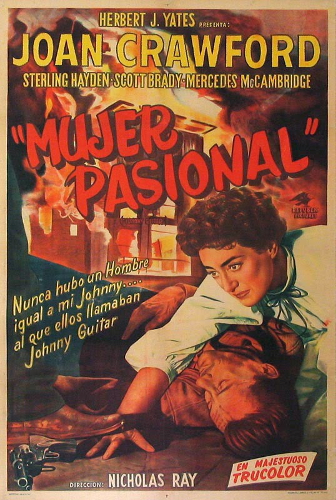
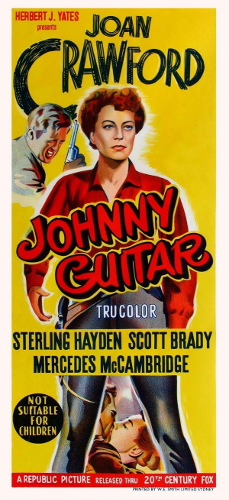
Above: Argentina and Australia
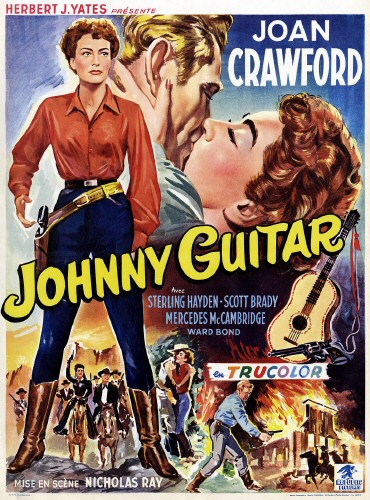
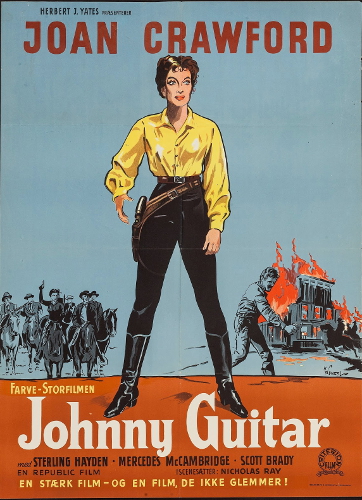
Above: Belgium and Denmark
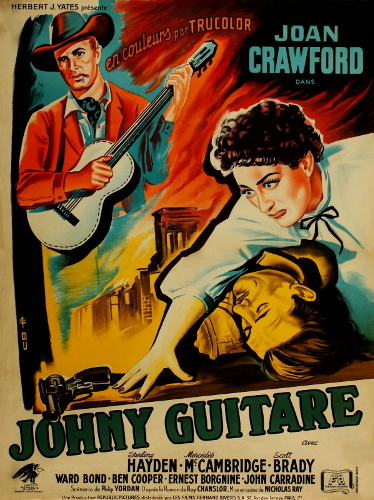
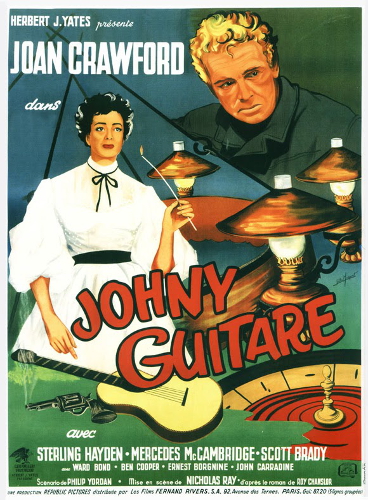
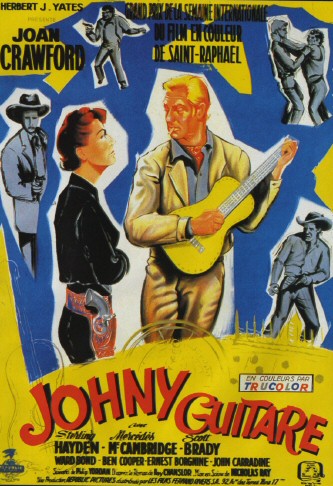
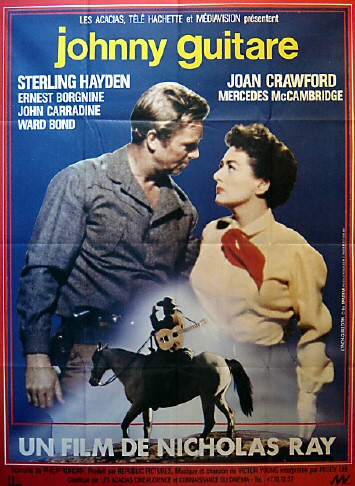
Above: France
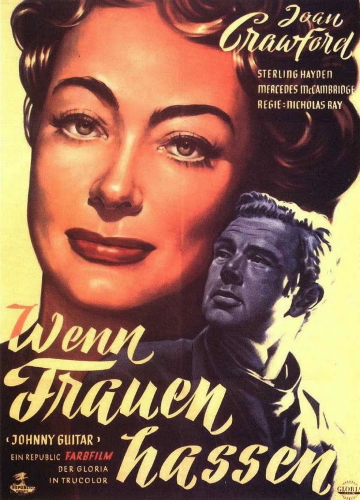
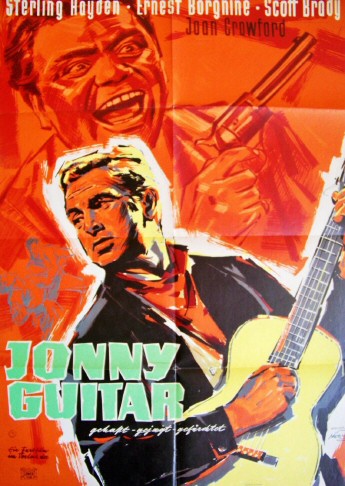
Above: Germany
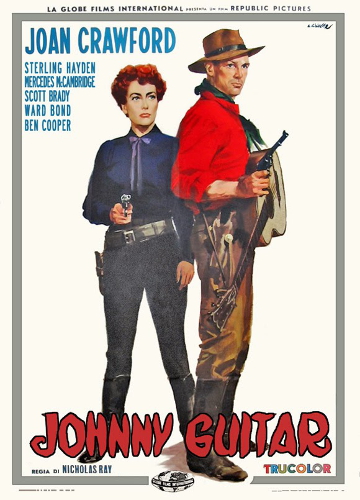
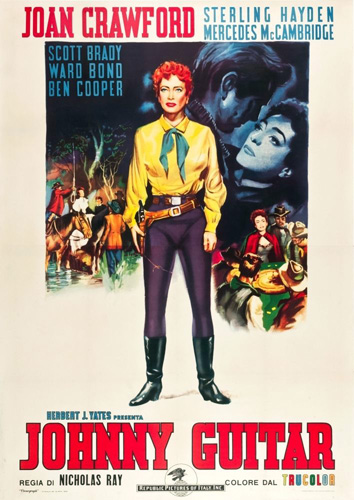
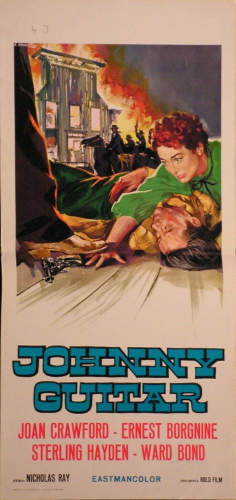
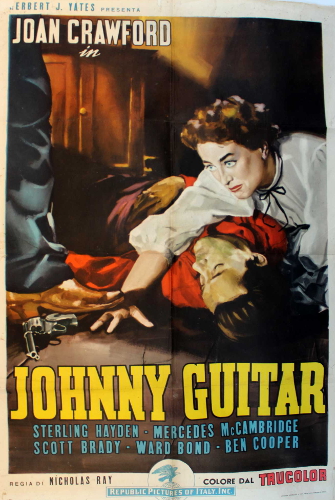
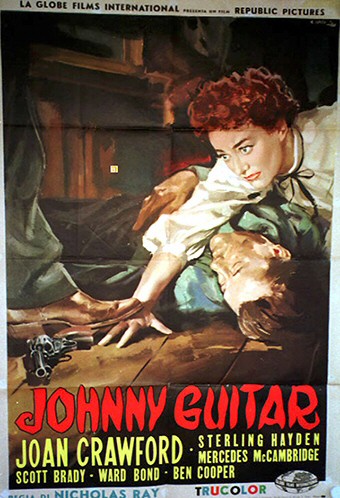
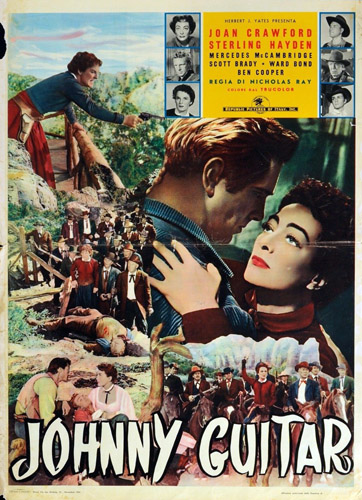

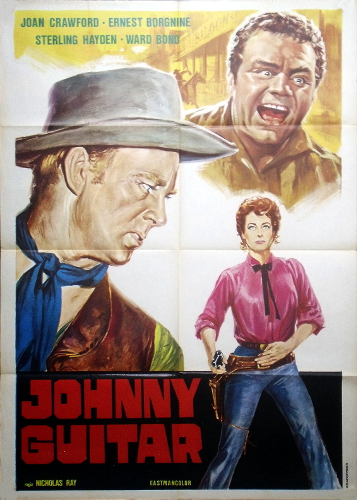
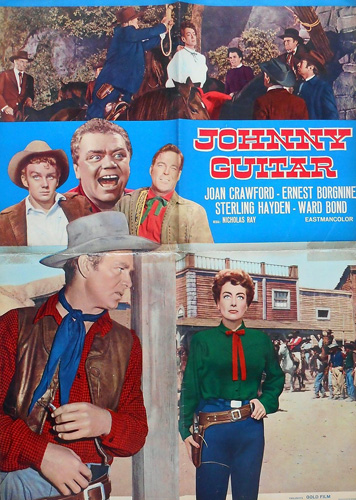
Above: Italy
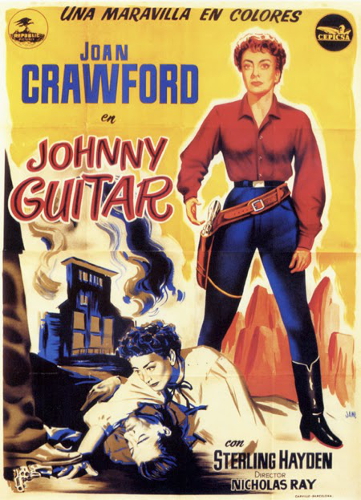
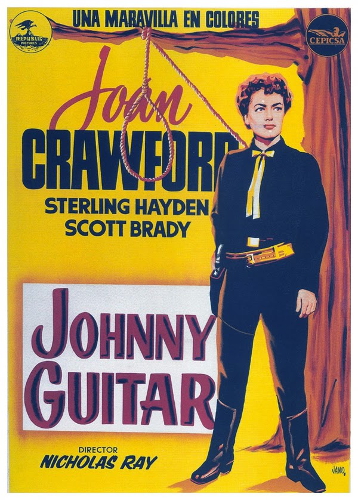
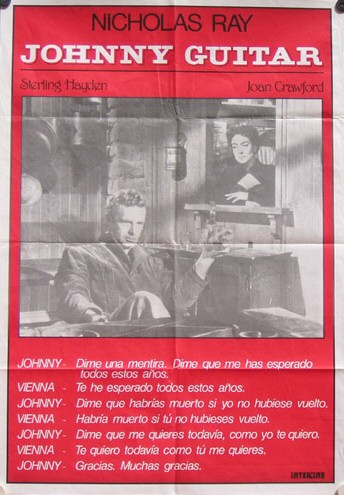
Above: Spain
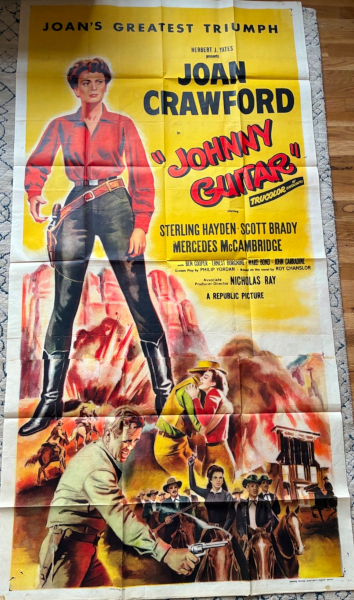
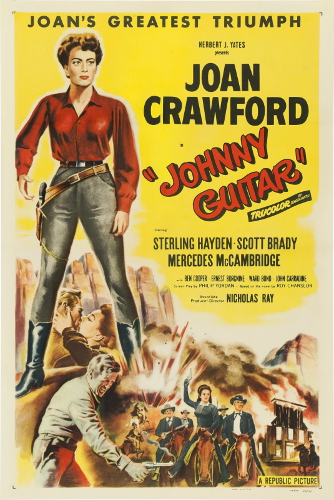
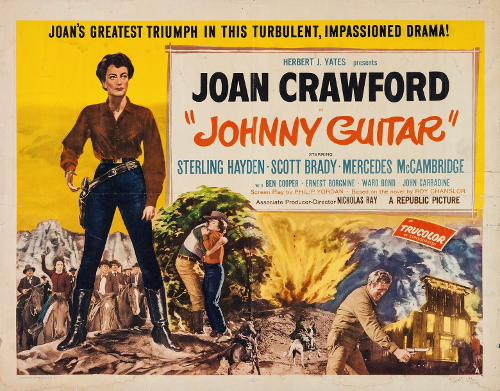
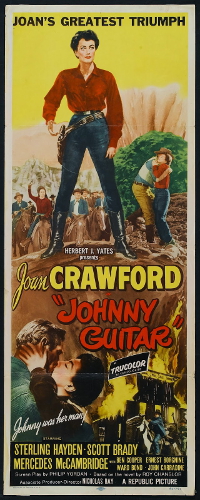
Above: United States
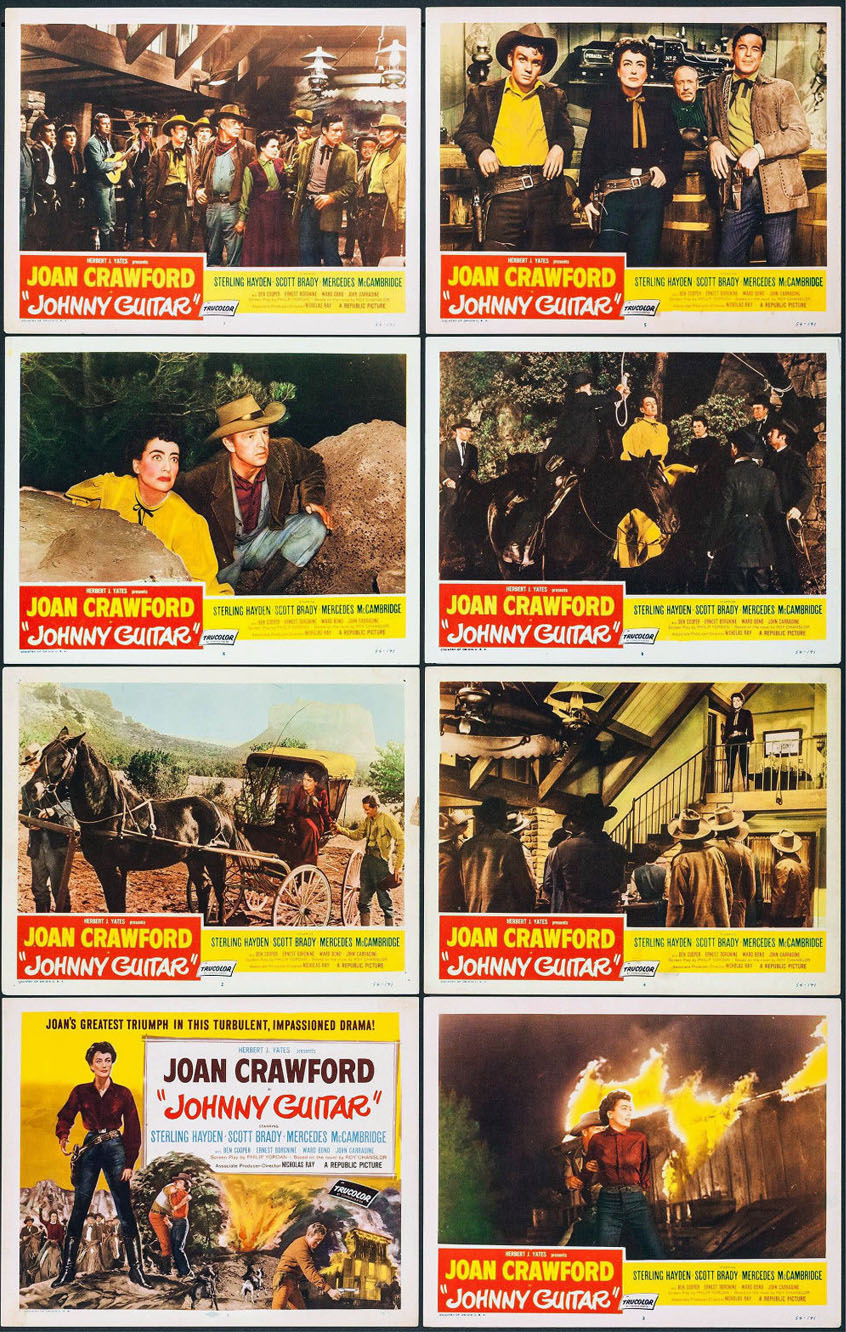
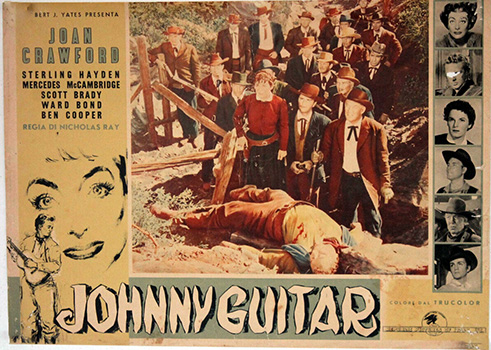
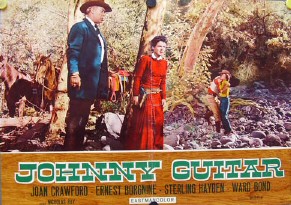
Above: US lobby cards. Below: Italian lobby cards.
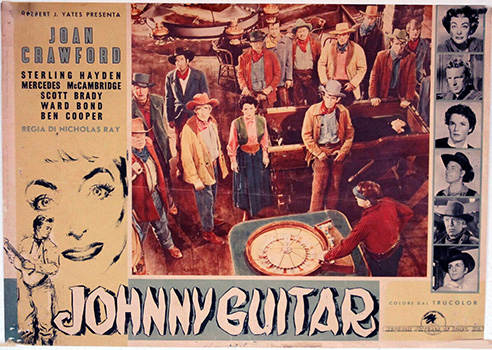
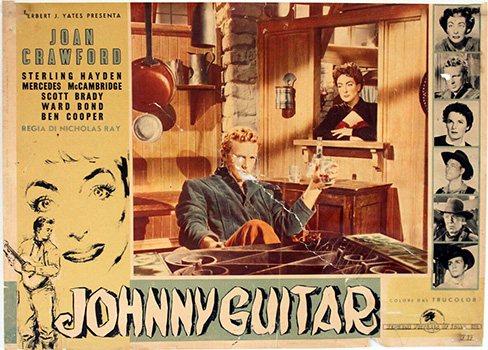
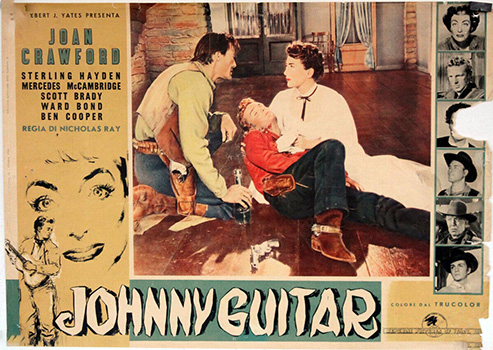
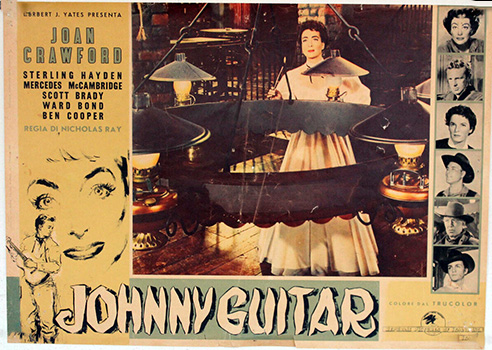
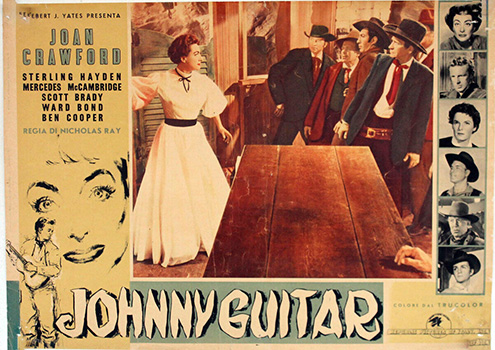
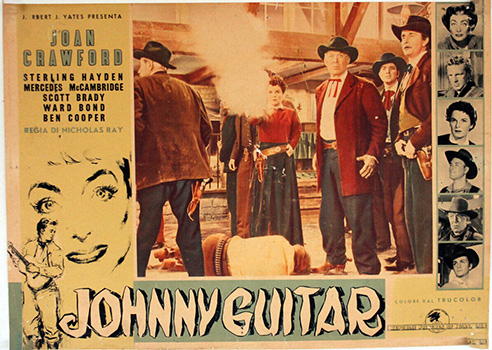
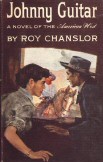
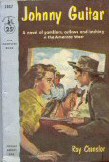
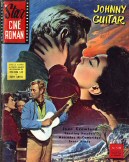
Above: See the Books page for more info.
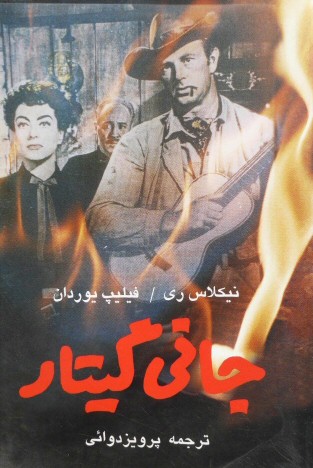
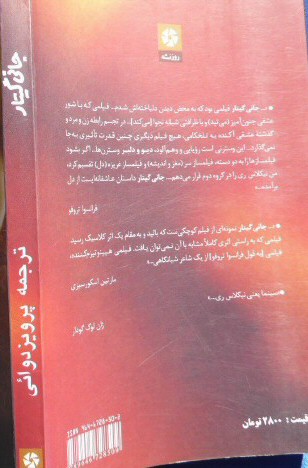
Below: Iranian novelization of Johnny Guitar.

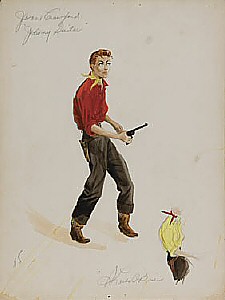
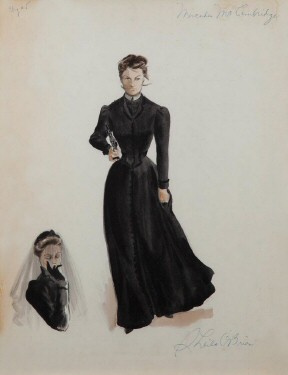
Above: Costume sketches for Vienna and Emma by Sheila O'Brien.
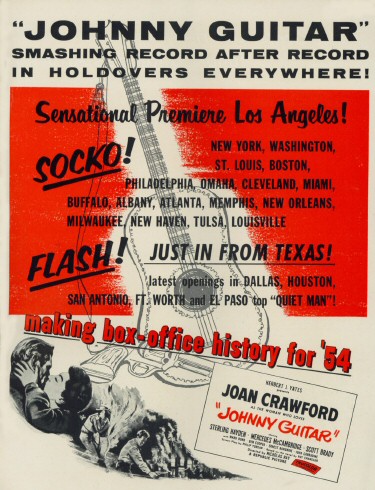
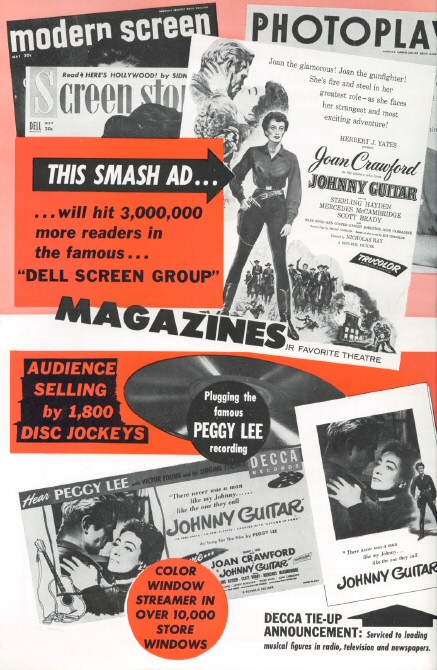
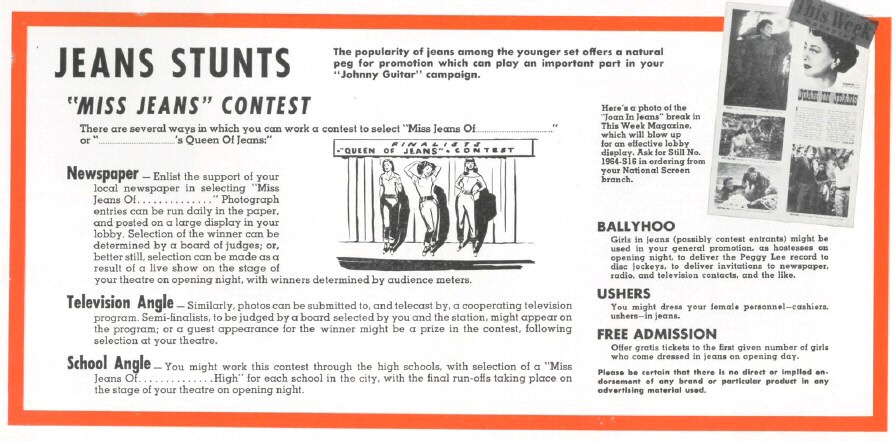
Above: Three US pressbook campaign promos.
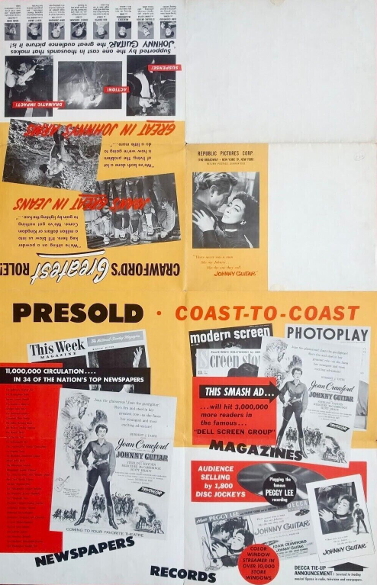
Below: US press campaign poster (front and back). 24 x 37 inches.

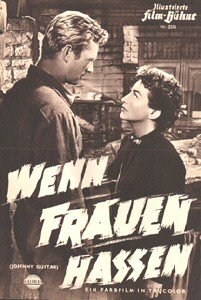
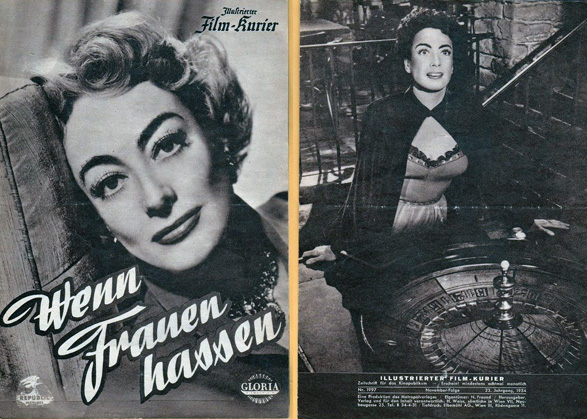
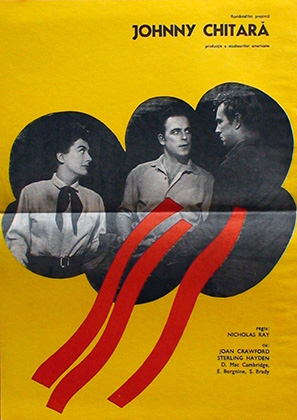
Above: German programs for If Women Hate. And a Romanian program at right.
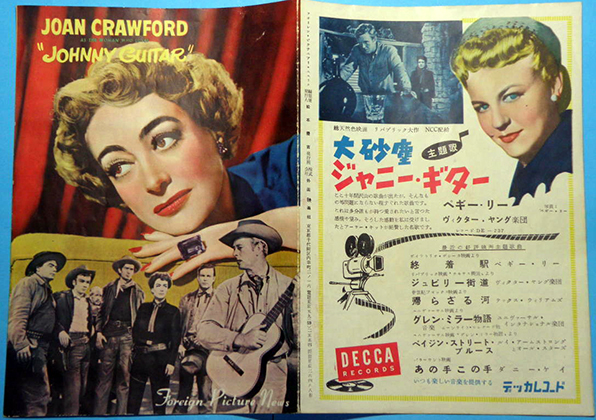
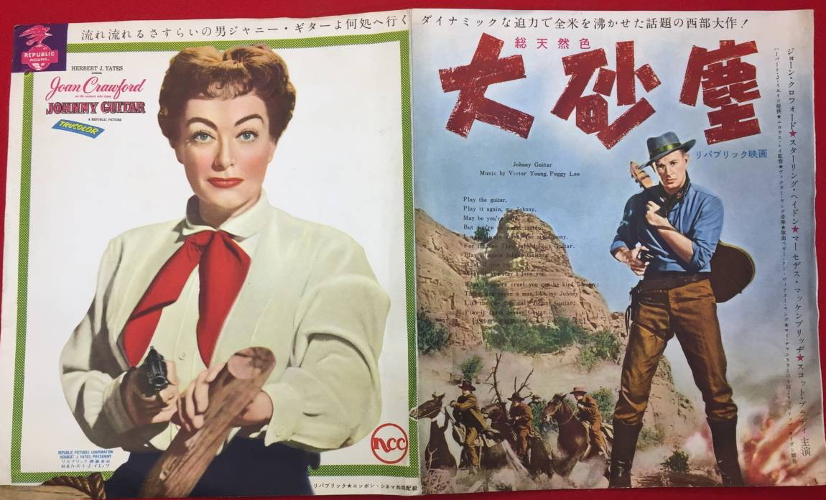
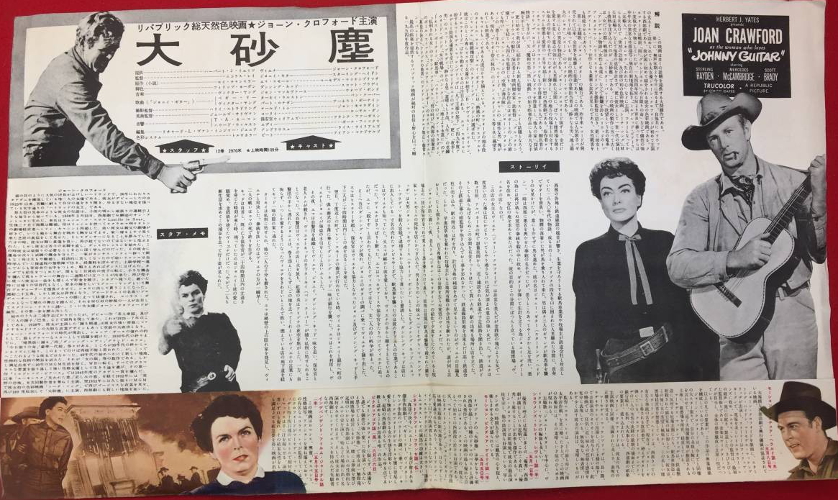
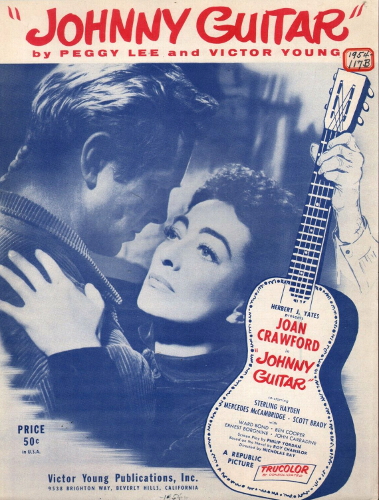
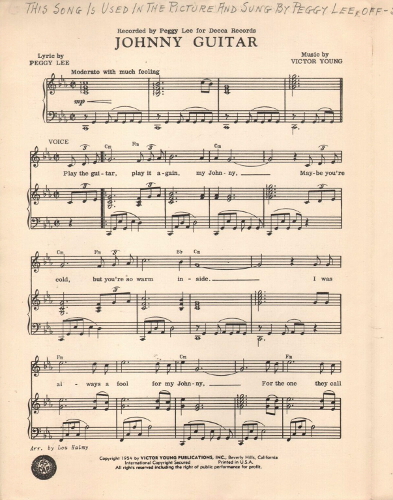
Above: US sheet music.
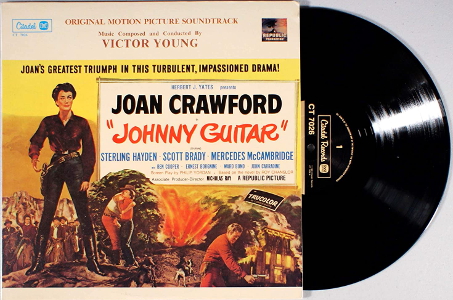
Above: See the Recordings page for more info.
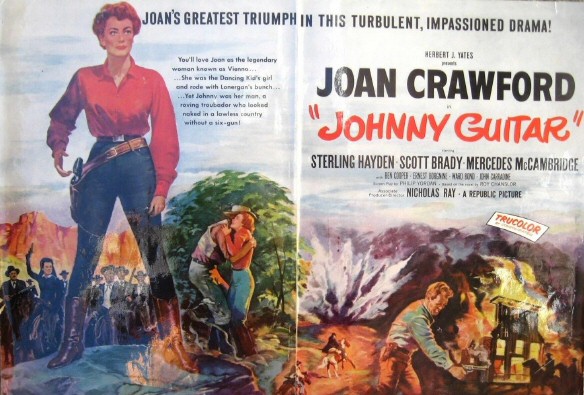
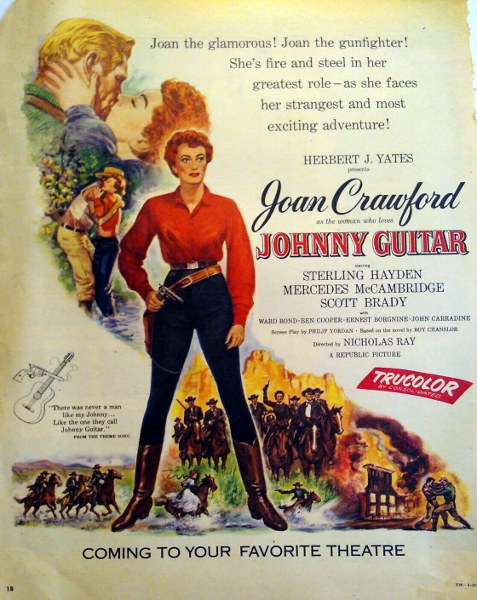
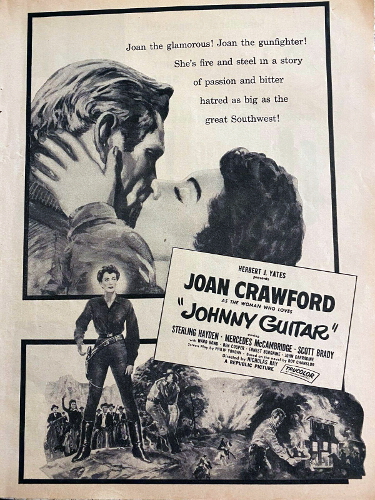
Above: Left: Ad from the Motion Picture Herald. Right: Two more trade ads.
Below (left to right): A 1954 ad mailer from Crockett, Texas; a US newspaper ad (unknown city); an ad from Fort Smith, Arkansas; and a 1955 ad from a Stillwater, New York, drive-in.


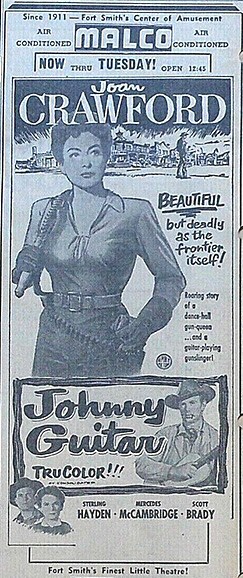
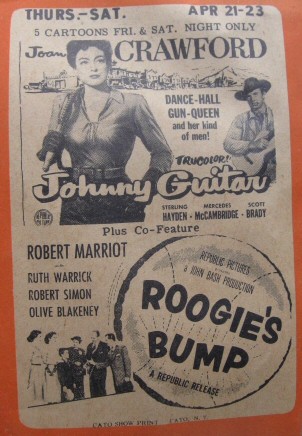
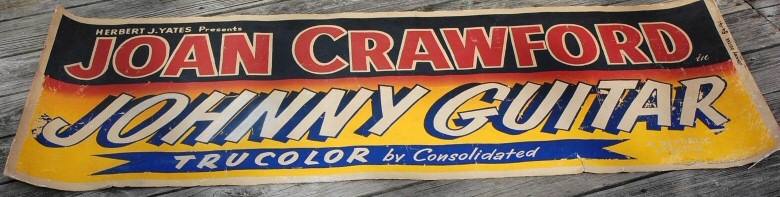
Above: A 5 x 2-ft US theater banner.
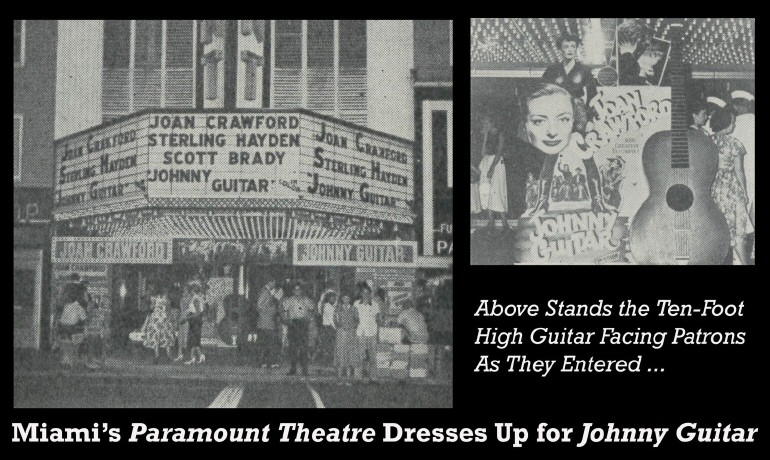
Below: Busker hired to promote JG in Times Square. (Photo by Frank Larson.)
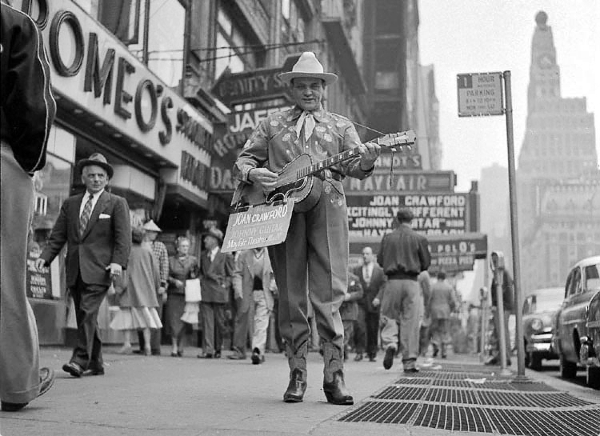
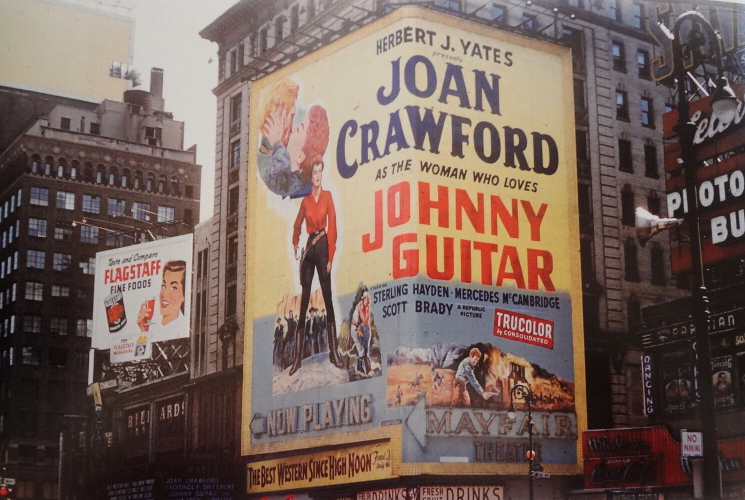
Below: Marquee at the Loew's Mayfair Theatre, Times Square.
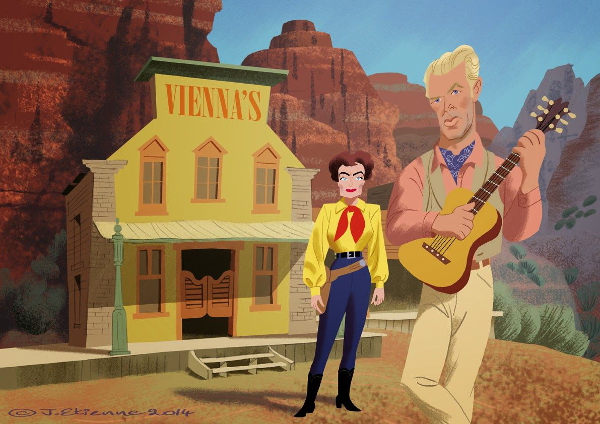
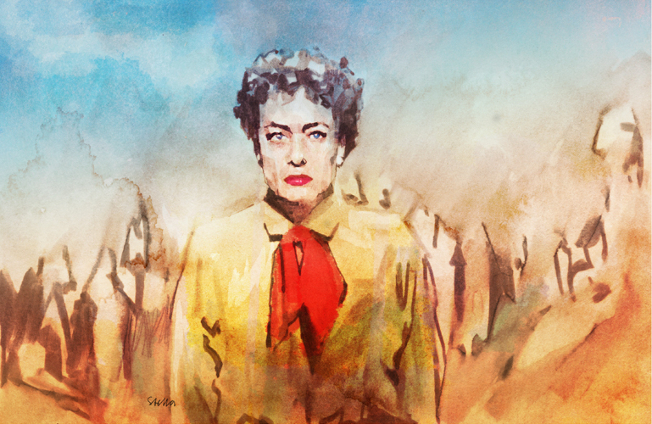
Below Left: Art by J. Etienne (2014). Below Right: Art by Tony Stella for the Bright Wall/Dark Room website (October 2019, Issue 76).
The Best of Everything
 Michael Lia (February 2026)
 Tom C. (December
2024)
Tom C. (December
2024)


 Stuart Hoggan (April 2013)
 Stephanie
Jones
Stephanie
Jones