Books About Joan Crawford
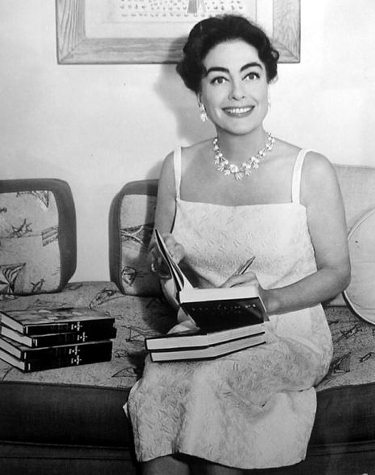 Below is
a list of Joan biographies (and related books, such as paper doll collections,
letters,
etc.).
Below is
a list of Joan biographies (and related books, such as paper doll collections,
letters,
etc.).
In the Books About Joan List below, click on a pink title to go to that book's description. (The descriptions follow the main list, and include cover photos, when available.)
If you have a review of any of the below Joan books that you'd like to share, please e-mail me. Please include a photo or avatar of yourself, along with a star-rating (with 5 stars the best).
In addition to this main page, you can also visit three other separate book pages on this site:
Fill in Joan's name in the Google Book Search below to find an extensive list of books both about Joan and with Joan mentions. For many of the books, you'll be able to see actual pages.
Books About Joan List
Alpha order. Click on a title to see its description and photo below.
Bette and Joan: The Divine Feud (Shaun Considine, 1989)
Conversations with Joan Crawford (Roy Newquist, ed., 1980)
Crawford's Men (Jane Ellen Wayne, 1988)
Crawford: The Last Years (Carl Johnes, 1979)
Ferocious Ambition: Joan Crawford's March to Stardom (Robert Dance, 2023)
The Films of Joan Crawford (Lawrence J. Quirk, 1968)
Jazz Baby (David Houston, 1983)
Joan Crawford (ed. Silvio Berlusconi)
Joan Crawford (Stephen Harvey, 1974)
Joan Crawford: A Biography (Bob Thomas, 1978)
Joan Crawford: The Enduring Star (Peter Cowie, 2009)
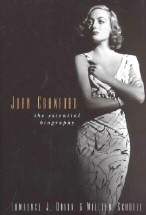
Joan Crawford: The Essential Biography (Lawrence J. Quirk, William Schoell, 2002)
Joan Crawford: Her Life in Letters (Michelle Vogel, 2005)
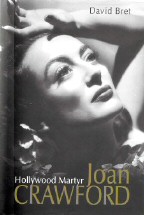
Joan Crawford: Hollywood Martyr (David Bret, 2006)
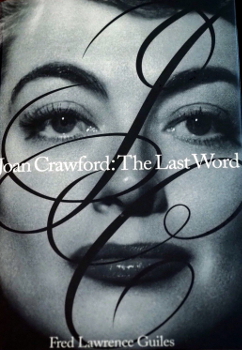
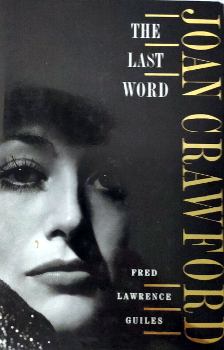
Joan Crawford: The Last Word (Fred Lawrence Guiles, 1995)
Joan Crawford Paper Dolls (Marilyn Henry, 1996)
Joan Crawford Paper Dolls in Full Color (Tom Tierney, 1983)
Joan Crawford: The Raging Star (Charles Castle, 1977)
Joan Crawford: The Ultimate Star (Alexander Walker, 1983)
Joan Crawford: Uma Homenagem (Walter Machado, 1994)
Joan Crawford: A Woman's Face (Scott Eyman, 2025)
Joan Crawford in Film Noir: The Actress as Auteur (David Meuel, 2024)
Just Joan: A Joan Crawford Appreciation (Donna Marie Nowak, 2010)
Legends: Joan Crawford (John Kobal, ed., 1986)
Mommie Dearest and Mommie Dearest Books on Cassette (Christina Crawford: 1978/1997, 1986)
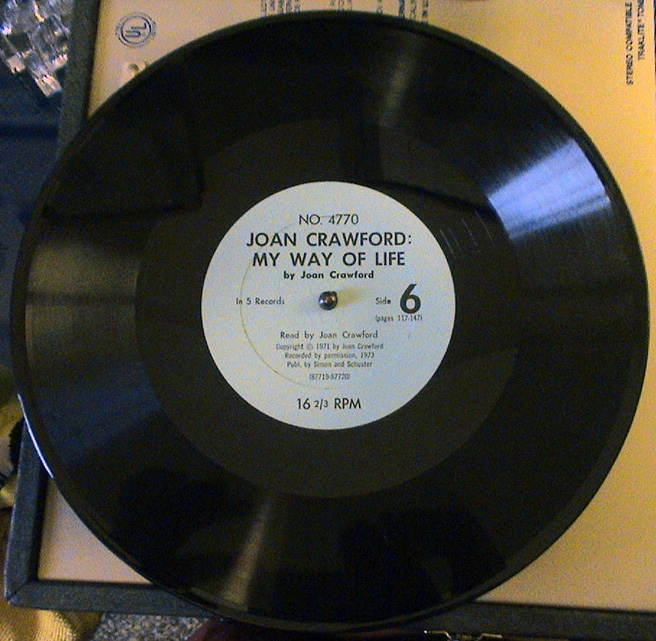
My Way of Life (Joan Crawford, 1971. Includes info on the 1973 5-album recording for the blind.)
Noches de Joan Crawford: 12 Cuentos Argentinos (various authors, 1996)
Not the Girl Next Door: Joan Crawford, a Personal Biography (Charlotte Chandler, 2008)
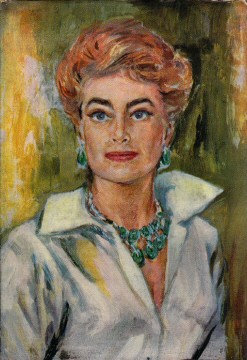
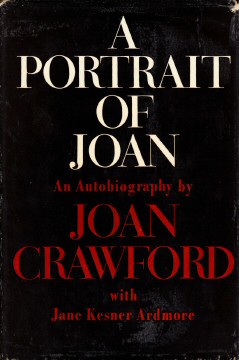
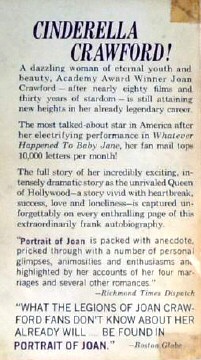
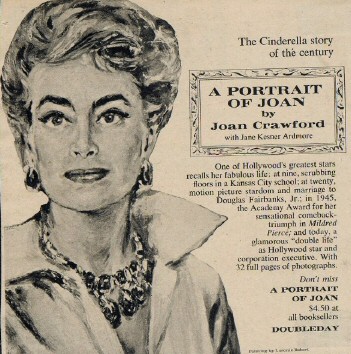
A Portrait of Joan (JC, with Jane Kesner Ardmore, 1962)
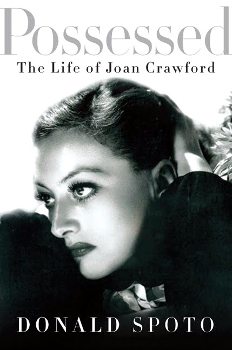
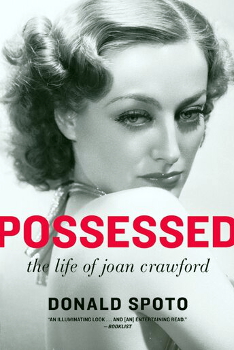
Possessed: The Life of Joan Crawford (Donald Spoto, 2010)
With Love, Mommie Dearest: The Making of an Unintentional Camp Classic (A. Ashley Hoff, 2024)
Books About Joan Covers and Descriptions
Bette & Joan: The Divine Feud (1989, E.P. Dutton)
Shaun
Considine
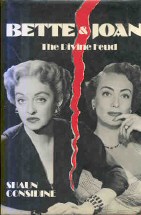
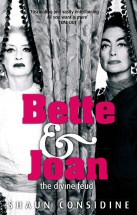
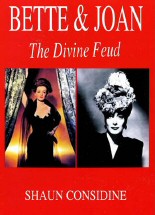
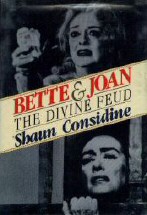
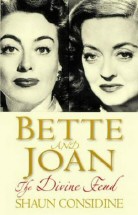
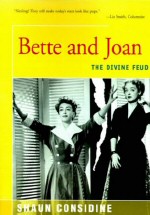
Description: Parallel bios of the two divas, and how their alleged "feud" began and continued. Lots of dish, with interesting backstory info on the making of Whatever Happened to Baby Jane.
Sample
Text:
As filming of Baby Jane continued, embellishments to the
characters and plot were added by both stars. While Blanche was being starved to
death by her evil sister, Joan lost weight in some areas of her body. As the
hollows in her cheeks grew deeper and her waist grew smaller, he breasts became
larger.
"Christ!" said Bette. "You never know what size boobs that broad
has strapped on! She must have a different set for each day of the week! She's
supposed to be shriveling away, but her tits keep growing. I keep running into
them, like the Hollywood Hills."
Click here for a reader review.
 Conversations with Joan Crawford (1980, Citadel Press) Roy
Newquist
Conversations with Joan Crawford (1980, Citadel Press) Roy
Newquist
Description: Author Newquist interviewed Joan dozens of times (initially for a magazine). Before any articles could be published, she passed away in 1977. This book is an uncensored compilation of those conversations. Includes Joan's frank (and sometimes humorous) opinions of each of her films up until What Ever Happened to Baby Jane?
Sample Text:
R.N.:
What
do you think of the films being produced today as contrasted to the films you
made?
Crawford:
You're asking me to compare peas and beans. The films
are so different, for the most part, there's no comparison. There are
exceptions, but not many. In my day we made films that had class. Today, if
class sneaks into a picture, it's by accident. I'm of the old school, and proud
of it. I find suggestion a hell of a lot more provocative than explicit detail.
You didn't see Clark and Vivien rolling around in bed in Gone with the
Wind, but you saw that shit-eating grin on her face the next morning and you
knew damned well that she'd gotten properly laid. I watched the picture a few
months ago, on television, and everyone with me got the same chuckle out of it
we got when it was first released. The impact was stronger because of the
subtlety.
Click here for a 2011 review from the New York Times.
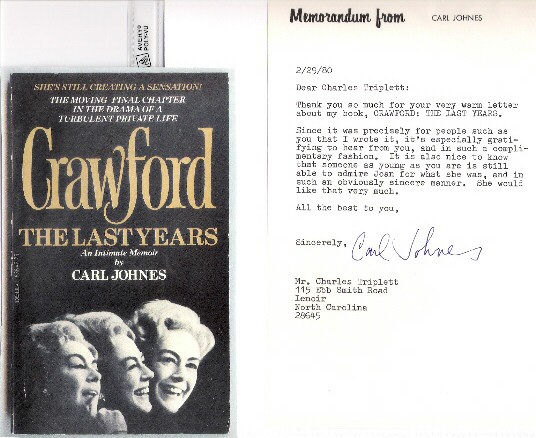
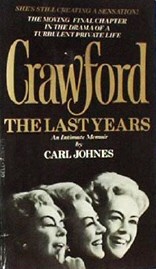 Crawford: The Last Years (1979, US PB Dell) Carl
Johnes
Crawford: The Last Years (1979, US PB Dell) Carl
Johnes
Description: Johnes was a young assistant initially sent by Columbia as a favor to help Joan sort out her book collection in 1972. The two eventually became friends and remained so from 1974 'til her death in '77. Johnes' recollections of their times together are honest and humorous.
Sample Text:
"Pick up
your dice."
Firmly.
"Honey, please look at your
board."
With despair.
"Oh, for God's sake! Protect that man! Like
that!"
Violently.
"That. Is A. Point. How many more times do I
have to tell you that a six and a one is a point! Now move
it!"
Controlled fury.
"A five! And a three! You copycat,
you!"
Girlishly.
Well, I learned. Between intimidation on East
Sixty-Ninth street and a paperback book of instructions (co-authored,
coincidentally, by John Crawford; I was being Crawfordized from every
direction), I had a new pastime and an unusual playmate, to say the least. To
give her just due, however, I must say that when she was particularly unfair, or
lost her cool (like screaming across the table "I know you don't have my
peripheral vision, but you're not blind, are you Carl!"), she would usually call
the next day and apologize.
|
|
|
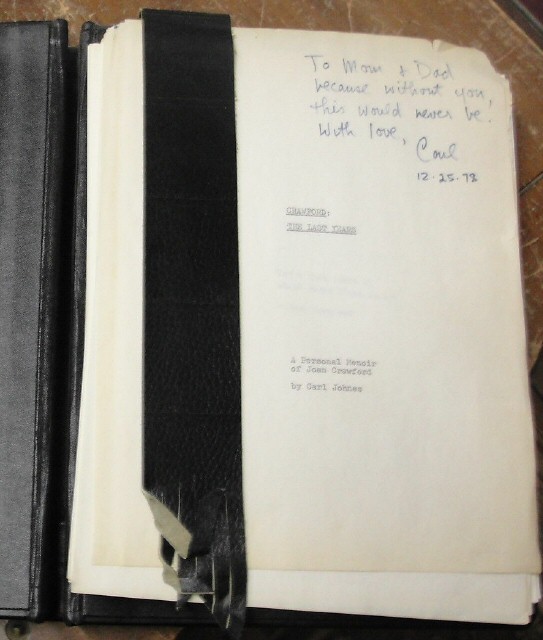
Above: Collector Charles Triplett wrote Carl Johnes an appreciative letter after this book came out, and received the above response from the author. (Thanks to Charles for permission to reproduce the letter here.) Below: Johnes' manuscript for The Last Years, with original inscription to his parents (which ultimately did not appear in book). The MS was held within a cover of Joan's script for her appearance on 1970's Tim Conway Comedy Hour. Offered on sale on eBay in December 2014, ultimately selling for over $1000. |
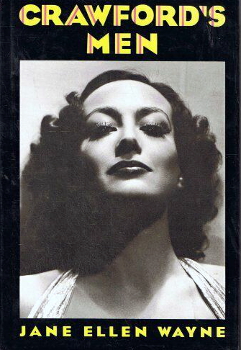 Crawford's Men (1988, HC Prentice Hall; PB St. Martin's Press) Jane
Ellen Wayne
Crawford's Men (1988, HC Prentice Hall; PB St. Martin's Press) Jane
Ellen Wayne
Description: An overview of Joan's relationships with the many
men (and women) in her life. Largely based on other bios, with little new info
(aside from the interesting preface Wayne writes about meeting Joan). Book also
annoyingly uses made-up dialogue.
Sample Text:
But the
day Joan found her husband with another woman, she was shattered despite her
cool at the studio. Always the star, she composed herself magnificently. If
Franchot was having an affair, every member of the crew knew about it, and Joan
would never allow anyone to feel sorry for her. After she was beyond the studio
gates, tears of hate burned down her face; she drove to the beach. "I didn't
love him anymore," she said. "It was as simple as that. The minute I saw him
with another woman, whatever I felt for him was gone."
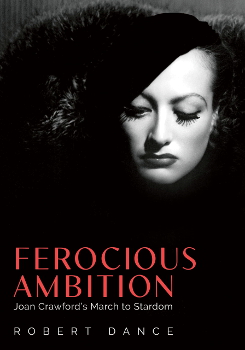 Ferocious
Ambition: Joan Crawford's March to Stardom (2023,
University Press of Mississippi HC) Robert
Dance
Ferocious
Ambition: Joan Crawford's March to Stardom (2023,
University Press of Mississippi HC) Robert
Dance
Description: 334 pp., with 114 black-and-white and 16 color illustrations.
From the Amazon promo material: Robert Dance’s new evaluation of Joan Crawford looks at her entire career and---while not ignoring her early years and tempestuous personal life---focuses squarely on her achievements as an actress, and as a woman who mastered the studio system with a rare combination of grit, determination, beauty, and talent.
Click here for my review.
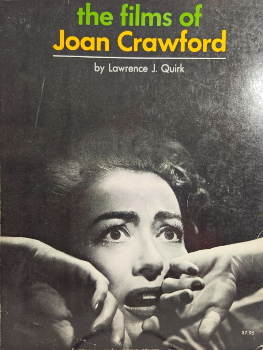
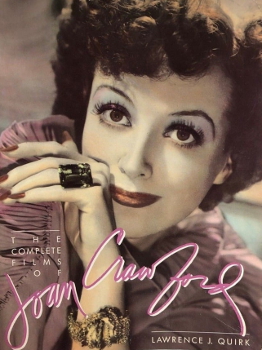 The Films of Joan Crawford (1968, Citadel Press;
re-issue 1988) Lawrence J.
Quirk
The Films of Joan Crawford (1968, Citadel Press;
re-issue 1988) Lawrence J.
Quirk
Description: An overview of
almost every major film Joan appears in (up to Berserk!).
Each film is given a
detailed synopsis and a reprint of the press reviews given at the time each film
was released. The book also includes black and white publicity photos from each
film. (The 1988 re-issue includes info
on Joan's 1970 film Trog.)
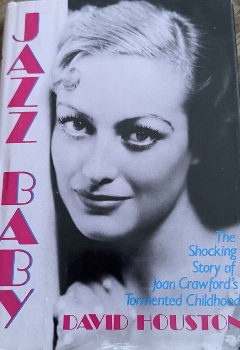 Jazz Baby (1983, St. Martin's Press) David
Houston
Jazz Baby (1983, St. Martin's Press) David
Houston
Description: The true
story of Joan's childhood, which was often ignored or changed when she became a
star. Author David Houston pieces together the little-known facts about Joan's
early life and her rise to stardom from numerous interviews with the people who
knew her family. This book deals primarily with Joan's life up until 1925 and
includes a few pages of photos including her College yearbook photo from
1922-23, a picture of the Cassin home, Rockingham Academy, and St. Agnes
Academy.
Sample Text:
This is
the story of the raw material, of little Billie Cassin, an eccentric child
lacking ordinary confidence who, Joan Crawford claimed, always lingered inside
her. "When I'm tired," she said in a 1955 interview, "Billie's child voice,
Southern Accent and all, rises again in my throat. When I need tears for a big
emotional scene in a picture, I catch back some of her memories!"
 Joan
Crawford (CIAK publishers, Italy)
Silvio Berlusconi,
ed.
Joan
Crawford (CIAK publishers, Italy)
Silvio Berlusconi,
ed.
Description: Softcover, 128 pages, photos.
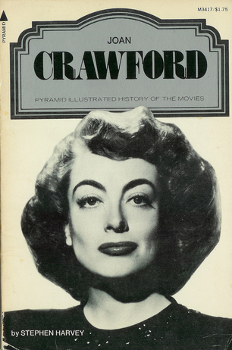 Joan Crawford (1974, Pyramid) Stephen Harvey
Description: Part of the Pyramid Illustrated History of the
Movies series, this volume focuses primarily on Joan's film career from her
first film to Trog with some mentions
made to her personal life during the films. The book is filled with various
publicity photos from her films including one from the aborted Hush...Hush Sweet
Charlotte.
Sample Text:
...Considering that Joan Crawford was an indisputable star long before
the majority of living Americans were born, it must seem to many that as long as
there have been movies there has been Crawford, as accomplished and unmistakable
a personality fifty years ago as she is today. As present-day audiences watch
her films, they see an actress whose grasp of her skills may vary from film to
film, but who undeniably possesses in full measure that ill-defined gift called
star quality. Surely she always had it; one can't imagine Crawford as ever
having been an ordinary and anonymous as the audience that for years genuinely
worshipped her, and still regards her with affection and more than a little
awe.
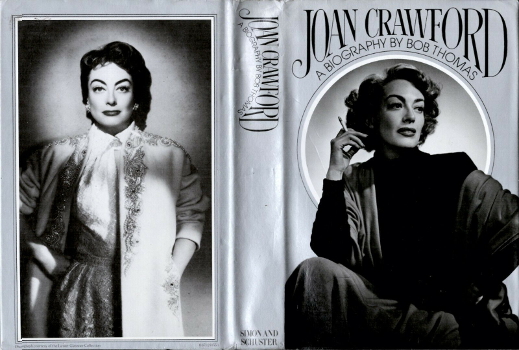 Joan Crawford: A Biography (1978,
Simon and Schuster) Bob
Thomas
Joan Crawford: A Biography (1978,
Simon and Schuster) Bob
Thomas
Description: First
in-depth biography of Joan
Crawford after her death in 1977. Journalist Thomas knew Joan for 30 years and conducted many interviews with her.
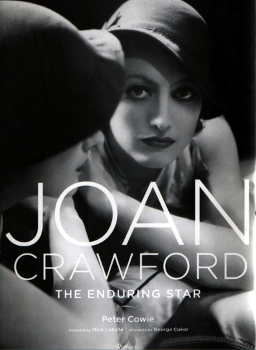 Joan
Crawford: The Enduring Star (2009,
Rizzoli) Peter
Cowie
Joan
Crawford: The Enduring Star (2009,
Rizzoli) Peter
Cowie
Description: 226 pages, 213 photos (with accompanying text). Intro by Mick LaSalle; afterword by George Cukor.
Click here for a reader review.
 Joan
Crawford: The Essential Biography (2002, Univ. Press of Kentucky) Lawrence J. Quirk, William Schoell
Joan
Crawford: The Essential Biography (2002, Univ. Press of Kentucky) Lawrence J. Quirk, William Schoell
Description:
 Joan
Crawford: Her Life in Letters (2005,
Wasteland
Press) Michelle Vogel
Joan
Crawford: Her Life in Letters (2005,
Wasteland
Press) Michelle Vogel
Description: Letters from Joan, accompanied by photos, with a foreword by Joan grandson Casey LaLonde. (Self-published and not copy-edited.)
 Joan
Crawford: Hollywood Martyr
(UK: 2006, Robson) David
Bret
Joan
Crawford: Hollywood Martyr
(UK: 2006, Robson) David
Bret
Description: From the inside jacket: "...[author Bret] discusses...her marriages--three of them to gay men--and her obsessions with rough sex. Bret divulges...how her loathed mother forced Crawford to work as a prostitute, appear in pornographic films and sleep her way to the top...."
Click here for a reader review.
 Joan Crawford: The Last Word (US: 1995,
Birch Lane Press; UK: 1995, Pavillion) Fred Lawrence
Guiles
Joan Crawford: The Last Word (US: 1995,
Birch Lane Press; UK: 1995, Pavillion) Fred Lawrence
Guiles
Description: From the dust jacket: "Meticulously
researched, Joan Crawford: The Last Word deals in full with her long movie
career and explores in detail her turbulent private life. Respected biographer
Fred Lawrence Guiles uses newly discovered sources and recent interviews with
many who knew her, and some who loved her, to establish the person behind the
carefully crafted screen icon."
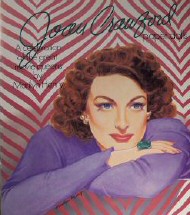
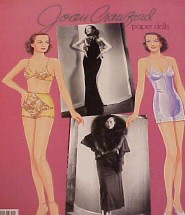
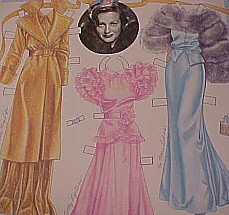
Joan Crawford Paper Dolls (1996, B. Shackman & Co.) Marilyn Henry
Description: Two 9-inch paper dolls, with 27 outfits plus accessories

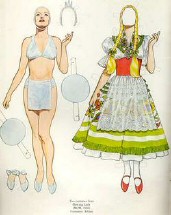
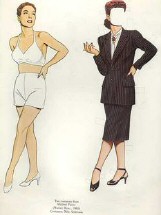 Joan Crawford Paper Dolls in Full Color
(1983, Dover) Tom
Tierney
Joan Crawford Paper Dolls in Full Color
(1983, Dover) Tom
Tierney
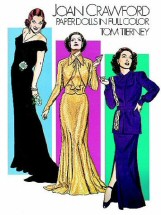
Description: 32 pages. From the back: "Fashion Illustrator has captured Miss Crawford in three lifelike paper dolls, representing three distinct phases in her long screen career, and twenty-eight meticulously rendered costumes from as many films, including Pretty Ladies, Grand Hotel, Rain, Letty Lynton, The Gorgeous Hussy, The Bride Wore Red, The Women, Mildred Pierce, Humoresque, Johnny Guitar, Female on the Beach, I Saw What You Did and Berserk!
This
collection, a tribute to a striking beauty and magnetic actress, is also a
salute to the many talented costume designers - Adrian, Milo, Anderson and
Sheila O'Brien, to name a few - who made Hollywood a fashion house. Miss
Crawford's many fans, fashion enthusiasts, as well as paper doll collectors will
welcome this Tom Tierney effort."
Click
here
to see text and much-larger complete pages from the book.
 Joan
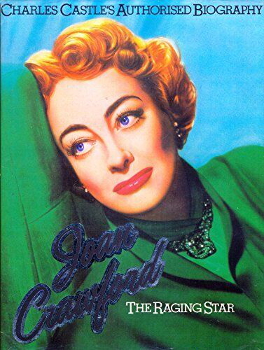
Crawford: The Raging Star (1977, New English Library) Charles Castle
Joan
Crawford: The Raging Star (1977, New English Library) Charles Castle
Description:
207 pp. with hundreds of black-and-white photos.
From the front
flap:
THE RAGING STAR is the official biography of Joan Crawford.
[Ed Note: It was neither "official" nor "authorised."]
Authorised by Miss Crawford in 1974 to write the book and to produce
and direct a documentary on her for BBC television, Charles Castle
spent three years researching into her background and life, interviewing
those closest to her in Hollywood, New York, and London, including
Douglas Fairbanks, Jr., Henry Fonda, James Stewart, the late Rosalind
Russell, Van Johnson and Michael Wilding....
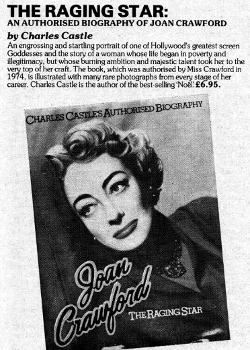
(Click UK ad at right to see full version.)
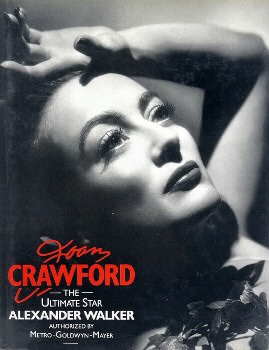 Joan Crawford: The Ultimate Star (1983,
Harper & Row)
Alexander
Walker
Joan Crawford: The Ultimate Star (1983,
Harper & Row)
Alexander
Walker
Description: An analysis of Joan's life and career, with an emphasis on the years Joan spent at MGM. Author Walker had unlimited access to previously unreleased information stored in the MGM vaults and peppers the text of this book with that information, along with anecdotes from Joan's friends and peers. Filled with numerous black-and-white publicity photos and film stills.
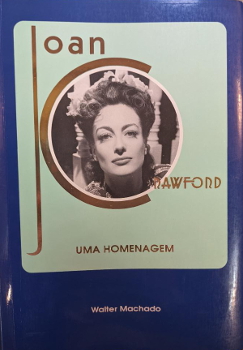 Joan Crawford:
Uma Homenagem (1993, Formato
Artes Graficas--Brazil; pictured: 1994 2nd ed.) Walter Machado
Joan Crawford:
Uma Homenagem (1993, Formato
Artes Graficas--Brazil; pictured: 1994 2nd ed.) Walter Machado
Description: 747 glossy pages, illustrated with 100s of photos, including author's own drawings. In Portuguese. (Subtitle translates as: "An Homage" or "A Tribute.")
Author Machado was a Brazilian architect, author, artist, and cinephile who was inducted into Brazil's Academy of Letters in 2005. His life-long devotion to Joan Crawford culminated in this 747-page opus.
See this special Books: Walter Machado page for more info on the author and more photos of the book's covers, copyright pages, Intro, and more.
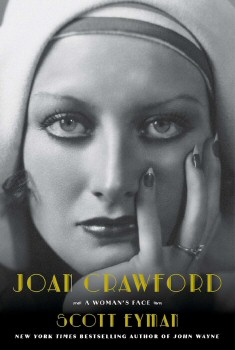 Joan
Crawford: A Woman's Face
(2025, Simon & Schuster) Scott
Eyman
Joan
Crawford: A Woman's Face
(2025, Simon & Schuster) Scott
Eyman
Description: 464 pages.
From Amazon page promo material:
Film historian and acclaimed New York Times bestselling
biographer Scott Eyman has written the definitive biography of
Hollywood icon Joan Crawford, drawing on never-before-seen documents and
photos from the Crawford estate.
Lengthy New Yorker review/essay by Richard Brody.
 Joan
Crawford in Film Noir: The Actress as Auteur
(2024, McFarland) David
Meuel
Joan
Crawford in Film Noir: The Actress as Auteur
(2024, McFarland) David
Meuel
Description: 225 pp.
From Amazon page promo material:
Joan Crawford's contribution to film noir during the 1940s and 1950s, though rarely discussed in its totality, is one of her most impressive and far-reaching career achievements. Several of her noir and noir-tinged efforts contain arguably her best acting work, and all bear her personal stamp. These aren't conventional film noirs, they are Joan Crawford noirs: highly distinctive films that extended the boundaries of noir content and brought added depth and dimension to the noir style.... Examining these films as a collective and relatively cohesive body of work, this book highlights what Crawford aspired to achieve in her art, how--when the circumstances were right--she could deliver superb results, how she helped expand the possibilities for noir, and why the best of her efforts speak across the decades with such intensity and authority.
See also this interesting 2024 interview with author Meuel on YouTube (Robert Bellissimo At The Movies).
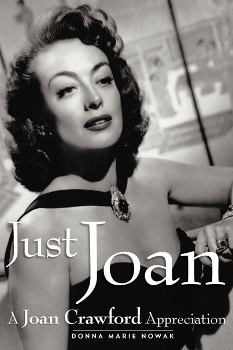 Just
Joan: A Joan Crawford Appreciation
(2010, Bear Manor Media) Donna
Marie Nowak
Just
Joan: A Joan Crawford Appreciation
(2010, Bear Manor Media) Donna
Marie Nowak
Description: 580 pp. Reviews, essays, photos.
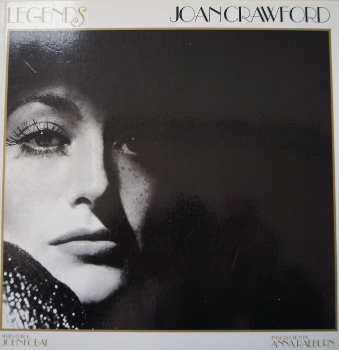 Legends: Joan Crawford (1986,
Little, Brown and Co.)
John Kobal, ed.
Legends: Joan Crawford (1986,
Little, Brown and Co.)
John Kobal, ed.
Description: From the back of the book: "The Hollywood
portrait photographers were responsible for turning mere mortals into myths.
Only recently, following the revival of interest in still photography, have
their achievements become recognized as an art form. John Kobal, the editor of
this series, has lovingly and meticulously collected the work of the studio
photographers and has one of the leading libraries of film photographs in the
world, from which the portraits for this volume has been selected. The Legends
series forms an instant and compelling collection of classic stars and
magnificent images."
Mommie Dearest (1978, William Morrow; 20th Anniversary Ed.: 1997, Seven Springs Press)
Christina Crawford
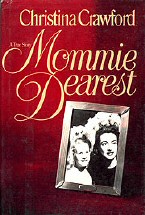
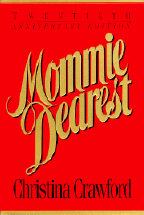
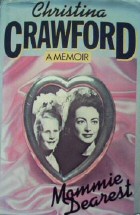
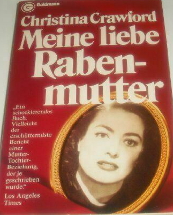
Description: Joan's adopted daughter Christina Crawford published this book in 1978, a year after her mother's death. Christina details the allegedly erratic and violent behavior and treatment of her mother toward herself and brother Christopher. The 20th-anniversary edition released in 1997 by Christina's vanity press contains 100 pages of new material. The book was made into a movie in 1981.
 Mommie Dearest:
Books on Cassette (1986, Listen for Pleasure, Inc.)
Christina Crawford
Mommie Dearest:
Books on Cassette (1986, Listen for Pleasure, Inc.)
Christina Crawford
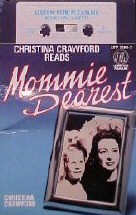
Description: An audio version of the infamous
book written by Joan's adopted daughter Christina Crawford shortly after her
death in 1977. In this three hour abridged version, Christina herself narrates
the book. This two-tape audio book also includes a portion of the 1949 Christmas
Eve performance in which Joan is heard telling the world that she plans to give
away all of the children's Christmas presents.
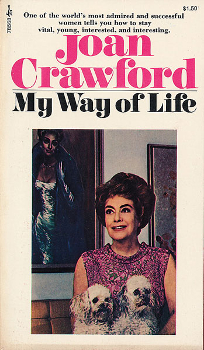 My Way of Life (US
hardcover: 1971, Simon and Schuster; US paperback: 1972, Pocket
Books. In UK, published in '72 by W.H. Allen) Joan
Crawford
My Way of Life (US
hardcover: 1971, Simon and Schuster; US paperback: 1972, Pocket
Books. In UK, published in '72 by W.H. Allen) Joan
Crawford
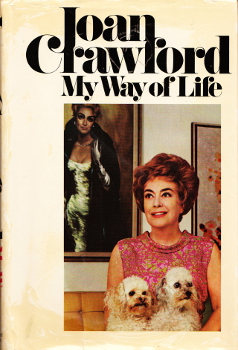
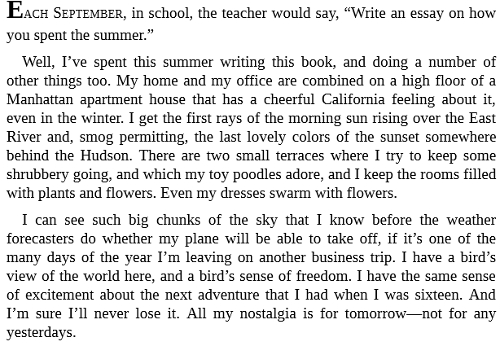
Excerpt from p. 1:
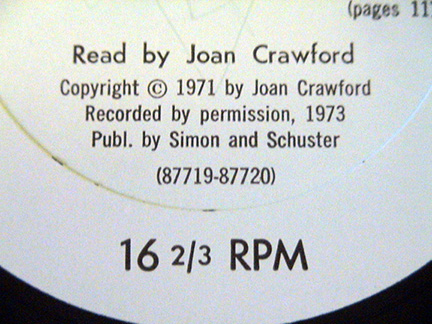
In 1973, Joan recorded MWOL for The American Foundation for the Blind, in association with the US Library of Congress. A 5-record set (5 hours). 16-2/3 RPM.
Said Joan in a 1976 letter to writer friend Robert Bloch about her recording:
One of my greatest experiences was when I recorded "My Way of Life" for the blind. I knew I was the only author to record her own book for the blind, and I closed my eyes and talked on tape for a moment -- played it back again and again. Then I read a paragraph of my book -- played it back again and again. Suddenly, I realized I must use my acting experience to project a personal conversational attitude, in order to project a picture into their minds, and it worked. It was a wonderful learning experience for me.
Noches de Joan Crawford: 12 Cuentos Argentinos (1996: Argentina) Various authors
Description: 165 pages.
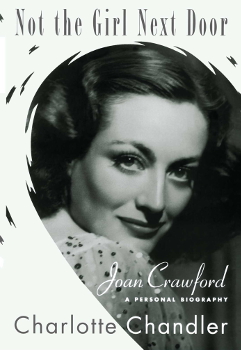
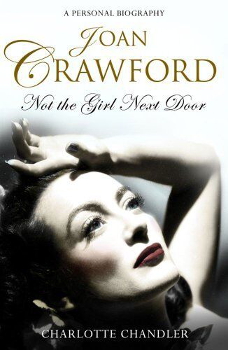 Not
the Girl Next Door: Joan Crawford, A Personal Biography
Not
the Girl Next Door: Joan Crawford, A Personal Biography
(2008, Simon and Schuster US; 2009, Simon and Schuster
UK) Charlotte
Chandler
Description: 352 pages.
Click here to read a review by John Epperson in the Washington Post (Feb. 24, 2008).
A Portrait of Joan (HC
1962, Doubleday: PB 1964, Paperback Library)
Joan Crawford Steele with Jane Kesner Ardmore
Description: 239 pages. Cover painting by Lucerne Robert.

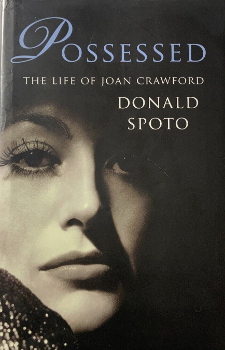
Possessed: The Life of Joan Crawford (US: 2010 HarperCollins HC and 2011 US HarperCollins trade PB. UK: 2011 Hutchinson HC) Donald Spoto
Description: 336 pages. 16 pages of photos.
 Starring Joan Crawford: The Films, the Fantasy, and the Modern Relevance of a Silver Screen Icon (US
HC: 2024,
Applause) Samuel
Garza Bernstein
(foreword
by John Epperson)
Starring Joan Crawford: The Films, the Fantasy, and the Modern Relevance of a Silver Screen Icon (US
HC: 2024,
Applause) Samuel
Garza Bernstein
(foreword
by John Epperson)
Description: 360 pp.
From the Amazon promo material: STARRING JOAN CRAWFORD is a rollicking exploration of the powerful women Joan Crawford vividly brought to life in her films—and the lasting, ever-evolving impact she has had on popular culture. Having carved out a revolutionary path through the entertainment industry while relying on men as little as possible—whether her studio bosses or her many husbands—she created a gallery of strong, assertive women who outsmarted men and refused to conform to gender expectations. In movies like Mildred Pierce, The Damned Don't Cry, Johnny Guitar, and What Ever Happened to Baby Jane?, she played to win, becoming a lodestar to LGBT audiences, a model of feminist self-determination for women, and an unforgettable icon for everyone.
Click here for my June 2024 review of this book.
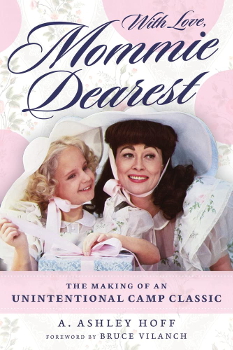 With
Love, Mommie Dearest: The Making of an Unintentional Camp Classic (US
PB: 2024, Chicago Review Press) A.
Ashley Hoff (foreword by Bruce Vilanch)
With
Love, Mommie Dearest: The Making of an Unintentional Camp Classic (US
PB: 2024, Chicago Review Press) A.
Ashley Hoff (foreword by Bruce Vilanch)
Description: 314 pp.
From the Amazon promo material: Based on new interviews with people connected to the book and the film—from cast and crew members to industry insiders—With Love, Mommie Dearest details the writing and selling of Christina's book and the aftermath of its publication, as well as the filming of the motion picture, whose backstage drama almost surpassed what was viewed on-screen in the film.