The Best of Everything
Encyclopedia Entry • Films Main
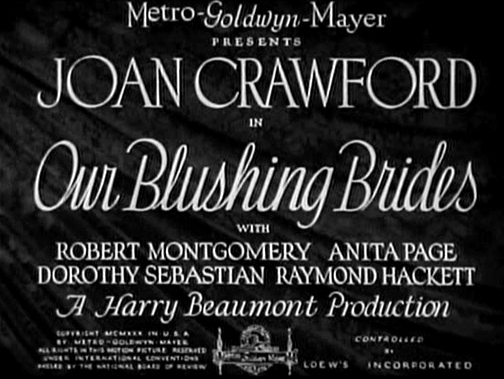
Our Blushing Brides
1930
Critics' Reviews • Our Reviews • Movie Posters • Lobby Cards • Misc. Images
Click here to see photos from the film.
US release: 7/19/30. On-demand DVD release from Warner Archives: 3/4/14. Cast: Joan Crawford (as "Jerry March"), Robert Montgomery, Anita Page, Dorothy Sebastian, Raymond Hackett, John Miljan, Albert Conti, Edward Brophy, Hedda Hopper. Credits: Based on a story by Bess Meredyth. Screenplay: Bess Meredyth and John Howard Lawson. Additional dialogue: Edwin Justus Mayer. Director: Harry Beaumont. Camera: Merritt B. Gerstad. Editors: George Hively, Harold Palmer. Costumes: Adrian. Art director: Cedric Gibbons.
Plot Summary: Having starred in Our Dancing Daughters (28) and Our Modern Maidens (30), the next logical step for Joan Crawford was Our Blushing Brides (30). Crawford is featured with her Dancing Daughters costars Dorothy Sebastian and Anita Page in this tale of three roommates trying to make good in the Big City. Crawford works as a department store mannequin, while Sebastian and Page have jobs as clerks. Robert Montgomery, son of the store's owner, marries Crawford, having failed to "score" any other way; Sebastian weds a thief (John Miljan) whom she mistakes as a millionaire; and Robert Montgomery's younger brother Raymond Hackett takes Page as his mistress, which results in her suicide after he drops her. Our Blushing Brides has plenty to blush about. ~ Hal Erickson, All Movie Guide
Notes: • By now, Joan had grown weary of "dancing girl" roles: "If I'd proved I could play the dancing girl I'd once been, fine. Now let's have a new objective." (Ultimate Star) • Some scenes ran into trouble with censors; in a Massachusetts case, the studio appealed and was permitted to retain the "entire drunk scene" as well as substitute a "Crawford-Montgomery kimono scene" for an offending dressing-room scene. (Ultimate Star)
|
|
Harrison Carroll in the LA Evening Herald August 2, 1930
Our Blushing Brides Named as Emphatic Hit at Criterion
It requires no word of mine to spread the news that Our Blushing Brides
is unmistakably one of the year's biggest hits. Thousands of people,
who mobbed the Criterion on the opening day of the MGM picture, will
have gotten in their words ahead of me.
Some pictures do not, at
first glance, have their fate written plainly upon them. There is not
room for the smallest doubt, however, of the popular appeal of Our
Blushing Brides.
It is as deft, as glamorous a bit of make-believe as the talking screen has produced.
The general effect of the film is not so much realism, as it is the
materialization of luxury. MGM has decked the production with a
gorgeous style show and a modernistic palace that may never have
existed but that elicits gasps of admiration.
Our Blushing Brides
is wholeheartedly devoted to entertainment. It is the love stories of
three girls, models in a New York department store.
Constance
(Anita Page) yields to the persuasion of a rich youth, and ends up a
suicide. Francine (Dorothy Sebastian), out to marry money, meets a free
spender, goes through a ceremony in a gin-haze and eventually is
disillusioned with the arrest of her husband as a racketeer. Jerry
(Joan Crawford) falls in love with the son of the owner of the store,
keeps him at arm's length and eventually marries him.
JOAN SPLENDID
In Jerry, Joan Crawford finds a role admirably suited to her, and she
gives the best performance of her career. Dorothy Sebastian likewise
wins new esteem (what a nice voice she has) as Francine. Though with
less to do than in the previous pictures of the series, Anita Page
imparts sympathy to the unfortunate Constance.
Among the men,
Robert Montgomery is excellent as the suave Tony, and Raymond Hackett
convincing as David, his brother, whose desertion drives Constance to
suicide. John Miljan gives an amusing portrayal of the racketeer,
Martin. Clever character bits are contributed by Albert Conti as the
style dictator from Paris, and by Edward Brophy as the persistent Joe.
STORY FINE
Our Blushing Brides is the most interesting of the series of stories
that began with Our Dancing Daughters. Bess Meredyth and John Howard
Lawson have couched it in the sophisticated terms of the day, and Harry
Beaumont has carried out this spirit in the direction.
The modernistic sets also are deserving of special mention.
In addition to the feature, the Criterion shows a Tom Terrae adventure, Sacred Fires, and another glimpse of the inimitable Mickey Mouse. You must not miss this bill.
Lucius Beebe in the New York Times (1930): It is all quite lamentable and would be downright depressing in its spurious elegance if it were not for the humorous and intelligent acting of Joan Crawford, who plays the part of a mannequin with enough assurance for a marchessa and enough virtue for a regiment. If the spectacle of a shopgirl carrying herself with the sophisticated aplomb of Park Avenue is not at all convincing, it is at least humorous, although it is to be doubted if the director of the film realized it.
New York Times (anonymous reviewer) August 2, 1930
After surviving many pictorial fashion shows and handsome close-ups of the decorative Joan Crawford, the spectator is given to understand that the life of a salesgirl, as depicted in "Our Blushing Brides," is not just measuring yard goods and taking trips to Coney Island. Such a simple existence, according to the film at the Capitol, is not for either Geraldine, Connie or Francine, the three heroines whose lives twist down tortuous paths—one ending in death, another almost approaching that "fate worse than death," and the third triumphant in her virtue. All three girls yearn for the trappings that make for a comfortable life, and the two who sacrifice their hall rooms for modernistic settings pay the piper. Connie goes to her death by poison after her David, a social lion, has led her to believe that marriage is the pot of gold at the end of their pre-marital adventures. Francine becomes attached to one whom she believes to be a millionaire, but who is caught as a thief. Gerry, however, true to her principles, remains the paragon and profits in the end by marrying Tony Jardine, the son of the department store owner. Considering that the program admits that the dialogue was written in part by John Howard Lawson, the lines are surprisingly dull. Miss Crawford admirably survives all her agonized facial contortions. She carries the burden of dramatics in this photoplay and comes off splendidly and intelligently. Dorothy Sebastian as Francine is excellent and so is Anita Page as the blond Connie, Robert Montgomery, in the rôle of Tony, the young scion who builds studios in trees as a place where "he can get away from it all," is acceptable. If by getting away from it all he means the angular settings that Cedric Gibbons has conceived, he is justified. Even the little studio in the tree, for example, when seen from inside, might have occupied a good portion of any armory.
Elizabeth Yeaman in the Hollywood Daily Citizen (1930) Joan
Crawford never looked prettier than she does in Our Blushing Brides,
which is at the Pantages Theater this week. Furthermore, she wears an
array of gorgeous apparel that would delight the most blase feminine
eye. But do not be deceived by the title. The story concerns three
comely girls who are but three cogs in the machinery of a great New
York department store. It takes you into their private lives and their
struggle for happiness and the things that youth desires. The fact that
their apartment is far more spacious than plausible, is of little
consequence, for the picture is not based on sordid backgrounds. Besides, the scene of lavish Long Island estates appear ridiculously
like a cardboard backdrop, but these details matter little also. Joan
Crawford displays a dramatic power and a fascination which overcomes
all the little inconsistences of plot and locale. ACTING IS PRAISED A fine actress, is this Miss Crawford, who heretofore has been confined
to "flaming youth" roles. It is time that MGM gave her an opportunity
for deeper characterizations. We all know that she can dance, sing and
make whoopee, but she can also be serious, and has great potentialities
as a tragedienne. She is, in fact, well suited to the type of roles
that Norma Shearer has portrayed of late. In Our Blushing Brides
she appears as a mannequin in the lingerie department of a great store.
Incidentally, we might suggest that some one out at the Culver City
studio look up the pronunciation of "lingerie," for the word is used
frequently in the picture. At home she shares an apartment with
Anita Page and Dorothy Sebastian. Anita is employed at the perfume
counter, and Dorothy is buried behind a pile of woolens at the blanket
counter. Joan is the only one of the three who does not complain about
her fate. She has an instinctive wisdom which makes her shy away from
the invitations of men who occupy a social set and financial station
far above her. But the economic pressure is too much for Anita and
Dorothy, and they go their separate ways with the men who can give them
luxury. FINERY DISPLAYED The conclusion is inevitable.
Opportunity is afforded throughout the picture for a display of
beautiful feminine finery. Miss Crawford is stunning in French
chemises, beach pajamas, winter sports wear and evening costumes. She
has all the grace and mannerisms of a perfect mannequin, and her beauty
is revealed to great advantage. Male leads for the three girls are
played by Robert Montgomery, Raymond Hackett and John Miljan. Although
Miljan has the smallest part, he makes it the most outstanding. Comedy
is injected by Edward Brophy, who as a department store admirer of Miss
Crawford, gives a delightful characterization. Albert Conti, as the
French designer is also introduced for comedy relief. The direction
of Harry Beaumont is excellent in the emotional scenes, but he allowed
the fashion revue at the Long Island estate to grow monotonous.
However, Our Blushing Brides, in spite of numerous little faults, is
topping entertainment. On the stage at the Pantages, Fanchon and Marco present their "Rhythm-A Tic Idea" with a bevy of girls and Harry Kahne, heralded as the world's greatest mentalist. He performs feats of numerical concentration.
Photoplay (1930): You must see Joan Crawford in those lace step-ins! Swell box office picture! |
If you've seen Our Blushing Brides and would like to share your review here, please e-mail me. Include a photo or avatar of yourself to accompany your review, a star-rating (with 5 stars the best), and any of your favorite lines from the film.
|
Rating: Our Blushing Brides (1930) finds our 3 heroines---Joan, Anita Page, and Dorothy Sebastian---as working stiffs in a department store in NYC and roommates in a dingy apartment. Anita (Connie) and Dorothy (Franky) are eager to find a man to help them escape their drab surroundings and dead-end lives. Joan (Jerry) is suspicious of all men, and thus content to stay at home laundering her lingerie while her roomies are out on the town trying to meet Mr. Right. Or even Mr. Good-Enough. The two men Connie and Franky land turn out to be heels, while the man (Bob Montgomery) who pursues Jerry, but whom she keeps putting off, turns out to be the only good egg in the lot, albeit not without a healthy dose of comeuppance and a tragic turn of events. (For more details, watch the movie!) Members of the OurBB supporting cast of note include Edward Brophy, playing a wisecracking detective who shows up only briefly about halfway through the movie. John Miljan---who was deliciously over-the-top as Inspector Burke in Paid---is likewise as lothario Martin Sanderson. Ray Hackett, as Connie’s tormentor, plays your prototypical vapid rich boy. OurBB brought Harry Beaumont back to the helm of the "Our" series. (He directed OurDD, while Jack Conway directed OurMM.) One thing that I think hurts OurBB is that it was not clear to me what exactly was Jerry’s problem with men! Did some man use her and cast her aside? A failed love affair? There was nothing I could discern that explained her extreme aversion. Brides, at 99 minutes, is 13 minutes longer than Daughters and a whopping 24 minutes longer than Maidens! Surely, they could have invested a few more minutes toward that plot point and left a bit of the fashion extravaganzas on the cutting-room floor. (Speaking of the fashion sequences, they have the saving grace that we get to see quite a bit of Joan in all her pre-Code, early-30s loveliness. In fact, I think JC shows more skin here than any other film of hers I can think of!) The three “Our” movies had the same female leads and an ever-changing assortment of gents. I would rate Brides as the runt of the cinematic litter among this pseudo-trilogy. OurDD holds the top spot for me, if for no other reason than it catapulted Joan to stardom, and without it, we would not be here enjoying the great diva’s career. Moreover, I think the characters were better in OurDD---not just Joan’s Diana, but also Dorothy’s Bea and especially Anita Page’s Ann. Ms. Page’s nasty streak really spiced things up in OurDD and provided Joan with a top-notch adversary. OurBB has no protagonist of similar quality. I think the gap between Maidens and Brides is small, and I give a slight nod to the former given the stronger supporting cast behind Joan, in particular Rod LaRocque, whose performance in OurMM impresses me more and more with each rewatching. There’s no LaRocque here. Bob Montgomery---who was wonderful in Joan's talkie debut, Untamed (1929)---is mostly wasted here and, like the other male leads, is largely incidental to the proceedings, showing up to be nasty or nice as plot requires, and then disappearing.
Rating:
I like this movie; it’s really a two-star, but because of my nostalgia for the character actors, I am happy to watch the whole movie and relish the atmosphere! The audiences were happy, too, just starting what would be a 50-year relationship with Miss Joan Crawford and a stage full of character actors. You have to admire the 1930’s audiences---they not only went to escape but they also put up with crappy fashion shows interjected into the drama and lots of underwear. They also came to escape their dreary lives; most actually did work in a department store or an office and could cry and sit at the edge of their seats and afterwards go out and have a dill pickle and talk about Miss Crawford’s clothes. The story (by good ol' Bess Meredith) had been used before in Joan movies like Sally, Irene and Mary (1925), and then again almost 30 years later in another re-hash of three girls cracking life in the big city, The Best of Everything (1959), as well as in numerous other Hollywood films (Ladies They Talk About, How to Marry a Millionaire, Ladies of Leisure, et al.). This story line provided actresses at every studio with a job. (The same story line is still being turned out today, but today we see the sex, and the three girls do crack and shop a lot more.) Harry Beaumont (who also directed Our Dancing Daughters, 1928, and started out doing shorts in 1914) was no Edmund Goulding (although he did direct the Oscar-winning talkie Broadway Melody) but he provided what Thalberg and Mayer wanted: a line at the box office. And Miss Crawford was there to provide it. The cameraman certainly did not do much. I had never heard of him but his work was limited throughout to a stagy camera set-up. The talkies at this time were still new and evolving, and the pace of action they had to set for themselves was astounding. In this film, the only thing Joan doesn’t do is play tennis: She cooks, cleans, scolds/gets scolded, punches a time clock, teaches the lessons of life, models clothes, dodges wolves, wears a blonde wig, has perfect diction, sits in a tree house, tries to be courteous to everyone, guards the fort and speaks frankly when she has to, and protects the trio and their dreams. She, rightfully, seems very tired, giving, for instance, an exhausting amount of sobs at Anita Page’s death scene. The story-line gives us both winners and losers. Miss Crawford's character has been hurt before, so she is guarded and controls her emotions, even though she really wants Robert Montgomery, the heir to the department store that she works in. (This second pairing of Crawford and Montgomery will eventually become a team for the next seven years.) Here in support are some of my favorite character actors: Edward Brophy (The Thin Man, 1934, and many others) just wants to give Joan a ride in his car. Hedda Hopper plays a sophisticate; she was a rotten actress and soon enhanced her legacy--after trying real-estate and golf lovers who committed suicide—by becoming the "voice and morals of Hollywood" as a columnist/reporter/writer, which got her free trips to Europe with old stars of the day. My favorite is John Miljan (Paid, 1930), who played everything from a guy named "Paulino" to the blind man in the remake of M; he was part William Powell, and part Edmund Lowe–as good a nice guy as he was a sleazeball. All of the elements are here in this 1930's timepiece, so take a chance and sit at the edge of your seat and cry for the three girls in the big city and their futures. Miss Crawford won't let you down.
Julie Reynolds (February 2011) “Our Blushing Brides” was the third and last in a series of highly popular movies about “young moderns” that teamed Joan Crawford, Dorothy Sebastian, and Anita Page. The first film in the series, “Our Dancing Daughters," had established Joan Crawford as a star in 1928. The second, 1929’s “Our Modern Maidens," co-starred Joan with her real-life fiance, Douglas Fairbanks, Jr., and featured an exciting, if brief, sound segment. “Our Blushing Brides” was the first all-talking picture of the three, and the primitive quality of sound recording for films is evident in this early talkie. (Despite the similar titles and same cast, the actresses played different characters in each film.) In “Brides," Jerry (Crawford), Francine (Sebastian), and Connie (Page) share a New York City apartment and work for Jardine & Co., an upscale department store. Connie works the perfume counter, Francine works in bedding, and Jerry is a clothes model, which brings her into contact with the store owner’s handsome older son, Tony Jardine, played by Crawford’s frequent MGM co-star Robert Montgomery. He is smitten with her and she is obviously infatuated with him, though she tries to hide it. These are not career girls by choice; they hate toiling away at their low-paying jobs and pinching pennies to afford things like decent hosiery. In one scene, Francine turns up her nose at the dinner Jerry has prepared, commenting in disgust, “Ooooh, salmon again!” The objective of each day, besides trudging through their lives and making do with what they have, is snagging a wealthy man. They get what they wish for, but things don’t pan out as they have anticipated. Francine meets one such wealthy man and, in a moment of drunken frivolity, marries him on the first date. He buys her pearls and $22-a-pair stockings, but turns out to be a career criminal with at least three other “dames” on the side. After he is jailed, a chastened Francine beats a hasty retreat from New York back to the family farm, where she embraces the simple life; the story leaves her learning how to milk a cow. Connie, in love with the younger Jardine son, David, agrees to be “kept” by him in a sumptuous apartment, quits her job and throws away her alarm clock. Her story takes a tragic turn after David marries a respectable (read: virginal) girl from his own socio-economic class. Jerry, on the other hand, feels that true love is more important than money, and holds out for it. Francine and Connie are quite pleased with how well they’ve done for themselves and criticize Jerry for remaining true to her ideals – that is, until they lose their men and their play-pretties. There is quite a bit of back-and-forth with Jerry warming up to Tony, then treating them coldly when he becomes less gentlemanly and more amorous than she is comfortable with. All the discussion around Jerry’s protection of her virtue becomes rather tiresome watching the film today, although perhaps not so in 1930. Nonetheless, after much angst, Jerry ultimately finds true love with Tony and becomes the future Mrs. Jardine. The film’s title is an odd one considering the fates of the young women, with the exception of Jerry; perhaps it was intended to be ironic, especially given the fact that these girls don’t blush about their life choices. Likewise, the film’s jazzy, upbeat opening theme belies the mostly dreary storyline. Despite the dreariness, this is an MGM production, so the filmmakers manage to work in a couple of gloriously over-the-top, highly improbable sets designed by Cedric Gibbons. These include a lavish Art Deco apartment built in a tree with a vanishing staircase, and a Busby Berkley-style musical number-- complete with bathing beauties diving into a pond -- held in the Jardines’ home. Hollywood gossip columnist and sometime-actress Hedda Hopper makes a brief appearance as a much-married socialite for whom Jerry models some nightgowns for her new wedding trousseau. In many ways, “Brides” is a Depression-era precursor to the 1959 film “The Best of Everything." Both center around three young women who live together, work together, and experience romantic travails together – and both star Joan Crawford, although in very different roles. In both films, it is Crawford’s character who tries to talk sense into one of the starry-eyed girls headed for heartbreak: In “Best of Everything," she’s the cynical, hardened boss talking to her underling; but in “Brides," made almost thirty years earlier, she’s one of the three young women herself, playing a sort of den mother to the other girls. It is fascinating to watch Joan Crawford when she was so young (in her mid-twenties) and still finding herself as an actress. Over the next two years following this film, she would undergo a rapid growth spurt in her acting range and a dramatic transformation of her onscreen persona – the first of many such transformations throughout her fifty-year career. For example, there are light-years’ difference between the level of her performance here and in “Possessed” only a year later. In “Brides," she speaks with an affected, high-pitched voice that she used in her early sound films. (Forty years later, Crawford said that initially she was very uncomfortable hearing her natural low voice and felt that she sounded like a man when recorded.) She exhibits some seemingly nervous tics of which she rids herself after the early ‘30s, and both she and Anita Page still employ some exaggerated facial expressions carried over from the requirements of silent-screen performances. Sebastian is the most natural of the three. There are just some films that stand the test of time, age well, have relevance for audiences of any era. This is not one of those films. But, it’s a decent example of the Pre-Code Hollywood treatment of moral themes, and it’s also a chance to see Joan Crawford when she was a hot young star, so far away yet from the steely, broad-shouldered, iconic persona with which the average person identifies her today – or as Charles Busch succinctly put it, “before she became JOAN CRAWFORD” – and as such, it’s an enjoyable period piece.
Scott (November 2007)
Rating:
While Our Blushing Brides may be what is known as "slight" entertainment, it's still a whole lot of fun. Joan plays Jerry, a virtuous shopgirl holding out for true love while her two somewhat hedonistic gal pal-roomates (Anita Page and Dorothy Sebastian) settle for shortcuts that ultimately lead to bad ends. Naturally, the long-suffering Jerry will win in the end, but in the meantime, virtue must be its own reward. The predictability of the plot hardly matters here. The real pleasures of "Brides" are the beautiful cinematography and Joan, who seems to have turned down the contrast on her former flapper image of only a year or two before. Her acting is toned down, too, and subtle compared to Our Dancing Daughters or Our Modern Maidens. Also skillfully comedic is the acting of Dorothy Sebastian, but Anita Page seems to think she is still in a silent movie, with her overly broad pantomimes and monotone Cupie-doll expression. Still, even she is appealing, and manages some touching moments, and the three girls generate a nice screen chemistry as they struggle to live in, and climb out of, poverty. Each in her own way, and with very different results. Of course, the film is a morality tale---but then so were most MGM pictures at this time, and acting in general was much stagier than it became even a few years later, still with many of the trappings of silent films to it. In light of this, I find Crawford judged a little harshly in contemporary reviews of the film that fail to take this factor into account. No one onscreen is acting in anything like a naturalistic style. In an operatic era, I find Joan's acting refreshingly natural and candid, in fact, as is Robert Montgomery as her love interest.Crawford does have some self-conscious mannerisms around this time---pursing her mouth too much, biting her lip, elocuting a bit too precisely---but she is already great at smoldering confrontation scenes, which would eventually become her trademark. These scenes of confrontation are really the meat of most of these otherwise-airy productions. And Joan is also one of the only actors on screen who really LOOKS at the other characters with any real sense of connection or urgency. She seems truly ALERT to them, not just waiting to say her next line as the others do. Her eyes are already unusually expressive, too, and adept at telegraphing her emotions. Even her shoulders and hands convey her shifting emotions, whereas the other actors seem to rely wholly on the dialogue to communicate their desires. Joan is convincingly touching as the "Mama Bear" who maternally watches over---and tries in vain to protect---those she loves, which in this case are two ingrates who barely appreciate it. Dorothy as "Franky" is the lazy one, who makes Jerry do all her chores and then complains about the dinners Jerry slaves to serve them, while Anita as "Connie" seems incapacitated by her constant mooning for the man who will eventually be her undoing. Only Jerry seems to have the benefit of common sense here, but nobody's listening. And she's got problems of her own---pursued by the boss's son (whom she secretly loves) and trying to be his equal, not merely another of his sexual conquests. "Brides" is also about the Class Struggle between sexes. Is a poor woman just as eligible to marry a rich man---and just as worthy of his love---as a wealthy women? Or is becoming his mistress the highest she can aim? For an early talkie, "Brides" moves along at a nice brisk pace, with gorgeous camerawork, lighting, set design, costume, hair, and makeup---all the production values that MGM did better than anyone. Gauzier and more fantasy-heavy than its grittier Warner Bros. counterpart---which generally had better stories---MGM nonetheless was the real Dream Factory, and its stars were presented as Gods and Goddesses, not real-life people. Joan elevated these lofty soap operas and melodramas with characterizations that have withstood the test of time and resonate even today with a touching sincerity.
Rating:
Our Blushing Brides is a disappointingly slight film (accompanied by some slight, rather stilted acting from Joan) that seems to focus more on Joan's underwear than on solid plot or characterization.
Despite the "Our" and alliteration in the title, Brides is completely unrelated plot-wise to Joan's earlier Our Dancing Daughters ('28) or Our Modern Maidens ('29), though she is reunited here with her Daughters director (Harry Beaumont) and co-stars Anita Page and Dorothy Sebastian. Here, the three women are department-store clerks and roommates in New York City who yearn to escape from their drab clock-punching existences and their primary collective fear that they'll wind up "in the Bronx doing dirty dishes."
Page is "Connie," who's in love with the store-owner's son David (Raymond Hackett), whom she naively believes will marry her. Sebastian is "Franky," who's so desperate for a rich man that she runs off with the crooked, seedy Martin. Joan plays "Jerry," who secretly likes the store-owner's other son Tony (Robert Montgomery), but constantly puts him off, fearing he's only toying with her. Joan's Jerry is the motherly, responsible one of the bunch, warning the others about trusting men and sitting home alone while the others are out with their inappropriate dates. (Jerry does have one suitor, a schlubby fellow store employee named Joe who's constantly pestering her to go out. She's amused but also depressed by his attentions---obviously the auras of "Bronx" and "dirty dishes" seem to hang over him!)
The movie does a nice job of portraying the little things that make low-paying working life so dreary: the cattle-like punching of the clock; the maddeningly mundane conversations and annoying customers at work; the cheap, monotonous takeout food; the rinky-dink apartments with loud, nosy neighbors. The desire to escape these dead-end surroundings is understandable, but here the theme is weakened by the broadly-brushed characters, writing, and plotting. For instance, the fact that Franky's man Martin is a lowlife is telegraphed from Minute One as he leers at her over the store counter, then leers at Jerry that evening when he comes to pick up Franky. In quick succession he and Franky show up drunk and married, then the law picks up Franky to question her about Martin, then the next thing you know Jerry is reading a letter from Franky, who's gone back to the farm. End of Franky. (Connie's dispatching takes until the end of the movie, but she too has only a few highly unsubtle scenes leading up to her denouement.)
Joan's relations with Montgomery's Tony are a bit more complicated, but still emotionally flat and uninvolving. Montgomery plays his stock 1930s character here---the suave, witty, rather smirky rich guy. The success of such a character, though, really depends on the quality of the dialogue and plot. It's hard to seem urbane when you take your date to a ridiculously art-deco TREE-HOUSE and the high point of your "banter" consists of immediately turning out the lights and groping your date, then when rebuffed trying to recoup your pride with a clunky pseudo-suave line like "That's clever. But you're being clever at the wrong time---let's have a cigarette." (Not to mention the ludicrousness of having to refuse to lower a step-ladder to keep your date from leaving a tree!) Though Tony, unlike the other two beaus, is supposed to be a decent guy, he's actually more of a mild jerk, which doesn't lead to any concern on the part of the viewer about whether he and Jerry will end up together.
Joan's character is rather stereotypically noble, and her vedy proper accent way too high-falutin' for a lower-class shopgirl. (Though, granted, this was only her 3rd talkie, and the vocal coaches at MGM had obviously been working strenuously to promote perfect diction.) And, as she also exhibited in a similar scene in the previous year's Untamed, her acting while grieving on someone's deathbed is excessive---heaving and overwrought. There are also plenty of annoying (to me) early-Joan mannerisms on display: the constant lip-biting, the forced gaiety. All in all, not one of Joan's strongest performances.
I have the sneaking suspicion that this film was cobbled together solely to provide a showcase for two things: (1) Joan the Clotheshorse in a myriad of outfits, and (2) Joan in her underwear. As for the first, how else to explain the film grinding to a complete halt nearly halfway through to present a 10-minute fashion-show sequence of no consequence whatsoever to the plot, other than to have Joan model four different outfits? (This sequence includes, inexplicably and cheesily, her doing some panty-revealing high kicks while wearing a delicate, long evening gown!) I disliked the fashion sequence in 1939's The Women for its clumsy disruption of the rest of the film, and found the tactic annoying here for the same reason. (There's also a scene near the beginning of Brides where Joan/Jerry and fellow mannequins also model fashions for several minutes, accompanied by the inane off-camera murmuring of the society ladies at the show: "Isn't that darling?" etc. Annoying, as well, but at least briefer and a way in the plot for Montgomery to first turn up and fall in love with her.)
As for Suspicion Number Two: I lost track of the number of times Joan plays scenes in her underwear. I get it, I get it: T-n-A sells pictures, but... just a little subtlety, PLEASE! Maybe a couple of underwear scenes rather than, oh, half-a-dozen of them? I'm no Breen, but, as a viewer, I do dislike being so overtly manipulated.
Come to think of it, much of this film made me also dislike having my intelligence so overtly questioned. Including the ending, for instance: What a weirdly-abrupt emotional turnabout! Though director Beaumont's work with Joan would improve the next year with Dance Fools Dance and Laughing Sinners, here he seems to either be completely out of control of, or to simply have no concern for, the proceedings.
|
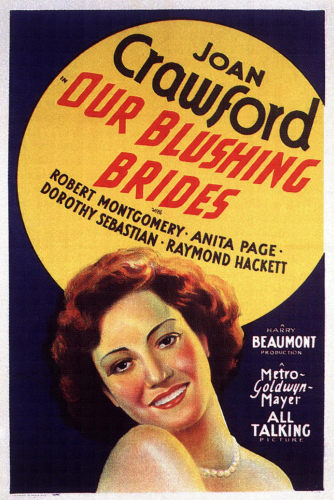

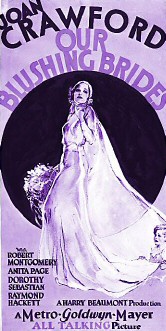
Above: US. Below: Sweden.

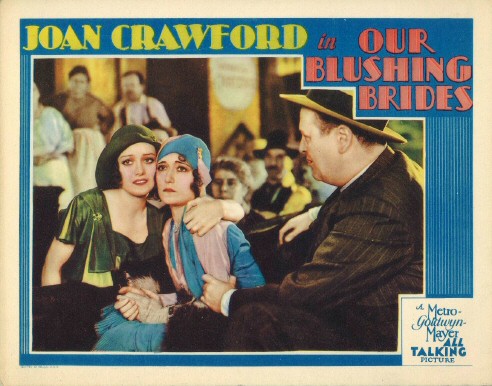
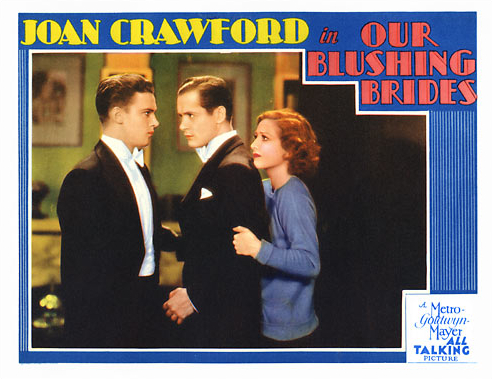
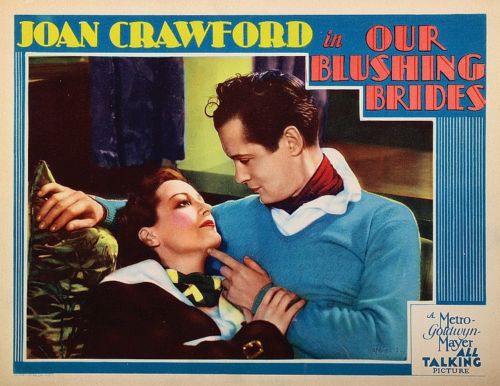
Below: US lobbies.
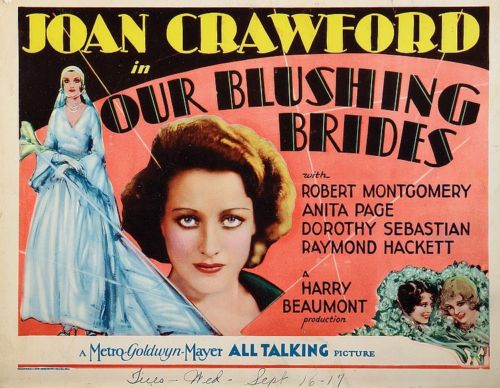


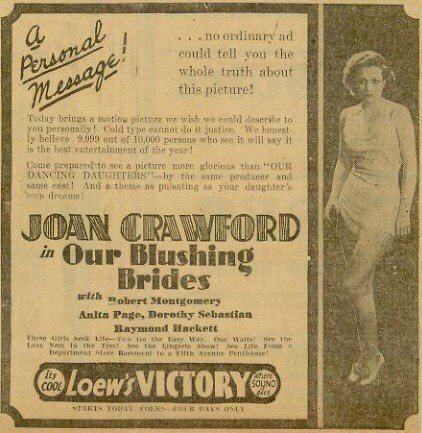

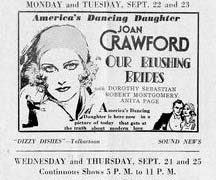
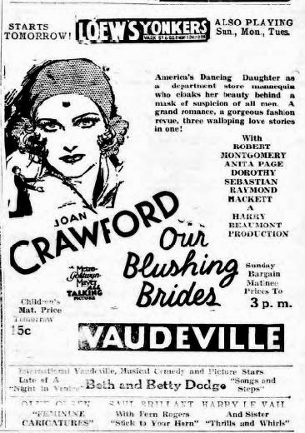
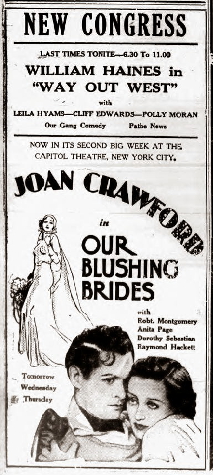

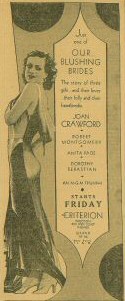
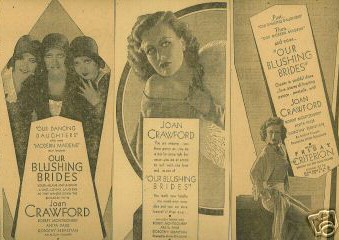
Above: US newspaper ads.
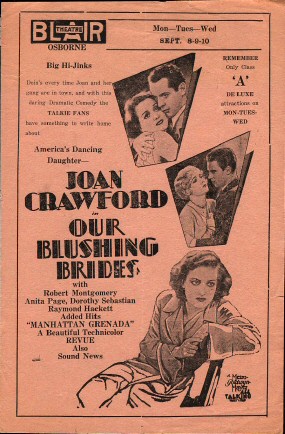
Below: US glass slide and flyer.

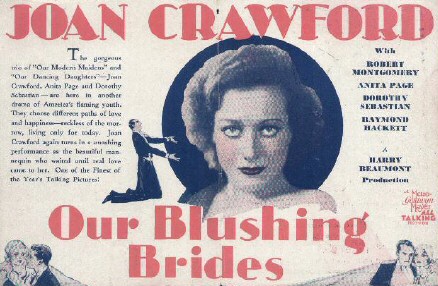
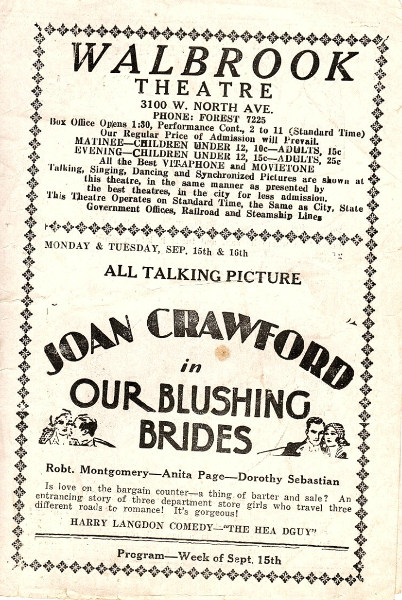
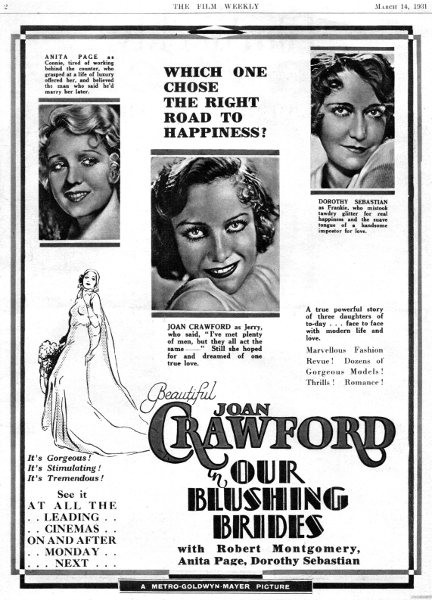
Below: US herald; US program from Baltimore, Maryland; and a UK ad from Film Weekly (3/14/31).
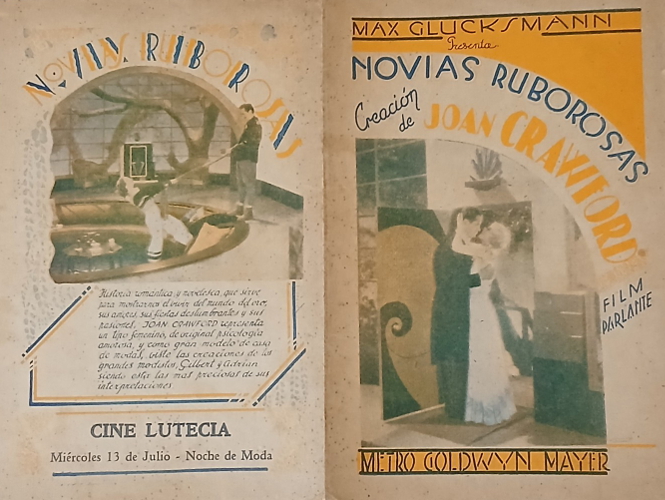
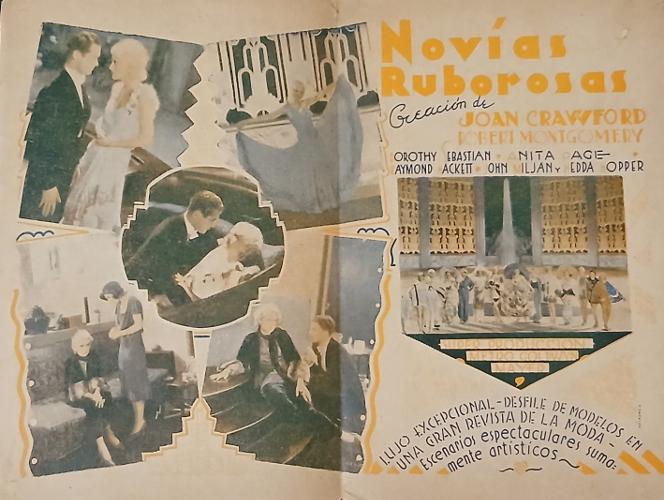
Below: Program cover and center from Argentina's Cine Lutecia theater.
Below: French and Danish novelizations. (See the Books Related to Joan Movies page for more info.)


The Best of Everything
 MGM. 99 minutes.
 Tom C. (August 2024)