The Best of Everything
Encyclopedia Entry • Films Main
Possessed
1947
Critics' Reviews • Our Reviews • Movie Posters • Lobby Cards • Misc. Images
Click here to see photos from the film.
US theatrical release: 7/26/47.
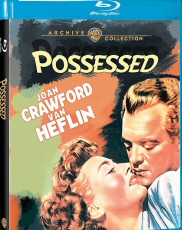
VHS release: 11/13/91. Region 1 DVD release: 6/14/05. Warner Archive Blu-ray release: 10/21/14. Cast: Joan Crawford (as "Louise Howell"), Van Heflin, Raymond Massey, Geraldine Brooks, Stanley Ridges, John Ridgely, Moroni Olsen, Erskine Sanford, Gerald Perreau, Isabel Withers, Lisa Golm, Douglas Kennedy, Monte Blue, Don McGuire, Rory Mallinson, Clifton Young, Griff Barnett. Credits: Based on the story "One Man's Secret!" by Rita Weiman. (Originally appeared in Cosmopolitan, March 1943.) Screenplay: Silvia Richards and Ranald MacDougall. Producer: Jerry Wald. Director: Curtis Bernhardt. Camera: Joseph Valentine. Art Director: Anton Grot. Music: Franz Waxman. Costumes: Adrian. Editor: Rudi Fehr.
Plot Summary: We first meet Joan Crawford, star of the moody flashbackfest Possessed, wandering aimlessly through the city streets, moaning "David....David." She goes to pieces in public and is rushed to the mental ward, where a team of psychiatrists try to find out who she is and where she's been. Who she is is a practical nurse, hired by Raymond Massey to care for Massey's invalid wife. While going about her duties, Crawford renews her acquaintance with an old flame, architect Van Heflin. Though Heflin is indifferent, Crawford is still crazy for the man. She remains so even after marrying her employer Massey, whose wife has committed suicide. Any further details would give away the ending, but we can note that Van Heflin's character name is David. Best scene: Crawford, descending into schizophrenia, imagining that she's killed Massey's vitriolic daughter Geraldine Brooks. While the psycho-babble delivered in the asylum scenes is laughable, Possessed still holds up well as one of the best of Joan Crawford's Warner Bros. soap operas. This black-and-white film is also available in a colorized version, but don't blame us. ~ Hal Erickson, All Movie Guide
Awards: 1948 Oscar nomination for Best Actress. (Joan's second, after Mildred Pierce.)
Film Notes: • According to a Hollywood Reporter article (8/6/46), production was shut down for several weeks because Joan had a case of strep throat. The same article reports that Joan had cinematographer Sid Hickox replaced with Joseph Valentine after 38 days. • Joan's own suggestion to studio execs for the film's title was The Secret. (Essential Biography) • Joan's co-star Van Heflin said a few years after filming: "Damn, I knew Joan had perfected the art of projecting her personality, but I never took her that seriously as an actress until I found myself up against her in that. She outplayed me, Raymond [Massey], everybody in the cast..." (EB) • Geraldine Brooks has her first major film role here as the daughter/love interest of Van Heflin's character. (EB) • The music featured in the film is the "Chopin" section of Robert Schumann's Carnaval. (EB) • A woman who had undergone shock treatment at a Pasadena sanitarium where Joan and others did research and observation for the film filed a lawsuit claiming invasion of privacy, seeking $200,000 in damages. She settled out of court. (EB) • Director Bernhardt had just finished working with Bette Davis on A Stolen Life and kept absentmindedly calling Joan "Bette," until Joan finally threw her purse at him. One day during filming, Bernhardt, Joan, and Davis surprised onlookers at the studio commissary by enjoying an animated lunch together. (Joan Crawford: A Biography) • This was the last movie for which the famed Adrian would design Joan's clothes. (JCB) • After filming ended in early 1947, Joan went to Las Vegas to conclude the adoption process for her twin daughters Cathy and Cindy. (The Last Word)
|
Bosley Crowther in the New York TimesMay 30, 1947
The last time we saw Joan Crawford, in the Warner's "Humoresque"—the last time, that is, before just seeing her in that same studio's "Possessed"—she was walking out into the ocean with the intention of drowning herself because John Garfield didn't love her as much as he loved music—speaking fictionally, of course. Apparently she succeeded, to judge by Hollywood's new film, and apparently this is her spirit—or a transmigration thereof—which we now see. For not only does Miss Crawford resemble anything so much as a water-logged cadaver at the outset of "Possessed"—and, for that matter, never looks completely dehydrated at any stage of the film—but her whole attitude throughout the drama is that of a desperate woman's ghost wailing for a demon-lover beneath a waning moon. And, indeed, the basic conflict in the story is so similar to that in "Humoresque" that the ghost aspect of the characterization seems to be almost studiously contrived. In this picture, as in the former, Miss Crawford plays a dame who goes mad because the man of her devotion doesn't love her the way she loves him. Only this time she goes completely batty and lands in a psychopathic ward, where, under the influence of narco-hypnosis, she relates her tragic tale. It is the tale of an unbalanced woman—a schizophrenic, as they point out—who develops a persecution complex when her lover refuses to marry her. (All of this clinical data is orally noted by the doctors attending the case, and it is to them that we are indebted for keeping us posted as the story unfolds.) And, although she eventually marries another—a man whose wife has committed suicide—she can never forgive the gent who jilts her, especially when he starts romancing her step-daughter. She grows hysterical, she has hallucinations, hollow voices ring in her ears. Finally she shoots her old lover and is off to the looney-bin. As a visualized psychoanalysis, this film has its fascinating points, even though it does leave some broad areas of the lady's neurosis unexplained. Her crack-up is fairly documented, within the frame of a primarily fictional film, and the efficiency and dispassion of science are suggested in a rather credible way. Stanley Ridges, as the psychiatrist, is the one person in the film whose preoccupation with his problem can be reasonably believed. But the morbidness of the drama and particularly its one-track emphasis upon the frustrations of a female are a little too thick for free flow. It is just a bit oppressive to see so much exclusive attention and sympathy lavished upon a woman whose life has been so conveniently warped. And, despite some rather classy histrionics, Miss Crawford in this role appears more a representation of a pampered actress than of a truly jangled dame. We'd like to sense, for instance, more respect and sympathy for Van Heflin, who is eminently worth it as the lover whom Miss Crawford shoots, or for Raymond Massey, who is sketched but lightly as the poor, unlucky man who marries her. Both of these unhappy fellows are given much too short and casual shrift. And we'd like to see treated more fully the role played by Geraldine Brooks, a newcomer who Hepburns brightly and warmly as Miss Crawford's sensitive step-daughter. However, it is wholly obvious that the writers and Director Curt Bernhardt were told to concentrate on the torments of Miss Crawford, Hollywood's current Great Sufferer, Academy style.
Variety (1947) Joan Crawford cops all thesping honors in this production with a virtuoso performance as a frustrated woman ridden into madness by a guilt-obsessed mind. Actress has a self-assurance that permits her to completely dominate the screen even vis-a-vis such accomplished players as Van Heflin and Raymond Massey. Heflin’s part of a footloose engineer who romances his ladies with one eye on the railroad schedule is now drawn with equal sharpness. By sheer power of personal wit, however, Heflin infuses his role with charm and degree of credibility despite a lack of clear motivation for his behavior. Unfolding via flashback technique, film opens with a terrific bang as the camera picks up Crawford wandering haggard and dazed through Los Angeles until she collapses. In the psychiatric ward of the local hospital, under narco-hypnosis, she relives the series of personal blows that ultimately reduced her to schizophrenia. Despite its overall superiority, Possessed is somewhat marred by an ambiguous approach in Curtis Bernhardt’s direction. Film vacillates between being a cold clinical analysis of a mental crackup and a highly surcharged melodramatic vehicle for Crawford’s histrionics.
James Agee in Time (1947): Most of it is filmed with unusual imaginativeness and force. The film is uncommonly well acted...Though she is not quite up to her hardest scenes, Miss Crawford is generally excellent, performing with the passion and intelligence of an actress who is not content with just one Oscar. In fact, the weaknesses in this unusual movie do not greatly matter beside the fact that a lot of people who have a lot to give are giving it all they've got.
Howard Barnes in the New York Herald Tribune (1947): Miss Crawford is at her best in the mad scenes. The actress has obviously studied the aspects of insanity to re-create a rather terrifying portrait of a woman possessed by devils.
Dennis Schwartz on Ozus' World Reviews (2003): Though Joan has a powerful presence in this movie, she played her mad role in a too cold and campy way to be thought of as a sympathetic figure. All the psychological treatment therapy sounded like psycho-babble and Joan's acting was overstuffed, though some of her morbid imaginations were gripping and held my attention. Too heavy with German stimmung, it still is fun to watch the melodramatics play out in this tale of overbearing love, painful rejection, paranoia and murder. Complete review.
MonsterHunter.com (2004): A surprisingly prescient movie for its time in showing the dangers of leaving mental illness untreated (Them crazy folks'll kill you!) with Crawford handling the fine line between portraying a real person suffering from these problems and simply being a scenery-chewing character with great aplomb. If you've never been a fan of Joanie's work or thought she was more reputation than talent, you should definitely check this one out.... |
If you've seen Possessed '47 and would like to share your review here, please e-mail me. Include a photo or avatar of yourself, a star-rating (with 5 stars the best), as well as your favorite lines from the film.
|
 Tom C. (October
2024) Tom C. (October
2024)Rating: Leave it to Joan to star in two completely unrelated movies with the same title: Possessed. There is the 1931 version, which I adore. The 1947 variant? They say confession is good for the soul, and so I must confess, this is not my favorite Joan flick. I know Joan gives a riveting performance as a woman driven to mental instability by a lost lover, a performance for which she was nominated for an Oscar. I know she was in the middle of her Warner Brothers renaissance. I know that she observed patients so that her portrayal would be accurate. I know all that. I just don’t like Possessed (1947). I think the heart of my dissatisfaction lies with Van Heflin’s character, David Sutton. He’s a heel, a wedding crasher, a jerk who dates the step-daughter of a jilted ex. For heaven’s sake, the man even worships parabolas, when every STEM major knows that hyperbolas are cooler! How the Great Diva could fall for such a worm is beyond me. Joan’s other co-stars are not much better, although, to be fair, they don’t have much to do, since this movie is all about Joan and her character. Geraldine Brooks is the step-daughter and comes across to me as a brat---Veda Pierce without the evil streak. Raymond Massey (who plays husband "Dean Graham") is so intertwined with Abraham Lincoln in my cinematic brain that I kept wondering when Honest Abe was going to emancipate a couple of teeth from Sutton's mouth. I did have some minor interest in the character actors: Stanley Ridges as Dr. Willard was quite good. And there is a very short appearance by one of Joan’s old buddies, Creighton Hale, as an extra at the coroner’s inquest. (Joan acted with Hale in The Circle [1925]. And when she first went to Hollywood, some of her earliest screen tests were shot with him.) OK, so what do I like about the film? The cinematography is excellent. Black-and-white, intersection of light and shadow, all the stuff we love about noir. I particularly like the first two scenes: Joan wandering around downtown LA in a daze; and then, in the next scene, as she is wheeled into the hospital and we get to see the journey from ambulance to examination room from her viewpoint. The music is also very good. Kudos to Joseph Valentine and Sidney Hickox for the former and to Franz Waxman for the latter. In my final analysis, 1931’s Possessed has pretty much everything that I like and that the 1947 variant lacks. The 1931 version is 30 minutes shorter, shows Joan fighting to build a brighter future rather than holding on to a painful past, and---importantly---has a male lead (Clark Gable) who is truly Joan-worthy.
Rating:
Ah, the mundanity of insanity! It's not an homme fatale who drives Louise to madness but rather a smirky nerd more interested in his compass than in kissing.
Let me start with a very mundane story of my own: When I first saw "Possessed," I was still relatively young (in my early 30s) and viewed it through the lens of someone still going through an obsession with my very first lover, who had quite cavalierly dumped me before I was emotionally done with her! Still in this mindset, I related very much to Joan's "Louise," cringing as she pleaded for love and failed to listen to Van Heflin's "David" as he told her overtly that he was bored and not in love with her. "I have no pride," she humbly and miserably tells him, spilling her guts as he rejects her.
Hand it to actor Heflin and the writers (Silvia Richards and Ranald MacDougall, who wrote the screenplay for Mildred Pierce): David is not a totally bad guy. And he wasn't ever really leading Louise on; he was, in fact, being quite honest with his lack of feeling the whole time, though Louise couldn't accept that. So the film hurt to watch at that still-raw time in my life. Which makes it a very good film---as is any work of art that can re-create actual emotions and, yes, make you feel uncomfortable while, voluntarily or not, re-living them.
Watching "Possessed" decades later, I am, fortunately, able to view it more objectively. The personal emotional pain is gone, and with it comes a new objectivity for the cinematic elements going on along with Louise's internal torment.
The film opens with a long shot of a faceless woman aimlessly wandering the streets of early-morning LA muttering "David, David." She's utterly anonymous until we finally see her inquiring "David?" of a bus-driver, when she's finally revealed as our star. Joan's Louise then goes on to a church as congregants are exiting---not to find God, but only "David." Then on to various working-class shops and cafes, until she's finally carted away to a psychiatric hospital in a catatonic state. (Not sure, exactly, why Los Angeles had to be inserted into the narrative---the majority of the action takes place in the Washington, DC, area.)
The story of how Louise got to this point unfolds via hospital flashbacks, after we first get some opinions from the doctors on staff. "She's frustrated---just like all the others we've seen," says the first doctor, who also gives us a lecture on the current decrepit state of civiliization and who, 15 minutes later, diagnoses Louise with a "persecution complex" and "schizoid detachment." Later in the film, we learn from another doctor that Louise exhibits "extreme suggestibility" and "neurasthenia" AND "schizophrenia."
These ridiculous 1940s Freudian movie tropes aside, Louise probably has good reason to be mentally upset, according to the script: Once her lover David has broken up with her, she goes back to the home where she's nurse to an equally mentally disturbed wife---who accuses her husband and Louise of having an affair, before she drowns herself. Louise has to deal with guilt over having left the wife alone, then has to deal with the daughter (Geraldine Brooks) who blames her for her mother's death, then has to deal with the husband who now wants to marry her... AND David is still hanging around, asking the husband for a job! Oh wait, there's more: The daughter and David start flirting, then talking of marriage!
The most interesting thing among all of these surface dramatics is Louise's PERCEPTION of what's going on. There's a great sequence starting with Louise and step-daughter Carol attending a piano recital. Carol---not knowing of Louise and David's relations but being attracted to him herself---invites David to their box. The subsequent sexual tension between David and Louise while the pianist plays a Schumann piece that David had once played for Louise privately is palpable. Louise leaves, upset, as David sees her out---chiding her for her "incorrect" reaction. Later, at home alone, Louise is overwhelmed by various sounds: tick of clock, drop of rain, howl of wind... and then there's a sequence of Louise confronting Carol as she comes home from the concert, which ends in a slap and Carol's death at the bottom of stairs... We viewers THINK this has actually happened, but then there's an alternate sequence of events...
Aside from the simplistic Freudian and psychiatric theories interspersed in this film are actual human emotions. For instance, it's not mere sex that Louise wants but rather a mental/emotional closeness that she cannot achieve with David, through no fault of either. Both Louise and David are fully realized characters, neither good nor bad. David's not a complete cad, just a rather emotionally careless, callous guy whose only "crime" is not recognizing the depth of Louise's feelings and making light of them. He and the much-younger Carol are definitely a much-better match---both are emotionally immature and content with their banter; like children, both blind to the pain they might be causing another. (In other words, quite realistic!)
There's very little happiness, or hope of happiness, in this film, unfortunately (maybe only a couple of minutes or so in total screen time---perhaps only slightly less than the approximate ratio that occurs in real life!).
One ill-deserved beef about Joan's acting in general is that she's always "Joan Crawford." That's only true about 25% of the time, and definitely not so in this film. In "Possessed," she's completely subsumed in the submissively tormented character of "Louise"---and deservedly got her second Oscar nomination for the role.
Rating:
My favorite Joan Crawford movie. Don't let the silly timepiece verbiage and "psycho-ward" babbling distract you. Unfortunately most reviews comment on this as if it makes the acting any less brilliant. Watch the scene at the nightclub where Mr. Graham has Carol and David join him and Louise. The manic-ness with which Joan starts extolling David's virtues builds to a crescendo, then cuts to her staring at herself in a mirror, at the other extreme of the mania, with an "oh my God what have I done now?" look. She plays this manic, woman-on-the-edge with the perfect balance of insecurity, sadness and hysterics. I think she deserved the Oscar for this movie--even more than she did for Mildred Pierce.
Rating:
Judging their shared sensibility for aesthetic, it is worth musing whether David Lynch and Joan Crawford would have made a dream collaboration. Much like Lynch's subversive suite of dark drama, Crawford's choice in roles during the 1940s encompassed brooding psychological noir that is perhaps most successfully defined by her Oscar-nominated turn in Possessed. The third picture to be produced after the momentous comeback cemented with Mildred Pierce, Warners once again allow Crawford to showcase her dramatic talents.
The film follows the unfurl of lead character Louise Howell, whose inability to cope with unrequited love may have been the catalyst for her mental decline. After being admitted into psychiatric ward and administered a truth serum by the doctors, Louise narrates her obsessive relationship-gone-south with David Sutton (Van Heflin), an engineer who also happens to work with Dean Graham, whose wife Louise is nurse to.
After David fails to reciprocate
the obsessive depth of her feelings, Louise suffers a series of
emotional meltdowns that only serve to alienate him further. Between the
rapid dissolution of their relationship, Louise also becomes an
integral part of the Graham household when Dean's wife suddenly drowns.
Reluctantly Louise marries Dean in a bid for companionship, and grows
closer to his estranged daughter Carol, who later becomes a romantic
prospect for David.
As with her triumphant turn in Mildred Pierce, this film depicts Crawford's ongoing pursuit of filmic interests. By rule Crawford was occasionally an outstanding actress in her more unexpected material. There's a high-octane nerve that she wisely maintains until her dramatic finish. Crawford is ably supported, too: Van Heflin swaggers through his part with a smug ambiguity; the beautiful Geraldine Brooks is sprightly and sensitive as Louise's stepdaughter. The script shines with the intelligent, ethereal demonstrations of Louise's increasing histrionics and her sardonic clash of wit with possible antagonist David.
Make no mistake about it, while this is far from the most polished film, this is the finest Joan Crawford performance. It's layered, complex and unapologetically volatile. And the final flavour this former hollow-cheeked clotheshorse leaves is of a serious actress more concerned with broadening her range than mere blockbuster.
Rating:
My feelings about Possessed are quite different from Mr. Bosley Crowther.
Possessed is a rather difficult film to review because there is a divided audience and a divided opinion, similar to Daisy Kenyon and a few other films where the fans or viewers are polarized. I am going to take my lead instead from Mr. James Agee, who wrote, “a lot of people who have a lot to give are giving all they’ve got.”
I can begin with Mr. Jack Warner. 1947 was a tuff year for the cinema; changes were happening fast on all ends of movie production. However, he and other Warner executives prevailed, and courageously they supported stars like Miss Crawford as well as the talented Rita Weiman, the author of the original story titled “One Man’s Secret,” and the screenplay by one of our favorites, Ranald McDougall (who also wrote the screenplay for Mildred Pierce)! He and the other writers change a few things from the original story, and that always fascinates me.
Things are coming together with cameraman Joseph Valentine assigned. The film he presents is realistic; he captures moods that do feel Hitchcockian and Noir, with a bit of the "haunted house feeling," too. It is another reason I love this film. (Valentine would win an Oscar for the disappointing Joan of Arc in 1948 and did film a few Hitchcock movies.) Some friends from the past like Adrian pop in and design a few gowns! (A lot of talented people!)
There are not many who can compete with Franz Waxman: he is the movie. His score is adjusted to all the feelings of all the characters. It really is his glorious pace that enables the movie to succeed.
With our star and script in place, Mr. Curtis Bernhardt (another creative refugee of Hitler), the director, gives us one of his best attempts at putting this difficult subject matter to the screen and elevating the script to the star's performance. He just wasn’t a Mike Curtiz. He does, however, do a splendid job, especially with the supporting players and their relationship with Miss Crawford’s character. Everyone plays off each other very well. The movie is about relationships and maybe revenge, as well as schizophrenia. We all know a Louise Howell! That is where I come in.
When I am depressed, or have been burned or mad, I watch Possessed. (When you're really mad, watch Queen Bee.) It makes me feel good because I love to see Miss Crawford shoot somebody; next to Bette Davis and John Wayne, she has great aim! There is nothing dated about this movie: it satisfies your senses, especially when you're upset with people. I know several people who fit right in with Miss Crawford’s character’s situation, be it addiction and recovery or post-traumatic something: people can and do go over the top or lose it or shut down. It could happen with a situation such as unrequited love, as it does for Miss Crawford’s character. Losing control is never any fun and witnessing it is very difficult. Luckily, most of us know how to rein in our emotions, but they are there and can erupt and disrupt just as Louise does.
Miss Crawford performs with a magnificent confidence in her characterization and blends with the script; her emotions take us on a twisted ride. She gives us a fine portrayal of a woman who does “lose it”; sadly, she is a very sick woman. I find this film more interesting than The Snake Pit (Fox 1948, with Olivia De Havilland). “Virginia’s in the chair” here; we do not have to go to the insane asylum (as we also do in the awful The Caretakers [1963]). And are those two films different from Girl Interrupted? NO! I don’t want to sit in a room with crazy people or people working out their problems in group therapy. I took acting classes and I lived near skid row. We are given a different side to look at and we get to watch Louise build up to her destruction and the murder of poor Van Heflin and the heartache she will cause. Can she be cured?
The doctor played by veteran character actor Stanley Ridges (Mad Miss Manton 1937, with Barbara Stanwyck) takes on more than you think. It is his job to figure out why and how to prevent her disease from ruining her further, and ruining society for that matter. Sixty years later, they are still trying to figure it out. Control, people!
Van Heflin is excellent: his interpretation is honest and real, his relationship with Miss Crawford is believable throughout. I knew guys like him! Louise just couldn’t handle it! I can say a mountain more about him and I think he also deserved to be nominated!!!
Geraldine Brooks performs like a seasoned player and can hit back hard with these tough pros. She is a real fox and has a wonderful way with her dialogue, almost purrs it. She is excellent in the few films I have seen her in and she is excellent here. I am sad she had an early demise .She was a vivacious woman.
Raymond Massey, another expert actor and a complete professional, has a difficult role as the husband, but he plays in the right manner. His scenes with Miss Crawford are some of the film's best and the most difficult to pull off. You really do feel he loves Louise. I hope he has the strength and patience.
At last someone finally cares for Louise but hell, will their lives ever be the same? Enjoy Miss Crawford offering you yet another character in her gallery of motion picture roles while Hollywood was still standing. Best to view on a dark rainy night or a hung-over gloomy morning.
Harley (November 2007)
First, I don't think Possessed is a noir even though there are noir elements. There's not the moral ambiguity, the choice between good and evil and the equal appeal that there is in so much noir. Also, most of the characters are pretty decent people and the crime that's committed isn't out of lust or greed but insanity. It's kind of like a dark weepie. Drew Casper (I always like his commentaries) in the audio commentary argues that noir is a style of movie making. I've always seen it as more of a genre. Either way though I can't see the Robinson movie House of Strangers as a noir even though Fox is selling it that way.
Possessed is a very interesting piece though. It combines a number of elements. In the middle section, when Joan's Louise is visiting the lake house, it could have almost been Val Lewton psychological horror. That was the whole essence of Cat People-- is she really a monster or is it in her mind and more importantly is there a difference?
When I saw the plot description I thought it was going to be a Fatal Attraction-type deal. It wasn't that at all. The Crawford character is very likable and sympathetic throughout. Reaching out to the daughter at the college was an act of human decency they wouldn't have granted Glenn Close.
Heflin's David to me is the villain of the piece if there is one. His character is kind of one of those annoying people who doesn't want someone but doesn't want them to have someone else. He has a right to pick whom he chooses but he keeps inserting himself in her life. The day after he dumps her, he decides to pay her boss a visit. At the wedding he stops by even though neither Crawford or Raymond Massey invited him. While there he's completely insensitive. Meanwhile he then chooses to date her step-daughter knowing full well that if it goes anywhere, it will create more pain and awkardness for Crawford. It is clear to him by her own admission that this is Crawford's first true love. And he risks and eventually does insert a constant permanent reminder of that painful loss into her life. He treats terribly at the opera when she is basically doing the decent thing. In many ways I feel he is reinforcing her psychosis by making her more worthless and reminding her of her passion for him.
While the Crawford character sticks around for him at first, she marries Massey because she needs the attention and so does he. She's up front about not being in love with him. The moment she's put some of her demons to bed and is ready to be happy with Massey, he shows up with the daughter. To paraphrase Major Rufus T. Cobb from the Jesse James movies: "Maybe he needed killing."
I would have preferred that David's killing be in her mind as well though. It would have increased the Lewton-like ambiguous tension.
I find it interesting that despite the image of a ballsy dame portrayed in Mommie Dearest that Joan's screen persona was often very delicate and fragile like it is here or in Grand Hotel or The Unknown or even Baby Jane. (I haven't seen the Castle flicks where her persona hardened though.)
James (June 2005) Rating:
Fresh from her triumphant performances in Mildred Pierce and Humoresque, Joan Crawford was at the top of her game in 1947. She could have starred in any number of top-flight films, and yet (in what I can only attribute to a case of momentary diva-envy) she instead decided to star in a film originally intended for Bette Davis, whose career projectile at this point was on its way down. Tailored for Miss Davis, Possessed was appropriately scripted as a semi-B movie intended for a falling star, not someone whose career was red-hot after winning an Academy Award two years previously. However, fate intervened and Bette, pregnant with her future poison-penned daughter BD, decided to opt out of Possessed and Joan snapped it up with alarming alacrity. I like to "pretend" that Joan didn't read the script...or at least that she was "in her 100 proof cups" when she did so. Because what Possessed eventually turned into is nothing more than an extravagantly grand display of "my male appendage is bigger than yours," clearly designed to piss off her rival. Unfortunately, Joan's efforts were spectacularly misguided, and I have the very distinct feeling that when she eventually saw Possessed, Miss Davis ended up having the last laugh.
The movie starts out in a promising manner, with shots of Joan wandering city streets, which immediately evokes memories of Mildred Pierce. But instead of "film noir," we get "preachy, out-dated psycho-babble" when Joan's character quickly ends up in a mental hospital being probed and prodded by a couple of hammy doctors straight from central casting. It's all downhill from there, and the audience is treated to endless scenes of head-clutching, hallucinatory, eye popping "insanity" (1940s style), with Joan suffering repeated mental-meltdowns and generally acting like Miss Davis herself on speed.
And the costumes...the horror!!! Poor Adrian must be burning in hell for the gawd-awful glad-rags he shackled Joan with ("shackled" being the operative word). With peculiar buckles and strappy-things hanging oddly from her austere, severely lined dresses (which were clearly intended to invoke images of strait-jackets), Joan resembles a couturier-gowned psycho on a day-pass at Macy's. In one memorable scene, sequined straps dangle distractingly beneath her bosom, accentuating her breasts like some sort of "psychologist recommended" push-up bra. Joan, suffering yet another breakdown, proceeds to laugh hysterically, which causes the straps to jiggle and swing wildly. The viewer watches in stunned amusement, and is left to ponder the very deep question: "What the HELL was Joan thinking when she agreed to star in this drek??!!!" But Joan cannot be blamed. All of the evidence points to BD Hyman, whose unfortunately timed birth (can you hear Bette cackling?) is the ONLY reason Joan's otherwise illustrious career was blighted with this massive mis-fire of a movie.
Possessed '47 is like watching "Joanzilla: She-Monster of the Glamazon" ... which is not, I am sure, the intention Miss Crawford had in mind.
|
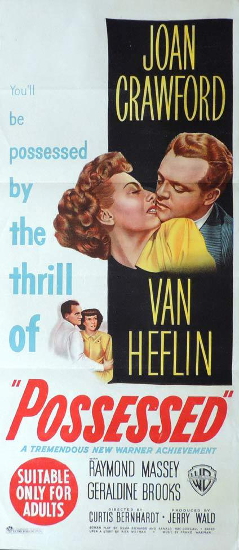
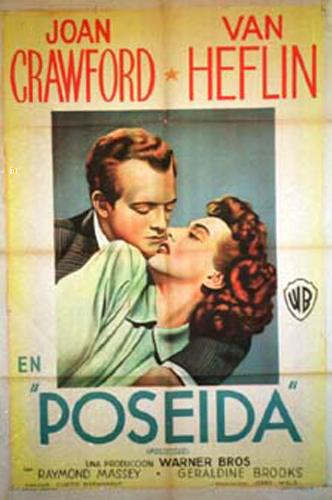
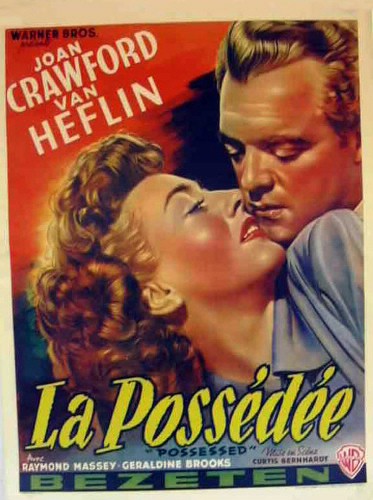
Above: Australian daybill (13 x 30 in), Argentinean poster, Belgian poster
Below: French poster, Italian insert (13 x 27 in), Japanese poster (20 x 29 in), Spanish poster
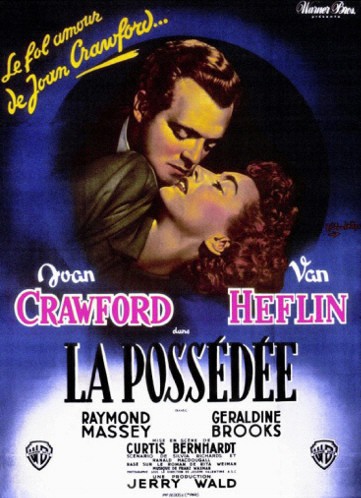
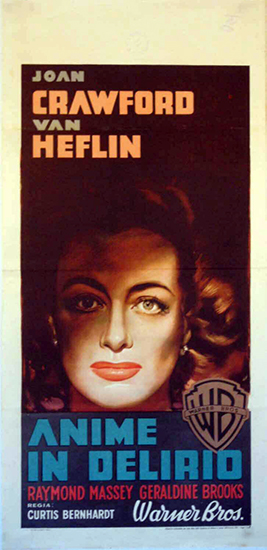
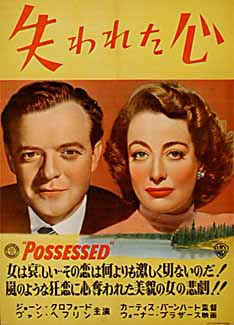
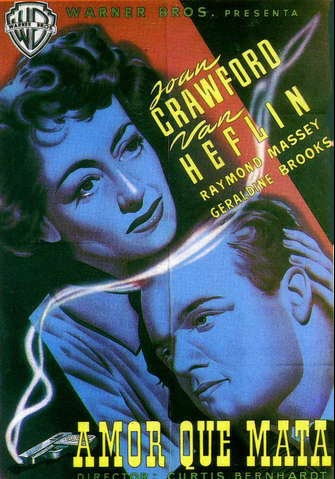
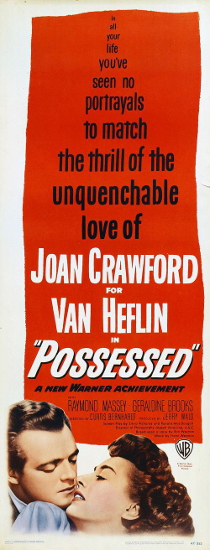
Below (top row): Two US one-sheets (27 x 41 in), US unknown size, US insert (14 x 36 in)
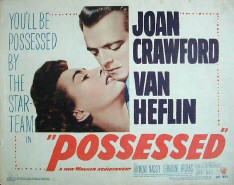
Below (bottom row): Two US half-sheets, Style A (22 x 28 in)
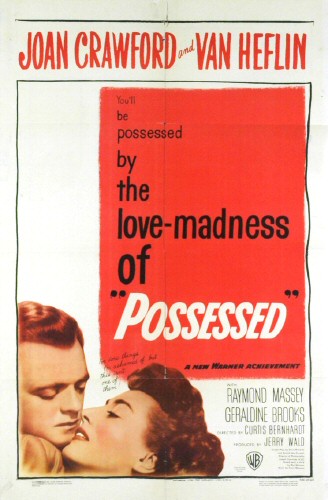
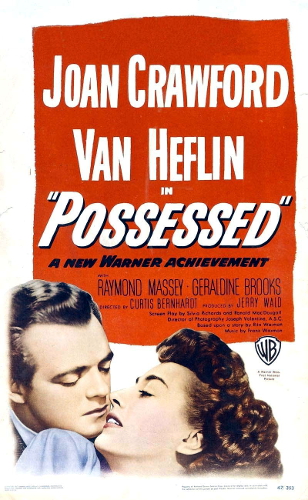


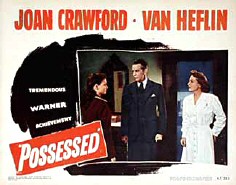
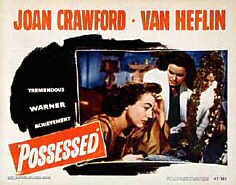
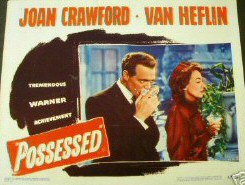
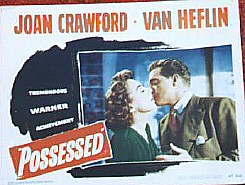
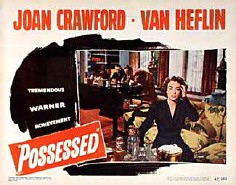
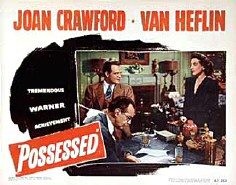
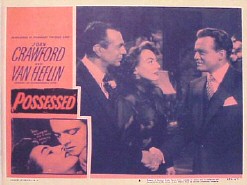
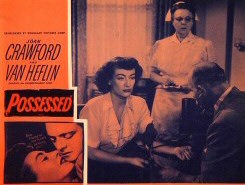
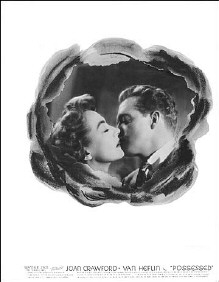
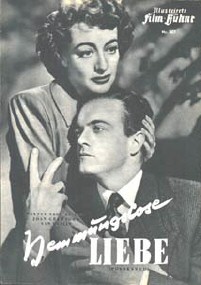
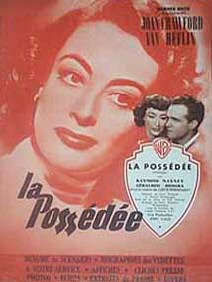
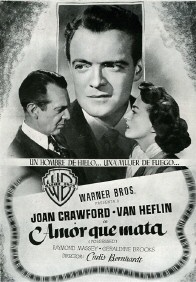
Above: Warners art still, German program cover, French pressbook cover, Spanish ad
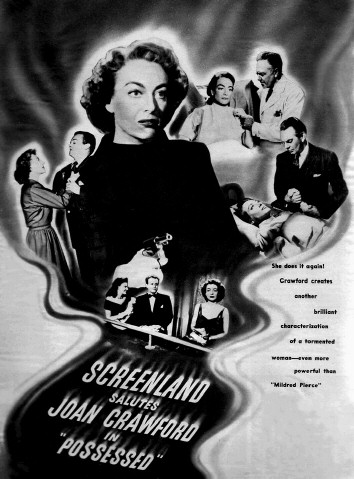
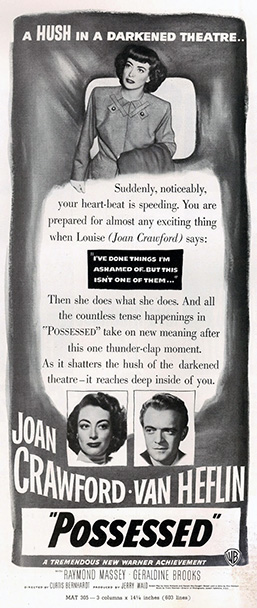
Below: Two US ads and a Swedish magazine ad.

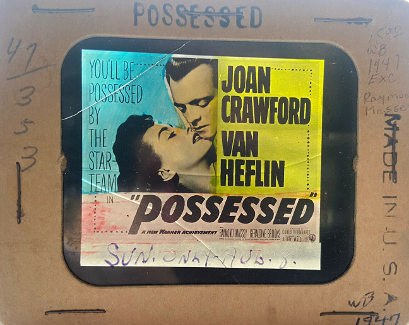
Above: US glass theater slide.
Below: US trade ads, and US pressbook cover.
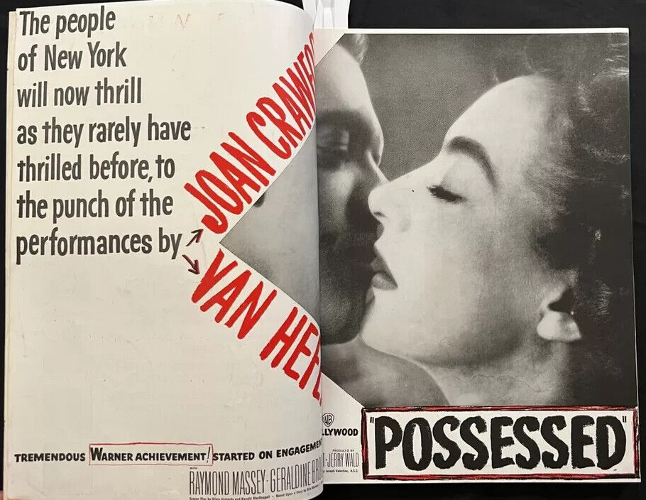
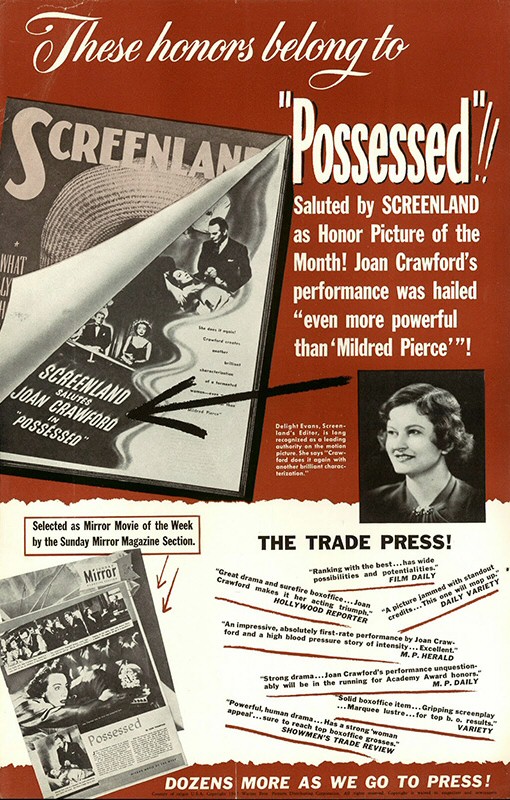
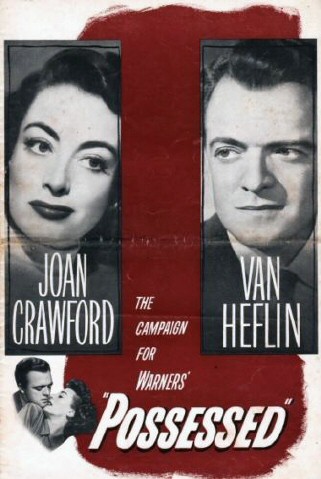
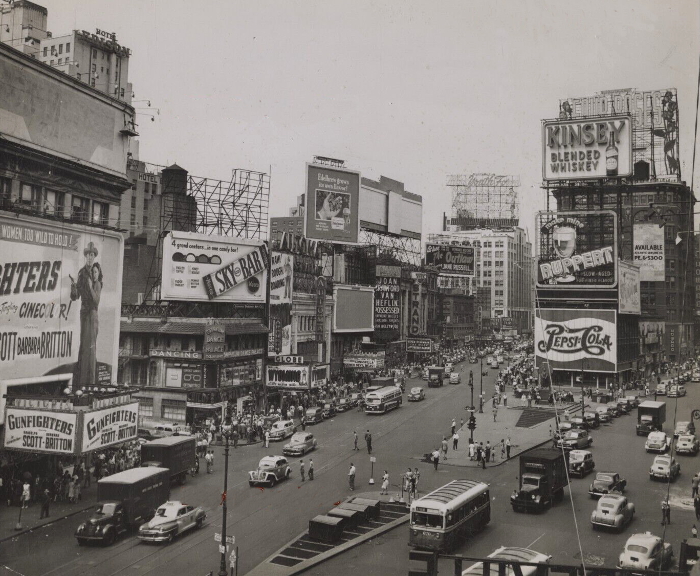
Below: NYC Times Square Possessed marquee (near center, to left of Strand sign).
The Best of Everything

 Stephanie Jones
 Ricoh
Vigen (June
2013)
Ricoh
Vigen (June
2013) Stuart Hoggan (April
2013)
Stuart Hoggan (April
2013)