Joan Crawford
a Suicide?
Doris Lilly Recalls the Star's Haunted Last 18 Months
Originally appeared in People Weekly, May 30, 1977
|
|
|
The last picture taken of Crawford in public was when she hosted a 1974 New York party for the late Rosalind Russell. |
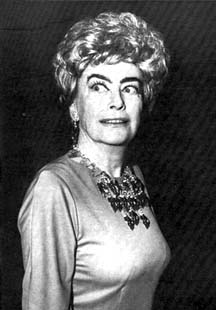
This month's obits of Joan Crawford chronicled her tough, traumatic youth, her 81 movies and her driving second career as the director of Pepsi-Cola Company. But there was no accounting for the eerie last 18 months of her 70-odd years. One of the few who knew was showbiz correspondent Doris Lilly, a close confidante and neighbor in the Manhattan apartment building where Crawford lived since 1967. Lilly is the author of the best-selling How to Marry a Millionaire; the forthcoming book Glamour Girl; and, for PEOPLE, of this highly personal account of the movie queen's last months and curious death.
Did Joan Crawford take her own life? As an experienced reporter and Joan's friend, I can only conclude that she did. She was cremated, according to her wishes, and no autopsy was performed to see if she might have taken an overdose of pills. Yet there is much evidence that she was preparing to die.
Among the many "coincidences": Her death occurred on May 10, the 22nd anniversary of her marriage to her fourth and last husband, the late Pepsi chairman Alfred Steele -- the only man, she said, she really loved. (Years after his death in 1959, she still set a place for him at the dinner table.) Starting in February, she began "cleaning out," sending me and a few other friends household items that she said she would no longer need. Just two days prior to her death, on Mother's Day, she told me she spent the day alone; none of her four adopted children came to call. The next day Joan sent her beloved pet Shih Tzu, Princess, away to be taken care of by friends in the country. In fact, Princess had not been outside the building for over a year, much less separated from her adoring mistress.
 |
| Crawford talks with a guest while mopping up after a 1959 party. |
During those months of self-imposed exile, I saw a great deal of Joan Crawford. Along with her psychiatrist and perhaps a few dozen others, I was one of the few. Joan had her meals delivered in and busied herself writing thousands of notes, for which she had become famous over the years.
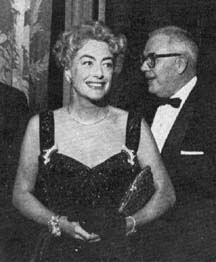 |
| After Phillip Terry, Crawford married fourth husband Pepsi chairman Alfred Steele -- "The only man I really loved." |
Each and every piece of furniture - and the walls - had been treated with a vinylizing process that could not be penetrated by dirt. There were no fresh flowers or plants. In the film Harriet Craig Harriet finally loses her crackerjack maid by demanding that the tree outside the back window be washed and waxed. Joan, too, filled her apartment with yellow wax flowers and plastic plants -- ones that could be swabbed with soap and water.
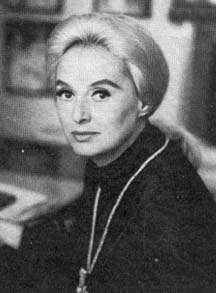 |
| Crawford's friend and neighbor Doris Lilly reports that Crawford lived cleanaholic role she played in Harriet Craig. |
Still, Joan was desperately unhappy. After the death of Alfred Steele, she played a major role as Pepsi's spokeswoman for more than a decade. But PepsiCo's current chairman, Donald Kendall, had frozen her out completely over the past two years. She still wanted to act, but now the scripts weren't coming in. Last March 21 the American Film Institute honored her archrival Bette Davis with a nationally televised tribute. No one approached Joan, and it hurt. Nonetheless, Joan, an avid TV watcher, told me that she thought the event was a glamorous tribute to a great star. For this performance alone, Joan Crawford could have earned another Oscar.
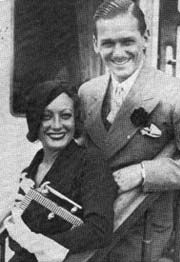 "He was always trying to prove he was good as his father," Joan says of first husband Douglas Fairbanks Jr. |
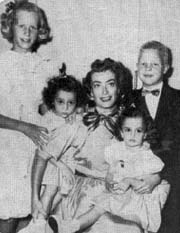 In 1950 Joan gathered her four adopted children -- from left, Christine, Cathy, Cindy and Christopher -- for a family portrait. |