 Ford Startime
"Talent Scouts"
Ford Startime
"Talent Scouts"
Broadcast
Information: February 23, 1960, on CBS. 120 mins.
Hosted by Dave Garroway, this program helped up-and-coming performers get their big break. Based on the recommendation of established celebrities, each hopeful performs a musical number or dramatic piece. Joan relates the story of how she travels frequently for Pepsi-Cola, leaving her little time for recreation. When she does have free time, she spends it in front "of a lovely, warm twenty-one inch screen!" Recently, she tuned into a local New York program called "Show of the Week," featuring Colleen Dewhurst. Joan then gives brief background info for Colleen and sets up what Colleen will be performing: the sleepwalking scene from Macbeth. Afterwards, Colleen and Joan admit they haven't met until that day's rehearsal and go backstage to talk.
32nd Annual Academy Awards
Broadcast info: 1960. Joan appeared in audience.
The Bob Hope Buick
Show
Broadcast Information: October 3, 1960, on
NBC.
Joan taped her
performance for this program on September 24, 1960.
What's My Line?
Broadcast Information: December 30, 1960, on
CBS.
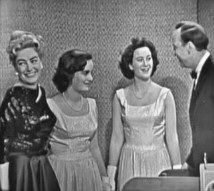
Joan was a guest and mentions her
upcoming appearance on Zane Grey Theater. She also brings out daughters Cathy
and Cindy.
 What's My
Line?
What's My
Line?
Broadcast Information: January 8, 1961, on
CBS.
 Dick Powell's Zane
Grey Theater: "One Must Die"
Dick Powell's Zane
Grey Theater: "One Must Die"
Broadcast
Information: January 12, 1961, on CBS. 30 mins.
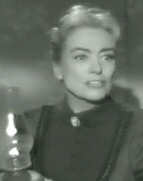
Joan plays good/bad twins "Sarah/Melanie Davidson." Also appearing in this episode were Philip Carey and Carl Benton Reid. Joan taped her performance for this program in mid-October 1960.
See the 1961 Images page for more screen shots from the show.
33rd Annual Academy Awards
Broadcast info: 1961. Joan appeared in the audience.
Miss America
Pageant
Broadcast Information: September 9, 1961, on
CBS.
Joan was a judge at this pageant held in Atlantic City.
The Foxes
Broadcast Information: September 21, 1961, on NBC. 80
mins.
Joan played
"Millicent Fox." Also appearing in this episode were John Ireland, Steve Forrest,
Colleen Dewhurst, Wesley Lau, Robert Sampson, Ellen Corby, John Baragrey, Liam
Sullivan and J.Pat O'Malley. This was the pilot episode, directed by Howard
Jaffe.
I've Got a
Secret
Broadcast Information: October 23, 1961, on
CBS.
 Dupont Show of the
Week: "The Ziegfeld Touch"
Dupont Show of the
Week: "The Ziegfeld Touch"
Broadcast
Information: October 29, 1961, on NBC. 60 mins.
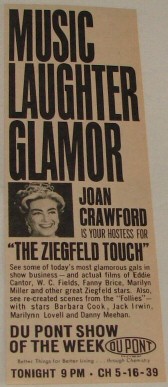
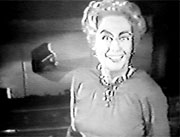
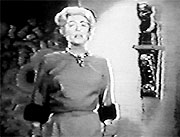
Joan narrates this program, the story of Florenz Ziegfeld (the master of the musical) and of his first wife, Anna Held, the girls he glorified and the songs he introduced. Performers taking part in this one-hour tribute include Barbara Cook, Marilynn Lovell, Danny Meehan and Jack Irwin, and the dancer Jayne Turner. Also included are film clips of performances by such Follies stars as Marilyn Miller, Fanny Brice, Eddie Cantor, Will Rogers and W.C. Fields.
Click here to see more photos from the show.
 34th Annual
Academy
Awards
34th Annual
Academy
Awards
Broadcast Information: April 9, 1962.
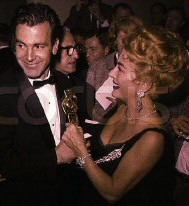
Joan presented the "Best Actor" Award to Maximilian Schell for
"Judgement at Nuremberg."
See the 1962 Images page for more photos.
Your First
Impression
Broadcast Information: July 12, 1962, on NBC.
 The Tonight
Show
The Tonight
Show
Broadcast Information: October 1, 1962, on NBC. 60
mins.
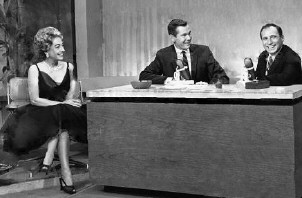
Joan is on the very first episode with host
Johnny Carson. Other guests were Rudy Vallee, Mel Brooks, and Tony Bennett. The
master reel for this episode was destroyed in a fire and only exists in an audio
format.
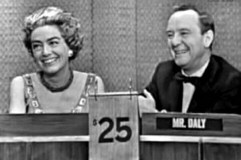 What's My
Line?
What's My
Line?
Broadcast Information: October 14, 1962, on
CBS.
On this game show, Joan promotes her appearance in What Ever Happened to Baby
Jane?
Here's Hollywood
Broadcast info: November 1962. Joan appears as herself.
Password
Broadcast
Information: December 16, 1962 on CBS.
From tvtome.com: "For one word, [host Ludden] Allen had forgotten Joan was playing the word to her partner and asked 'Jim' to give the clue. Joan commented 'Jim? I couldn't pass THAT physical!' to a huge spontaneous audience laugh." Barry Nelson was the other celebrity on the program.
Editor's note: See this site's photo page for 3 screen shots from this program, showing 2 of Joan's passwords.
Lykke og krone
Broadcast info: 1962. A Norwegian TV special on Hollywood.
The Merv Griffin
Show
Broadcast Information: March 7, 1963, on NBC.
Car 54, Where Are You?
Broadcast Information: March 17, 1963.
The 26th episode of the show's second season is titled "Joan Crawford Didn't Say No." Joan doesn't appear on the show, but is mentioned throughout, since a Bronx matchmaker has set up a local elderly deli owner to be married to Joan! Joan's picture appears prominently displayed in the matchmaker's office.
35th Annual
Academy
Awards
Broadcast Information: April 8, 1963.
Joan presented the "Best Director" award to David Lean for "Lawrence
of Arabia." Also accepted "Best Actress" award on behalf of Anne
Bancroft.
I've Got a Secret
Broadcast info: May 27, 1963, on CBS.
 Route 66: "Same
Picture, Different Frame"
Route 66: "Same
Picture, Different Frame"
Broadcast
Information: October 4, 1963, on CBS. 60 mins
Joan plays "Morgan Harper." Also appearing in this
episode were Glenn Corbett, Martin Milner, Patrick O'Neal, Tom Bosley, Charles
White, Jacqueline Courtney, Griff Evans, Arthur Anderson and George Lambert. The
director was Philip Leacock. During filming in Maine, Joan became afraid of the
crowds.
Hollywood and the Stars
Broadcast info: October 7, 1963. Clip of Joan shown in the "Sirens, Symbols and Glamour Girls" episode.
Hollywood and the Stars
Broadcast info: March 30, 1964. Clip of Joan shown in "The Oscars - Moments of Greatness: Part 1" episode.
36th Annual Academy Awards
Broadcast info: 1964. Joan presented the "Best Director" award.
The Celebrity Game
Broadcast info: September 12, 1964. Joan appeared as "Herself."
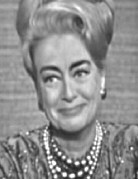 What's My
Line?
What's My
Line?
Broadcast info: December 13, 1964, on
CBS. Joan appeared as a Mystery Guest. Panel: Arlene Francis, Victor Borge, Dorothy
Kilgallen, and Bennett Cerf.
From tvtome.com: "Joan Crawford showed her funny side during the mystery guest round when she answered the panel in a faux southern accent, a la Scarlett O'Hara. She wasn't promoting any appearance in particular, but had been in town for a U.S.O. benefit."
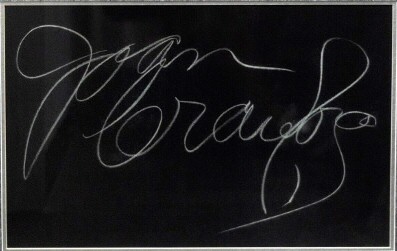 Joan's
sign-in on the 12/13/64 What's My Line? chalkboard.
In July 2020, appraised at
$20,000 and auctioned on eBay starting at $8,900.
Joan's
sign-in on the 12/13/64 What's My Line? chalkboard.
In July 2020, appraised at
$20,000 and auctioned on eBay starting at $8,900.
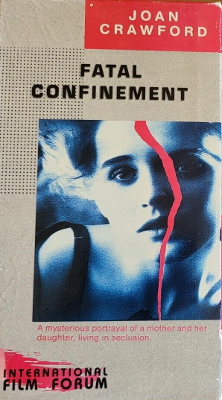
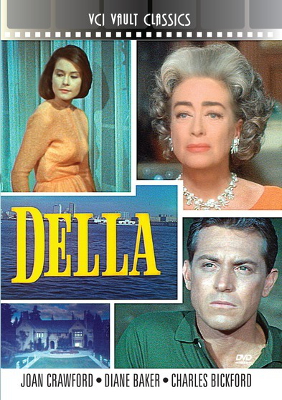
Broadcast
Information: 8/8/1964. Originally 60 minutes, broadcast as NBC
pilot "Royal
Bay." Later released as 68-minute feature "Fatal
Confinement." Co-stars Charles Bickford, Diane
Baker, Paul Burke. Joan
plays "Della Chappell."
Director: Robert Gist. Executive Producer and Writer: Richard Alan Simons.
VHS release: 1988 (International Film Forum)
DVD release: 2012 (VCI)
Notes: Shot from 10/11/63 to 10/30/63.
See the 1964 Photos page for more photos.
Hal Erickson, All Movie Guide:
Fatal Confinement originated as an hour-long TV pilot film titled Royal Bay. Joan Crawford stars as a reclusive woman living with her daughter in a California coastal town. A business firm, headed by Charles Bickford [Editor note: Bickford does not play the business head; he plays an old flame of Joan's, now a retired lawyer, with an aggressive lawyer son], wants to buy her property. The sudden intrusion of the outside world causes personal and emotional problems for Crawford and her daughter. When Royal Bay failed to sell as a series, it was rechristened Fatal Confinement and expanded to 70 minutes for theatrical showings.
Our Reviews:
Stephanie Jones (site editor) (December 2024):
RatinRating:  - 1/2 of
5
- 1/2 of
5
Originally a pilot for a proposed-but-rejected NBC series, Royal Bay, "Della" was later released theatrically (with a few cuts restored) in 1965, then sold to TV for late-night syndicated viewing.
Oh, but it's so much better than mere TV! Sure, the sets are "TV-cheap," and the cuts are "TV," and the writing is often TV-shorthand...but THE Joan Crawford is pure movie-star here! The looks (both sartorial and facial-expressions) are thrilling to behold, perhaps much-moreso because of the relatively non-expressive surroundings.
A brief synopsis: Joan's "Della Chappell" is a local wealthy recluse who owns some very valuable land in Royal Bay that town businesspeople are anxious to get their hands on so they can make a multi-million-dollar deal with "Delta Space Industries." City leaders turn to a now-retired former-power-lawyer Bernard Stafford (veteran actor Charles Bickford) to try to convince Della to sell her land. Not willing to put the squeeze on her himself ("It's her land"), Bernard turns the case over to his overly aggressive son Barney Stafford (Paul Burke), who threatens to increase Della's taxes 5-fold if she won't cave. Barney quickly finagles his way into meeting with the recluse---at 2am that night!---and then discovers that she has a lovely daughter ("Jenny," played by Diane Baker), who might or might not be a prisoner in the home...
The business/personal dichotomy is interesting here. Kinda like Johnny Guitar, where the townspeople are actually at odds with Vienna not just because Mercedes McCambridge tells them so, but because they want to protect their grazing land from Vienna's selling her land to the government for train tracks---oh, and they also don't like the outlaws that Vienna supports. Here, the hotshot Barney is initially fired up about Della's "selfish" keeping of her own land, but then goes ga-ga for her moon-child daughter, who hints and hints and hints that her mother is keeping her a prisoner and "hates people." But, alas, 'tis the early/mid-60s season of loonies in films, and this daughter is nuts (as Diane Baker also was in the previous year's Strait-Jacket). For at one point, Jenny says to Barney:
You're too young for her.
Who?
Who
do you think?
After Jenny runs off at the first break of dawn, Barney goes to sleep---only to have Jenny creep into his bedroom and light a cig for him. But he insists on opening the blinds to daylight, so Jenny freaks out and again runs off...Enter Della:
How long was she here?
Don't get any wrong ideas.
What a fine, stunning animal you are... Well, that's ALL you are, all you'll ever be, and all you'll ever UNDERSTAND! [spoken to Barney's bare-chested self as she first covers his mouth and then slaps him across it]
Whoa!
Early/mid '60s wasn't quite the height of Flower Power just yet, but there's plenty of hippy-dippy stuff as a fore-runner out of Cali: Della and daughter apparently worship some statues out in their garden: The Moon Goddess, and the Sun God, whom they feed flowers... Daughter Jenny's only friend is apparently the moon... And Barney's so confused!
Contributing
to the psycho-sexual oddness is this scene where Della brushes Jenny's
hair in front of the mirror (a mirror that also reflects Joan's
gorgeous back):
Della: We
need each other, Jenny. We're all we have.
Jenny: Please don't touch me... I'm sick of this house and I'm sick of you!
Della: Do you want me to go away, Jenny, and leave you alone...
Jenny [freaking out, hugging her]: No, please...
Della: We musn't hurt each other, ever, ever...
Aside from the trying-way-too-hard semi-freaky stuff, there's actually a solid backbone behind the whole "picture": The narration of Charles Bickford as the father, Bernard Stafford. He initially tells us about the town of Royal Bay, how he grew up there and left at one point, how his four sons have all either stayed or left. (In this case, son Barney was the hot-head who went off to make his way in the world, only to return.) And father Bernard has also, apparently, also once been involved with Della herself when they were both younger. As he closes, when Barney asks him if he had ever been in love with Della:
Family Secret, Sonny Boy... Not the first secret in Royal Bay and certainly not the last.
Great lead-in for a series that never was!
Series or no, the best part of this whole thing is Joan. Her coiffures and carriage and clothing are all jaw-dropping and beautiful, but more importantly, she absolutely DELIVERS in every one of her scenes. She's simultaneously affectionate and brusque with her daughter, simultaneously polite and brusque with the suitor. And, in this oddest of forums, she has some of her best lines ever:
Della upon entering town for the first time in 15 years, to befuddled secretary upon giving her name:
Do you want me to spell it?
Della upon meeting with her former lover (father of current nemesis):
Della: I made a big mistake.
Father:
You made a big mistake a long time ago.
Della:
I mean about your son.
Father: Barney's a tough fella.
Della: So am I.
Oh, and how can we ignore the theme of "insane, ungrateful daughter" acting choices that Joan was now making? (Diane Baker as two of them, in Strait-Jacket and here, in only the past year alone!)
Ed Guinea (February 2009):
"Della" was unfortunately a missed opportunity for Joan Crawford. You
may ask why as she was in the TV film and played the central character of the story. "Della" was packaged as a TV pilot
titled "Royal Bay" in 1964 by Four-Star and Revue Television to star
TV veteran Paul Burke ("Naked City") as a lawyer and movie veteran
Charles Bickford ("The Song of Bernadette," "Duel In The Sun," among
others) as his cantankerous, righteous father. The program was to be
produced on location weekly and was seeking a commitment for 30
weeks. To ensure success, the producers needed a sure bet and the
concept grew into a scant feature-length pilot when director Robert
Gist secured the services of superstar Joan Crawford as guest star.
The episode was to be labelled "Della," after the character that was
offered to Miss Crawford.
Royal Bay is a California coastal town of means. Throughout the film, Joan Crawford commands attention as Della Chappel. She plays a
reclusive woman of wealth, consumed by power and dedicated to protecting her daughter's future from apparent harm. Her home is her
castle and her property is her daughter's future. Devoid of emotion,
Della displays no smile, no laughter, no love except for her primary
focus, Jenny - her daughter, who is battling an unusually fatal eye
disease. There is no soft side to her, only the hint of one at the
closure of the film as she realizes she has lost her fight to keep
what was hers. Crawford's character holds the town of Royal Bay
hostage to her will and her demands politically. This cloud of destiny hampers the towns growth and neglects necessary tax
incentives. Lawyer Burke asks to meet Della at her home to discuss
the possibilty of buying some - or all - of her vast holdings. Now
the dark underside: she agrees to meet him after midnight in the dead
of night. This weird quirk offers a clue to Della's reasons for being
difficult to bargain with. When Burke arrives, it is a sudden intrusion into the Chappel domain and one that unsettles the
unusually introverted Jenny. Jenny has never met a young man her age
and is distraught over her feelings. The domineering Della states
that her property is likely to remain so. Burke says he will fight
her decision using the villagers as a rebellious contingent.
Like Moses coming down from the mountain, frustration edges the reclusive widow into downtown Royal Bay the next day to pay a
personal visit on senior law partner Bickford, a man of her age and
an old acquaintance. She connives to discredit Burke and bribe Bickford's son away from her idyllic privacy. Despite this,
Burke engineers his return to Chappel House and Jenny. The dramatic
exchanges between Crawford and Burke generate heightened dramatic
tension and these are the highlights of the film. The basis of the
struggle is Jenny, not the property but Della blames the sparks on
the land issues to throw off suspicion. The secret to Della's commitment is revealed and in defiance of the mother's pressure,
Jenny leaves the house with immediate disregard for her health and
the "love" of a man.
Crawford is enthusiastic and compelling as Della Chappel. Force pours from her body with her rich voice and her vigorous strength. Diane
Baker is Jenny, and plays her third role opposite star Crawford.
Baker is gentle and subtle with a childlike quality that we don't yet
understand.
The strength of many great films lie with its character actor co-stars and this is no exception. The great Charles Bickford, built
like a brick warehouse and wearing his trademark mop on his head,
played his role with humility and empathy for the characters. Otto
Kruger provided strong support in his minor role. Paul Burke is
bland, yet displays charisma enough to propel him further into stardom, but in his role he was harsh, demanding and decisive. He
gives the impression he is corrupt and eager to buy the Chappel real
estate to further his own initiatives. He wanted what he wanted and
he was determined to get it. Of course, one look at Baker and Burke
just might change his mind. 1950's star Richard Carlson plays a
brother in his ample sized role as he tries to talk Burke out of his
pursuit of the Chappel real estate. The pilot was directed by Crawford friend (she appears on The David Frost Show with him) Robert
Gist.
Now back to why this was a missed opportunity for Joan Crawford: 1964 was a banner year for the star and Pepsi executive. She had a movie
in the can (the successful "Strait-Jacket"), the scripts
for "Hush...Hush Sweet Charlotte" and "Sex and Mrs. Macado" on her
desk, plus plans for a new book and an extended tour for the ever-growing Pepsi-Cola firm during their aggressive "For Those Who Think
Young" campaign in the summer months. For a sixty year old actress,
this is a strenuous schedule, but Crawford drew strength from extensive work and fan-based activity. "Della" was a misfire for her
and a waste of time and energy because no one ever saw it. The TV
pilot was rejected, unaired and scrapped with the footage released
as "Della" to TV stations three years later as part of a Universal
Pictures syndicated film package, with "Della" at the bottom of the
list and showing on television at 1AM in the morning. What had started out as a year of possibly great achievement ended up as a
less-than-stellar year.
As a sidenote, "Della" fell into the public domain and was rescued 16
years ago and released on video with the curious box title "Fatal
Confinement." The title on the film remains "Della."
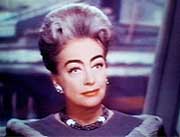
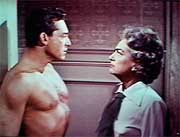
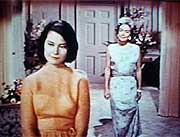
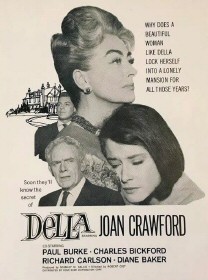
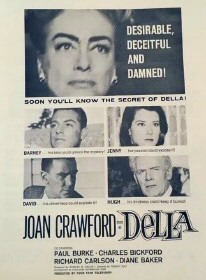
Click on either ad below to see larger versions and other Della promo material.
The Tonight
Show
Broadcast Information: February 16, 1965, on NBC. 60
mins.
37th Annual
Academy
Awards
Broadcast Information: April 5, 1965.
Joan presented the "Best Director" award to George Cukor for "My Fair
Lady."
The Tonight
Show
Broadcast Information: May 14, 1965, on NBC. 60
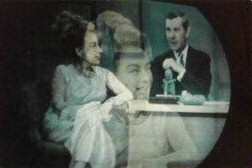
mins. [Editor's note on photos: Joan appeared
on The Tonight Show 3 times in 1965. I couldn't determine
which appearance in particular these shots taken by a fan of his
television screen came from.]
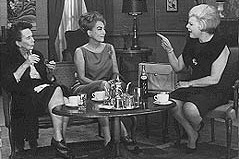 Girl
Talk
Girl
Talk
Broadcast info: May 14, 1965.
The Tonight Show
Broadcast info: May 22, 1965, on NBC. 60 mins. (It seems odd that she was on the show again only a week after her last appearance there. But the IMDb lists this date.)
The Merv Griffin Show
Broadcast info: July 19, 1965.
ABC's Nightlife
Broadcast info: July 20, 1965.
Miss America
Pageant
Broadcast Information: September 11, 1965, on
CBS.
Joan was a judge at this pageant held in Atlantic City.
 Emmy
Awards
Emmy
Awards
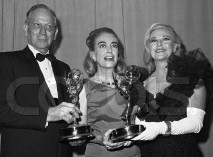
Broadcast Information: September 12, 1965, on
NBC.
Joan was on hand to accept awards for
Alfred Lunt and Lynn Fontanne's performances in the Hallmark Hall of Fame's
TV special "The Magnificent Yankee."
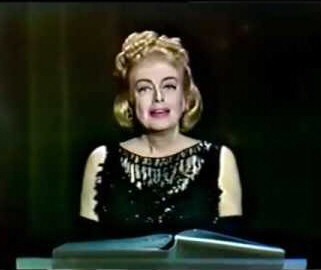
Broadcast Information: October 9, 1965, on ABC. 60 minutes.
The show was in rehearsals from 9/22 to 9/24, and was pre-recorded on 9/24. Joan received $7500 for her appearance, plus a $2500 hostess fee. Page of contract. More photos from the show.
Guests
included singer Jack Jones (who performed "Just Yesterday" and "More"
and a duet, "Call Me," with Joanie Summers), Joanie Summers ("Till
There Was You"), Allen and Rossi (comedy team), Steve Rossi ("Al Di
La" and "Battle Hymn of the Republic"), Godfrey Cambridge (comic),
Lily Yokoi (Japanese bicyclist), The Rodos (West German acrobats), and Stebbings'
Boxers (comic dogs from England). Joan read "A Prayer for Little Children"
on this episode.
The Merv Griffin Show.
Broadcast info: November 10, 1965.
To Tell the Truth
Broadcast info: November 10, 1965. Joan appeared as "Herself."
The Merv Griffin Show
Broadcast info: November 16, 1965.
Every Day is
Mother's Day
Broadcast Information: Joan plays "Diane Miles." This was an un-filmed program
by Hope Pictures, Inc. Joan signed the contract for this program on December 7,
1965. She was to be paid $7,500 for the 10-day shoot, which was to begin on
January 4, 1966.
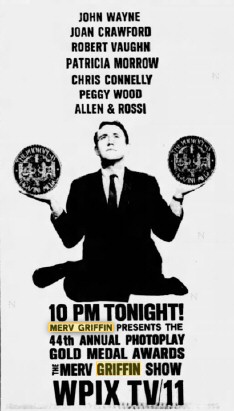
Broadcast info: March 3, 1966. Griffin special: 44th Annual Photoplay Gold Medal Awards. More info: Classic TV Archive
44th Annual Photoplay Awards presented to Joan Crawford and John Wayne.
Robert Vaughn and Dorothy Malone voted Most Popular actor and actress.
Patricia Morrow, Peggy Wood, and Chris Connelly voted Most Promising.
Ely Landau accepts special award for the film "The Pawnbroker."
Movie prize to "The Sound of Music."
Also appearing: Marty Allen and Steve Rossi.
38th Annual Academy Awards
Broadcast info: 1966. Joan appeared in the audience.
The Merv Griffin Show
Broadcast info: April 5, 1966.
Girl
Talk
Broadcast Information: April 20, 1966.
Joan and Anita Colby are the guests. Show hosted by Virginia Graham.
What's My Line?
Broadcast Information: July 3, 1966, on CBS. Joan appeared
as a Mystery Guest. Panel: Arlene Francis, Tony Randall, Suzy Knickerbocker, Bennett Cerf.
From tvtome.com: "Joan Crawford, as always, was greeted by wild applause from the audience. She then stumped the panel, before Bennett guessed her identity after the last card was flipped. He asked if she sipped on Pepsi. Joan seemed to have fun tonight, and was relaxed and cheerful. She even did a spot-on imitation of Judy Holliday! She also mentioned her former husband, Franchot Tone, as part of a pun when Mr. Daly said, in reference to her disguised voice, "that tone comes through." Joan then said, "Franchot Tone?" When the pun dawned on Mr. Daly, he remarked, "Oh you! Don't be like Bennett, Joan, pleeeease! Heavenly days!" It was a cute moment! Crawford and Tone were married from 1935 until their divorce in 1939.
This was a pretty rough night for the panel. ...They were totally stumped by the second contestant as well as mystery guest Joan Crawford. After the final card was flipped, Bennett did guess Joan Crawford, but it was too late! Miss Crawford was able to stump the panel by using different tones for her voice, and this trick threw them off completely. At one point, Bennett asked Joan if two mystery guests were present. That showed how great an actress she was, even at the tail end of her career. She got big laughs and applause when Tony asked, "Are you a boy?" and she stood up to show off her womanly curves. During the post game chat, John mentioned that Joan is a vice-president of the USO, and heads up the women's activities for USO...."
Girl Talk
Broadcast info: August 28, 1966.
 Crusade
'67
Crusade
'67
Broadcast Information: 1967
Joan speaks on behalf of the American Cancer Society and recites
the poem "Dirge Without Music," by Edna St. Vincent Millay.
Dirge Without Music
Edna St. Vincent Millay
I am not resigned to the shutting away of loving hearts in the hard ground.
So it is, and so it will be, for so it has been, time out of mind:
Into the darkness they go, the wise and the lovely. Crowned
With lilies and with laurel they go; but I am not resigned.
Lovers and thinkers, into the earth with you.
Be one with the dull, the indiscriminate dust.
A fragment of what you felt, of what you knew,
A formula, a phrase remains, --- but the best is lost.
The answers quick & keen, the honest look, the laughter, the love,
They are gone. They have gone to feed the roses. Elegant and curled
Is the blossom. Fragrant is the blossom. I know. But I do not approve.
More precious was the light in your eyes than all the roses in the world.
Down, down, down into the darkness of the grave
Gently they go, the beautiful, the tender, the kind;
Quietly they go, the intelligent, the witty, the brave.
I know. But I do not approve. And I am not resigned.
Girl Talk
Broadcast info: February 8, 1967.
 The Man from
U.N.C.L.E: "The Five Daughters Affair"
The Man from
U.N.C.L.E: "The Five Daughters Affair"
Broadcast Information: March 31 and April 7, 1967, on
NBC, in Season 3 of the show. (Filmed: February 17, 20-24, 27-28, March 1-3, 6-9, 1967)
Directed by Barry Shear, produced by
MGM Television. Released in UK as feature film "The Karate Killers."
Joan plays "Amanda True."
Plot: U.N.C.L.E. agents Napoleon Solo and Illya Kuryakin travel around the globe in an effort to track down a secret formula that was divided into four parts and left by a dying scientist with his four daughters, all of whom live in different countries. Evil THRUSH agent Randolph, who has killed his wife, played by Joan, also wants the formula, and is aided by his karate-chopping henchmen.
39th Annual Academy Awards
Broadcast info: 1967. Joan appeared in the audience.
Girl Talk
Broadcast info: April 7, 1967.
 Hollywood
Palace
Hollywood
Palace
Broadcast Information: April
22, 1967, on ABC. 60 minutes.
This episode (# 29) was taped on February 10, 1967. Joan has 7 wardrobe changes throughout the program. The executive producer was Nicholas Vanoff; the producer was William O. Harbach; the director was Grey Lockwood; and it was written by Joe Bigelow, Bernie Orenstein and Jay Burton.
Joan opens the program with a quick joke about Pepsi-Cola and then welcomes Halasis (an acrobatic act) followed by the band Cyrkle, who sing "Impressions." Next up is a comedy sketch titled "The Warden Gets a Word In" with Joan and Tim Conway. Joan plays a reporter interviewing Warden Conway about the lackluster security at his prison. Afterwards, The Flying Cavarettas (young trapeze artists) perform and then Nancy Ames sings a song. Magician Ralph Adams does some magic tricks. Julius LaRosa sings "Look Me Over." Finally, Joan performs a dramatic reading written by Milton Geiger called "The Dreamer" and closes the show.
The Merv Griffin
Show
Broadcast Information: April 26, 1967
Girl
Talk
Broadcast
Information: April 27, 1967.
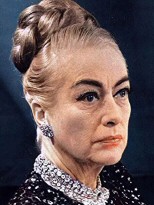 A Film
Profile: Joan Crawford
A Film
Profile: Joan Crawford
Broadcast
Information: June 29, 1967, on BBC. 30 mins.
BBC
interview with Joan filmed in 1966 on the set of "Berserk!" She discusses
her long career and makes comments on clips of her films that are shown. She reminisces
about working with John Barrymore, Clark Gable, Bette Davis. She talks about how
Barrymore was rude to her and about how Confidential magazine tried to do a story
on her troubles with Christina. She also relates stories about George Cukor and
Elizabeth Taylor and speaks of Greta Garbo with great fondness.
The Merv Griffin
Show
Broadcast Information: June 28, 1967
The Merv Griffin
Show
Broadcast Information: September 11, 1967
House Party
Broadcast info: January 22, 1968.
The Joey Bishop Show
Broadcast info: January 26, 1968.
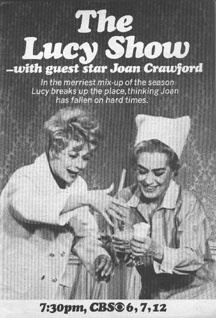
 The Lucy
Show: "Lucy and the Lost Star"
The Lucy
Show: "Lucy and the Lost Star"
Broadcast Information: February 26, 1968, on
CBS. 30 minutes.
Plot: When Lucy's car breaks down, she goes to a nearby home to phone for a mechanic. The home belongs to Joan Crawford, who is in the process of cleaning. Lucy mistakenly believes Joan has lost all of her money and decides to do what she can to help the "ailing" star.
Visit the 1968 Images page for more photos from the show.
The Merv Griffin
Show
Broadcast Information: February 27, 1968
Girl Talk
Broadcast info: April 12, 1968
The Merv Griffin
Show
Broadcast Information: May 6, 1968
The Merv Griffin
Show
Broadcast Information: September 17, 1968
The Mike Douglas
Show
Broadcast Information: September 23 - 27, 1968.
Joan appeared on one of this week's shows with Christina to promote the new Films of Joan Crawford book. After the show's taping on
9/18, Joan was informed that
Franchot Tone had passed away.

Broadcast Information: Friday,
October 15; Monday, October 28; Wednesday, October 30; and Thursday,
October 31, 1968, on
CBS. Each episode was 30 mins.
Joan played "Joan Borman Kane," substituting for her sick daughter Christina. Joan was paid $585 for her work, which she gave to her hairdresser. (Soap Opera Encyclopedia)
See the 1968 Images page for other photos from the show.
From "Joan Crawford: A Biography" by Bob Thomas:
Joan's adopted daughter Christina was hospitalized for an abdominal operation and could not perform. Joan contacted Gloria Monty, director and offered to step in for her. Gloria accepted, delighting Fred Silverman, chief of daytime programming at CBS. He cleared the use of a studio for rehearsals. On the night before rehearsal, Gloria visited Joan at her apartment; Joan was excited about the role she was to play, comparing it to "Mildred Pierce". Joan asked that no publicity be issued for her appearance but the network couldn't resist the temptation. On the first day of rehearsals, Joan was greeted by the press which added to her nervousness. During rehearsal, Silverman visited the set and thanked Joan for her help. On the day of taping, Joan brought a Pepsi-Cola cooler of vodka. Monty attempted to keep her away from the alcohol during taping but Joan's performance was poor. Afterwards, the director pieced together what he could of the performance into the series. When asked to comment, Christina said "I couldn't exactly jump and down in bed about it, but it was fantastic she would care that much."
Girl Talk
Broadcast info: November 1, 1969.
The Merv Griffin Show
Broadcast info: November 4, 1969.
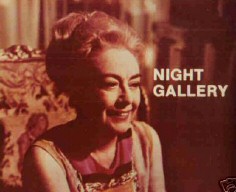 Night
Gallery
Night
Gallery
Broadcast Information: November 8, 1969, on
NBC. 30 minutes.
Pilot episode for series. Joan plays "Claudia Menlo" in a segment (the second of three) called "Eyes." Steven Spielberg makes his directorial debut here. Barry Sullivan and Tom Bosley co-star.
Click here to see more photos from the show.
Click here to read the "Eyes" chapter of the book Rod Serling's Night Gallery: An After-Hours Tour (by Skelton and Benson; Syracuse University Press, 1999).
Plot: Claudia Menlo is a rich recluse who lives alone in an apartment building on 5th Avenue in New York City. She has been blind since birth and blackmails her physician into performing an illegal operation on her that will give her the healthy optic nerves from a man desperate for cash, despite the fact that she will only be able to see for 12 hours. On the night of the operation, Claudia's joy at having her eyesight returned is destroyed when the city experiences a blackout.
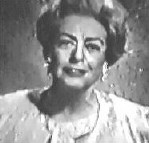 Garbo
Garbo
Broadcast
Information: November 6, 1969,
on BBC; November 8, 1969, on PBS. 65 mins. Produced by Fred
Burnley; written by later Garbo (and Crawford) biographer Alexander Walker.
Filmed in the summer of '69, Joan narrated this documentary about legendary screen actress
Greta Garbo.