The Best of Everything
Encyclopedia Entry • Films Main
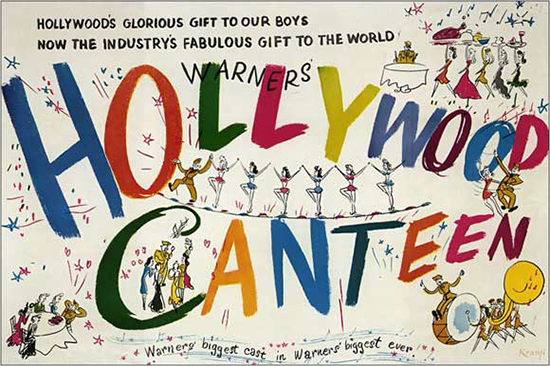
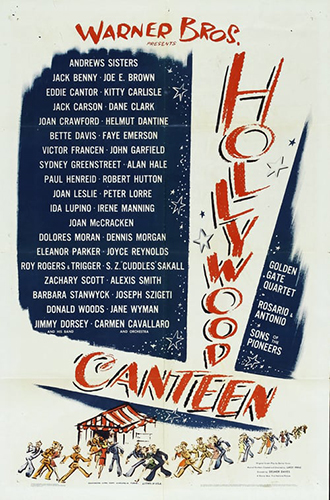
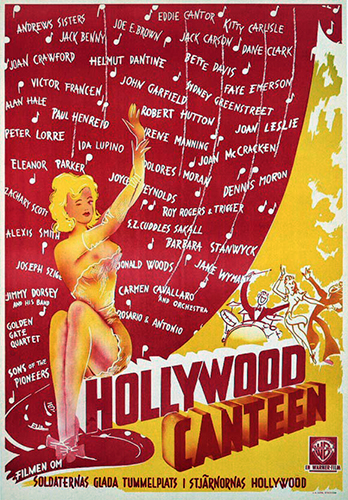
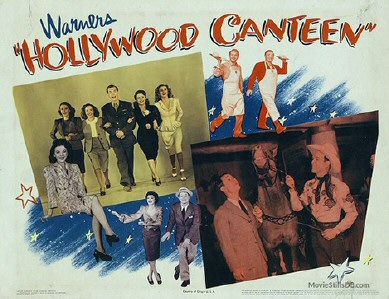
Hollywood Canteen
1944
Critics' Reviews • Our Reviews • Movie Posters • Lobby Cards • Misc. Images
Click here to see photos from the film.
US general release: 12/31/44.
VHS release: 7/24/91. DVD release: 11/11/2008.
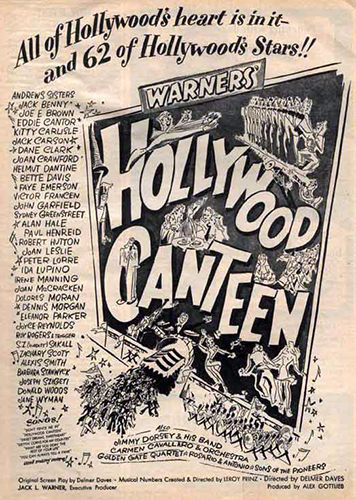
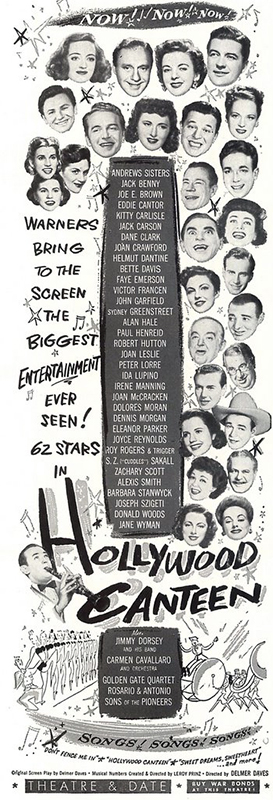
Cast: Joan Leslie, Robert Hutton, Dane Clark, Janis Paige. Guest stars include: the Andrews Sisters, Jack Benny, Joe E. Brown, Eddie Cantor, Kitty Carlisle, Jack Carson, Joan Crawford, Bette Davis, John Garfield, Sydney Greenstreet, Paul Henreid, Peter Lorre, Ida Lupino, Irene Manning, Joan McCracken, Dennis Morgan, Eleanor Parker, Roy Rogers and Trigger, Barbara Stanwyck, Jane Wyman.
Credits: Original Screenplay: Delmer Daves. Producer: Alex Gottlieb. Director: Delmer Daves. Camera: Bert Glennon. Art Director: Leo Kuter. Musical Director: Leo F. Forbstein. Musical Numbers: LeRoy Prinz. Music Adaptation: Ray Heindorf. Editor: Christian Nyby.
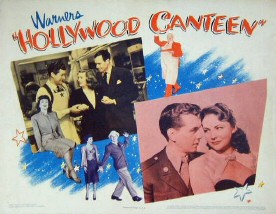
Plot Summary: The West Coast's answer to Broadway's Stage Door Canteen, the Hollywood Canteen was created as a GI morale-booster by film stars Bette Davis and John Garfield. The Canteen was established so that Our Boys on leave in Tinseltown could have a good time with good food and good dancing -- and, as a bonus, rub shoulders with their favorite movie personalities, who functioned as waiters, chefs, busboys and dancing partners. Since the 1944 all-star flick Hollywood Canteen was produced by Warner Bros., it was only to be expected that the celebrities seen herein would consist mostly of Warner Bros. contract players. The frail plot concerns a soldier on medical leave (played by Robert Hutton) who falls in love with lovely leading lady Joan Leslie (played by Joan Leslie) while visiting the Canteen. Bette Davis and John Garfield are on hand to emcee the Canteen's variety acts, and to act as cupids for the Hutton/Leslie romance. The "supporting cast" includes the likes of The Andrews Sisters, Jack Benny, Joe E. Brown, Eddie Cantor, Sidney Greenstreet, Paul Henreid, Peter Lorre, Ida Lupino, Dennis Morgan, Roy Rogers, S.Z. Sakall, Barbara Stanwyck, and the Jimmy Dorsey and Carmen Cavallaro musical aggregations. Virtually everyone involved donated their salaries to the Canteen fund--even Jack Benny. As with most of these patriotic wartime star rallies, the results are a mixed bag: the best sequences include Benny's violin "duel" with Joseph Szigeti and Roy Rogers and the Sons of the Pioneers introducing Cole Porter's "Don't Fence Me In." Hollywood Canteen won three Oscar nominations, more for its good intentions than its inherent excellence. Still, don't pass up the opportunity when this "movie star salad" shows up on cable TV. ~ Hal Erickson, All Movie Guide
Awards: 1945 Oscar nominations: Best Music, Original Song: "Sweet Dreams, Sweetheart" (music, M.K. Jerome; lyrics, Ted Koehler). Best Music, Scoring of a Musical Picture: Ray Heindorf. Best Sound, Recording: Nathan Levinson.
|
Bosley Crowther in the New York Times December 16, 1944
If it's quantity you want in entertainment — entertainment, that is, of the sort that is generally thrown together in an "all-star benefit show"—then the Warners' grotesquely laden "Hollywood Canteen" is for you. As a matter of fact, you'll probably love it if you're frankly susceptible to "names." For this two-hour-and-four-minute catch-all, which came to the Strand yesterday, gives out with short snatches of diversion (and some not so short) by virtually every player on the Warner lot. It has every sort of thing, from Eddie Cantor and Nora Martin singing the so-called "Baby Song" to Joseph Szigeti and Jack Benny doing a violin travesty of "Souvenir." It also has Roy Rogers, borrowed from Republic, singing "Don't Fence Me In," and the Andrews Sisters, borrowed from Universal, singing "Gettin' Corns for My Country," a fitting song. But if it's quality you want in your entertainment and just a slight touch of dramatic grace, beware the elaborate hocus-pocus of "Hollywood Canteen." There is not a fairly distinguished song or turn of dialogue in the show, and the story which binds the "acts" together is an embarrassingly affected affair. It is the story of a South Pacific veteran who goes to the Hollywood Canteen, that famous caravansari for service men, and meets his dream girl, Joan Leslie. It's a recount of his speechless admiration every time he sees a famous movie star and of his almost unbearable exuberance when Miss Leslie actually bends to his romance. To be perfectly blunt about it, this film seems a most distasteful show of Hollywood's sense of its importance and what its people are doing for "the boys." Throughout it plainly points benignly to the wonder of "big shots" entertaining little ones and it stretches propriety to the limit in demonstrating how human the stars are. There is no question that the Hollywood Canteen has been a most welcome haven to service men and that it has done a lot to help them. But this advertisement seems a most ungracious boast. Comparison of this film with "Stage Door Canteen," a previous star show, is inevitable, since both of them follow the same pattern—and were, in fact, both written by the same man. It is notable that the former was much more modest in its account of show folk devoting themselves to service men and much more realistic in its development of a romance. It is also much more distinguished in the quality of the entertainment put out. In the present film, Miss Leslie plays herself with elaborate sweetness and Robert Hutton plays her soldier-courtier in the manner of a musical comedy juvenile. Dane Clark is broad and obvious as an ungrammatical sergeant from — yes, Brooklyn—and thirty or forty other people play themselves (see cast above). In a more or less introductory comment, Joe E. Brown describes Hollywood Canteen: "This place is just a great big juke box." So is the film. It is that full of stuff.
Kate Cameron in the New York Daily News (1944): It is an elaborate show, but it is presented by author-director Delmer Daves in such a patronizing manner as to make one blush for its complete lack of reserve in singing the praises of Hollywood. It boasts screen personages unashamedly and without a flicker of humor. The players in the picture seem constantly awed by their own gracious and hospitable entertainment of the servicemen.
Variety (1944): There isn't a marquee big enough to hold all the names in this one, so how can it miss? Besides, it's basically solid. it has story, cohesion, and heart. That's not a bad parlay, either.
Doug Pratt on dvdlaser.com: One of the best of the 'Canteen' movies, the film's surreal parade of stars, portraying touchy-feely versions of themselves, never ceases to be fascinating, and the movie's pace, musical numbers, and contrived dramatic framing device are breezier than most. Our favorite moment is a well-written interlude featuring Sydney Greenstreet and Peter Lorre ("He didn't trust us, Peter." "Oh, and we are such gentle people." Greenstreet raises his eyebrows, "Are we?"), but others will find giddier pleasures in the specter of Joan Crawford, Bette Davis and John Garfield happily, and indeed enthusiastically, rubbing elbows with the ordinary, hardworking, uniformed common folk.
threemoviebuffs.com (2010): ...What passes as a plot is really just an excuse to get inside the club for a series of movie star cameos. Robert Hutton and Dane Clark play two GI’s on medical leave from the South Pacific. Hutton plays Slim a shy guy with a huge crush on Joan Leslie. Clark is Sergeant Nowland a loudmouth from Brooklyn and Slim’s best pal.
The story is any soldier or sailor’s shore leave fantasy come to life. Slim gets to experience Hollywood by rubbing shoulders with many famous Warners' stars (they originally approached Paramount, MGM and other studios about contributing stars for cameos but were turned down). He is crowned the one millionth service member to enter the Canteen and wins a date with Joan Leslie, a hotel suite for the night and the use of a fancy car.
The list of stars is quite impressive; see cast list above. The best ones are Ida Lupino and Joan Crawford who both have amusing scenes with Clark. Sydney Greenstreet and Peter Lorre have a funny moment where they scare an overly exuberant soldier who has been dancing with Patty Andrews and Jack Benny does one of his silly violin routines. Full review.
|
If you've seen Hollywood Canteen and would like to share your review here, please e-mail me. Include a photo or avatar of yourself, a star-rating (with 5 stars the best), plus any of your favorite lines from the film.
|
Rating: Hollywood Canteen (1944) tells the story of the eponymous club for enlisted men and women formed in the aftermath of America's entry into World War 2. While the movie - as well as the contemporary press - focused on the contributions of actors and actresses in its founding, the movie does highlight the important contributions of the craftspeople behind the camera - and their guilds - in bringing the Hollywood Canteen to fruition. To tell the story of the Hollywood Canteen, write Delmer Daves - who is also the director - employs two actors, Robert Hutton (Slim) and Dane Clark (Sgt. Nowland). They play GIs wounded in the Pacific Theater who come home on a hospital ship. They have a few days' leave in LA before heading off to San Francisco for further assignment. Slim's girl back home stopped writing to him, so he has transferred his affections to starlet Joan Leslie (whom you may remember playing Jimmy Cagney's sister, Mary, in 1942's Yankee Doodle Dandy). Since this is Hollywood, Slim gets to meet Ms. Leslie on his first night at the Hollywood Canteen. He returns the next night and, as coincidence still would have it, is the canteen's Millionth Customer, which wins him a bunch of smooches from admiring actresses, use of a car for the weekend, and a date with Joan Leslie. (What are the odds!) His buddy, Sgt. Nowland, is having much less luck with the ladies, and indeed swears off women for the duration. However, his luck turns as he next dances with our heroine, none other than Ms. Joan Crawford! Joan's cameo - her initial role for a new studio, Warner Brothers - is about halfway through the movie, which clocks in at a little over 2 hours. After a few steps across the ballroom, Nowland inquires of his dance partner as to whether "Anybody ever tell you you look like Joan Crawford?" to which she replies, "Why yes, my husband has." (Given the time this was filmed, that would be Philip Terry.) After a little more dancing, JC lets him in on a secret "Don't look now, but, I AM Joan Crawford," at which point our hero faints. (Can't say I blame him; I would have done the same thing!) Joan made 4 similar movies in her career. In chronological order: The Hollywood Revue of 1929 (1929), The Stolen Jools (1931), this movie, and 1949's It's a Great Feeling. But in my estimation, Canteen is less entertaining than Joan's other similar efforts. Canteen is more like Revue than anything else Joan did. However, Revue was a true variety show with an MC introducing the segments and no unifying plot; in Canteen, the adventures of Slim and Sgt. Nowland provide a thin thread to string together the song and dance scenes and the cameos. The Stolen Jools has a similarly thin story line, but it's only, appropriately, 20 minutes long. IAGF is a fun movie and Joan's poking fun at her own image is hilarious. And, although Revue also clocks in at 2+ hours long, Joan's bit is only 6 minutes in, and it occupies an important place in the Joan filmography - her first talking role - making it a definite must-see for Joan fans. There are a few amusing bits here in Canteen. For example, I enjoyed the Roy Rogers and Trigger rendition of "Don't Fence Me In." (I wonder if Mr. Rogers realized that Joan's 1931 movie, Montana Moon, introduced the concept of the singing cowboy. Hope he thanked her!) Old school vaudeville pros like Eddie Cantor and Joe E. Brown seem to be in their element in Canteen. Jack Benny - who was one of the MCs in Joan's Hollywood Revue of 1929 - appears here, as well, although his bit goes on a bit too long. (And in other Joan-centric news, Robert Hutton, who plays GI Slim, has the distinction of being in Trog [1970], Joan's last big screen effort.) As mentioned above, Delmer Daves had what I am guessing were the thankless jobs of writing and directing this film. I don't know much about Daves apart from the fact that he appears several times in the diary of one of my other favorite classic Hollywood divas, Kay Francis. Ms. Francis - the queen of the lot at WB before Bette Davis came along - had a long string of lovers and gave Delmer high marks for his performances. Not sure his screenplay/directing performance here is up to the same standard, but I am also not sure how much can be done with such a "cast of thousands"-type movie. I gave Revue 2 stars. I gave It's a Great Feeling 3 stars. This is closer to the former, so 2 stars it is. And that's being generous.
Rating:
In late June 1943, Joan left MGM after 18 years. Two days later, she was put on the Warners payroll with a 6-year contract for a 3-picture, $500,000 deal. (Joan would stay under contract at Warners until 1952.)
Hollywood Canteen, a WW II "Support the troops!" propaganda picture, was the first film Joan made for her new studio, although she only appears for less than 2 minutes, along with dozens of other top Warners stars. The film is based on the goings-on at the real-life Hollywood Canteen, founded by Bette Davis and John Garfield and located at 1451 Cahuenga Blvd in Hollywood from 1942 through 1945.
To get right to the Joan-gist: Joan's brief cameo occurs about an hour into the film; she's wearing a blouse with a hideous cartoon cat sprawled across both the front and back. After overhearing soldier Dane Clark say that he's "off women for the duration," Joan says: "Isn't that an unfortunate attitude to have at the Hollywood Canteen?" After she asks him to dance, he first offers to name the cat on her shirt, then: "Has anyone ever told you you look like Joan Crawford?" She replies: "Well, yes, my husband has." Clark doesn't really think she's Joan, but when she reveals she actually is, he literally faints. Thus is Joan's uber-bland beginning of her new Warners career---which thankfully would soon get more exciting with the next year's Mildred Pierce!
The whole film is primarily a series of cameos by Warners stars (e.g., wisecracks by Joe E. Brown and Eddie Cantor; funny menacing by Sydney Greenstreet and Peter Lorre; soldiers flirting with the likes of Barbara Stanwyck, Jane Wyman, Ida Lupino) interspersed with a variety of musical numbers that include the following:
JImmy Dorsey and his Orchestra Jack Carson and Jane Wyman: "What
Are You Doin' the Rest of Your Life" Eddie Cantor and Nora Martin: "We're Having a Baby" Sons of the Pioneers ("Tumbling Tumbleweeds"---after which the Middle American main character Slim Green [played by Robert Hutton] says "I really go for that Cowboy music." Responds Brooklynite Dane Clark: "Yeah, it reminds me of Flatbush.") Roy Rogers and Trigger: "Don't Fence Me In." (With Trigger doing tricks before and after.) Andrews Sisters: "Corns for My
Country" and "Don't Fence Me In." A "violin battle" of "Souvenir" between classical violinist Joseph Szigeti and Jack Benny. Pianist Carmen
Cavallero: "Voodoo
Man"
Actual Canteen founders Davis and Garfield pop up time and time again to sign autographs, do dishes, announce winners of contests, etc. Bette closes out the movie as a ghostly presence superimposed on the screen over a shot of the Canteen, intoning to all Allied soldiers (including "our own colored boys," Russians, Philippinos, et al): "Wherever you go, our hearts go with you..."
The musical numbers are mildly entertaining enough, with a wide selection of styles (from schmaltz to modern swing to country to classical) designed to appeal to all segments of the population. But I did get mightily annoyed with a few things:
(1) The plot forced upon the proceedings: Stereotypical Middle-American Boy (played by Robert Hutton as "Corporal Green") and his stereotypical wisecracking Brooklyn buddy (Dane Clark) get a 3-day leave in Hollywood, where Hutton sincerely expresses to one and all his puppyish devotion to Warners starlet Joan Leslie. Lo and behold! Here she is at the Canteen! And she sings to him! And they fall in love! And she takes him home to meet, and pray with, her parents! At the end, she sees Corporal Green off at the train station after his leave is up, implying that, though she's an up-and-comer in Hollywood, she will, nonetheless, wait for him to come back from the war. I found all of this pretty unrealistic and condescending to the viewing public, as in: "See! You, too, Average Joe, can really have a Hollywood star fall in love with you!" Dane Clark's wise-guy does provide some needed relief from the saccharine love of Hutton and Leslie, with his kvetching and ongoing pursuit of a starlet-wannabe who claims "I live for my art!" (while actually working as a studio messenger girl).
(2) The patronizing attitude of the Warners stars: All of the Big Warners Stars at the Canteen are a bit too self-congratulatory about being so utterly patriotic and "democratic." Aside from the numerous patriotic speeches, this overwrought aspect of the film is stated outright when Dane Clark's lowly Brooklyn man is oh-so-grateful for "all the famous people being friendly and democratic." Most of the Warners stars that appear, both male and female, are overtly portrayed as "good eggs" who aren't too big to wait tables or do the dishes but are, nonetheless, pretty condescending, as if seemingly thinking to themselves: "Oh, look how kind we are to the Little People who can't properly dance or speak French!" Even Joan looks askance at poor Dane!
(3) Why the Joan McCracken dance number? This bit occurs when Hutton and Clark are given a tour of the Warners lot. Hutton sees a love scene with Joan Leslie and Zachary Scott (after which Scott unpleasantly wipes his mouth) and gets jealous (OK, that's still kind of relevant to the boring plot), while Clark's Messenger Girl takes him to McCracken performing a lengthy pouting and bow-legged dance--- "Ballet in Jive." McCracken (of recent Oklahoma! fame and wife of Jack Dunphy, Capote's later long-time lover) was, of course, a recent acquisition of Warners, which they felt the need to show off here. There's absolutely no reason for this sequence being in the film.
Hollywood Canteen's director Delmer Daves also wrote the weak screenplay for the film (in addition to writing the previous year's Stage Door Canteen, the similar Broadway-star version of entertaining the troops). Despite its blatant shortcomings, Hollywood Canteen was Warners' top-grossing film (and the nation's 5th-grossing) for 1944.
|
gre





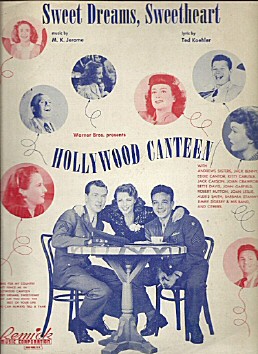
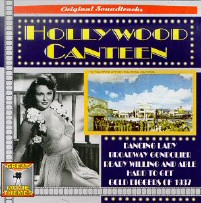
See the Recordings page for complete track listings and description.
The Best of Everything
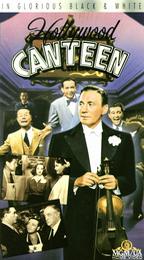
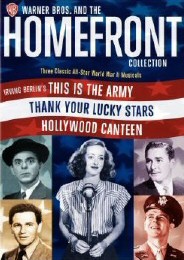 Warner Brothers. 123 minutes.
 Tom C. (April 2026)